
What makes a printed photo stop you in your tracks? Is it luminous color, velvety blacks, a subtle sheen, or the satisfying heft when you lift a sheet?
This guide highlights five standout photo papers chosen for real-world performance, consistent color, and reliable handling. We drew on user feedback, hands-on impressions, and durability notes to summarize each paper’s strengths and trade-offs. You won’t need endless specs to decide; just clear pros and cons and realistic expectations.
You’ll also find a concise buyer’s guide that highlights what matters most when choosing paper and how to test prints before committing. Small trials can reveal more than specs on a box, especially when you pair images with the right surface.
Whether you’re printing portraits for the wall, portfolios for clients, or keepsakes for loved ones, the paper matters. Read on and we’ll cut through the marketing noise so you can pick papers that make your photos look intentional and last. A few informed choices will change how your images sing in both color and feel.
We considered common workflows and printers to keep recommendations practical for photographers at every level. The result is a short, actionable selection you can use to elevate prints from your next shoot.

Moab Juniper Baryta Rag 305 Semi-Gloss 100% Cotton Fine Art Inkjet Paper 8.5x11 305gsm 25 sheets
1. Canon Pro Platinum PT-101

Canon PT-101 Pro Platinum A6 50 sheets
Premium small-format glossy sheets offering exceptional brightness, vivid colors, and professional print longevity—perfect for stunning pocket-size photos and presentations.
Check PriceI use the Canon Pro Platinum PT-101 when I want prints that really pop. Its high-gloss finish produces vibrant, saturated colors that leap off the page, making it an easy choice for colorful work where impact matters.
For portraits and color images it’s especially strong — skin tones and gradients render naturally and smoothly, so faces look lifelike rather than oversaturated. Prints often have a professional, lab-quality look, and you’ll see the best results when pairing it with Canon printers.
The paper itself feels thick and sturdy with a premium hand, so it works well for display or gifting straight out of the printer. Users report good resistance to fading, so these can perform as archival prints if you want longevity alongside punchy color.
That said, the high-gloss surface is highly reflective, so glare can be an issue in bright or uncontrolled lighting. It also shows fingerprints and smudges easily, so handle with care or consider protective sleeves or frames if the prints will be handled often. Overall, if you want bold, gallery-style color prints and can control the lighting and handling, the PT-101 is a very strong option.
- Excellent color vibrancy and saturation
- High-gloss, professional lab-quality appearance
- Thick and sturdy; premium hand feel
- Resists fading; suitable for archival prints
- Highly reflective — can cause glare
- Shows fingerprints and smudges easily
2. Canon Pro Luster LU-101
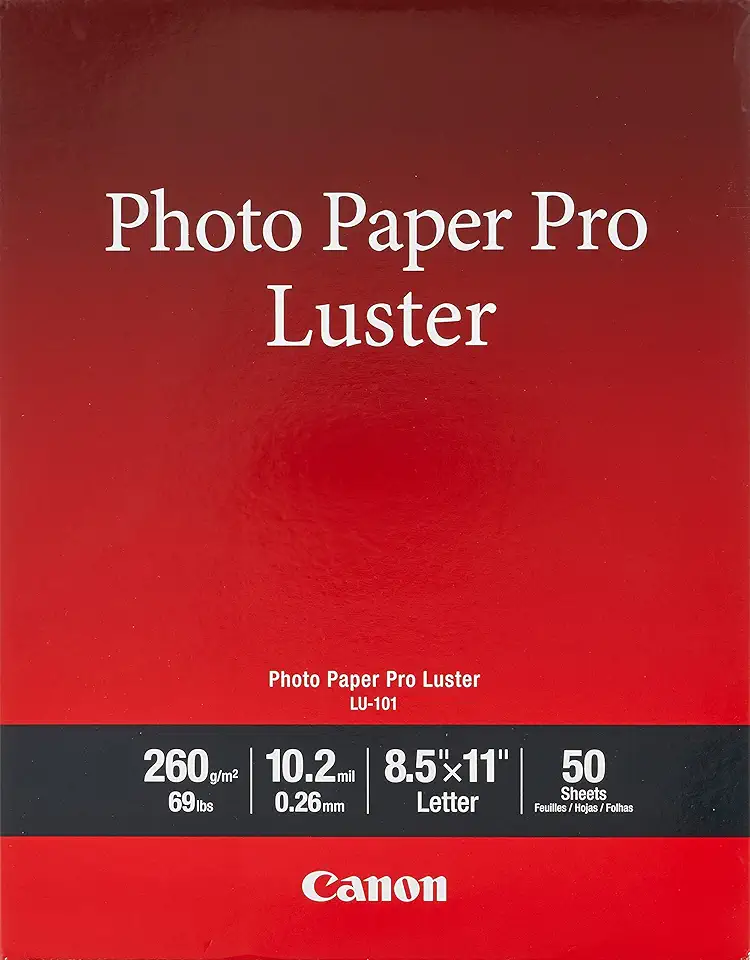
Canon LU-101 Luster Photo Paper Letter 50 sheets
Balanced luster finish with rich blacks and natural skin tones; reliable, versatile sheets crafted for crisp portraits, proofs, and display-worthy photographic prints.
Check PriceThe Canon Pro Luster LU-101 sits neatly between glossy and matte, giving you that coveted luster sheen without the full-on reflection of high-gloss papers. As a working photographer I reach for it when I need sharp detail and rich color but also want prints that are easy to handle and view in varied light.
Its reduced glare makes it particularly useful for prints that will be displayed in brighter rooms or on walls with direct light. That reduced reflectivity also means guests and clients can view images without chasing reflections, which is great for portfolio reviews and events.
LU-101 is versatile—excellent for portraits, landscapes, and event work—so you don’t need a dozen paper types in your bag for different shoots. The surface is less prone to fingerprints than glossy options, which speeds up handling and framing. Expect crisp detail and reliable color reproduction that holds up for client deliveries and personal prints.
Keep in mind this is a compromise paper: colors are rich but not as punchy as on high-gloss stock, and you can still get some glare in certain lighting. If you want a balanced, professional look that’s forgiving in handling and lighting, LU-101 is a strong all-around choice. If absolute maximum saturation is your priority, glossy may be more suitable.
- Reduced glare compared to glossy papers
- Attractive luster finish suitable for various subjects
- Less prone to fingerprints and smudges than glossy
- Sharp detail and rich color reproduction
- Not as vibrant as glossy papers
- Can still show some glare, though less than glossy options
3. Moab Juniper Baryta Rag 305
Moab Juniper Baryta Rag 305 Semi-Gloss 100% Cotton Fine Art Inkjet Paper 8.5x11 305gsm 25 sheets
Archive-grade baryta-coated 100% cotton paper delivering smooth semi-gloss, remarkable tonal depth, and museum-quality prints for fine art and photography.
Check PriceAs a working photographer, I reach for Moab Juniper Baryta Rag 305 when I want prints that really sing — it produces crisp, vivid prints with excellent detail and color saturation that hold up for close inspection. The sheet itself has a thick, luxurious feel and a smooth, uniform surface that immediately reads as premium in the hand.
The baryta coating is the standout for me: it mimics traditional darkroom papers and gives a timeless, classic look that flatters both color and black-and-white work. Because of that surface, it’s particularly effective for images where tonal gradation and shadow detail matter.
There’s an added environmental benefit too — the paper is made from recycled cotton, which is meaningful if you’re producing limited editions or client work with sustainability in mind. That recycled-cotton base still delivers the tactile quality and depth you expect from fine-art photo papers.
Two practical notes: it’s more expensive than standard photo papers, so reserve it for prints where the finish and presentation justify the cost. Also, like many smooth, premium surfaces, it can show fingerprints if not handled carefully, so use gloves or a clean work surface when producing final pieces.
- Crisp, vivid prints with excellent detail and saturation
- Thick, luxurious feel; smooth, uniform surface
- Mimics traditional darkroom papers for a timeless look
- Environmentally friendly—made from recycled cotton
- More expensive than standard photo papers
- Can show fingerprints if not handled carefully
4. Hahnemühle Photo Rag 308
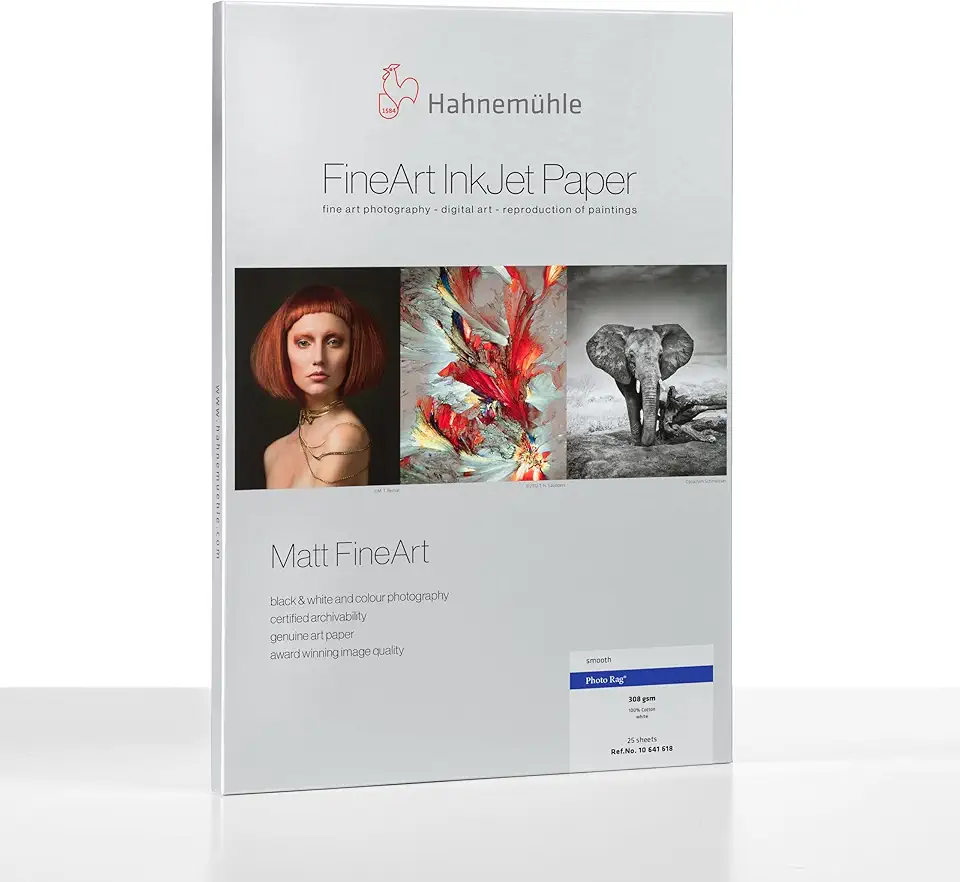
Hahnemühle Photo Rag 308gsm A3 25 sheets
Ultra-thick, soft-textured fiber paper offering exceptional color gamut, archival permanence, and a luxurious feel for gallery prints and archival reproductions.
Check PriceWhen I need a paper that reads like fine art rather than a photo lab print, I reach for Hahnemühle Photo Rag 308. Its soft, matte finish tames glare and gives images an elegant, museum-ready look.
The color reproduction is surprisingly strong for a matte stock, and the paper delivers deep blacks and striking contrast that work equally well for color and black‑and‑white work. That tonal depth makes prints feel more substantial and photographic, not flat.
One of the standout features is the lightly defined felt structure. It gives a subtle three-dimensional appearance that lifts textures and brush‑stroke detail, which is especially appealing for prints destined for galleries or exhibitions.
Hahnemühle Photo Rag 308 is noted for archival qualities, so if longevity and permanence matter—archive prints, portfolio pieces, or exhibition work—this paper is a reliable choice. It’s also easy to handle and versatile enough for a variety of subjects, from portraits to fine-art landscapes.
That said, it isn’t for everyone. The matte aesthetic won’t satisfy photographers who prefer the punch and sheen of glossy or luster finishes. Also, it can be pricier than standard photo papers, but you’re paying for a paper built around presentation and permanence.
- Soft, matte finish with excellent color reproduction.
- Deep blacks and striking contrast.
- Three-dimensional appearance from felt structure.
- Archival qualities suited for gallery/exhibition prints.
- More expensive than standard photo papers.
- Matte finish may not appeal to glossy/luster fans.
5. Epson Premium Photo Paper

Epson Premium Glossy Photo Paper 8x10 20 sheets S041465
High-gloss professional sheets that enhance color vibrancy and sharpness while resisting smudges—ideal for frame-ready, exhibition-quality photographic prints.
Check PriceAs a working photographer I often reach for Epson Premium Photo Paper when I need dependable, consistent prints straight from an Epson printer. It’s popular for a reason: you get a professional look and feel without wrestling with complicated color profiles.
Color accuracy and detail are solid. Sharp, vibrant prints are frequently achieved without extensive color management, which is a big time-saver when you’re proofing large batches or delivering client galleries on a deadline.
The paper handles easily in trays and by hand, which reduces jams and accidental damage during production. That makes it a great choice for portraits, landscapes, and event work where throughput matters alongside image quality.
Durability is another practical advantage. Prints are resistant to fading, so they hold up well for framed work or keepsakes you plan to share with clients and families.
If you want the absolute heaviest, most luxurious feel or the deepest possible saturation, this might not be the ultimate choice. But for everyday professional use—where reliability, color fidelity, and ease of handling come first—Epson Premium Photo Paper is a go-to that strikes a strong balance between quality and practicality.
- Reliable and consistent, especially with Epson printers.
- Professional look and feel across a range of subjects.
- Easy handling; sharp, vibrant output.
- Durable and fade-resistant.
- Not as thick or luxurious as some premium papers.
- May not match the color saturation of higher-end papers.
Understanding Photo Paper Types
When I print, the paper finish often matters more than the printer. A glossy sheet gives punchy colors, deep contrast and razor-sharp detail—perfect for landscapes, travel shots and portfolios where vibrancy is the goal. Just be ready for reflections and fingerprints; glossy needs controlled lighting and careful handling.
Matte papers feel quietly different. They tame glare and yield a soft, elegant look that flatters portraits and black‑and‑white work. The colors are more subdued, the surface resists smudges, and the tactile texture adds a gallery-quality presence to fine art prints.
Luster, satin or semi‑gloss sits in between and is my everyday go‑to for weddings and client portraits. It preserves good color and detail while cutting down glare and fingerprint issues, so prints survive being handled and displayed under varied lighting. If you need a reliable all‑rounder, luster is a sensible compromise.
Pearl and metallic finishes add a luminous, almost three‑dimensional pop that suits images with lots of highlights or metallic elements. They can make colors sing and are excellent for exhibition prints, but they also change how the image reads under different angles, so preview carefully.
Textured options like linen or silk/washi introduce character and a handcrafted feel. Linen works well for vintage or artistic projects, while washi delivers a subtle, refined texture prized in fine art printing. Both give prints a unique presence that glossy and luster can’t match.
Finally, don’t ignore the paper base. Resin‑coated sheets are durable and easy to handle, fiber‑based stock yields richer blacks and archival stability, and cotton rag papers are the gold standard for longevity and museum prints. My practical rule: pick the finish to match the mood of the image and the base to match how long and where the print will live, then always run a few test prints to confirm color and feel before committing to a full batch.
Choosing The Right Photo Paper
Choosing the right photo paper is less about picking the most expensive option and more about matching the paper to the image and how it will be seen. Think about where the print will live, how often it will be handled, and what feeling you want the image to convey. Those three things narrow your choices fast.
If you want punchy color and mirror-like depth, glossy or pearl-type papers are the way to go. They make landscapes and vibrant street scenes sing, but they also show glare and fingerprints, so reserve them for controlled lighting or framed work behind glass.
For portraits, events, and anything that will be handled often, a luster or satin finish is a sweet middle ground. You keep most of the color richness and sharpness of gloss while cutting reflections and hiding smudges. It’s why many wedding photographers default to luster.
Matte and cotton rag papers lend a softer, more tactile look. They’re my go-to for fine art and black-and-white prints because they emphasize tone and texture over shine. If archival quality matters, fiber-based or cotton-rag stocks will outlast most resin-coated alternatives and give a premium hand-feel.
Weight and surface matter as much as finish. Heavier papers feel substantial and photograph better under gallery lights. Baryta-coated papers mimic traditional darkroom prints and add a subtle depth that suits both color and B&W work.
Practical handling counts too: glossy and metallic finishes need careful handling; luster and matte are forgiving. Always use the proper ICC profile for your paper and run small test prints. A few 4×6 tests will tell you far more than specs on a box.
In short, match finish to subject, base to permanence, and always test before committing to a full run. The right paper turns a good file into a memorable print.
What People Ask Most
What is the best paper for printing photos?
The best paper depends on the image and how you plan to display it. Choose a finish and base that match your desired look and the viewing conditions.
Should I use glossy or matte paper for photo printing?
Pick glossy for a vivid, high-contrast look and matte for a softer, non-reflective appearance. Consider how the print will be handled and displayed when deciding.
What weight paper is best for photo prints?
Heavier papers tend to feel more substantial and can handle display or framing better. Match the paper weight to your aesthetic preference and to what your printer supports.
What type of photo paper do professional photographers use?
Professionals choose papers that suit the project, favoring archival bases and finishes that enhance the image. The selection is driven by print longevity, texture, and the intended presentation.
Can you use regular printer paper to print photos?
Regular paper can accept ink but will not deliver the same finish, color depth, or durability as dedicated photo paper. For best results, use paper designed for photographic printing.
What is the difference between luster, glossy, and matte photo paper?
Glossy papers are reflective and make colors appear vivid, while matte papers are non-reflective with a softer look. Luster falls between the two, offering a slight sheen with reduced glare and fewer fingerprints.
How do I choose the best photo paper for inkjet versus dye-sublimation printers?
Use papers recommended for your printer type and the printing process it uses. Choose a coating and base that are compatible with the printer to achieve reliable color and finish.
Conclusion For Best Printer Paper For Photos
Choosing the right paper finish and base to match your image content and display conditions is the simplest way to improve a print’s visual impact and longevity.
Whether you want bold, high-gloss color or a subtle, archival fine‑art look, the paper you pick will shape how viewers perceive your work.
Run small test prints on a few candidate papers to see how tones, contrast, and color translate in real life before committing to larger runs, and weigh the pros and cons like glare, texture, and durability.
Factor in handling and display: some finishes dazzle but show fingerprints or glare, while luster and matte options are more forgiving in bright or high‑traffic settings.
If you’d like to keep improving your printing and workflow, read more articles on the site for practical tips and inspiration, and leave a comment below if you have questions—we usually reply within a few hours.




0 Comments