
What’s the point of a gorgeous shot if the audio sounds like it came from across the room? Clean, reliable sound keeps viewers engaged and gives your videos a professional edge.
First, you’ll find a flexible podcast-style microphone that works with both computers and traditional audio gear. It suits podcasters, streamers, and creators who need studio sound at home and on the road.
Second is a compact wireless lavalier system that lets talent move freely without cables. It’s ideal for vloggers, solo creators, and small video teams on the go.
Third is a directional shotgun mic made for camera or boom mounting and tight focus. Filmmakers and run-and-gun videographers use it to isolate dialogue and cut background noise.
Fourth is a studio-friendly condenser that delivers detailed, polished vocals in controlled rooms. Pick this when you record voiceovers, narration, or music and can treat the space.
Finally, we cover a budget-friendly dynamic that punches above its price for video creators starting out. It’s a solid learning tool and a reliable pick for classrooms, podcasts, and first channels.
Throughout, the guide explains real-world strengths and trade-offs so you can choose with confidence. Consider this a short guide to picking the best mic for recording videos, whether you shoot at home, on the street, or in a studio.
1. Shure MV7+ Podcast Microphone

Shure MV7+ Dynamic Microphone USB-C XLR
Versatile podcasting mic with dual digital and analog outputs, built-in touch controls, and studio-grade vocal clarity for home or on-the-go recording.
Check PriceI bring the Shure MV7+ Podcast Microphone on almost every interview and behind-the-scenes video I shoot. It’s widely used by podcasters, streamers, and content creators for home and mobile setups, so you get a mic built for both studio desks and quick location work.
The dual USB/XLR output is the feature I reach for first. It lets me plug straight into a laptop for fast turnaround or switch to an analog board or field recorder when I need higher-end routing or multi-channel workflows.
The built-in DSP — with auto-level and noise reduction — is a genuine time-saver on noisy shoots. That processing smooths inconsistent delivery and tames room issues, so many users report professional-grade audio even in suboptimal acoustics.
Physical and digital pop filters work together to cut plosives without a big external rig. The customizable LED touch panel is also handy on set; it gives simple, immediate mute and status control so I don’t fumble with software while talent is on camera.
If you want a mic that bridges easy USB podcasting and proper XLR-based production, the MV7+ is a rare, practical compromise. It’s mostly a win for solo creators and small crews who need clean, reliable voice capture without bringing a full studio everywhere.
- Dual USB/XLR output for flexible setups.
- Built-in DSP for auto-level and noise reduction.
- Effective physical and digital pop filters.
- Convenient LED touch panel for mute controls.
- Relatively heavy—can challenge some boom arms.
- Software interface can be complex for beginners.
2. DJI Mic 2 Microphone

DJI Mic 2 1 TX + 1 RX Wireless Microphone
Compact wireless kit with transmitter and receiver, long-range reliable transmission, crystal-clear audio capture, and easy clip-on lavalier convenience.
Check PriceAs a photographer who shoots a lot of behind-the-scenes and on-the-go video, the DJI Mic 2 is the kind of tool I reach for when mobility matters. It’s clearly aimed at vloggers, YouTubers, and small video teams who need wireless ease without a lot of fuss.
Setup is refreshingly simple. The wearable transmitters are easy to clip on talent, and that fast setup means fewer retakes and more usable footage from a single shoot.
Technically the 32-bit float recording is a standout. It helps prevent clipping during loud moments, so I worry less about unexpected peaks when shooting in dynamic environments. Do note that those 32-bit files require post-production conversion, so you’ll need a workflow that handles the files.
The intelligent adaptive noise cancelling is another real-world win. I’ve used it outdoors and in busy locations, and it does a solid job of keeping vocals crisp without a lot of tinkering. That makes it especially suitable for solo creators or small teams who don’t have a sound tech on set.
Battery life and range are practical strengths. Users praise its long battery life, and the wireless transmission can reach up to 250m, which gives freedom for run-and-gun shoots and interviews across moderate distances.
Overall, if your priority is reliable wireless vocal capture with minimal setup, the DJI Mic 2 is a smart choice. If you need to record ambience or music as a priority, consider that it’s primarily designed for vocal recording rather than ambient capture.
- Fast setup and wearable transmitters for mobility.
- 32-bit float recording prevents clipping.
- Adaptive noise cancelling effective outdoors/noisy settings.
- Long battery life and up to 250m transmission range.
- 32-bit files require post-production conversion.
- Primarily designed for vocal recording, less suited for ambient/music capture.
3. Audio-Technica AT8015 Microphone

Audio‑Technica AT8015 Condenser Microphone
Short shotgun condenser engineered for location recording, focused directionality, low self-noise, and natural speech/reverb rejection in challenging environments.
Check PriceAs a photographer who often shoots interviews and run-and-gun documentary work, I appreciate a mic that points exactly where I need it to. The Audio-Technica AT8015 is favored by videographers and filmmakers for that kind of directional accuracy in the field, and it delivers clear audio capture even in challenging conditions.
It gives you dual power options—battery or phantom—which makes it flexible on shoots where you may not have phantom power available. The switchable low-frequency roll-off and long interference tube design do a solid job rejecting side and rear sounds, so dialog stays clean even in busy environments.
The build is durable and feels right for on-location use; it’s the kind of piece you don’t worry about when moving between locations. That said, some users note a moderate level of self-noise in very quiet environments, so it’s not the ideal choice for whisper-quiet studio takes where noise floor is critical.
Another practical point: the AT8015 is relatively bulky for some camera setups. If you’re mounting directly to a small mirrorless rig or run-and-gun camera with limited balance, you may find it cumbersome compared with slimmer shotguns.
In short, if your priority is directional accuracy, ruggedness, and flexible powering on location, the AT8015 is a strong contender. If your work frequently involves dead-quiet studio captures or very compact camera rigs, weigh the self-noise and size considerations before committing.
- Battery or phantom power options
- Effective off-axis rejection via low-frequency roll-off and interference tube
- Durable, reliable build for location work
- Clear audio capture even in challenging conditions
- Moderate self-noise in very quiet settings
- Bulky size may complicate some camera rigs
4. Rode NT-USB Microphone

Rode NT-USB+ USB Condenser Microphone
Plug-and-play studio mic with premium capsule, zero-latency monitoring, onboard controls, and clear, broadcast-ready sound for streamers and musicians.
Check PriceThe Rode NT-USB is a great studio-friendly USB mic that I reach for when I need reliable, clean vocals with minimal fuss. It’s widely used by podcasters, streamers, and content creators for studio-quality audio and ease of use, so you know it’s built for voice-first applications.
What stands out is the built-in digital processing — noise gate, compressor, and APHEX effects — which can noticeably improve your recordings without pulling up extra software. That onboard processing is a real time-saver when you’re shooting videos and want a polished sound straight out of the box.
Integrated headphone monitoring gives you realtime feedback, so you can catch pops, sibilance, or level issues while recording. Combined with the simple plug-and-play setup for vocals, instruments, and narration, it’s a practical choice for solo creators and small studio rigs.
There are trade-offs to consider. The NT-USB has a fixed cardioid pattern, which limits versatility compared to multi-pattern condenser mics. If you need omnidirectional or figure‑8 for interviews or stereo instrument work, this might feel restrictive.
Also, onboard controls are limited, so many adjustments require software. If you prefer tactile, hardware-based tweaks on-location, that could be a drawback. Overall, if you want straightforward, studio-quality voice capture with helpful onboard processing and live monitoring, the Rode NT-USB is mostly a smart, user-friendly pick.
- Onboard noise gate, compressor, APHEX
- Integrated headphone monitoring
- Simple plug-and-play setup
- Studio-quality audio for vocals/instruments/narration
- Fixed cardioid pattern limits versatility
- Limited onboard controls—software required
5. Samson Q2U Microphone
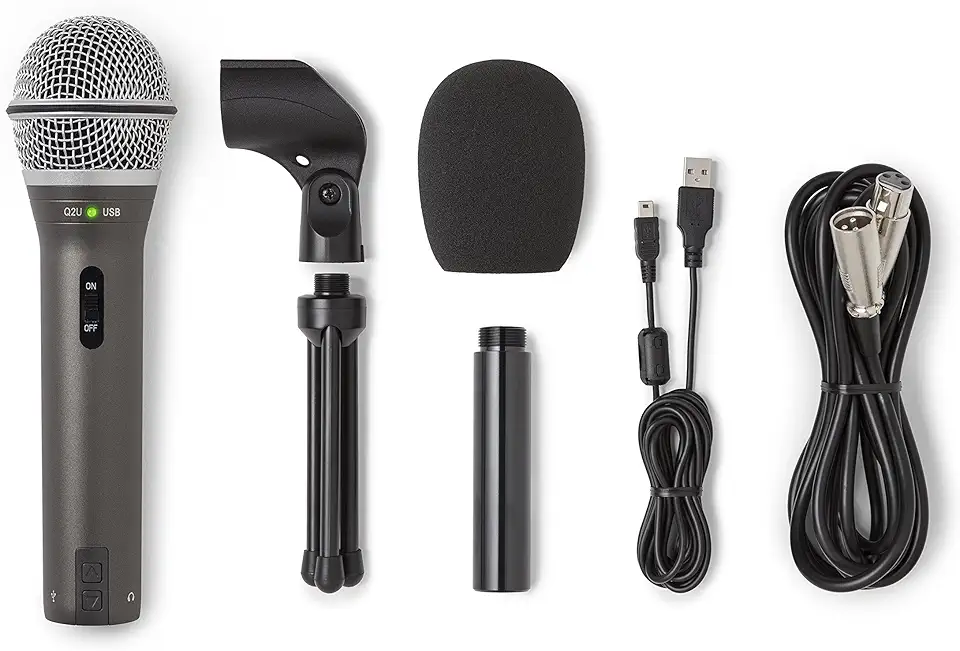
Samson Q2U Dynamic USB/XLR Microphone
Durable dynamic mic offering both digital and analog connectivity, forgiving vocal tone, easy setup, and reliable performance for podcasting and live use.
Check PriceAs a photographer who also shoots talking-head videos, I value gear that just works — and the Samson Q2U fits that bill for budget-minded creators. It offers dual USB/XLR outputs, so you can plug straight into a laptop for quick voiceovers or route via XLR to a mixer or camera for better on-set control.
Sound-wise the Q2U punches above its price. It delivers good sound quality relative to price, making dialogue clear and present without fuss. The straightforward setup and ease of use are a real plus when you’re juggling lights, framing and audio alone.
Practical note: it can be prone to plosives if not positioned correctly, so use a pop filter or angle the mic slightly off-axis to tame hard P and B sounds. Also be mindful of handling noise; a simple stand or shock mount will save you a lot of cleanup in post.
Build quality isn’t as rugged as higher-end models, so treat it gently when traveling with camera kits or tossing it into a bag. That said, for studio-ish setups, home interviews, vlogs and beginner podcasts it’s a reliable, affordable option for videos that gets the job done without breaking the bank.
If you’re starting out or need a flexible mic that works with both computers and conventional audio gear, the Samson Q2U is a smart, cost-effective choice — just protect it against plosives and rough handling.
- USB/XLR outputs for flexible recording options
- Good sound quality for the price
- Easy setup—beginner friendly
- Reliable, affordable option for videos
- Susceptible to plosives without proper positioning
- Less durable build compared with premium mics
Overview of Microphone Types for Video
Picking the right microphone for video starts with knowing the scene you’ll be shooting. Different mics are tools for different jobs: some survive rough outdoor work, others reveal tiny vocal details in a quiet studio. Think of the mic as part of your camera kit—choose it to match distance, movement, and environment.
Dynamic microphones are the workhorses for run-and-gun and noisy locations. They don’t need external power, reject background noise well, and can take a beating in the field. You trade a bit of high-end detail for durability and reliability when conditions are anything but ideal.
Condenser microphones shine when you want clarity and nuance. They need phantom power or battery and are best in controlled rooms where their sensitive diaphragms can capture the full frequency range. Large-diaphragm condensers give warmth for voiceovers, while small-diaphragm models deliver accurate, detailed sound for instruments or ambience.
Lavalier mics are indispensable for on-camera interviews and vlogging because they free talent to move. They’re usually omnidirectional and need careful placement and wind or clothing protection to avoid rustle and unwanted noise. When hidden mics are needed, plan for sound checks and subtle mounts to keep audio consistent.
Shotgun mics offer a tight, lobar pickup that’s ideal for distant dialogue and boom work. They reduce side noise but demand precise aiming and often a boom operator for best results. On-camera shotguns are practical for solo shooters, but remember they’re less forgiving if you wander out of the beam.
Other options like ribbon mics are beautiful in studio settings but fragile for location work. Polar patterns—cardioid, hypercardioid, bidirectional, omni—matter as much as type, and power/connectivity (USB vs. XLR, phantom power) will determine your workflow. Match mic choice to whether you need portability, toughness, or sonic detail, and you’ll save time in setup and a lot of grief in post-production.
How to Choose a Microphone
Choosing the right microphone comes down to one simple rule: match the mic to the job and the room. I always start by thinking about who I’m recording, where they’ll be, and how much movement is involved.
For a single talking head that won’t move, a studio condenser or a USB mic gives the smoothest, most detailed sound. If your subject needs to move or you want the mic hidden, lavaliers are the practical choice, while on-camera shotguns are ideal when you need distance without too much background noise.
Environment matters more than most shooters expect. In a controlled studio a condenser shines; in crowded streets, a rugged dynamic or a shotgun with good off-axis rejection performs better. Wind protection and a deadcat are mandatory outdoors—nothing ruins a take faster than rumble or rustle.
Polar pattern decides what you capture and what you reject. Cardioids are great for isolating one voice, omnis work well for roundtable or ambient sound, and bidirectional mics are perfect for face-to-face interviews. Shotguns give you a tight front focus, but they demand careful aiming.
Think about power and connections before you buy. Condensers often need 48V phantom, while USB mics plug straight into your laptop or phone. Mics with both USB and XLR outputs are the swiss army knife of field work—useful for fast mobile shoots and proper interfaces in the studio.
Portability and build quality influence real shoots more than spec sheets. I choose rugged, lightweight mics for run-and-gun jobs and reserve fragile large-diaphragm condensers for controlled sessions. Also consider how easy it is to set up: lavs need placement care, shotguns may need a boom operator, and heavy mics can strain small boom arms.
Finally, test your choice in the environment you’ll actually work in. Record a few takes, check for wind, plosives and unwanted room tone, and prefer the mic that gives consistent, usable audio with the least fuss. Practical reliability beats specs when you’re on a shoot.
What People Ask Most
What is the best microphone for recording videos?
There is no single best mic for every situation; the right choice depends on your environment and what you are recording. Consider whether you need mobility, background rejection, or studio clarity when choosing a microphone.
What microphone is best for YouTube videos?
The best mic for YouTube depends on your content style and workflow. Choose a convenient option that balances sound quality with ease of use and portability for your typical shoots.
What microphone do most YouTubers use?
There is a wide range of microphones used by creators based on their needs and budget. Many favor easy-to-use solutions that reliably deliver clear voice audio for their format.
Should I use a lavalier or shotgun mic for recording videos?
Use a lavalier when you need a hidden, close-to-source mic that allows movement. Choose a shotgun when you need focused pickup from a distance or want to keep the mic out of frame.
What is the difference between condenser and dynamic microphones for video recording?
Condenser microphones are more sensitive and capture finer detail, making them well suited for controlled studio environments. Dynamic microphones are generally more robust and better at rejecting background noise in less controlled settings.
Can I use my smartphone microphone to record videos?
A smartphone microphone can work for casual or quick recordings, but it often picks up more ambient noise and offers less control. For improved clarity and consistency, use an external microphone when possible.
How should I position a microphone for the best audio when recording video?
Position the microphone as close to the sound source as practical while keeping it out of frame and aiming it toward the mouth or sound source. Test and adjust placement to minimize plosives, clothing noise, and unwanted room reflections.
Conclusion for Best Video Mics
To recap, the Shure MV7+ is a great fit for podcasters and streamers who need flexible USB/XLR workflows, the DJI Mic 2 works well for vloggers and mobile shooters who value wireless ease, the Audio‑Technica AT8015 is tailored to filmmakers needing focused, directional capture, the Rode NT‑USB shines for studio podcasters and creators who want plug‑and‑play studio sound, and the Samson Q2U gives budget-conscious beginners a versatile, easy-to-use option.
Choose by matching the mic to your recording environment, mobility needs, and preferred connectivity—pick rugged, directional tools for noisy or outdoor shoots and USB or lavalier solutions for quick setups and interviews.
If you want to keep improving your recording and production skills, explore more articles on the site for practical tips, workflows, and troubleshooting ideas to help you get better results fast.
Have a question or need tailored advice? Leave a comment below and we’ll usually reply within a few hours.


0 Comments