
Ever tried photographing a painting only to have the colors look wrong and glare steal the detail?
You’re not alone — lighting makes or breaks fine-art photography. This quick guide walks you through five trustworthy lighting options, plus practical setup and color tips to help your images match the artwork.
When you shop for lights, some features matter far more than brand names. Adjustable color temperature, high color rendering, soft diffusion to tame reflections, enough brightness, and portability should drive your decision.
Color accuracy keeps pigments faithful to the original and cuts down on post-processing guesswork. Soft, even light eliminates hotspots and harsh shadows so texture and brushwork read correctly, and the right balance of output and mobility means the same setup works for a small print or a large canvas.
Rather than overwhelm you with specs, I focus on real-world performance and simple setup moves that actually improve your results. Expect guidance on what to look for, how to position lights, and quick color-check habits that save time so you can get reliable, true-to-life reproductions right out of the camera.

LimoStudio AGG3214 22x32in Softbox Light Kit with 85W Bulbs and Remote (3000K-5500K)
1. Dracast Kala LED1000 Bi-Color Panel

Dracast Kala Plus 1000 Bi-Color LED Video Light (2800K-6500K) with V-Mount Plate, Barn Doors & Diffusion Panel
Versatile LED panel offering 2800–6500K color range, battery-plate compatibility, barn doors and diffusion for clean, controllable studio-quality illumination.
Check PriceThe Dracast Kala LED1000 is a professional-grade bi-color LED panel that gives you adjustable warm-to-cool color control. As a photographer, I appreciate the ability to dial precise color temperature when reproducing artwork so whites and pigments stay true. Its bright output makes it well suited for larger paintings and prints where a weaker lamp would struggle.
In practice I often bounce the Kala off ceilings or walls to create a soft, even wash of light that minimizes glare and harsh shadows. You can also shape the beam with accessories — barn doors, softboxes, and diffusers work well with this panel to control falloff and reflections. That flexibility matters when you’re dealing with varnished surfaces or framed pieces.
Users praise the Kala for solid build quality and reliable color rendering, which is exactly what you want for accurate reproduction. There’s also an optional battery-powered mode for on-location shoots or studios without convenient power. For anyone shooting larger work or working professionally, that combination of durability, color control, and portability is a big plus.
It isn’t for everyone: the Kala1000 is bulkier than simple desk lamps and getting the best results can require a bit more technical setup. But if you’re a pro or a serious hobbyist who values precise color and flexible lighting options, this panel will serve you very well.
- Good color-temperature adjustability.
- Durable and versatile with many accessories.
- Battery-powered option for portability.
- Soft, even lighting reduces glare and harsh shadows.
- Bulkier than simpler lamps.
- More technical setup may intimidate beginners.
2. BenQ e-Reading LED Desk Lamp

BenQ e-Reading Desk Lamp, adjustable arm, dimmable
Eye-care desk lamp with adjustable arm and smooth dimming for glare-free, personalized lighting during reading or work.
Check PriceThe BenQ e-Reading LED Desk Lamp is a surprisingly capable tool for artwork photography, even though it was designed for desk work and reading. It gives you adjustable color temperature and smooth dimming, which means you can dial in near-daylight tones and lower intensity to avoid blown highlights.
In practice I use it for close-up reproductions and fine-detail shots. Its flexible neck and precise positioning let you aim a narrow, clean pool of light exactly where you need it, so texture and brushwork read clearly without heavy shadowing.
Users call it a “game-changer” for control, and that matches my experience: the compact form makes it easy to drop into a small studio or a desktop setup and quickly tweak angle and output. The smooth dim control is great for balancing exposure without fiddly gels or extra modifiers.
That said, it’s not intended to replace panel lights. The lamp is best suited to small- to medium-sized artwork or as a targeted fill/spot light for detail shots. If you need even flood coverage for a large wall piece, you’ll find its beam too narrow and its maximum brightness lower than larger studio panels.
Bottom line: if you shoot small to mid-size paintings, prints, or need a compact light for product-style detail shots, the BenQ is an excellent, portable choice that improves workflow and color control. If your work is large-scale reproduction or requires very high output, consider it a supplementary tool rather than the primary light.
- Adjustable color temperature
- Adjustable brightness / smooth dimming
- Precise positioning
- Compact form that enhances workflow
- Not a broad floodlight—poor for large/wall-sized art
- Lower maximum brightness than panel lights
3. WILLED Dimmable Touch Light Bar

WILLED 5W Dimmable Light Bar with 2000mAh Battery, Touch & Remote Control, Magnet Mount
Portable 5W rechargeable light bar with touch and remote controls, magnetic mount, and adjustable brightness for versatile accent or task lighting.
Check PriceAs a photographer who often shoots small prints and studio-made pieces, I rely on the WILLED Dimmable Touch Light Bar as a handy, rechargeable LED fill and spot light. It’s a simple unit but it performs exactly where you need nimble control—close-up work and quick adjustments. The build feels solid, and it’s clearly designed to be moved around a workspace.
The touch dimming is immediate and intuitive, so I can dial in softer light for texture or boost it for fine-detail clarity without fumbling through menus. The magnetic base is a real workflow saver: you can stick it to metal easels or charge and position it without clamps. It’s also rugged enough to survive being knocked around, so I don’t worry about it in a busy studio.
Users praise its consistency, and I agree—this light gives uniform illumination for small-scale artwork or as a supplementary fill when you need to kill a shadow. It isn’t trying to be a primary studio fixture, though; it excels as a portable workhorse for tabletop shots, detail fills, and quick location checks. If you need a compact, no-nonsense lamp, this is one of the most practical options.
Know the limits before you buy: the coverage area is modest, so you’ll need multiple bars or larger fixtures for wall-sized pieces. I often pair it with broader sources for full reproductions, but when you need nimble control and durability, this light is hard to beat.
- Durable, drop-resistant design
- Magnetic base for placement and charging
- Rechargeable and portable
- Easy touch dimming — great for quick setups and detail work
- Limited coverage area
- Insufficient as sole light for large artwork
4. LimoStudio LMS103 LED/Fluorescent Kit
LimoStudio AGG3214 22x32in Softbox Light Kit with 85W Bulbs and Remote (3000K-5500K)
Complete softbox kit with strong 85W bulbs and remote, delivering adjustable 3000–5500K soft, even lighting for photography and video.
Check PriceThe LimoStudio LMS103 Continuous Lighting Kit (LED/Fluorescent) is a straightforward studio kit that ships with three 45W CFL bulbs, light stands, and umbrella reflectors — everything a beginner needs to start shooting artwork. As a photographer, I appreciate that it delivers continuous light, so you can compose and check color in real time rather than guessing with a flash.
Umbrella diffusion gives a soft, even spread that minimizes harsh shadows and glare on glossy surfaces, which is exactly what you want for tabletop and small–mid-size artwork. The kit’s soft coverage makes it especially useful when you’re reproducing prints, sketches, or smaller paintings without investing in more complex gear.
User feedback notes the kit is affordable and provides decent indoor light quality, so it’s a solid entry-level option for hobbyists and newcomers. Setup is simple: the stands and umbrellas are included and easy to assemble, meaning you can get to work quickly without a clunky learning curve.
There are trade-offs: the CFL bulbs aren’t as color-accurate as high-CRI LEDs, so you may need to use manual white balance or color correction in post for critical color work. Also, CFLs can take time to warm up and are less environmentally friendly and may generate more heat compared with modern LEDs.
In short, the LMS103 is a practical, budget-friendly kit that reliably produces soft, continuous light for smaller artwork. If you value ease of use and soft diffusion over absolute color fidelity, this kit will serve you well.
- Soft, diffused light
- Continuous lighting for framing/color checks
- Includes stands and umbrellas—easy setup
- Good for tabletop and small–mid-size artwork
- Lower CRI than pro LEDs—may need white-balance fixes
- CFLs warm up, less eco-friendly and can run hotter
5. Godox 37-Inch Octagon Softbox

Godox 37in (95cm) Octagon Softbox with Bowens Speedring
Large octagonal softbox with universal speedring for flattering, wraparound light ideal for portraits and studio setups.
Check PriceThe Godox 37-inch octagon softbox is one of my go-to tools when I need large, even illumination for artwork. Its 37-inch diameter gives a broad soft source that helps tame specular highlights on varnished paintings and glossy prints.
In practice it produces uniform lighting that eliminates glare and harsh shadows, which makes color and detail much easier to capture accurately. The octagon shape and size are optimal for larger paintings and prints, and I always notice a cleaner, more natural look compared with a bare flash.
Build quality matters when you’re moving gear around, and this softbox has a durable build that stands up to regular studio use. It works especially well paired with high-CRI LEDs or flashes for a “natural-to-the-eye” color rendering, and it’s compatible with a variety of continuous or strobe light sources.
This is a tool aimed at professionals focused on art reproduction or anyone who needs large, even, color-accurate lighting. Be aware it requires an external light source and the larger size can demand more studio space, but if you have the room and lights, it’s a straightforward way to lift your reproduction work.
- Produces soft, even light that reduces reflections.
- High durability and quality materials.
- Compatible with various light sources (LEDs, flashes).
- Enhances color accuracy and detail capture.
- Requires an external light source.
- Larger size may demand more studio space.
Setting Up Your Lighting
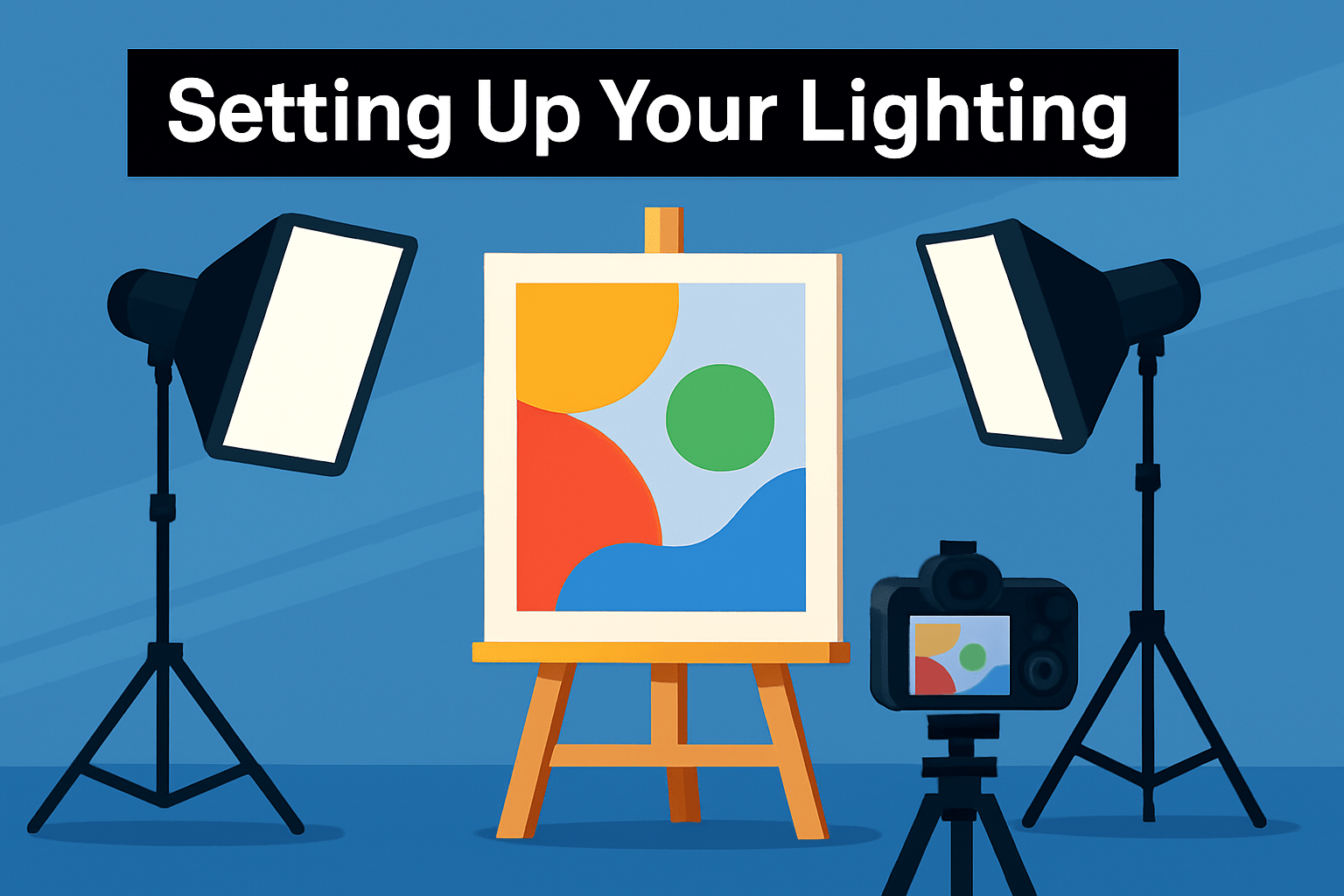
Your goal is uniform, diffused light that reveals color and texture without glare. Softboxes, umbrellas or even a single large diffuser will tame hotspots and hard shadows, so start by making the light source as big and soft as you can.
Place two lights roughly 45° to the plane of the artwork and point them toward the middle of the piece. Keep them at equal distances so the illumination reads even across the surface; picturing an equilateral triangle with the camera and the two lights helps — it keeps angles balanced and minimizes bright spots.
Work in small, measurable steps. Move a light a foot or two and take another test shot; the difference is often surprising. If you have a light meter, use it to match exposures on both sides; otherwise trust your camera’s live view and histogram to check for clipped highlights.
Avoid direct flash and harsh sunlight. Flash tends to produce glare, and direct sun brings strong color casts and contrast. If you must use natural light, favor overcast skies or a north-facing window so the sun is effectively diffused.
When mixing window and artificial light, control the window so it becomes a soft fill rather than a competing source. Close blinds or hang diffusion to make the incoming light match the color and quality of your lamps rather than fighting them.
Use a neutral background and clamp or sandbag stands so nothing moves during the shoot. A sturdy tripod for the camera is essential — it lets you keep ISO low and preserve color and detail without accidental blur.
Finally, don’t be precious about the first setup. Small tweaks to angle, distance and diffusion often fix stubborn reflections. Step back, review test images at 100%, and adjust until the lighting reads flat, even and true to the artwork.
Achieving Accurate Colors
Getting colors right is the single most important part of photographing artwork. Aim for a daylight-balanced setup around 5000–5500K and use lights with a CRI above 90 so pigments render naturally and predictably. When your lights are honest, you cut down the guesswork in post.
Always include a ColorChecker Passport or a neutral grey card in a test shot. Set a custom white balance in-camera or shoot RAW and use the eyedropper in Adobe Camera Raw on that neutral patch. This simple step will remove color casts and make color correction repeatable across a series of images.
Don’t mix light sources with different color temperatures — that’s the fastest route to strange, uneven color. If you must combine window and artificial light, diffuse the window and match the artificial lights to the same kelvin rating. Consistent color temperature makes skin tones and paint hues stay true from frame to frame.
Check your setup regularly with a light meter and reference charts, especially if you’re shooting multiple pieces over several days. Small shifts in lamp output or bulb replacement can change the look, so retest whenever you move lights or swap bulbs. Consistency is how professional reproduction maintains its accuracy.
For workflow efficiency, tether to a laptop when possible so you can view true-to-size previews and adjust on the spot. Keep backgrounds neutral and avoid reflective varnishes or glossy frames without first testing angles to reduce glare. A calm, repeatable process beats correcting problems later — and your client will thank you for faithful color reproduction.
What People Ask Most
What is the best lighting for photographing artwork?
Soft, even, diffused lighting with adjustable color temperature and high color rendering is ideal for accurate results. Avoid direct flash and harsh sunlight to prevent glare and color shifts.
How do I light artwork for photography to avoid glare?
Use diffusion such as softboxes or umbrellas and position lights at about 45 degrees to the artwork to minimize reflections. Balance the two sides so no single hotspot appears.
Should I use natural light or artificial light to photograph paintings?
Both can work: controlled artificial continuous light gives consistent color and control, while overcast or north-facing window light provides soft natural illumination. Avoid direct sun and avoid mixing different color-temperature sources.
What color temperature is best for photographing art?
Aim for daylight-balanced color temperature around 5000–5500K to reduce color casts. Use lights with high CRI and include a grey card or set a custom white balance for accurate results.
How do I get even, shadow-free lighting when photographing artwork?
Use diffused, even lighting with softboxes or umbrellas and position lights symmetrically at about 45 degrees to the artwork. Keep the lights at equal distances and make test shots, adjusting until illumination is uniform.
What equipment and lights do I need to photograph artwork professionally?
Common essentials include a stable tripod, diffused continuous lights with adjustable color temperature and good color rendering, and a large softbox or umbrellas for even coverage. Add light stands, clamps, and a grey card or color target for consistent white balance.
How far should lights be from artwork when photographing?
Place lights far enough to evenly cover the artwork while keeping both sides at equal distances, adjusting distance to control intensity and shadow falloff. Use a light meter or test shots to fine-tune placement until the lighting looks uniform.
Conclusion For Best Lights For Artwork
Whether you lean toward a professional bi‑color panel and softbox or a compact desk lamp and light bar, the five options covered give practical, real‑world ways to get even, glare‑free lighting for artwork of any size.
Choose your setup based on artwork size and working space, and prioritize reliable color rendering, adjustable color temperature, soft diffusion, sufficient brightness, and portability to match your workflow.
Remember the basics: diffuse the light to avoid hotspots, balance your sources for even coverage, and use neutral references and a steady camera setup to keep color and detail accurate.
If you want to deepen your skills, take a look around the site for more tutorials and gear guides to refine your technique and streamline your process.
Have questions or want feedback on a setup you’re trying? Leave a comment below — we usually reply within a few hours.


0 Comments