
Ever stood on a ridge in half-light and watched a trophy buck blur into the trees? Choosing the best Nikon binoculars for hunting can turn that blur into sharp, actionable detail.
This guide compares five Nikon binoculars across the practical spectrum, from budget-friendly field tools to near-premium glass. Selections were guided by real hunting use rather than showroom numbers. You’ll get straight answers about which strengths matter in the field.
Optical quality comes first—clarity, contrast, and control of color fringing determine what you actually see. Field of view and the magnification/objective balance shape scanning speed and identification distance. We also weigh weatherproofing, fog resistance, and ergonomic fit since cold, wet, and long sits reveal flaws fast.
Hunting terrain changes priorities: dense woods reward wide, fast-scanning glass while open country values reach and edge-to-edge sharpness. Comfort, weight, and eye relief matter when you carry glass for hours. A balanced pair keeps your hands and neck steady and preserves spotting time.
Think of this as a field-forward lens on Nikon’s hunting options—practical, not theoretical. This piece highlights the trade-offs so you can match a pair to your style, season, and terrain. By the end you’ll know which Nikon features to prioritize for the hunts you run.
1. Nikon Monarch 7 10×42 Overview

Nikon MONARCH M7 10x42 Binoculars
Ultra-clear ED glass and advanced coatings deliver razor-sharp, high-contrast views with long-range clarity; rugged, waterproof design for serious outdoor enthusiasts.
Check PriceThe Nikon Monarch 7 10×42 is a hunter’s workhorse: 10x magnification with a 42mm objective and a 4.2mm exit pupil gives you the reach you need for open-country glassing while remaining manageable in the field. It weighs 24 ounces, so despite being a full‑size binocular it’s light enough to hold steady for longer glassing sessions.
Optically it’s built around ED (extra‑low dispersion) glass, delivering sharp, crisp images with good contrast and minimal chromatic aberration. You’ll notice excellent control of glare and stray light in most conditions, though very low‑light dawn and dusk performance isn’t quite at the ultra‑premium level.
Mechanically these feel designed for real hunting use: thick rubber armoring for a sure grip, a locking diopter for secure focus settings, and close‑focus down to about 6.3 ft for scanning nearby cover. Users also praise the secure lens caps and overall quality construction that stands up to rough weather and heavy use.
As a professional photographer who spends long hours glassing, I appreciate the balance here — strong optics and ruggedness without the weight penalty of heavier premium bins. If you hunt in rugged terrain and need a reliable, sharp 10x that won’t fatigue your hands, this is a very sensible choice. If your hunts are mostly at extreme low light, consider that it won’t outperform the very top-tier low‑light designs.
- Rugged, weather‑resistant build
- Lightweight/compact for a full‑size binocular
- Sharp, bright images with minimal glare
- Comfortable grip and secure lens caps
- Not top performer in very low light vs premium competitors
- Some stray light can affect image in challenging light
2. Nikon Monarch 5 10×42 Overview
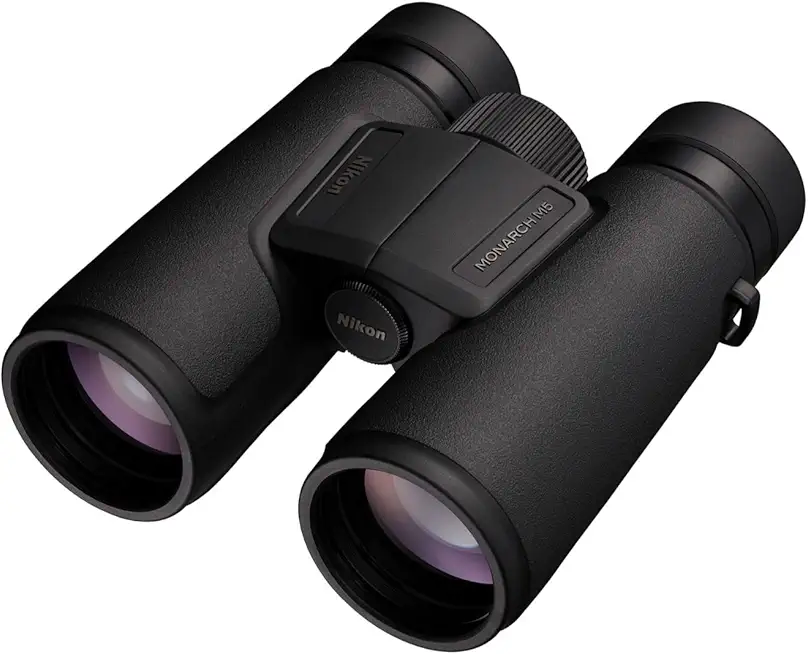
Nikon MONARCH M5 10x42 Binoculars
Bright, high-resolution optics with smooth focus and comfortable ergonomics; weather-sealed housing for reliable performance in any outdoor condition.
Check PriceThe Nikon Monarch 5 10×42 is a classic hunting bino built around 10x magnification and 42mm objectives, offering long-range reach without an oversized footprint. Its field of view is 288 ft at 1,000 yards, which is relatively narrow, so expect tighter scenes when glassing open country.
Optically it shines thanks to premium ED glass and advanced coatings — dielectric mirror coatings and phase-correction — that deliver crisp focus and minimal color fringing. That combination is especially beneficial in low light, making these bins a strong choice for dawn and dusk sits.
Ergonomically the Monarch 5 feels lightweight and durable for extended hunts, with reliable all‑weather sealing: waterproof, fogproof and shockproof construction. Eye relief is approximately 18mm, which is comfortable for most eyeglass wearers and helps maintain a full view without blackouts.
In the field you’ll appreciate sharp, contrasty images and a dependable focus mechanism that holds up across seasons. However, the narrower 288 ft FOV does limit peripheral scanning, so it’s less ideal for dense brush where quick target acquisition matters.
Some users report minor accessory fitment issues with eyepiece covers, caps or the case, but most agree the optical and build quality outweigh those inconveniences. If your priority is low-light performance, edge-to-edge sharpness and a rugged, lightweight package for long sits, these binoculars deliver.
- Excellent low-light performance
- Lightweight and comfortable for long use
- Sharp images with minimal chromatic aberration
- Strong weather sealing and ruggedness
- Narrow 288 ft FOV limits scanning
- Accessory fit issues reported
3. Nikon Monarch M5 8×42 Overview

Nikon MONARCH M5 8x42 Binoculars
Wide field of view and excellent low-light sensitivity make tracking fast-moving subjects effortless; durable, fogproof construction for all-season use.
Check PriceThe Nikon Monarch M5 8×42 is a practical hunting binocular that balances weight, field of view and solid optics. It offers 8x magnification with 42mm objectives and a field of view of roughly 335 ft at 1,000 yards, which is excellent for scanning brush and tracking movement.
Weighing just 22.5 ounces, it’s noticeably light for extended glassing sessions. The ergonomic rubber armoring with thumb grooves makes it comfortable to hold and reduces fatigue on long sits or glassing walks.
Build-wise it’s ready for the field: nitrogen‑purged, waterproof, fogproof and shockproof. That means you can carry it through rain, cold mornings and rough handling without worrying about internal fogging or short‑term impacts.
Optically the Monarch M5 gives good close‑to‑medium range clarity and contrast. It won’t match Nikon’s top ED‑glass models for ultimate edge‑to‑edge sharpness or very low‑light performance, but for a mid‑range bin it delivers very usable images for most hunting situations.
I’d recommend the M5 to hunters who prioritize a wide scanning view and light carry weight. It’s particularly well suited to younger hunters, spot-and-stalk scenarios, and anyone who needs a dependable all‑season binocular without paying for premium glass. If you spend long hours glassing forests or need extreme long‑range detail, consider higher‑end optics; otherwise the M5 is a very good, practical choice.
- Lightweight and very comfortable
- Waterproof, fogproof and shockproof
- Wide ~335 ft FOV for easy scanning
- Good optical clarity for a mid‑level binocular
- Optics below premium ED models
- Not ideal for extreme long‑range detail
4. Nikon Monarch HG 10×42 Overview

Nikon MONARCH HG 10x42 Binoculars
Professional-grade optics with exceptional resolution and edge-to-edge sharpness; premium coatings maximize contrast and color fidelity in varied lighting.
Check PriceThe Nikon Monarch HG 10×42 pairs a 10x magnification with a 42mm objective and premium ED glass plus Nikon’s field‑flattener lens system. This optical formula is designed to deliver high resolution and reduced chromatic aberration in a compact package.
In the field it produces sharp, bright images that are nearly on par with larger, heavier optics, but in a smaller chassis. Advanced coatings and the field‑flattener design give excellent color fidelity and edge‑to‑edge sharpness, which matters when you’re trying to pick out subtle details at range.
It performs well across varied lighting conditions, so it’s versatile for different hunting scenarios from mid‑day glassing to lower light moments. The large central focus wheel is well suited to quick tracking and fine adjustments while following moving game.
The chassis is a compact magnesium alloy frame that keeps weight down without sacrificing ruggedness. The binoculars are fully waterproof and fogproof and feel solid in hand, with ergonomic touches that stand up to intensive outdoor use.
If you want near top‑tier optics in a portable hunting binocular, the Monarch HG is a strong choice—especially when edge‑to‑edge clarity and accurate color renderings are priorities. Keep in mind the 10x magnification can be a bit much for very close‑range scanning, and this model has had slightly less long‑term field testing compared with some long‑established alternatives.
- Near top‑tier optics in a compact form
- Excellent durability and weather sealing
- Lightweight magnesium alloy chassis for portability
- Large focus wheel for quick tracking/focusing
- Slightly less field‑tested than some models
- 10x magnification may be high for very close‑range scanning
5. Nikon Prostaff P3 8×42 Overview

Nikon PROSTAFF P3 8x42 Binoculars
Lightweight, affordable option delivering crisp images and easy handling; reliable waterproofing and simple focusing ideal for beginners and casual birders.
Check PriceThe Nikon Prostaff P3 8×42 is the sort of binocular I reach for when I want dependable performance without spending a lot. It pairs 8x magnification with 42mm objectives to give a bright, stable image that’s ideal for daytime hunting and general nature observation.
Optically it’s sensible rather than flashy. You get solid image sharpness and brightness for the price, which makes it a great choice for entry‑level or casual hunters who need reliable glass in the field.
Buildwise it’s waterproof and fogproof, so it holds up in rain and humid conditions. The weight is moderate and the footprint is compact enough for long sits and quick glassing from the truck or saddle.
Ergonomically it feels comfortable for extended use, though the rubber coating is a bit utilitarian compared with higher‑end models. That said, the control layout and balance make steady handheld viewing straightforward, which is a real benefit during long days of scanning.
Where it falls short is in demanding low‑light situations and for users who need ultimate edge‑to‑edge sharpness. If your hunts are at dawn/dusk or you routinely need the finest detail at distance, this is a compromise model rather than a specialist low‑light optic.
Overall, the Prostaff P3 8×42 is a pragmatic, value‑driven binocular. It’s a smart pick if you want dependable performance, good weather sealing, and a lightweight package without the cost and complexity of premium optics.
- 8x magnification
- 42mm objective lenses
- Waterproof & fogproof
- Affordable, good value
- Not as sharp as premium optics
- Less effective in very low light (dawn/dusk)
Evaluate Optical Quality for Hunting Binoculars
Optical quality will make or break your hunting glass. As a photographer I treat binoculars like lenses: resolution, contrast and color fidelity determine whether you actually identify game or just guess at shapes in the trees.
Resolution and clarity are the first things to check. Standardized tests such as the 1951 USAF chart reveal fine‑detail resolving power, but in the field I look for the same things: individual hairs on a buck, the texture of a distant rock, or the weave of a fence. If those details are soft, the specs won’t help you when it matters.
Watch for image artifacts and color fringing. Good binoculars use fully multi‑coated optics and phase‑correct prisms to preserve natural colors and boost contrast, while field‑flattener designs keep the edges sharp instead of soft. A clean, neutral image with minimal stray light feels like a high‑quality photograph through glass.
Low‑light performance is crucial for dawn and dusk hunts. Objective size (42mm is common) and coatings affect light transmission, and ED glass helps reduce chromatic aberration so contrast holds up in dim conditions. Remember that exit pupil matters too: more light to your eye means more useful detail in low light.
Durable build and sealing protect optical performance over time. Nitrogen or argon purging plus O‑ring seals prevent internal fogging and water damage, so your optics stay consistent through wet mornings and heavy use. Also test how the glass handles bright highlights—glare and internal flare can quickly destroy contrast.
Comfort and controls affect how steady your view stays. Aim for roughly 15mm or more of eye relief if you wear glasses, and a smooth, positive focus wheel that lets you snap to a target without hunting. A well‑balanced binocular will let you hold steady longer, which translates directly into perceived sharpness.
When testing, do it in realistic conditions: try distant fine‑detail subjects, bright point lights, and low‑light windows of time. Bring your glasses, use a tripod for high magnifications, and scan the edges of the field to reveal soft corners or color fringing. Those hands‑on checks separate good optics from great ones.
Choose Field of View for Hunting
Field of view is one of the most practical specs for hunting, yet it’s easy to overlook. It determines how much terrain you can sweep without shifting your feet or missing a fleeting shape at the edge of your vision.
A wider field of view lets you catch movement and track animals more easily. The trade‑off is simple: higher magnification usually narrows that field, so you sacrifice scan area for reach.
In tight cover—thick timber, brush or ridgeline timber—lean toward lower magnification in the 6x–9x range and a field of view of at least 340 ft at 1,000 yards. That extra peripheral sweep makes it much faster to find and follow game as they dart through vegetation.
On open country or long glassing sessions, 10x or higher magnification makes sense because you need to resolve distant animals. Expect a narrower field of view there, and accept the need to be more deliberate when scanning.
From a handling perspective, a wide FOV is forgiving. It reduces the need for perfect hand alignment and lowers eye strain during long sits; lower magnification also helps with image steadiness if you’re hand‑holding.
Remember to balance FOV against other optics traits. Close‑focus, generous eye relief and sharp edge‑to‑edge performance matter as much as sweep width. A very wide FOV with soft edges or heavy chromatic aberration won’t help you spot or identify animals any better than a slightly narrower but clearer view.
If your hunting covers mixed terrain, opt for a compromise like an 8×42 configuration or try several pairs in the field. Hold them, sweep slowly in overlapping arcs, and check the manufacturers’ ft/1,000 yd spec to confirm the real‑world coverage you need.
When glassing, use your peripheral view to pick up motion, then center and lock on to identify. If more detail is required, move in or switch to higher magnification or a spotting scope for positive ID.
What People Ask Most
What are the best Nikon binoculars for hunting?
Choose a model that matches your hunting environment and budget. Entry and mid‑level options offer good value while Monarch models provide higher optical quality and durability.
Are Nikon binoculars good for hunting?
Yes, Nikon offers a range of hunting binoculars that balance optical performance and weather resistance. There are practical options for beginners as well as higher‑end models for demanding conditions.
Which Nikon binocular models are best for long-range hunting?
Monarch models with ED glass and higher magnification are generally better suited for long‑range spotting. These designs emphasize sharpness and contrast for identifying distant game.
How do Nikon Prostaff and Monarch binoculars compare for hunting?
Prostaff models focus on dependable performance and value for everyday hunting use. Monarch models prioritize improved glass, coatings, and ergonomics for better low‑light performance and image quality.
What magnification and objective size are best for hunting with Nikon binoculars?
Objective sizes around 42mm are common for a balance of light gathering and portability. Lower magnifications in the 6x–9x range and a wide field of view suit dense terrain, while 10x and above help in open country.
Are Nikon binoculars waterproof and fogproof for hunting?
Many Nikon hunting binoculars are sealed and gas‑purged to resist water and internal fogging. These features help maintain reliable performance in wet or variable conditions.
What features should I look for in Nikon hunting binoculars?
Look for quality glass and coatings, a wide field of view, comfortable eye relief, and solid weather sealing. Ergonomics and a reliable focus mechanism are also important for extended use in the field.
Conclusion for Best Nikon Hunting Binoculars
These Nikon options span the spectrum from value-focused to premium-leaning choices, giving hunters practical paths to prioritize things like optical clarity, field of view, magnification balance, weatherproofing and ergonomics.
Match the binocular’s strengths to your typical hunting environment by favoring optics optimized for low light when you hunt around dawn and dusk, or selecting wider fields of view and lower magnification for dense, close-range terrain.
Don’t overlook fit and durability: comfortable ergonomics, manageable weight and solid weather sealing keep glassing productive during long outings and variable conditions.
If you’re undecided, spend time handling options and comparing real-world views so you can judge clarity, edge performance and ease of use before committing.
Want to keep improving your skills and gear knowledge? Explore more articles on our site to refine technique and make better-informed choices for the field.
Leave a comment with your questions or experiences and we’ll usually reply within a few hours to help guide your next step.



0 Comments