
Which lens will make a single dew-kissed petal look like a magazine cover shot?
The right lens changes everything. It can turn a fleeting bloom into a timeless study of texture and color.
This guide helps you choose the best lenses for flower photography and master macro techniques. Whether you’re shooting dew-specked wildflowers at dawn or curated still lifes at home, the lens you pick shapes your results.
We cover five top lenses and practical usage tips to help you shoot sharper and more expressive floral images. From fieldwork to studio setups, you’ll find advice that works with your camera and your patience.
Whether you’re buying your first macro or upgrading to pro-level glass, this guide helps you match gear to style. Read on to learn simple techniques and lens choices that make flowers sing in photos.
Along the way we’ll demystify focal length, aperture and how working distance affects composition. No heavy tech talk. Just usable tips you can try on your next shoot.
Whether you favor intimate tight frames or dreamy background blur, we’ll point you toward lenses that deliver. Grab your camera and a fresh bouquet; let’s get shooting now.
1. Nikon 105mm f/2.8 Macro

Nikon NIKKOR Z MC 105mm f/2.8 VR S
Close-focus short-telephoto macro with optical stabilization, outstanding sharpness and smooth bokeh for detailed close-ups and flattering portraits.
Check PriceCall it “scary sharp” — that’s exactly how I describe the Nikon 105mm f/2.8 Macro when I need pixel-level detail in petals and stamens. The lens delivers incredible sharpness at every aperture, so you can stop down or shoot wide open and still get images that hold up for large prints or tightly cropped web use.
The bokeh is a real joy; backgrounds render creamy and smooth so your subject pops without distracting edges. That separation makes it ideal when you want a single bloom to dominate the frame, whether in a studio setup or out in a garden with busy surroundings.
One of the practical wins for flower work is the working distance. You can get close for fine detail and still have enough distance to photograph flowers higher on trees or to avoid disturbing delicate subjects. That reach also makes it versatile for both tight close-ups and somewhat more distant floral compositions.
If you shoot mirrorless, the Nikon Z MC 105mm f/2.8 maintains very similar optical excellence, so you don’t lose the core strengths when switching systems. In short, this lens is aimed at intermediate to professional macro flower photographers who demand outstanding image quality and predictable, consistent performance.
Keep in mind two trade-offs: it’s bulkier and heavier than smaller primes, so expect a bit more weight on your rig. Also, macro focusing and composition require skill and patience—this lens rewards technique, not shortcuts.
- Exceptional sharpness and image quality across apertures
- Beautiful, creamy bokeh for subject isolation
- Good working distance for close details and moderately distant subjects
- Consistent, reliable professional performance
- Bulky/heavy compared to smaller primes
- Macro focusing/composition requires skill
2. Canon EF 100mm f/2.8L Macro

Canon EF 100mm f/2.8L IS USM Macro
Professional-grade short-telephoto for life-size magnification, image stabilization, and fast silent autofocus delivering crisp, high-contrast close-ups.
Check PriceThis Canon EF 100mm f/2.8L Macro IS USM is a classic macro lens that many flower photographers reach for first. It feels like a purpose-built tool for close-up work, with a solid Canon L-series build that inspires confidence in the field and studio.
Image Stabilization is a real advantage when you’re shooting handheld in natural light. It lets you squeeze usable shutter speeds without a tripod, which is helpful for early-morning or late-afternoon flower work.
The working distance sits at roughly ~12 inches, which is generous for a 100mm macro. That space makes it easy to position diffusers, reflectors, or subtle fill without shading the subject or stressing delicate petals.
Optically the lens renders superb detail—petals, stamens, and water droplets resolve beautifully at 1:1 magnification. Color rendition is clean and natural, so the subtle hues in blooms translate well straight from camera.
It’s versatile for both indoor single-flower still life and outdoor small-scene work. If you want stabilization plus true 1:1 macro with reliable color and sharpness, this lens fits the bill for most enthusiasts and pros who prefer shooting in natural light.
Two practical trade-offs to note: autofocus can be a bit slow or noisy at times, so expect to use manual focus for the most critical compositions. It’s also slightly heavier than non-L primes, so if absolute lightness is essential, consider that when packing.
- Image Stabilization for handheld use
- High sharpness and crisp detail
- ~12-inch working distance for diffusers/reflectors
- Durable Canon L-series build
- Autofocus can be a bit slow or noisy
- Slightly heavier than non-L primes
3. Canon EF 50mm f/1.8 STM
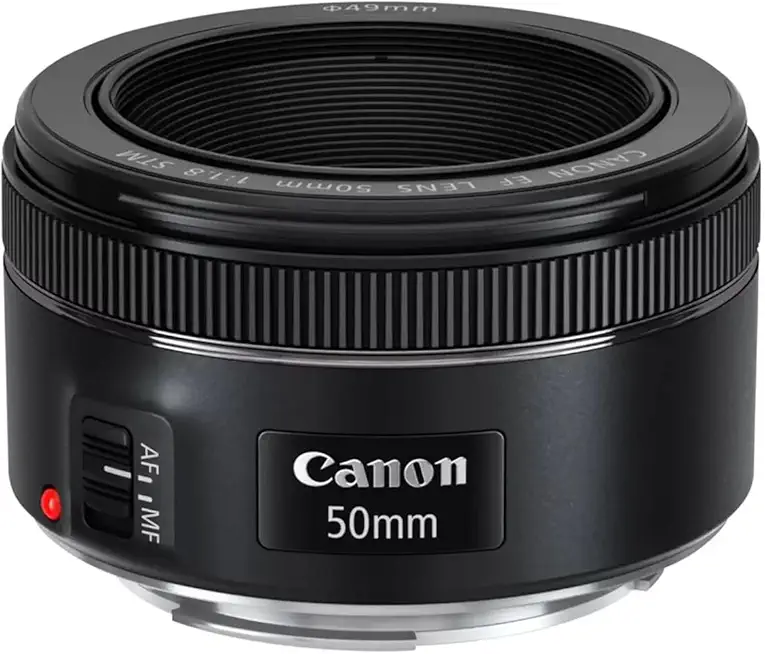
Canon EF 50mm f/1.8 STM
Compact, lightweight normal lens with bright aperture for creamy background blur, low-light performance, and affordable sharpness.
Check PriceThe Canon EF 50mm f/1.8 STM, affectionately known as the “Nifty Fifty,” is an outstanding starter lens for flower work. It’s popular for still-life flower photography and casual macro work, though it is not a true macro lens. The optic is notably sharp when stopped down to f/10 or smaller, delivering crisp petal and texture detail for tabletop setups.
Physically the lens is compact and lightweight, making it easy to hand-hold in the studio or carry into the field. Autofocus performs well for general use, but many flower shooters prefer switching to manual focus for precise control over a single blossom or tiny details. That manual-control habit is great training for more advanced macro work later on.
Be mindful of its minimum focus distance of ~1.5 feet, which limits extreme close-ups and 1:1 magnification. That constraint encourages careful composition and stepping back to include context or full blooms instead of filling the frame with a single stamen. If your goal is detailed, life-size macro of tiny features, this lens will feel restrictive.
For beginners and budget-conscious photographers it’s a very sensible choice. It gives excellent image quality for the price, teaches manual focusing discipline, and performs reliably for still-life arrangements and environmental flower shots. If you want a lightweight, affordable prime that produces pleasing results without breaking the bank, it’s hard to beat.
- Sharp, reliable image quality
- Light and easy to handle
- Inexpensive and widely compatible
- Good for learning manual focus techniques with flowers
- No zoom; requires moving the camera for framing
- Cannot capture extreme macro close-ups due to minimum focusing distance (~1.5 feet)
4. Sigma 150mm f/2.8 Macro

Sigma 150mm f/2.8 AF APO EX DG OS HSM Macro Lens Canon EF mount
Long-reach macro with optical stabilization, apochromatic design, and fast focusing for detailed distant close-ups and telemacro flexibility.
Check PriceThe Sigma 150mm f/2.8 EX DG OS HSM Macro is a go-to when you need working distance without sacrificing magnification. Its longer focal length keeps you far enough to avoid disturbing delicate flowers and insects, which is a huge advantage in the field.
Optical stabilization (OS) makes handheld macro work much more practical outdoors. I often rely on the stabilization to capture sharp images when a tripod isn’t practical or when I need to move with changing light and wind.
Image quality is strong — users report sharp, high-resolution results with smooth, creamy bokeh that separates subjects beautifully from busy backgrounds. That pleasing separation lets you isolate petals and tiny details while keeping a natural, soft backdrop.
The lens is also versatile across systems; it performs well on both full-frame and crop cameras and doubles as a capable portrait and nature lens beyond strict macro work. For shooters who want one lens to handle close-ups and broader field work, this flexibility pays off.
Keep in mind the trade-offs: the longer 150mm design is larger and heavier than shorter macro primes, and it sits at a price point that may be higher than casual shooters want to invest in. But if your priority is working distance, reliable stabilization, and great bokeh, this Sigma is worth considering.
- Longer focal length = increased working distance
- Sharp, contrasty images with pleasant bokeh
- Effective optical stabilization for handheld use
- Versatile for portraits and broader nature work
- Larger and heavier than shorter macro primes
- Higher cost may deter casual users
5. Sony FE 90mm f/2.8 Macro G OSS

Sony FE 90mm f/2.8 Macro G OSS SEL90M28G
Premium medium-telephoto macro featuring optical steady shot, stunning sharpness and creamy bokeh for professional close-up and portrait work.
Check PriceAs a Sony shooter, the FE 90mm f/2.8 Macro G OSS quickly became my go-to for flower work because it delivers exceptional sharpness and true-to-life color reproduction that make petals and veins sing. The 90mm focal length gives a comfortable working distance that balances high magnification with enough space to avoid disturbing delicate blossoms.
Its OSS stabilization really changes handheld close-ups—I’ve been able to nail shots in low light without resorting to a tripod, and the lens maintains smooth focus transitions that are crucial for pleasing bokeh and subject isolation. The optic also doubles nicely for portrait work, so it’s useful when you want versatility beyond strict macro shooting.
Autofocus is generally smooth and fast, helping when you need to lock onto a stamen or water droplet quickly, though I sometimes switch to manual focus for the absolute closest, most deliberate compositions. Build quality is solid and feels professional in the hand, which matters during long field sessions when durability and handling comfort count.
If you prioritize top-tier image quality, handheld stability, and a lens that can handle both intimate flower details and occasional portraits, this Sony macro is a strong choice. Be prepared for a higher price tag, and expect to use manual focus at extreme close distances on tricky subjects.
- Outstanding optical performance and razor‑sharp detail
- OSS improves handheld shooting success
- Smooth, fast autofocus for precise macro focusing
- Solid build quality and professional handling
- Relatively expensive versus older or third‑party options
- Autofocus can be tricky at extreme close distances for some users
Choosing the Right Lens for Flower Photography
Choosing the right lens changes everything about how you photograph flowers — your reach, how much the background falls away, and how you move around the subject. Spend a little time making this choice and you’ll avoid crushed petals, awkward shadows, and images that don’t read the way you intended.
True macro lenses, roughly 60–150mm, give you 1:1 magnification and let you render veins, pollen and petal texture with stunning clarity. Longer macros (90–150mm) buy working distance so you don’t scare insects or cast shadows with a diffuser. Shorter macros and standard primes are more compact but force you closer to the bloom.
Aperture controls depth of field: use f/1.8–f/4 for dreamy isolation and f/8–f/16 when you need more of the flower sharp. Remember macro close-ups inherently have very shallow DOF, so consider focus stacking when you want front-to-back detail instead of relying solely on stopping down.
Don’t confuse focal length with how large a subject appears — minimum focusing distance and magnification determine how much of the frame the flower fills. If extreme close-ups matter, prioritize a true macro lens or try extension tubes rather than expecting a standard prime to do the same job.
Image stabilization is a huge help for handheld flower work, especially with longer macros or in low light, but it’s no substitute for steady technique. Autofocus can speed up composition, yet I often switch to manual focus and live-view magnification for pixel‑level precision on tiny details.
Think about how you shoot: in the studio I reach for a 50mm or 100mm for compact handling and clean lighting control, while in the field a 90–150mm macro gives cleaner backgrounds and comfortable distance. Also be mindful that very wide lenses used up close can exaggerate and distort petals.
Finally, match a lens to your style — working distance, stabilization, weight and handling matter more than specs on paper. If you’re unsure, rent or borrow lenses and test extension tubes; handling and working distance are what you’ll notice first when shooting real flowers.
Macro Flower Photography Techniques
Macro flower work rewards patience and a deliberate approach. Use a true macro lens or add extension tubes when you need more magnification, and remember that filling the frame doesn’t always mean getting as close as possible. Thoughtful composition often matters more than sheer reach.
Start by picking a point of interest—a petal edge, a stamen, a droplet—and compose around it. Focusing on texture tells a clearer story than capturing the whole bloom at once. Move around the subject to find clean backgrounds and angles that simplify the scene.
Depth of field is the constant challenge in macro work. Even stopped down, DOF can be wafer-thin, so I typically work between f/2.8 and f/8 to balance sharpness and background separation. When I need edge-to-edge detail, focus stacking on a tripod is the most reliable solution.
Light is everything at close range. I prefer soft, diffused light in the early morning or late afternoon, and I carry a small reflector and diffuser to tame contrast. Backlighting translucent petals creates a beautiful glow, but add a gentle fill to preserve shadow detail.
Stability and precise focusing are non-negotiable—tiny vibrations ruin macro shots. Use a tripod or sturdy monopod and trigger the shutter with a remote or timer, and switch to manual focus for pixel-level control when the AF hunts. If you must shoot handheld, favor lenses with stabilization and push shutter speed to avoid blur.
Don’t be afraid to get creative: wide apertures can produce painterly abstracts, while dew and backlight add texture and mood. Longer macro focal lengths (90–150mm) give you breathing room to use diffusers and avoid disturbing subjects, and they help separate the flower from busy backgrounds.
Practicalities matter: shoot when the air is calm, clean your lens and sensor, and protect delicate blooms from your shadow. Small adjustments in distance, angle, or lighting often transform a so-so image into a keeper. Be patient—macro rewards those who pay attention to tiny details.
What People Ask Most
What focal length is best for flower photography?
Different focal lengths serve different uses: shorter lenses suit tight spaces and still life, while longer lenses give more working distance and background separation. Choose based on how close you need to get and the background look you want.
Do I need a dedicated macro lens for flower photography?
You do not always need one; standard primes can work well for still-life flower shots. A dedicated macro lens is beneficial when you want extreme close-up detail and a comfortable working distance.
What aperture should I use when photographing flowers?
Aperture affects depth of field and background blur, so use a wider setting for a shallow, dreamy look and a smaller setting for more of the subject in focus. For maximum detail, consider focus stacking when depth of field is limited.
Can I use a prime lens for flower photography instead of a zoom?
Yes, primes are a great choice for many flower shots because they tend to be sharp and compact. They work especially well in controlled still-life setups where you can move the camera to frame the subject.
Are telephoto lenses suitable for flower photography?
Telephoto lenses are useful for isolating subjects and keeping distance from delicate flowers or insects. They may not focus as closely as macro lenses, so consider your need for close-up detail.
What features should I look for in a lens for flower photography?
Look for a lens that offers sharpness, a comfortable working distance, and the aperture range you need for your creative goals; stabilization can help for handheld shooting. Build quality and reliable focusing also matter for field work and studio use.
How do macro and close-up lenses compare for flower photography?
Macro lenses are designed for high-quality close focusing and true macro magnification, making them ideal for fine detail work. Close-up lenses or extension accessories can be a cheaper way to get closer but may not match a dedicated macro lens for image quality or working distance.
Conclusion for Best Lenses for Flower Photography
In short, the right lens for flower photography is the one that balances focal length and working distance with stabilization, autofocus behavior, sharpness, and bokeh to support your creative vision.
For studio work, prioritize compact handling and precise close‑focusing control.
Field shooters will often favor longer reach, effective stabilization, and portability that performs in changing outdoor conditions.
Nothing replaces hands‑on testing—practice the macro techniques covered here, try lenses in real light and wind, and observe how working distance and background rendering shape your images.
Over time you’ll learn which compromises matter most for your subjects and shooting style and make faster, more confident gear choices.
If you want to keep improving your flower photography, explore more articles on our site for practical tips, comparisons, and workflow ideas.
Leave a comment with your questions or experiences—we usually reply within a few hours and are happy to help with gear or technique advice.




0 Comments