
Ever wonder how a single lens can change the way you see a city? On the street, lens choice governs discretion, low-light performance, and how you frame a story. A stray stop of light, a passing face, a sliver of architecture — the lens decides how much of that moment you keep.
This guide distills five Sony lenses that span classic street focal lengths. From environmental wide angles to tighter portrait perspectives. It includes practical notes on handling, low-light shooting, and the trade-offs between size and reach.
Whether you favor compact primes, moderate standards, or longer telephoto stand-offs, small choices shape big results. We’ll focus on real-world shooting scenarios rather than lab-sourced numbers. The aim is to help you pick gear that complements how you move and compose.
Expect clear, usable advice on which focal lengths work best in crowded alleys, subway platforms, and twilight plazas. No jargon-heavy spec dumps — just concise guidance to help you stay quick, discreet, and creative. You’ll get straightforward tips for staying nimble while keeping image quality high.
If street photography is about reading light and moments, the right lens is your most important tool. This guide helps you weigh discretion against reach, and low-light speed against the kind of background separation you like. Read on to match Sony options to your vision and shooting style.
1. Sony FE 24mm f/1.4 GM Wide-Angle Prime

Sony FE 24mm F1.4 GM SEL24F14GM
Ultra-fast wide-angle prime delivering exceptional sharpness, creamy bokeh, and superb low-light performance for landscapes, nightscapes, and environmental portraits.
Check PriceThe Sony FE 24mm f/1.4 GM is a fast wide-angle prime that feels built for streets after dark. Its f/1.4 aperture gives you real low-light headroom and shallow depth for subject separation even in cramped urban scenes.
Optically it’s outstanding — corner-to-corner sharpness holds up even wide open, and the rendering is pleasing with natural colors and strong dynamic contrast. I also love the bokeh; for a 24mm it produces a smooth, film-like falloff that helps isolate subjects without feeling unnatural.
In practical shooting it’s compact and discreet for a 24mm f/1.4, so you can move through crowds without drawing attention. Autofocus is fast and quiet, which is invaluable for candid work where the moment must remain unnoticed.
The lens controls flare well and is weather-sealed, so you can shoot damp nights or windy city corners without worry. It’s ideal if you want one lens that handles wide environmental scenes and intimate close-ups with equal confidence.
If you value low-light capability, image quality, and a relatively small footprint for a bright wide prime, this is a keeper. Expect a little more size and weight than slower primes, and some vignetting at f/1.4 that’s easily corrected in post — both small trade-offs for what it delivers.
- Exceptional corner-to-corner sharpness even wide open
- Compact and lightweight for a 24mm f/1.4
- Fast, quiet autofocus suitable for candid shots
- Weather-sealing for varied conditions
- Slightly heavier and bigger vs slower aperture primes
- May show vignetting wide-open
2. Sony FE 35mm f/1.4 GM Street Prime

Sony FE 35mm F1.4 GM
Versatile normal prime combining stunning resolution, smooth bokeh, and fast aperture for street photography, environmental portraits, and low-light creativity.
Check PriceThe Sony FE 35mm f/1.4 GM is rightly called the “street normal”—it balances context and intimacy in a way that makes you want to walk the city all day. As a working street photographer I reach for it when I want images that feel immediate but still show where the subject lives within the scene.
Optically it delivers a real 3-dimensional pop and creamy bokeh that separates a subject from a busy background without obvious rendering artifacts. It’s sharp wide open, so you can use unobtrusive shallow depth of field for environmental portraits and close street work while keeping important detail when needed.
Autofocus is fast and reliable, even at twilight, which matters when moments happen quickly and light is fading. The build is solid with weather sealing, so you can keep shooting in less-than-perfect conditions without worrying about your kit.
The main trade-offs are physical and financial: it’s a relatively large, heavier prime that can feel intrusive on the street, and the price point is higher than many alternatives. For someone prioritizing image quality, low-light performance, and professional handling, this lens is worth the investment; if you need ultimate discretion or a tiny kit, consider those priorities first.
- Superb optical performance with excellent sharpness and contrast
- Fast and accurate autofocus
- Beautiful bokeh for subject isolation
- Solid build quality with weather sealing
- Relatively large and heavier prime (can be intrusive)
- Higher price point (commonly noted)
3. Sony FE 55mm f/1.8 ZA Standard Prime

Sony FE 55mm F1.8 Sonnar T ZA
Compact mid-teleprime with razor-sharp optics, gorgeous micro-contrast, and natural color rendering for flattering portraits and everyday shooting.
Check PriceThe Sony FE 55mm f/1.8 ZA is one of Sony’s sharpest and most compact lenses, and that combination matters on the street. It delivers exceptional color rendering and contrast that make everyday urban scenes sing without heavy post-processing. As a standard/portrait-length prime it flatters people, giving a natural look that’s great for candid portraits and close environmental work.
Optically it’s very crisp even wide open, so you can shoot at f/1.8 for subject separation while keeping files that resolve a lot of detail. The rendering favors pleasing skin tones and mid-contrast, which helps when you want a polished, magazine-ready look straight from the camera.
Handling is where this lens truly shines for long days of roaming. It’s lightweight and compact, so it stays unobtrusive and won’t weigh you down during long walks. The build includes weather sealing, so you can keep shooting through changing conditions without worrying about a light drizzle or dusty alleys.
Autofocus is fast with good accuracy, which is crucial for fleeting street moments. It’s responsive enough for candid work and quick portrait grabs, though some newer AF designs may feel a touch quicker in certain snapping situations.
If you want a high-performance, pocketable standard prime that prioritizes image quality, color, and discreet handling, this lens is a strong choice. It’s particularly well suited to photographers who prefer the 50–55mm field of view and who value a flattering portrait rendering in a small package.
- Extremely sharp and crisp even wide open
- Lightweight and compact for all-day roaming
- Fast autofocus with good accuracy
- Weather sealed for varied environments
- Not as fast in focus speed as some newer AF lenses
- Focal length may feel limiting for wider context
4. Sony 50mm f/1.8 OSS Stabilized Prime

Sony E 50mm F1.8 OSS SEL50F18
Image-stabilized standard prime offering bright aperture, smooth bokeh, and steady handheld performance for portraits and low-light scenes.
Check PriceThe Sony 50mm f/1.8 OSS is a refreshingly affordable 50mm prime that punches above its price for street work. It’s budget-friendly, offers optical image stabilization (OSS) for handheld low-light shooting, and delivers decent sharpness and natural color reproduction.
In practice I reach for this lens when I want a stabilized, walk-around 50mm that’s light and unobtrusive. The f/1.8 aperture gives a pleasing shallow depth of field for subject separation, and the autofocus is quick and quiet — perfect for candid moments — even if it’s not as refined as Sony’s top-tier G Master units.
This lens is ideal for beginner to intermediate street photographers who want a stabilized 50mm for environmental shots and portraits without breaking the bank. Its lightweight, compact build makes it easy to carry all day and keeps you discreet in crowded urban situations.
Be mindful: image quality and absolute sharpness aren’t at the high-end G Master level, and the AF can hunt in very low light or with very fast-moving subjects. If you prioritize stabilization, portability and value over absolute flagship optics, this is one of the most practical 50mm options for street shooters.
- Optical image stabilization (OSS) for handheld low-light shooting
- Lightweight and compact for portability
- Fast f/1.8 aperture for shallow depth of field
- Quiet autofocus for candid moments
- Image quality/sharpness not as high-end as G Master primes
- AF can hunt in very low light or with fast-moving subjects
5. Sony FE 85mm f/1.8 Portrait Prime

Sony FE 85mm F1.8 SEL85F18
Classic short-telephoto portrait lens with beautiful background separation, crisp rendering, and fast aperture for flattering headshots and studio work.
Check PriceAs a working street photographer I turn to the Sony FE 85mm f/1.8 when I need a telephoto perspective that keeps me out of the moment but close enough for emotion. Its stand‑off candid portrait capability is exactly why it’s praised in urban shooting—people don’t notice you as much, and you get intimate expressions without being intrusive.
Optically it delivers: the lens is known for very sharp optics and a creamy bokeh that isolates subjects beautifully. That combination makes it a go‑to when I want heads and shoulders framed tightly against a softly rendered background.
The autofocus is another highlight—fast, accurate, and quiet—so I can track a subject at a distance without drawing attention. In practice that AF reliability at range means more keepers when light or movement gets challenging on the street.
Physically the lens is relatively small and quiet for an 85mm f/1.8, which helps during long walks in the city. Its compactness reduces fatigue and keeps handling unobtrusive, a real benefit when you’re roaming for hours.
It’s ideal if your street work leans toward portraits or discreet candid moments at a distance in urban environments. Be aware that the longer focal length is less versatile for wider street scenes, and it has a limited close focusing distance compared to macro lenses—so don’t expect wide environmental shots or extreme closeups from this optic.
- High image quality with very sharp optics
- Fast, accurate, and quiet autofocus
- Compact and lightweight for an 85mm prime
- Excellent bokeh for subject isolation
- Longer focal length less versatile for wider street scenes
- Limited close focusing distance compared to macro lenses
Choosing Lens Size for Discreet Street Photography
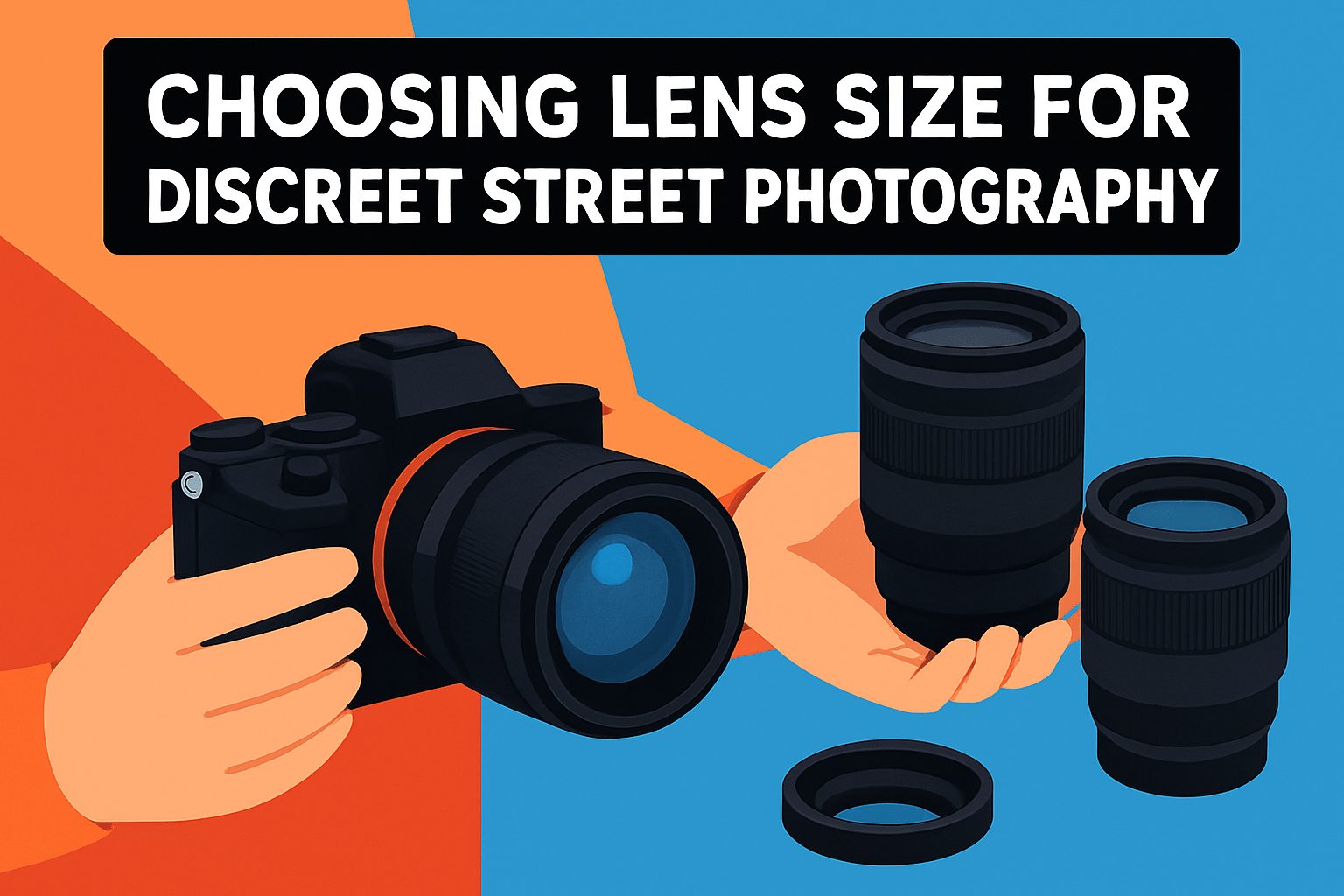
When I want to remain unnoticed on the street, lens size matters as much as focal length. Small, compact primes reduce your visual footprint and cut down fatigue on long wandering shoots. That combination keeps your shooting natural and your subjects relaxed.
35mm is my go-to for balancing context with intimacy in most urban scenes. It offers a natural field of view that flatters faces while still showing surroundings. You can work close for environmental portraits yet step back for candid sequences without changing lenses.
A wider 28mm invites storytelling by emphasizing foreground and the environment around subjects. It excels in tight streets and markets where atmosphere is half the picture. Beginners should watch for edge distortion and stronger perspective, but the payoff is immersive images.
Longer primes like 50mm and 85mm are perfect when you want distance and compression. They let you isolate faces and gestures without stepping into someone’s personal space. The trade-off is losing immediate context, so use them when you want a voyeuristic, portrait-like feel.
Primes encourage movement and deliberate framing, which makes your shooting less obvious. Zooms can be useful, but they often lead to static framing and a bulkier profile. On crowded sidewalks, a small, silent prime helps you blend into a crowd and preserves candid moments.
If profile matters, consider tiny primes such as the Sony Sonnar T* FE 35mm F2.8 ZA. Its compact design sits flush on a camera and attracts far less attention than larger G Master glass. That subtlety translates into more natural expressions and the confidence to shoot longer days.
If you’re unsure, start with a compact 28–35mm prime; it’s the most versatile street pairing. Once comfortable with that range, add a 50mm or 85mm to expand your storytelling options. Carry one prime and master its framing — that habit teaches you to see and blend in.
Understanding Aperture for Low-Light Street Photography
Aperture is the first control I reach for when dusk or street lamps start to dominate the scene. Opening the lens to f/1.4–f/2.8 brings in far more light, so you can keep ISO lower and shutter speeds high enough to catch quick, candid moments without heavy noise. That extra light also gives you cleaner files to push in post when the mood calls for it.
In practical terms, a lens like the Sony 35mm f/1.8 is a great compromise: fast enough to work in twilight, small enough to stay discreet, and capable of pleasing background separation. Faster glass, such as f/1.4 primes, will perform even better in the darkest moments, but expect a shallower depth of field and a bit more responsibility on your focusing technique.
Speaking of depth of field, wide apertures give beautiful subject isolation but demand precise focus. At f/1.4–f/1.8 the plane of focus is razor thin, so use a single AF point, back-button focus, or AF-C for moving subjects and aim for the subject’s eye or face. If you miss focus often in dim light, stop down a stop or two to gain forgiveness.
When story and environment matter, stop down to f/4–f/5.6 to bring more of the scene into focus. You’ll gain edge-to-edge sharpness, but the trade-off is less light; compensate with a bit more ISO, slower shutter (if the subject is static), or take advantage of in-body or lens stabilization if you have it.
Fast lenses also help autofocus work faster and more reliably because more light reaches the sensor and AF system. Still, ultra-wide-open shooting can sometimes confuse AF in contrast-poor night scenes, so balance aperture with AF strategy—use continuous AF for movement, single-shot for carefully composed portraits.
For everyday low-light choices I pick the aperture that guarantees a usable shutter speed first, then tune depth of field to taste. Aim for shutter speeds that freeze the action you want—roughly 1/125s for someone walking, faster for running—and raise ISO only as needed.
Finally, use aperture as a storytelling tool. Move closer to increase background blur, or stop down to include neon-lit streets and context. Practice in the same kind of light you shoot most; each lens has its own “sweet spot” where sharpness, bokeh and AF all come together.
What People Ask Most
What focal length is best for street photography on Sony?
There isn’t a single best focal length; it depends on how much context versus subject isolation you want. Many shooters favor a 35mm full-frame equivalent for its natural perspective and balance between environment and intimacy.
Is a 35mm or 50mm better for street photography on Sony?
Both work well but serve different styles: 35mm gives more context and a wider view, while 50mm provides tighter framing and a more portrait‑oriented look. Choose based on how close you like to be to your subjects and the story you want to tell.
Should I use a prime or zoom lens for street photography with a Sony camera?
Primes encourage movement, discretion, and often a smaller, less conspicuous setup, which suits candid street work. Zooms offer framing flexibility but can make shooting feel more deliberate and visible.
What is the best Sony lens for low-light street photography?
Fast aperture primes are generally best for low-light street work because they let in more light and help maintain lower ISO settings. Look for lenses known for wide apertures and reliable autofocus for night and dim scenes.
What is the best wide-angle lens for street photography on Sony?
Wide-angle choices depend on how much environment you want to include; very wide lenses suit expansive scenes while mild wides preserve subject proportions. Lenses in the mid‑20mm to low‑30mm range are commonly recommended for environmental street shots.
Are Sony APS-C lenses good for street photography on full-frame bodies?
APS‑C lenses can be practical for compact, lightweight setups, but they will change framing and workflow if used on full‑frame bodies. Check your camera’s compatibility and how it handles crop modes or adapters before deciding.
Which Sony lens is most compact and discreet for street photography?
Smaller prime lenses are typically the most discreet and comfortable for all‑day roaming. Compact designs, including some short‑prime Sonnar or modest‑aperture options, are often praised for low profile and ease of use.
Conclusion on the Best Sony Street Lenses
Choosing the right lens ultimately changes how you see and tell stories on the street, with discretion, low‑light capability, and framing distance shaping the mood and narrative of each frame.
Match your priorities—whether capturing wide urban context, isolating a subject, or working handheld at night—to a lens whose size, aperture, and reach support that approach rather than fighting it.
Remember that primes encourage movement and engagement, fast apertures shape depth and mood, and reliable autofocus helps you seize fleeting moments.
If you want to build on these ideas and improve your practical skills and gear decisions, explore more of our articles on the site to refine your technique and find what truly fits your shooting style.
Please leave a comment with your questions or streetshooting experiences; we usually reply within a few hours and enjoy helping photographers dial in their setup.



0 Comments