
Which lens will take your Sony vlogs from good to unforgettable without turning your rig into a workout?
The right glass shapes your framing, motion, and low-light confidence.
It can make handheld clips feel cinematic and conversations feel intimate.
This guide compares five top Sony-compatible lenses for vlogging and lays out the buying considerations that matter.
We focus on practical use, not marketing hype.
You’ll learn which lens fits specific shooting styles, from run-and-gun travel clips to sit-down reviews.
Coverage includes both APS-C and full-frame options, with a mix of primes and zooms calibrated for video.
Expect discussion of power-zoom behavior, aperture control, autofocus performance and how each lens renders motion.
We’ll also weigh portability and build for handheld, gimbal, and tripod setups.
A perfect lens for one creator can be a poor fit for another.
Matching lens choice to your camera body, desired field of view, stabilization workflow and low-light needs is critical.
Sensor size, focal length and whether you rely on in-body or optical stabilization will shape every recommendation.
Read on to cut through the clutter and pick lenses that actually improve your storytelling.
No jargon, just real-world pros and cons that help you decide.
By the end you’ll know which features to prioritize for your Sony setup and why.
1. Sony E 11mm f/1.8 for Vlogging
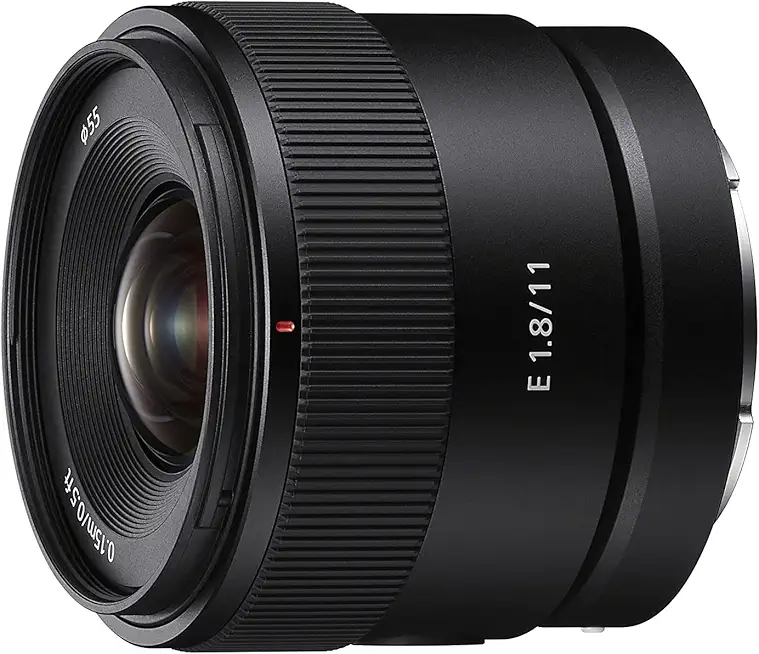
Sony E 11mm F1.8 APS-C
Ultra-wide prime delivering dramatic perspectives and exceptional low-light performance with a bright aperture — perfect for landscapes, architecture, and creative wide-angle storytelling.
Check PriceThe Sony E 11mm f/1.8 is an ultra‑wide prime built for APS‑C vloggers who want to include themselves and the environment without stepping back. At 11mm (≈16.5mm full‑frame equivalent on APS‑C) it gives a generous selfie field of view that’s ideal for arm’s‑length shooting and contextual B‑roll.
Weighing only ~181g, it’s compact and unobtrusive — perfect for run‑and‑gun days or travel where every gram counts. That light balance also pairs nicely with small bodies like the ZV‑E10, so the rig feels natural handheld and on gimbals.
The f/1.8 aperture is actually very useful for vlogging: it helps in low light and gives subject separation when you want a bit of background blur. Autofocus is quiet and fast, and the lens focuses down to ~0.12m, which lets you do dramatic close‑up shots and still maintain sharpness.
One practical touch — the clickless aperture ring — makes smooth exposure transitions while recording so your iris changes won’t betray you in footage. Image quality punches above its price bracket, delivering sharp results that make it an excellent value for content creators.
Important caveat: there is no optical image stabilization in the lens, so you’ll rely on in‑body stabilization or a gimbal for steady moving shots. Some users also feel the price is a bit high for an APS‑C prime, so weigh budget against how much you need that ultra‑wide f/1.8 combo.
- Ultra‑wide 11mm (≈16.5mm APS‑C)
- Very portable (~181g)
- Quiet, reliable AF and pleasing bokeh at f/1.8
- Close focus ~0.12m for dramatic foregrounds
- No optical image stabilization
- Some find price high for an APS‑C prime
2. Sony FE 16-35mm f/2.8 GM II Overview

Sony FE 16-35mm F2.8 GM II
Professional-grade wide-angle zoom with fast constant aperture, outstanding sharpness and creamy bokeh for landscapes, events, and cinematic video.
Check PriceThe Sony FE 16-35mm f/2.8 GM II is a G Master wide‑angle zoom built for high‑quality video and stills. Its constant f/2.8 aperture gives you consistent exposure and usable low‑light performance across the zoom range. The 16–35mm reach covers environmental wide shots and tighter framing without changing lenses.
At roughly 547g it’s remarkably compact for a professional zoom. That reduced size and weight makes handheld shooting and gimbal mounting much more manageable. Clickless aperture and smooth focus operation make exposure pulls and focus transitions feel filmic and unobtrusive.
Optically the lens delivers exceptional sharpness and attractive bokeh, which users often praise for crisp video quality. Autofocus is fast and reliable, so you can trust it to track and lock for run‑and‑gun vlog work. Close‑focusing capability also helps when you want intimate, near‑subject shots while still keeping a wide perspective.
For vloggers this is mostly a strong choice: it gives flexibility to reframe without swapping glass, pro image quality, and video‑friendly controls. It does have trade‑offs — it’s a pro‑level lens that may be more than a beginner needs, and there’s no built‑in optical stabilization, so you’ll rely on in‑body stabilization or a gimbal for the steadiest handheld footage. If you want top-tier wide‑angle footage and you pair it with a stabilized body or gimbal, this lens will serve you very well.
- Top‑tier image quality and sharpness
- 16–35mm flexible focal range
- Constant f/2.8 for low light and exposure consistency
- Fast, silent AF and video‑friendly controls
- May be overkill for beginners
- No built‑in optical stabilization
3. Sony E PZ 10-20mm f/4 G Overview

Sony E PZ 10-20mm F4 G APS-C
Compact power-zoom delivering smooth, distortion-controlled ultra-wide coverage and consistent exposure—ideal for vlogging, architecture, and immersive video.
Check PriceThe Sony E PZ 10-20mm f/4 G is an ultra‑wide power‑zoom built for video-first creators, covering 10–20mm (≈15–30mm on APS‑C) which is perfect for arm’s‑length selfie shots and sweeping environmental framing. Its power zoom delivers smooth, motorized zooms that look cinematic on camera without the wobble you get from manual zooms.
It has a constant f/4 aperture and an internal zoom design (no barrel extension), so the lens stays compact and balanced on gimbals and rigs. That internal zoom plus a weather‑resistant build makes it a reliable choice for solo creators who need to move fast and shoot in varying conditions.
Optically it’s described as very sharp for an APS‑C zoom, so you get clean, punchy footage straight out of camera without hunting for detail in post. The lens’s smooth, jitter‑free zoom pulls are specially praised by gimbal users and vloggers who want controllable reframing while recording.
The main tradeoffs are practical: the f/4 maximum limits low‑light capability compared with faster primes, meaning you’ll often crank ISO or add lights for indoor or night shoots. Also, aperture control is handled through the camera rather than a physical ring, which may slow down tactile adjustments for some shooters.
In short, if you value smooth, cinematic zooms, ultra‑wide coverage and a gimbal‑friendly form factor, this lens is a strong, video‑centric option. If low‑light performance or a dedicated aperture ring are musts for your workflow, plan to supplement with lighting or a faster prime.
- Power zoom enables smooth, controllable video zooms.
- Ultra‑wide coverage for environmental/selfie shots.
- Gimbal‑friendly internal zoom; solid build.
- Weather‑resistant, compact, and very sharp for an APS‑C zoom.
- Relatively slow f/4 aperture for low light.
- No physical aperture ring (aperture controlled via camera).
4. Sony 20mm f/1.8 G for Vlogging

Sony FE 20mm F1.8 G SEL20F18G
Bright, ultra-wide prime offering edge-to-edge sharpness and impressive low-light capability—perfect for nightscapes, landscapes, and environmental portraits.
Check PriceThe Sony 20mm f/1.8 G is a versatile wide prime built for handheld video and stills. Its bright f/1.8 aperture gives you low‑light headroom and the ability to separate subjects from backgrounds. The lens is compact and lightweight, which makes it an easy carry for travel and run‑and‑gun vlogging.
Image quality is a standout. You get strong sharpness, natural color rendition, and pleasing bokeh that helps your subject pop without looking artificial. Autofocus is fast and quiet, which is exactly what you want when recording dialogue or walking‑and‑talking shots.
On full‑frame bodies this is a true wide prime; on APS‑C cameras the field of view tightens to roughly a 30mm equivalent, so it won’t be as wide for arm’s‑length selfie framing. Also note there’s no built‑in optical stabilization, so you’ll want a body with IBIS or to use a gimbal for the steadiest handheld footage. Overall, if you prioritize image quality, color and low‑light capability in a small package, this 20mm f/1.8 G is an excellent, video‑friendly choice.
- Bright f/1.8 aperture for low light
- Strong sharpness and natural color
- Pleasing bokeh and subject separation
- Fast, quiet autofocus
- Narrower effective FOV on APS‑C (~30mm equiv.)
- No optical stabilization (relies on IBIS or external)
5. Sigma 16mm f/1.4 DC DN Contemporary Overview

Sigma 16mm F1.4 DC DN Contemporary Sony E 402965
Fast-aperture wide-angle prime providing creamy bokeh, excellent low-light performance, and compact handling for creators shooting landscapes, astro, and street scenes.
Check PriceThe Sigma 16mm f/1.4 DC DN Contemporary is a standout APS‑C prime for Sony vloggers who want a bright, natural‑looking wide angle without the bulk. Its f/1.4 aperture gives you real low‑light performance and smooth background separation that makes talking‑head shots feel cinematic even in modest lighting.
On Sony APS‑C bodies (ZV‑E10, a6000 series) the 16mm focal length sits at roughly ≈24mm full‑frame equiv., which offers a wide but natural perspective with minimal distortion. That field of view is great for arm’s‑length selfie vlogs and for showing a bit of environment without the exaggerated wide‑angle look.
Image quality punches above its price: Sigma delivers sharp, clean images with controlled chromatic aberration and distortion. Autofocus is fast, accurate and quiet for video, so the lens keeps pace with run‑and‑gun shooting while staying unobtrusive on your camera’s mic track.
There are a couple of practical caveats to be aware of. Some users report slight softness when shooting wide open at f/1.4 and occasional purple fringing in high‑contrast highlights, so you may want to stop down a stop or two in demanding scenes. Also, the lens lacks optical stabilization, so pair it with a body that has IBIS or use a gimbal for the steadiest handheld footage.
- Very bright f/1.4 for bokeh and low light
- 16mm (≈24mm full‑frame equiv.) natural wide perspective
- Sharp, clean images with fast, quiet AF
- Compact and affordable alternative to Sony primes
- Minor softness and purple fringing at widest apertures
- No optical stabilization (relies on camera IBIS)
Power Zoom Advantages for Vlogging
As a vlogger, nothing sells a scene like a controlled push‑in. Power‑zoom lenses give you that control — motorized, repeatable zooms that are far smoother than a hand pull and easy to match across takes. They also help maintain continuity across takes, which makes editing far easier.
Because the zoom is driven by an internal motor it’s usually whisper‑quiet, so you don’t catch zooming noise on your tracks. That matters when you rely on on‑camera mics or want clean audio without hiding the lens behind a sleeve.
Sony’s modern PZ glass pairs tightly with their vlog bodies like the ZV‑E10, FX30 and ZV‑1 II. You get dedicated zoom controls, adjustable zoom speeds and remote operation from gimbals or camera buttons. That setup lets a solo creator reframe shots, execute cinematic pushes and keep focus without needing an assistant.
Designs with internal, non‑extending zooms are gimbal‑friendly because they don’t shift balance or introduce wobble mid‑zoom. Modern optics also reduce focus breathing and zoom‑shift so subject size and angle stay consistent during a pull. The trade‑off is often a smaller constant aperture — many PZs sit around f/4 — so plan lighting or accept higher ISOs when needed.
My practical tip: use the slowest zoom speed for cinematic pulls and time the movement to your edit so it reads on screen. Keep continuous AF on for run‑and‑gun, and test the zoom while listening to your audio to confirm silence. If low light is a concern, add a small LED or step up to a faster prime for cutaways.
For solo travel and interview vlogs, a power‑zoom is a creative Swiss Army knife — it gives you motion without a crew. Pair it with stabilization and modest lighting and you can raise production value instantly. They’re not a replacement for faster primes when you want extreme shallow depth of field, but they make your videos feel more produced with minimal extra gear.
Choosing Wide-Angle Lenses for Vlogging
Wide-angle lenses let you include yourself and your surroundings — essential for selfie vlogging and giving context. Modern Sony wide angles minimize edge distortion, so subjects at the frame edges still look natural.
Large apertures (f/1.8–f/1.4) are a huge advantage: better low-light performance and the option to separate yourself from the background when you want a cinematic look. But very wide fields of view also keep more in focus, so total background blur will be subtler than with longer lenses.
Weight and size matter on long days. Compact primes like the Sony E 11mm f/1.8, Sigma 16mm f/1.4, or Sony 20mm f/1.8 are easy to carry and fast in low light. Zooms — like the Sony FE 16–35mm f/2.8 GM II or the Sony E PZ 10–20mm f/4 — give framing flexibility; the PZ’s motorized zoom is invaluable for solo creators who want smooth push‑ins.
Don’t forget stabilization. Many wide-angle vlogging lenses forego optical stabilization, so you’ll rely on in‑body stabilization (IBIS) or a gimbal for silky handheld footage. Paired with active stabilization, wide lenses produce very steady, usable clips even when you move around.
Also match focal length to your sensor. On APS‑C bodies 11mm behaves like roughly 16.5mm full‑frame, 16mm like 24mm, and 20mm like about 30mm. That matters when you’re shooting arm’s‑length selfie videos — 20mm on APS‑C may feel too tight whereas an 11mm or 10–20mm zoom gives the open look vloggers love.
My practical rule: pick the widest fast prime you can comfortably carry if you shoot a lot handheld and in low light. If you need compositional flexibility and cinematic moves, choose a wide zoom or a power‑zoom. Finally, balance field of view, aperture and your stabilization workflow — that combo will dictate the best lens for your vlogs.
What People Ask Most
What is the best Sony lens for vlogging?
There isn’t a single best lens for everyone; it depends on your camera, framing needs, and shooting style. Pick a lens that balances field of view, low‑light capability, and handling for the way you vlog.
What focal length is best for vlogging on Sony cameras?
A wider focal length is often preferred for selfie and environmental vlogs because it keeps you and the background in frame. Choose focal length based on how close you typically position the camera and the look you want to achieve.
Is a wide-angle lens better for vlogging with Sony?
Wide-angle lenses are great for including yourself and surroundings and for shooting in tight spaces. However, if you want tighter portraits or a more cinematic look you may prefer a less wide option.
Should I use a prime or zoom lens for Sony vlogging?
Primes offer simplicity, compact size, and often stronger low‑light performance, while zooms provide framing flexibility without changing lenses. Choose based on whether you prioritize image quality and portability or versatility in framing.
Which Sony lens is best for low-light vlogging?
For low light, choose a lens with a bright maximum aperture and good optical quality, then pair it with proper stabilization and lighting. Good autofocus and handling also help maintain usable footage in dim conditions.
Can I use APS-C Sony lenses for full-frame vlogging?
APS‑C lenses can often be mounted on full‑frame Sony bodies, but they may require crop modes or produce vignetting depending on the camera. Always check compatibility and expected framing before relying on an APS‑C lens on a full‑frame body.
What lens do vloggers commonly use on Sony cameras?
Vloggers commonly use wide primes or wide zooms that offer a broad field of view, reliable autofocus, and lightweight handling. Power‑zoom lenses are also popular for smooth in‑camera zooms when a single operator needs to adjust framing.
Conclusion for Best Sony Vlogging Lenses
This comparison distilled practical choices among five Sony‑compatible options, showing how sensor size, prime versus zoom trade‑offs, field of view, stabilization approach and low‑light needs should guide your vlogging lens pick.
Think in terms of what matters most for your shooting: portability and wide coverage, shallow depth and low‑light capability, or the smooth control that motorized zooms bring to solo filming.
If you want to sharpen your technique and gear decisions, read more articles on the site to deepen your understanding and improve your vlogging results at your own pace.
Have questions or want to share your experiences with these lenses? Leave a comment below — we usually reply within a few hours.


0 Comments