
What is a speedlight and how can it change your photos? It is a small, portable flash that adds controllable bursts of light to your camera to shape shadows and highlights.
This guide shows how a speedlight works and the key modes: TTL, Manual, and High‑Speed Sync. You will also learn trigger options, head zoom behavior, and simple bounce and modifier techniques.
We compare speedlights to built‑in pop‑up flashes and full studio strobes so you can pick the right tool for travel, events, or studio shoots. Expect starter settings, battery tips, troubleshooting, and screenshot‑ready quick settings for portraits, events, and product shots.
By the end you’ll know when to use TTL or Manual, when to switch to HSS, and how to set up on‑camera and off‑camera flashes. Ready to make your lighting smarter and faster? Let’s dive in.
What is a speedlight?
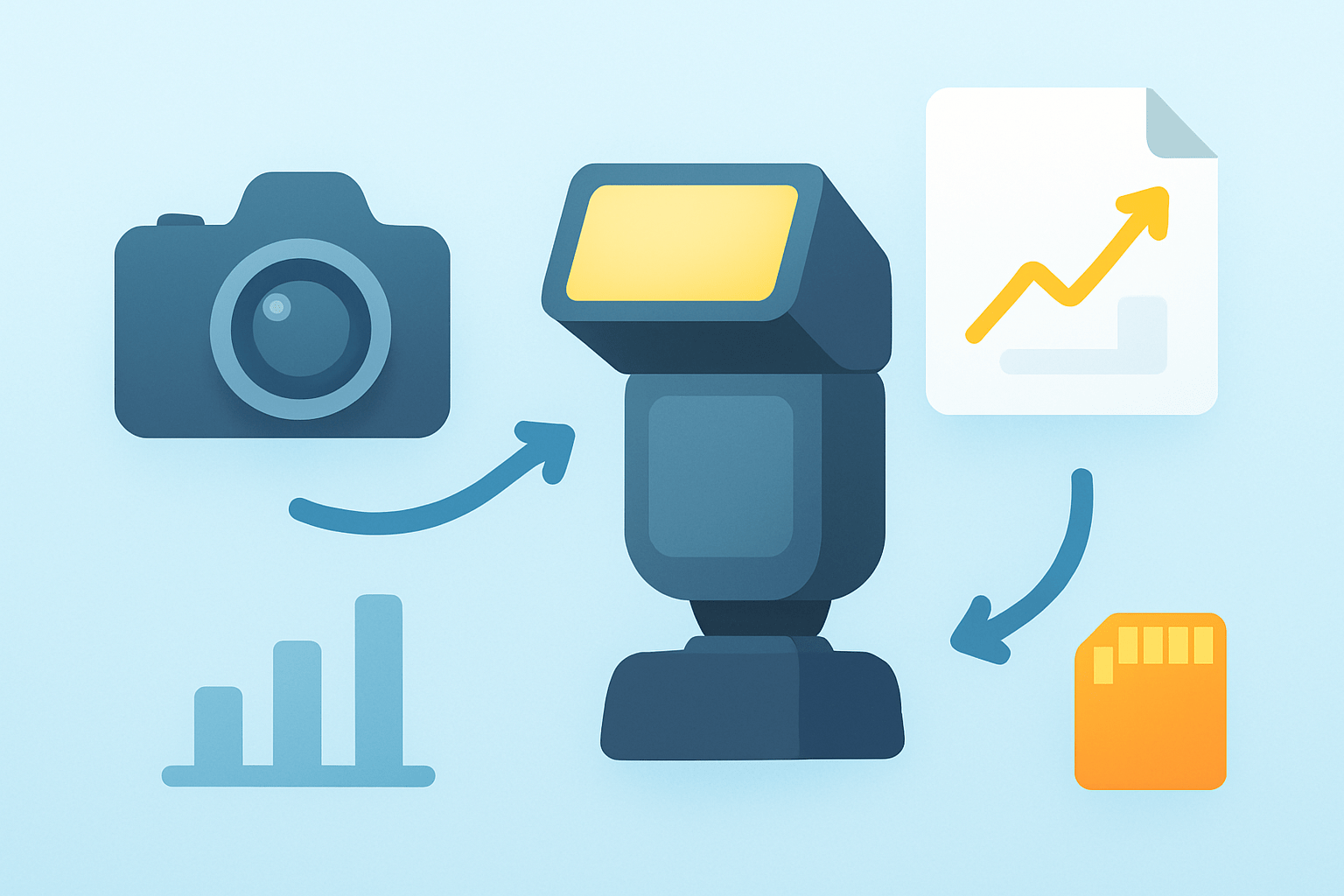
The answer to what is a speedlight: a compact, portable external camera flash that mounts on the hot shoe or fires off‑camera to add controlled bursts of light (also spelled/marketed as “Speedlite” by some brands).
A good speedlight slides into your camera’s hot‑shoe mount and brings smart features like a zoom head, swivel and tilt for bouncing, TTL metering, and manual power control. Many units add High‑Speed Sync, radio or optical triggering, and all run on batteries so you can light anywhere. This tiny box gives you control over direction, power, and timing that the camera’s pop‑up flash can’t match.
If you’re wondering what is a speedlight versus a pop‑up flash, think power and control. A speedlight is stronger, points and swivels where you want, bounces light off walls and ceilings, and can be used off‑camera for more creative looks. A pop‑up points straight ahead, often looks harsh, and can’t be placed away from the lens.
Photographers use speedlights for portraits, weddings and events, quick fill light outdoors, and small product shots on a table. They are fast to set up and easy to carry, so they fit travel and run‑and‑gun work. If you want a simple primer with examples, skim this helpful overview on Using a speedlight and then come back ready to practice.
Try a quick exercise today. Put your speedlight on the hot shoe, set TTL, swivel the head to bounce off a white wall, and take a headshot both direct and bounced. Compare the shadows and skin tones to see how direction changes everything.
How a speedlight works (fundamentals)
Inside the flash a capacitor charges from the batteries and stores energy until you press the shutter. When triggered, that energy dumps through a flash tube to create a very short, bright burst of light, often just a few thousandths of a second. In TTL mode the flash usually fires a tiny pre‑flash so the camera can meter through the lens before the main burst.
There are several ways to trigger the flash. On‑camera hot‑shoe sync is simple and reliable, while a PC cord adds a basic wired option for older gear. Optical slave modes can see another flash and fire in response, and radio triggers give longer range, no line‑of‑sight limits, and more channels, though they add cost and battery needs.
Flash exposure behaves differently than ambient light. At normal sync speeds, the flash’s brightness on your subject is mostly controlled by aperture and distance, because the burst is so fast it acts like its own shutter. Your camera’s shutter speed then mainly affects the background and ambient light, unless you turn on HSS, which changes the game.
Recycle time is how long the capacitor needs to recharge before the next shot, and it depends on battery type and power level. Flash duration is the length of the light burst, and at lower powers it can be extremely short, which is how a speedlight can freeze motion like hair flips or splashing water. Use fresh NiMH rechargeables for snappier recycle and more consistent output.
The head zoom concentrates the beam to match your lens, which increases effective reach at telephoto settings and spreads light at wide angles. Bounce the head off a ceiling or wall for softer, larger light, and add simple modifiers to manage spill and contrast. For a quick refresher on setup steps, see this concise quickstart guide and then practice bouncing in three different rooms.
Modes explained — TTL, Manual and High‑Speed Sync
TTL, or Through‑The‑Lens, measures a pre‑flash and calculates power for you. It shines when the scene changes fast, like people moving between sun and shade or a couple dancing through a spotlight. Watch for pitfalls such as pre‑flash blink, shiny surfaces that can fool the meter, and mixed lighting that shifts color, and remember Flash Exposure Compensation is your dial to bias TTL brighter or darker.
Manual mode lets you set the exact power in fractions such as 1/1, 1/2, 1/4, down to 1/64 or 1/128 depending on the model. Because the power doesn’t change unless you change it, manual is perfect for portraits, product work, and multi‑light setups where consistency matters. You can use a flash meter for precision, or refine with two or three test shots while checking the histogram and highlights.
High‑Speed Sync, or HSS, allows shutter speeds faster than your camera’s normal sync by pulsing the flash rapidly as the shutter curtains travel. The tradeoff is reduced effective power and shorter range, and your batteries work harder. Use HSS when you need a wide aperture in bright sun, or when you must shoot at 1/1000 to freeze action and still keep shallow depth of field.
Here’s a rule of thumb to guide you. Use TTL for unpredictable light and events, use Manual for controlled scenes and studio style work, and turn on HSS only when you must go faster than your sync speed or need wide apertures outdoors. For practice, shoot the same portrait in TTL and then Manual at 1/4 power, and you’ll quickly feel the difference in control.
Speedlight vs studio strobe (and vs built-in flash) — which to choose
Speedlights are light, small, and battery powered, while studio strobes are larger, more powerful, and often add a modeling lamp to preview shadows. Strobes recycle faster at high powers, tend to hold color temperature more consistently, and pair with big modifiers that eat light. Speedlights cost less and travel easier, but they have less output and no true modeling light.
Choose a speedlight for travel, events, on‑camera fill, quick off‑camera setups, and when you’re starting on a tight budget. Choose a strobe or monolight for a dedicated studio, for very large softboxes or umbrellas, for products and groups, and when you want uniform color and high power all day. Built‑in pop‑up flash is a last‑resort tool for emergency fill, and it lacks power, direction, and off‑camera options.
Match the tool to your job by thinking about portability, budget, required distance and power, whether you’ll scale to multiple lights, and if you need a modeling light or mains power. A simple exercise is to photograph the same portrait with a speedlight bounced on‑camera, then with a borrowed strobe through a softbox, and compare skin tone, shadow edge, and catchlights. You will see why each tool has a place.
Practical tips & quick settings for beginners
Start with an indoor bounce portrait at ISO 200, shutter between 1/60 and 1/125, and f/4, with the head tilted about 45 degrees toward a white ceiling. Try manual 1/4 power for a solid base, or use TTL with Flash Exposure Compensation at minus 0.3 to minus 0.7 to taste. Take two frames, then rotate the head to bounce off a nearby wall for a softer side light.
For outdoor fill, set your ambient first for the background, then add flash just to lift shadows. TTL works well for moving subjects, while manual around 1/16 to 1/8 power is great when your subject stays put, and HSS may be needed in bright sun. If you want a deeper dive on placement and triggering, read about working flash off-camera and then test with a friend at golden hour.
Know your max sync speed, usually 1/200 to 1/250, because going faster without HSS causes dark bands across the frame. Remember the inverse‑square law in plain terms: when you move the flash twice as far away, your subject gets about four times less light. In practice, step in closer or open one stop if you see the exposure drop.
Bounce when you have a low, neutral ceiling or a clean wall, and go direct when there’s nothing good to bounce or you want crisp drama. A small bounce card can add bright catchlights, while a mini softbox or dome spreads light for softer faces but costs some power. Off‑camera, radio triggers are the most reliable outdoors, while optical slaves are simple but can be confused by TTL pre‑flashes.
Use high‑capacity NiMH rechargeables for faster recycle and keep spares warm in your pocket in winter. Give the flash a break during long bursts to avoid overheating, and watch the ready light before firing again. If your subject is underexposed, either raise flash power or move the light closer, and if TTL acts inconsistent, switch to manual and lock the look.
Plan a few visuals to cement the concepts. Capture a before‑and‑after set showing direct, bounced, and diffused flash, add a simple diagram of the TTL pre‑flash followed by the main flash with the sync speed marked, and shoot a comparison frame of a speedlight versus a strobe using the same setup. Save a compact quick‑start settings card on your phone so you can pull it up on location when nerves kick in.
Here’s a simple “quick settings” card you can screenshot right now: Indoor bounce portrait — ISO 200, 1/60–1/125, f/4, manual 1/4 or TTL at −0.3 to −0.7 FEC; Outdoor fill — expose background first, then flash at TTL or manual 1/16–1/8; Freezing motion — HSS on, 1/500–1/2000, move closer or raise power to compensate for lost range. Keep it handy and adjust one variable at a time.
Two little pro tips will lift your results fast. Use a small bounce card to add a clean catchlight while keeping your light soft, and slightly feather the flash so the edge of the beam lights the face more gently. A beginner’s kit can be as simple as one speedlight with TTL and HSS, a basic radio trigger, spare NiMH batteries with a smart charger, and a compact diffuser or mini softbox.
Once you understand what is a speedlight and how it shapes light, every room becomes a studio and every sky becomes a backdrop. Practice the recipes, test one new setting each shoot, and you’ll gain confidence with every pop.
What People Ask Most
What is a speedlight and how can it improve my photos?
A speedlight is a small, powerful external flash that adds controlled light to your shots, helping fill shadows and freeze motion for clearer images.
How is a speedlight different from my camera’s built-in flash?
A speedlight is more flexible and stronger than a built-in flash, letting you change direction, power, and placement for better-looking light.
Can a beginner use a speedlight easily?
Yes, beginners can start with simple TTL or manual modes and learn basic bouncing and diffusing techniques to get quick improvements.
What kinds of photography benefit most from a speedlight?
Portraits, events, indoor shoots, and close-up work all benefit from a speedlight because it adds controllable, flattering light where you need it.
How can I use a speedlight to create softer light?
Bounce the speedlight off ceilings or walls or use a small diffuser to spread the light and reduce harsh shadows for softer results.
What common mistakes should I avoid when using a speedlight?
Avoid pointing the flash directly at subjects without diffusing, overexposing backgrounds, and relying only on automatic settings without checking results.
Can a speedlight be used off-camera and why would I do that?
Yes, using a speedlight off-camera gives you creative control over light direction and depth, producing more natural and dynamic images.
Final Thoughts on Speedlights
If you came here asking what a speedlight does, you’ve learned it’s a pocketable, controllable burst of light that helps you shape exposure and mood on the fly. Many models — from travel‑friendly units like the 270 to rugged pro heads — prove how a small flash can replace heavier gear without sacrificing creative control. That portability and precision are the core benefit: more light, fewer compromises.
One realistic caution: they’re weaker than studio strobes and HSS or TTL can eat battery life and range, so expect to move closer or add modifiers in bright conditions. They’re best for travelers, event shooters, portrait photographers and anyone who wants big creative gains from compact gear.
We broke down how they work, when to use TTL, Manual and HSS, compared them to strobes, and gave starter recipes so you can get real results quickly. Keep experimenting with bounce, modifiers and simple off‑camera setups — you’ll see steadier, more flattering light in your images soon.


0 Comments