
What lens would you grab when a rare bird appears at the treeline and you have seconds to capture the moment?
This guide distills five long‑reach, field‑tested options for Sony shooters — the best lenses for wildlife photography Sony users will consider — from big mammals to twitchy songbirds. It focuses on real‑world use, handling, and the practical trade‑offs that shape keepers versus misses in the field, so you can choose with confidence.
You’ll get plain‑English takes on autofocus reliability, sharpness across the frame, and how aperture and focal length influence subject isolation and background separation. We also cover handling: balance, stabilization, tripod needs and how lens size affects long days and travel logistics. Plus, there’s clear guidance on teleconverters — how they extend reach, what they typically cost you in effective aperture and AF speed, and when they’re worth adding for action or distant subjects.
Whether you lean toward a fast prime for ultimate image quality or a versatile zoom for fewer lens swaps in the field, this guide clarifies the compromises. We cut through marketing hype and spec sheets to focus on what truly matters: image results, autofocus behavior, handling and total ownership costs. Read on if you want to choose a Sony‑compatible telephoto setup that matches your subjects, shooting style and budget without surprises in the field — and that you’ll actually enjoy carrying.
1. Sony FE 200-600mm f/5.6-6.3 G OSS Highlights

Sony FE 200-600mm F5.6-6.3 G OSS SEL200600G
Versatile long-range zoom delivering crisp detail and reliable stabilization for wildlife and sports, with responsive autofocus and portable handling.
Check PriceThe Sony FE 200-600mm f/5.6-6.3 G OSS is a genuinely practical “do‑it‑all” telephoto for wildlife work, covering everything from large mammals to birds without constant lens swapping. Its reach and flexibility make it a favorite for travel and fieldwork where you need range without lugging multiple primes.
Autofocus is a standout—fast, precise and very reliable for subject tracking in challenging conditions. That makes it easy to nail moving subjects in the field, and the AF keeps up well across the focal range.
Despite its long reach, the lens is relatively lightweight and compact for what it delivers, so handheld shooting is more achievable than with heavier primes. The internal zoom design helps maintain balance and reduces dust and debris ingress, which you’ll appreciate on dusty safaris and windy shorelines.
Image quality is strong across the zoom, and sharpness at 600mm is particularly impressive—often outperforming competing zooms at that focal length. If you need even more reach, a 1.4x teleconverter extends it to 840mm, though AF performance and image quality are slightly reduced when you do.
For working wildlife photographers who want versatility, solid optics and reliable AF without going to a heavy prime, this is a very sensible choice. It’s not perfect—the handling trade‑offs and some optical quirks are worth knowing—but for most users it balances reach, IQ and portability effectively.
- Excellent autofocus speed and accuracy
- Robust build quality and weather sealing
- Smooth zoom throw and internal zoom mechanism
- Strong sharpness at long end
- Noticeable pincushion distortion, especially at longer focal lengths
- Still large and heavy for extended handheld use
2. Sony FE 400-800mm f/6.3-8 G OSS Highlights

Sony FE 400-800mm F6.3-8 G OSS
Extreme-reach telephoto zoom providing steady, high-contrast images at distance, optimized for remote subjects and extended outdoor use.
Check PriceThe Sony FE 400-800mm f/6.3-8 G OSS is a specialist tool for serious wildlife shooters who need reach above all else. Its native 800mm reach gives you access to small birds and distant subjects without relying on extenders.
Sharpness stands out, especially at 800mm, delivering detailed images where pixel-level resolution matters. Autofocus remains fast and reliable even at the long end, so you can track skittish subjects with confidence.
Build quality is professional grade with solid weather sealing, so it holds up in real‑world field conditions. The zoom action is smooth and the lens balances well on pro bodies, making framing less fatiguing during extended sessions.
Internal zooming helps keep the center of gravity stable and reduces dust ingress, which is a real advantage when you’re working in dusty hides or windy shorelines. That internal design also contributes to a more controlled handling feel compared with externally extending super‑telephotos.
The tradeoffs are clear: this is a very large and heavy lens that isn’t ideal for long handheld stints or travel. The maximum aperture becomes f/8 at 800mm, so low‑light performance is limited compared with faster primes.
- Outstanding sharpness and image quality at 800mm
- Fast and accurate autofocus at long reach
- Excellent build and weather sealing
- Internal zoom improves balance and reduces dust ingress
- Very large and heavy; challenging for handheld use and travel
- Relatively slow maximum aperture (f/8 at 800mm), limiting in low light
3. Sony FE 600mm f/4 GM OSS Highlights

Sony FE 600mm F4 GM SEL600F40GM
Professional-grade super-telephoto prime offering blazing brightness, exceptional resolution, and precise autofocus for demanding wildlife and action photography.
Check PriceThe Sony FE 600mm f/4 GM OSS is regarded by many professionals as the ultimate wildlife lens for tack‑sharp images and subject isolation at f/4. It delivers the kind of resolution and background separation that makes subjects stand out in challenging scenes.
Autofocus is a standout—extremely fast and reliable, capable of tracking fast subjects with confidence. It also performs well with teleconverters, so you can extend reach without losing the core AF performance.
Speaking of reach, teleconverters expand the lens to 840mm and 1200mm, giving you enormous reach for distant subjects. That flexibility keeps you out of bushes and blinds while still filling the frame.
Build quality is clearly professional: robust construction, thorough weather sealing and a balance that suits pro camera bodies. The lens is used for both stills and video, so it’s versatile across assignments where ultimate image quality is the priority.
That said, this is a specialist tool. It is very large and heavy, which makes handheld work and travel challenging. It also comes with a very high price, so it’s best for photographers who need top‑tier sharpness and are prepared to manage the size and cost.
- Exceptional sharpness even wide open at f/4
- Fast, reliable autofocus with fast subjects
- Robust professional build and weather sealing
- Strong teleconverter compatibility (to 840mm and 1200mm)
- Very large and heavy; challenging for handheld use and travel
- Very high price
4. Sony FE 400mm f/2.8 GM OSS Highlights

Sony FE 400mm F2.8 GM SEL400F28GM
Ultra-fast prime delivering stunning low-light performance, creamy bokeh and rock-solid sharpness for sports and birding pros.
Check PriceThe Sony FE 400mm f/2.8 GM OSS is a true workhorse when you need reach and speed. Its fast f/2.8 aperture gives strong subject isolation and noticeably improved low‑light performance, which translates to cleaner files and smoother bokeh when you’re trying to separate a bird or mammal from a busy background.
Autofocus is extremely fast and reliable, handling challenging lighting and quick subjects with confidence. The lens is also well balanced on pro bodies and has become a popular choice for both stills and video shooters who demand consistent tracking and responsiveness.
Image quality is a highlight: this lens delivers exceptional sharpness even wide open, so you don’t have to stop down to get tack‑sharp results. Combined with the f/2.8 aperture, that sharpness makes it ideal for isolating subjects and freezing motion in dim conditions.
Build quality and weather sealing are top tier, giving you the confidence to work in changeable field conditions without worrying about the elements. Despite being a super‑telephoto prime, it’s relatively lighter than many other super‑telephoto primes, which makes extended handheld or gimbal-assisted shoots more manageable.
If you’re a pro or serious enthusiast focused on ultimate image quality, subject isolation and fast AF, this lens will serve you very well. Keep in mind it is a fixed focal length, so you’ll need to move for composition changes, and it carries a premium price tag that reflects its professional credentials.
- Exceptional sharpness even wide open
- Very fast and reliable autofocus
- Excellent build quality and weather sealing
- Relatively lighter than many other super‑telephoto primes
- Expensive
- Fixed focal length limits framing flexibility
5. Sigma 300-600mm f/4 DG OS Sports Highlights

Sigma 300-600mm F4 DG OS Sports L-Mount
Rugged, high-speed telezoom built for fieldwork: robust weather sealing, image stabilization, and consistent sharpness across the range.
Check PriceAs a wildlife shooter who spends long days in the field, the Sigma 300-600mm f/4 DG OS Sports is the kind of lens that changes what you can capture. It’s a unique zoom that gives you an f/4 aperture all the way to 600mm, so you get prime‑like subject separation and low‑light performance while keeping the framing flexibility of a zoom.
Autofocus is fast and reliable, holding locked focus even in challenging lighting — which matters when birds or predators make sudden moves. The lens is built like a tank: strong build quality, weather sealing and a balance that fits professional camera bodies, so it’s comfortable to mount for long periods and suitable for both stills and video.
Image quality is impressive; sharpness and rendering remain excellent even at the 600mm end, so you won’t feel like you’ve compromised by choosing a zoom for reach. Cost-wise it represents strong value for photographers who want an f/4 reach without paying prime prices, though it’s not exactly light on the wallet.
Be realistic about handling: this is a big, heavy optic and will demand a robust tripod, monopod or gimbal for extended use or travel. If you prioritize reach, speed and image quality over absolute portability, this lens is an attractive, real‑world tool for serious wildlife work.
- Exceptional sharpness and image quality even at 600mm
- Fast and reliable autofocus
- Robust build and weather sealing
- Better affordability compared with many super‑telephoto primes
- Very large and heavy; challenging for handheld use and travel
- Price still high, though lower than many super‑tele primes
Primes vs Zooms for Sony Wildlife
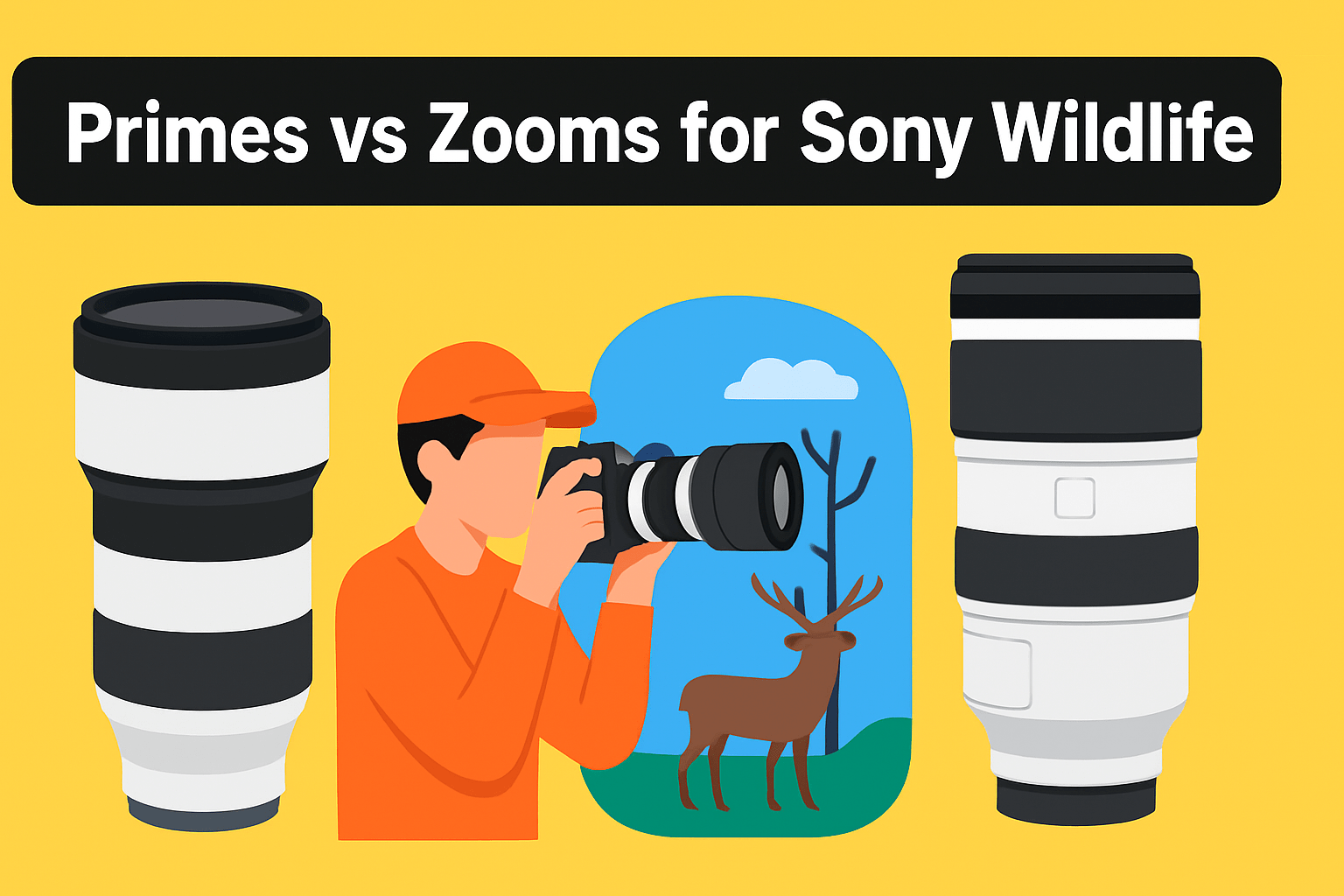
Choosing between a prime and a zoom often comes down to three things: what you shoot, the light, and how much gear you want to carry. I decide by picturing the moment — a tight flight shot or a scene with context.
Primes win where image quality and low‑light performance matter. Lenses like Sony’s 600mm f/4 GM or 400mm f/2.8 GM give stronger subject separation and cleaner detail; they also tolerate teleconverters with less AF compromise.
Those benefits bring trade‑offs: size, weight and cost. Super‑tele primes are heavy and demand a solid tripod or gimbal, and they force you to move to reframe rather than zoom.
Zooms are the Swiss Army knife of wildlife work and often the smarter travel choice. A lens like the Sony 200‑600mm covers a huge range, includes stabilization and internal zooming so you spend less time swapping lenses and more time shooting.
Even the best zooms lag slightly in ultimate sharpness and low‑light headroom versus top primes, especially at their long end. Specialty zooms — Sigma’s 300‑600mm f/4, for example — blur that line by offering f/4 at reach, but they become big and heavy.
In practice many pros carry both. Use a prime on a gimbal for the decisive wing‑beat or backlit portrait, and rely on a 200‑600 zoom to cover approach shots, perched birds or mammals on the move.
Teleconverters buy reach but reduce effective aperture and can slow AF; primes usually cope with them better than zooms. Also plan support gear — a sturdy monopod or gimbal head and spare batteries for long sessions — as part of the lens decision.
Scale your choice to subjects and shooting style, then test gear before committing. Rent the prime you think you need for a trip; if it feels restrictive, a high‑quality zoom will likely be the more productive choice.
Budget Considerations for Sony Wildlife Lenses
Budget for wildlife glass is more than the sticker price; it’s about image goals, aperture needs and what you can carry. Premium primes like the Sony FE 600mm f/4 GM deliver top sharpness, subject isolation and fast AF, but they cost significantly more and usually need heavy support gear. Planning for those extra tripod, gimbal and carry costs prevents nasty surprises.
For most shooters a single high‑quality zoom is the most economical route to consistent results. The Sony FE 200–600mm f/5.6–6.3 G OSS covers a wide range, includes stabilization, and reduces the need for multiple primes in the bag. That versatility keeps costs down while letting you react quickly to changing wildlife situations.
Third‑party lenses can give excellent value and bridge the gap between zoom flexibility and prime performance. The Sigma 300–600mm f/4 DG OS Sports brings f/4 speed at long reach for less than many super‑tele primes, while Tamron’s 150–500mm options offer good reach on a lower budget. Expect compromises in weight, handling or slightly different AF tuning compared with native Sony glass.
Remember to budget for handling and accessories because support gear isn’t optional with big glass. Tripods, gimbal heads, reinforced cases and even extra baggage fees add up and influence where you can shoot. Teleconverters can be a cheap reach trick — the 600mm f/4 becomes about 840mm with a 1.4× and 1200mm with a 2× — but they reduce the effective aperture, slow AF and slightly soften images.
My practical advice is to define priorities before spending: ultimate image quality, maximum reach or portability. For balanced cost‑to‑performance most of us start with a modern, stabilized zoom and add a premium prime later if needed. Factor in support gear, travel and operational costs when you total the budget and you’ll be far happier with the final setup.
What People Ask Most
What is the best Sony lens for wildlife photography?
There is no single best lens; choose based on your target subjects, shooting distance, budget and how you handle weight in the field. Primes tend to deliver top image quality and low‑light performance, while high‑quality zooms offer greater flexibility and fewer lens changes.
Which Sony telephoto lens is best for bird and wildlife photography?
Pick a lens that gives you the reach you need for the species you shoot while matching your budget and support gear. Fast, well‑sealed lenses with reliable autofocus are usually best for active wildlife work.
Is a Sony 100-400mm lens good for wildlife photography?
A 100‑400 style lens can be a very versatile choice, balancing reach with portability for many larger mammals and closer birds. It may be less suitable for very distant or very small subjects where more native reach is required.
Is the Sony 200-600mm lens suitable for wildlife and bird photography?
Yes, it is a flexible option that covers a wide range of wildlife situations and is easier to carry than some heavier primes. Keep in mind that using teleconverters can slow autofocus and slightly affect image quality.
What focal length range is ideal for wildlife photography with Sony cameras?
There is no single ideal range; choose focal lengths to match your typical shooting distances and subject size. Longer focal lengths work better for distant or small subjects, while shorter telephoto ranges suit larger or closer animals.
Should I use a teleconverter with Sony wildlife lenses?
Teleconverters can extend reach but often reduce autofocus speed and image quality, and they change how much light the lens delivers. Use them when you need extra reach and your gear reliably maintains autofocus and image quality; otherwise a native longer lens may be preferable.
Are Sony 70-200mm lenses suitable for wildlife photography?
70‑200 style lenses are useful for closer wildlife, action and situations where mobility matters, offering good versatility for larger subjects. For distant birds or very small subjects you will likely need longer focal lengths.
Conclusion for Best Sony Wildlife Lenses
Choosing the right long‑reach kit comes down to matching your target subjects, shooting style and budget so your gear supports the images you want to make rather than limiting them.
Balance the usual trade‑offs—ultimate image quality and low‑light speed from primes against the framing flexibility and convenience of zooms—and remember that teleconverters, weight and handling all affect real‑world results as much as raw specs.
Think in terms of priorities: if ultimate sharpness or low‑light performance is critical, plan for primes and support gear; if versatility and fewer lens swaps matter, opt for a high‑quality zoom or a mixed kit that covers both needs.
If you want to sharpen your decision‑making and shooting skills, read more of our site’s practical guides and reviews to build confidence before you buy or rent—that continued learning pays off in the field.
Have questions or want advice on your specific setup? Leave a comment below and we usually reply within a few hours.


0 Comments