
Ever wondered why your night photos turn into noisy, soft disappointments as soon as the sun sets? This guide curates five top Nikon lenses that will upgrade your low-light work and help you make smarter lens choices after dark.
Whether you shoot portraits, weddings, street scenes, or nightscapes, the right optic changes everything. I’ll show which lenses excel in real-world dim conditions and why. Each pick reflects a balance of performance, handling, and value.
At the heart of the evaluation are four crucial factors: maximum aperture to gather light, true optical image quality for clean shadows, autofocus reliability when contrast is low, and Vibration Reduction to steady handheld shots. You’ll also see how things like bokeh, flare resistance, and weight influence practical use. I test lenses for how they behave wide open and in the kinds of scenes you actually shoot.
Low-light lenses demand compromises—extreme speed often means more size or cost, while stabilization can add heft. I’ll break down those trade-offs so you can choose the lens that aligns with your shooting style and tolerance for weight or budget.
Flip the page and you’ll get photographer-tested picks, plus clear reasons to choose one lens over another for dim situations. If you want cleaner files, faster focus, and steadier handheld shots when light is scarce, this guide is for you.
1. Nikon NIKKOR Z 35mm f/1.8 S Mirrorless

Nikon NIKKOR Z 35mm f/1.8 S
Compact, ultra-sharp wide-normal lens for creative low-light shooting, delivering smooth background separation, precise autofocus, and exceptional edge-to-edge clarity.
Check PriceThe Nikon NIKKOR Z 35mm f/1.8 S is a true go-to for Nikon Z shooters who want a compact, sharp low-light prime. Its bright f/1.8 aperture gives you real flexibility for handheld work in dim conditions without the bulk of faster, heavier glass.
Optically it’s been updated to minimize flare, ghosting, and chromatic aberration, so you get clear, contrasty images even under tricky light. The 9‑blade rounded diaphragm produces very pleasing, smooth bokeh that helps subjects pop against a soft background.
In the field users consistently call it “very sharp”, “clear”, and “lightweight” — and that matches my experience. For street, landscape, and environmental portraits in dim conditions it balances image quality and portability exceptionally well.
Because it’s compact and fast, it’s ideal for handheld low‑light shooting where stabilizers or tripods aren’t practical. The combination of image clarity and manageable size makes it a practical everyday lens for travel and event work where you need to be nimble.
Keep in mind the tradeoffs: f/1.8 is excellent, but it won’t gather as much light as f/1.4 alternatives if you demand the absolute shallowest depth of field or lowest ISO at night. Also, being a prime, the single focal length requires you to think about framing and move to adjust composition.
If you want a sharp, compact 35mm that performs reliably in low light and gives lovely background separation, this lens is an excellent, versatile choice for many Nikon Z shooters.
- Excellent sharpness in low light
- Lightweight and easy to carry
- Smooth, rounded bokeh from 9 aperture blades
- Minimal ghosting and flare in challenging conditions
- f/1.8 gathers less light than f/1.4
- Prime focal length limits compositional flexibility
2. Nikon AF-S NIKKOR 24mm f/1.4G ED DSLR
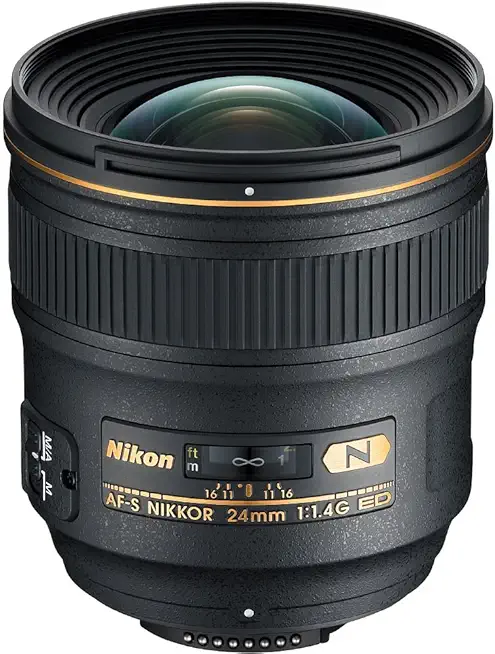
Nikon AF-S FX NIKKOR 24mm f/1.4G ED
Ultra-wide professional prime built for dramatic landscapes and night skies, offering superb sharpness, minimal distortion, and reliable low-light performance.
Check PriceThe Nikon AF‑S NIKKOR 24mm f/1.4G ED is a professional wide‑angle prime built for FX full‑frame DSLRs, and its ultra‑fast f/1.4 aperture is the headline feature for low‑light work. That wide aperture lets you shoot with lower ISO and faster shutter speeds, which is invaluable for night landscapes, cityscapes, and environmental portraits.
Optically it’s impressive — incredibly sharp even wide‑open at f/1.4, with almost no coma or distortion reported. Nikon’s Nano Crystal Coat helps reduce flare and chromatic aberrations, so streetlights and highlights stay clean rather than smeared into ugly ghosts.
In the field the lens delivers beautiful out‑of‑focus rendering thanks to a 9‑bladed iris, giving smooth bokeh for subject isolation in dim scenes. It’s also weather‑sealed and built like a pro lens, so you can keep shooting in damp, gritty urban nights without worrying about the barrel taking a hit.
Do note the trade‑offs: some users find the autofocus is moderate in speed and requires careful focusing in low light, so if you need lightning‑fast AF on a DSLR you might feel the difference versus newer models. The lens is also heavier and bulkier than smaller primes, so it’s a commitment to carry for long walking shoots.
Overall, if you’re a serious DSLR shooter who prioritizes image quality and low‑light capability in a wide field of view, this 24mm f/1.4G is a compelling tool. It rewards deliberate technique and gives stunning results when you nail the focus.
- Outstanding sharpness and contrast wide-open
- Beautiful, smooth bokeh from 9‑bladed iris
- Nano Crystal Coat minimizes flare/ghosting
- Weather-sealed, sturdy professional build
- Autofocus can be slower and less consistent in low light versus newer models
- Heavier and bulkier than smaller primes
3. Nikon Z 35mm f/1.2 S Mirrorless

Nikon NIKKOR Z 35mm f/1.2 S
Luxury fast prime for stunning subject isolation, creamy bokeh, and unmatched low-light capability with professional-grade resolution and color rendition.
Check PriceThe Nikon Z 35mm f/1.2 S is an ultra-fast mirrorless prime built for the Z system, and it shows up in the field like a purpose-built tool. With an f/1.2 maximum aperture it gathers incredible light, letting you shoot at lower ISOs and get shutter speeds you simply can’t achieve with slower lenses.
Optically it’s sophisticated: 17 elements in 15 groups and an 11‑blade diaphragm give you smooth, pleasing bokeh and excellent control over out‑of‑focus rendering. That construction, combined with the wide aperture, produces images with rich character and vibrant colors straight out of the camera.
Autofocus is a real strength — users consistently report fast, reliable AF even in challenging low light, so you spend less time hunting and more time composing. The lens is robustly weather‑sealed and feels like a professional workhorse, which makes it ideal for portraits and events where conditions and pace can change quickly.
There are tradeoffs: it’s heavier and bulkier than other 35mm primes, so it’s not the lightest lens to carry all day. If you prioritize absolute low‑light performance, shallow DOF, and rock‑solid AF for professional portrait or event work, this lens is hard to beat; if you need a compact travel solution, consider the weight and footprint first.
- f/1.2 — exceptional light gathering & bokeh
- Fast, reliable autofocus in low light
- Excellent weather resistance for outdoor use
- Produces rich character and vibrant colors
- Considerably heavier and bulkier
- Less suited to casual or travel use
4. Nikon Z 50mm f/1.4 S Mirrorless

Nikon NIKKOR Z 50mm f/1.4
Classic standard prime delivering natural perspective, beautiful background blur, fast autofocus, and rich contrast for portraits and everyday photography.
Check PriceThe Nikon Z 50mm f/1.4 S is one of those lenses I reach for when I need reliable low‑light performance without lugging around a heavy rig. Its bright f/1.4 aperture and 9‑blade iris give you exceptional subject separation and creamy bokeh while still delivering sharp images even wide open.
Autofocus is fast and whisper‑quiet, which makes it ideal for weddings and events where discretion matters. At roughly 420 g and with weather sealing, it’s comfortable to use all day and tough enough for outdoor shoots.
In practice the lens shines for portraits and event work: the rendering isolates subjects beautifully and the quick focusing locks on in dim venues. Its relatively light construction also reduces fatigue during long assignments, so you can shoot handheld longer without compromise.
Do keep in mind the 50mm field of view is narrower than wider primes, so you may need to step back in tight spaces to get the framing you want. It’s slightly less multipurpose than a 35mm, but if your primary work is portraits, weddings, or events on a Nikon Z body, this lens is very hard to beat.
If you value sharpness, creamy bokeh, quiet AF, and a lens you can carry all day, the Z 50mm f/1.4 S is an excellent choice that balances image quality and practicality for low‑light shooting.
- Fast, quiet AF suitable for low light and events
- Creamy, smooth bokeh for subject isolation
- Lightweight and weather-sealed for outdoor/long sessions
- Sharp even wide-open at f/1.4
- Narrower field of view may require stepping back in tight spaces
- Slightly less multipurpose than wider primes
5. Nikon 20mm f/1.8G ED DSLR

Nikon AF-S FX NIKKOR 20mm f/1.8G ED
Extremely wide-angle optic ideal for expansive landscapes, architecture, and interiors, offering remarkable edge-to-edge sharpness and controlled aberration in low light.
Check PriceThe Nikon 20mm f/1.8G ED is a gem for night and astrophotography on DSLRs — its bright f/1.8 aperture gives you almost a full stop advantage over typical f/2.8 zooms, letting you use faster shutter speeds or lower ISO for cleaner stars. In practice the lens delivers a very sharp center and low flare, so star cores and nightscape highlights render cleanly even with moonlight present.
It’s also pleasantly lightweight at roughly ~357 g, which makes handheld night shooting and travel much easier than heftier wide-angle glass. That portability, combined with decent ISO efficiency, reduces camera shake and noise when you need mobility instead of a tripod.
Be aware of the trade-offs: at its maximum f/1.8 the lens can show some corner coma and softness, which astrophotographers often mitigate by stopping down — many users report improved corner sharpness around f/2.2 for landscape and edge-to-edge star work. If you need perfectly pin-sharp corners wide-open, you’ll have to either stop down or accept a touch of coma in the corners.
For anyone shooting night-sky panoramas, Milky Way work, or wide environmental nightscapes on a DSLR, this 20mm is an excellent, practical choice — especially when you value center sharpness, low flare, and a light kit. It’s less flexible if you want multiple focal lengths in one lens, but for pure wide-field low-light work it’s hard to beat for the price and weight.
- Bright f/1.8 — nearly one stop over f/2.8
- Very sharp center for stars and nightscapes
- Lightweight (~357 g) — great for handheld
- Minimal flare even with moonlight
- Corner coma/softness at f/1.8 — often needs f/2.2
- Fixed wide focal length limits framing
Low-Light Performance
Aperture is the single biggest factor when you’re working in dim light. A lens that opens to f/1.4 or f/1.8 lets you use faster shutter speeds and lower ISO, which keeps images cleaner and motion under control.
Primes and zooms approach low‑light work differently. Primes tend to be lighter and sharper when shot wide open, while fast zooms trade outright speed and weight for framing flexibility; Nikon makes both, from 50mm f/1.4 and 20mm f/1.8 primes to 24–70mm f/2.8 zooms that perform well after dusk.
Keep in mind that “wide open” image quality varies by design. The 20mm f/1.8, for example, delivers strong center sharpness and low flare at its maximum aperture, but some lenses will show aberrations like corner coma; stopping down a stop or two often tames these issues.
For practical shooting, I usually reach for a fast prime on handheld jobs—50mm f/1.4 or 20mm f/1.8 are perfect for events, travel and quick night street work. Their compact size reduces camera shake and keeps you mobile compared with heavier, faster‑aperture zooms.
If you need dramatic subject isolation or the absolute lowest light capability, specialty optics such as the 58mm f/0.95 Noct are unmatched. For more versatility at events, a stabilized 24–70mm f/2.8 gives you coverage and reliability, even if it’s not as light‑gathering as an f/1.4 prime.
Ultimately choose what matters most for your shooting style: raw light‑gathering power, edge‑to‑edge sharpness, or the freedom to reframe quickly. Balancing those trade‑offs is the practical side of low‑light work and will guide you to the right Nikon lens for the job.
Before you commit, try the lens wide open in the situations you shoot most. Seeing how it renders bokeh, coma and flare will tell you whether to embrace wide‑open performance or plan to stop down a touch.
Autofocus and Vibration Reduction
Autofocus and Vibration Reduction can make or break a low‑light shoot. Choosing a lens with a strong AF system and useful VR changes the kind of shots you can confidently take after sunset.
Modern Nikon lenses with AF‑S (Silent Wave Motor) or AF‑P (stepping motor) keep focusing reliable when light gets scarce. Still, AF speed and accuracy fall off as light drops, and long glass is often the hardest to lock on.
That’s why I reach for wide‑aperture primes for critical low‑light work. The extra light through an f/1.4 or f/1.8 lens helps the AF system find contrast, and the shallow depth of field makes subject separation easier when it matters most.
When AF does struggle, practical tricks help: switch to a single point or a small AF zone, use back‑button focus for control, and on Z bodies rely on focus peaking or magnified view for tricky manual pulls. These small changes often convert a frustrating session into keepers.
Vibration Reduction is equally important for handheld night work. Nikon’s VR uses gyroscopic sensors and voice‑coil motors to shift elements and counteract pitch and yaw, often buying you up to roughly four stops of stabilization.
Newer combinations that use Synchro VR — syncing lens and in‑body stabilization — can be a game changer for longer lenses and for video. That extra stability is especially useful when you can’t or don’t want to raise ISO.
Use VR when shooting handheld at speeds slower than the reciprocal of the focal length (for example, ~1/50s for 50mm) and half‑press the shutter to let it settle before the exposure. Turn VR off on a steady tripod to avoid the system hunting; many lenses also include a Tripod Mode or Active setting for tricky situations.
Remember: VR only combats camera shake, not subject motion. My rule of thumb is to prioritize a fast aperture and a quiet, accurate AF motor for low light, and add VR when you need slower shutter speeds handheld — together they widen what’s possible after dark.
What People Ask Most
What are the best Nikon lenses for low light photography?
The best choices are lenses with wide maximum apertures, strong autofocus, and good coatings for contrast. Pick a lens that matches your shooting style, whether that’s portraits, landscapes, or events, to get the best real‑world results.
Which Nikon lenses have the largest apertures for low light?
Nikon’s ultra‑fast prime lenses and specialty Noct models offer the largest apertures designed for extreme low‑light work. These lenses prioritize light gathering and subject separation for challenging dim environments.
Are prime lenses better than zoom lenses for low light on Nikon cameras?
Primes often offer wider apertures and lighter weights, which helps in low light and can improve image quality at wide openings. Zooms trade some maximum aperture for flexibility, so the better option depends on whether you need speed or versatility.
What is the best Nikon lens for low light portrait photography?
A fast standard or short telephoto prime with reliable autofocus and pleasing bokeh is typically the best choice for portraits in low light. Select a focal length and handling that suit your shooting distance and style for natural subject isolation.
Which Nikon lens is best for low light indoor photography?
Fast primes and stabilized zooms are both strong options indoors; prioritize a lens with a wide aperture and dependable AF for quick focusing. If you shoot handheld in very dim rooms, consider lenses with vibration reduction for steadier results.
Do Nikon lenses with Vibration Reduction help in low light?
Yes, Vibration Reduction helps compensate for camera shake and lets you use slower shutter speeds when shooting handheld in low light. It does not stop subject motion, so you still need appropriate shutter speeds for moving subjects.
Which Nikon full-frame lenses perform best in low-light situations?
Full‑frame lenses with wide apertures, effective coatings, and fast autofocus tend to perform best in low light. Match the lens character to your subject—wide primes for nightscapes, standard primes for portraits, and stabilized zooms for versatile event work.
Conclusion For Nikon Low-Light Lenses
This roundup aimed to clarify how aperture, image quality, autofocus, and stabilization combine to shape real-world low‑light results so you can choose gear that fits your shooting style.
Rather than chasing a single “best” lens, match the type of optic to the scenario—fast portrait primes for subject work, wide-angle primes for nightscapes and astro, and fast primes or stabilized zooms for versatile low‑light assignments.
Keep the selection criteria front and center: prioritize maximum aperture for light gathering, reliable AF for lock‑on in dim scenes, and VR when you need steadier handheld exposures.
If you want to build your low‑light skills further, read more articles on the site to compare techniques, settings, and gear trade‑offs that suit your camera and shooting habits.
Got questions or a setup to share? Leave a comment below — we usually reply within a few hours and enjoy helping photographers refine their low‑light approach.




0 Comments