

Want to know if the Autel EVO Lite 6K Drone is right for your shoots?
If you’re a hybrid creator who cares about both stills and video, this one’s aimed at you.
Having flown plenty of drones, I took the EVO Lite 6K into real shoots to see how its 1-inch 50MP sensor, 6K video, adjustable aperture, and long endurance perform.
It’s bigger than ultra-portable models and has partial obstacle sensing, so you’ll trade compactness for camera control and flight time.
I’ll walk through real-world image quality, flight behavior, safety quirks, and how it stacks up against rivals — make sure to read the entire review as I dig into what actually matters, keep reading.
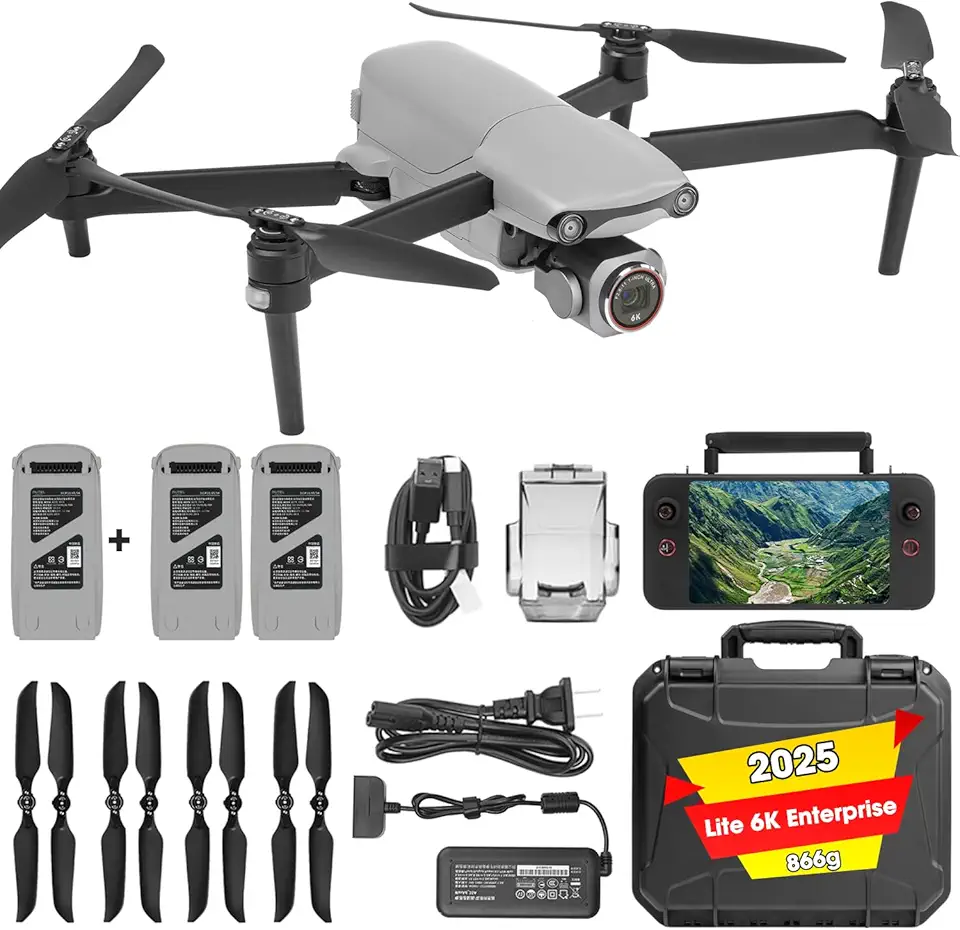
Autel EVO Lite 6K Drone
Capture cinematic 6K footage with a lightweight, travel-ready quadcopter that excels in low light. Smooth gimbal stabilization, smart shooting modes, and reliable obstacle sensing deliver pro-grade aerial content.
Check PriceThe Numbers You Need
| Spec | Value |
|---|---|
| Sensor | 1-inch CMOS |
| Photo resolution | 50 MP |
| Video resolution | 6K at 30 fps |
| Max aperture | f/2.8 (adjustable) |
| Flight time | Up to 40 minutes |
| Max flight distance | ~12 km |
| Max speed | 19 m/s |
| Gimbal | 3-axis mechanical stabilization |
| Weight | Approximately 820 g |
| Max takeoff altitude | 4500 m |
| Obstacle avoidance | Forward, backward, downward sensors |
| Storage | microSD card support |
| ISO range (photo) | 100–3200 |
| Max video bit rate | 120 Mbps |
| Remote controller compatibility | Included controller with HDMI output |
How It’s Built
In my testing the Autel EVO Lite 6K Drone felt like a solid step up from smaller travel models. It’s noticeably heavier than tiny foldables, so packing it means a bit more thought for carry-on and hike days. For beginners that means better camera gear at the cost of a chunkier bag.
The 3‑axis gimbal is tucked right into the body and comes with a handy protector that stayed put during transport. I liked how steady the camera felt out of the box — gimbal play was minimal and footage stayed level during normal moves. What could be better is that the body weight makes one‑handed handling less comfy on long shoots.
The included controller is a real workflow win with HDMI out for clean monitoring on external displays. For storage I stuck with V60 or UHS‑II microSD cards and at least a moderate size for longer sessions; that combo kept files flowing without hiccups. New users will appreciate seeing framing on a bigger screen when composing shots.
Buttons and sticks have a familiar, photographer‑friendly layout and felt clicky and precise in my hands. Battery swaps are simple and safe to do in the field, which makes multiple sorties easy. The finish feels durable overall, though some doors and ports are a bit snug and take an extra second to open.
In Your Hands
Out in the field the EVO Lite 6K feels built for longer days: battery life lets you plan multiple sorties without constant panic over power, so I routinely broke my shoots into purposeful legs and swapped cells with minimal fuss. That endurance changes how you scout and sequence shots—more time to wait for light, less hurry between setups.
The link proved robust in open areas, with reliable control as long as I kept a clear sightline and avoided dense interference. Top-end responsiveness makes it easy to reposition for a passing subject, though it’s better suited to deliberate chases than frantic high-speed pursuits; in mountain air it still climbs and holds its line when you need it most.
The three-axis gimbal is a quietly impressive stabilizer: horizons stay level through pans and orbits, and micro-vibrations are well damped so footage is ready for grading without heavy stabilization. Rapid direction changes remain smooth, delivering consistent frames for both video plates and stitched panoramas.
Shooting stills is satisfying—the larger sensor and high-resolution files give you room to crop and push tone, while the adjustable aperture lets you control depth and exposure more like a mirrorless camera. Low-light work will need measured ISO discipline, and expect big files that benefit from fast cards and using the controller’s monitoring output to nail focus and framing on the fly.
Startup, satellite lock, and return-to-home behaved predictably during my tests, and the overall workflow—controller ergonomics, battery swaps, and media handling—felt mature and photographer-friendly. For hybrid shooters who value image control and dependable flights, it’s a platform that performs reliably in real-world conditions.
The Good and Bad
- 1-inch CMOS sensor for stills and video
- 50 MP photo resolution
- Adjustable aperture with f/2.8 maximum
- Up to 40 minutes flight time
- Heavier body: approximately 820 g, less compact for travel
- Obstacle sensing not omnidirectional (no side or upward sensors)
Ideal Buyer
If you’re a photographer who prizes high-res stills and flexible exposure control, this is for you. The 1-inch sensor and 50MP files deliver detail and cropping headroom. Hybrid creators who want 6K/30p video with an adjustable aperture will appreciate the image control.
Field shooters and content teams who plan long missions will like the up-to-40-minute endurance and roughly 12 km link, which reduce battery swaps and staging time. It’s a great fit for landscape, real-estate, and travel shoots where time in the air matters. Expect fewer interruptions on multi-location days.
Serious pilots who fly with eyes on the drone and accept partial obstacle sensing will get the most from this platform. Avoid crowded, confined, or forested environments where side and upward sensors would be critical.
If you run a monitored workflow the included HDMI-capable controller is a real productivity win. Be ready to carry a slightly heavier airframe in exchange for camera capability and flight time. The Autel EVO Lite 6K Drone sits between lightweight pocket flyers and full pro flagships — perfect for creators who prioritize image quality over ultimate portability.
Better Alternatives?
We’ve gone over the Autel EVO Lite Plus in detail — its strong 1‑inch camera, 6K capture, adjustable aperture, and long flight times. That package makes it a great hybrid shooter, but it isn’t the only way to get great aerial photos and video.
If you want something smaller, or want different image qualities, or need longer sensing coverage, there are solid alternatives. Below I’ll point out three drones I’ve used in real shoots, what they do better or worse than the EVO Lite 6K Drone, and who would prefer each one.
Alternative 1:

DJI Air 2S Drone
A compact powerhouse featuring a 1-inch sensor for stunning 5.4K detail and rich dynamic range. Fast autofocus, intelligent flight modes, and robust transmission mean confident, cinematic storytelling from above.
Check PriceI’ve used the Air 2S on travel shoots where packing light mattered, and the thing that stands out compared to the EVO Lite 6K Drone is how much more pocketable it is. In the field it’s easier to carry, gets in the air fast, and still delivers clean daytime images thanks to its 1‑inch sensor. If you value quick setup and portability for run‑and‑gun work, the Air 2S is nicer to live with.
Where it loses to the EVO Lite 6K Drone is in exposure control and sheer resolution. The Air 2S has a fixed aperture, so you don’t get the same depth‑of‑field and exposure control the EVO’s adjustable aperture gives you in changing light. For low‑light or when you want the shallow look, I’ve preferred the EVO on several dusk shoots. Also, when you need the highest still resolution for big prints, the EVO’s shots felt more detailed.
Buyers who will like the Air 2S are photographers who travel a lot, want reliable DJI flight software and tracking, and need a small, fast rig that still makes great daytime photos. If you rarely work in difficult low light and prefer smoother, more polished automated flight modes, this one is a solid choice.
Alternative 2:

DJI Mavic 3 Classic Drone
Professional-grade imaging with a large four-thirds sensor and refined color science for ultra-detailed stills and smooth 5K video. Long endurance flights, omnidirectional sensing, and precision controls empower creators.
Check PriceOn professional shoots where image latitude and low‑light headroom mattered, I reached for the Mavic 3 Classic. Its larger sensor really shows in shadows and highlights — you get more room to pull detail in post and cleaner night shots than with the EVO Lite 6K Drone. The omnidirectional sensing also makes complex aerial moves less nerve‑wracking when flying near buildings or trees.
The tradeoffs are practical: the Mavic 3 Classic is bigger, heavier, and pricier. It’s less convenient for quick travel runs and you’ll feel the weight difference when hiking to a remote ridge. In day‑to‑day shooting the EVO is easier to carry and still produces excellent images, but if ultimate image quality and worry‑free obstacle sensing are your top priorities, the Mavic 3 Classic outperforms the EVO.
Choose the Mavic 3 Classic if you’re a pro or serious enthusiast who needs the best dynamic range, cleaner low‑light performance, and longer, safer flights. If you’re doing commercial work where image latitude and reliability matter more than packing light, this is the one I’d pick.
Alternative 3:

DJI Air 3S Drone
Versatile dual-camera system combines wide and tele perspectives for flexible framing, impressive dynamic range, and cinematic motion. Portable, fast to deploy, with intelligent tracking and extended flight performance for creators.
Check PriceThe Air 3S (with its dual‑camera setup) was my go‑to when I needed framing flexibility without swapping lenses or moving the drone a lot. The wide and tele options mean you can change composition on the fly and get closer-looking shots without physically closing distance. Compared to the EVO Lite 6K Drone, the Air 3S makes it easier to vary framing during a single flight, which is great for short client edits or social content.
Where it doesn’t beat the EVO is in single‑sensor control — you lose the EVO’s adjustable aperture and its particular look for shallow depth and low‑light handling. In my tests at dusk the EVO’s aperture control gave me cleaner highlights and nicer background separation. Also, if you care most about the absolute best still resolution from one sensor, the EVO’s 50MP advantage shows up in large crops.
The Air 3S is for creators who want one drone that covers multiple focal lengths in one flight and who value quick framing options and fast delivery. If you shoot a lot of event or real‑time social footage where flexibility and speed matter more than the last bit of low‑light finesse, you’ll appreciate the Air 3S approach.
What People Ask Most
Is the Autel Evo Lite+ worth buying?
Yes — it’s a strong buy if you want excellent image quality, long flight time and a user-friendly drone at a competitive price.
How good is the camera on the Autel Evo Lite+?
The camera is excellent for aerial photos and video, with a large sensor and adjustable aperture that give strong dynamic range and low-light performance.
What is the battery life of the Autel Evo Lite+?
Advertised flight time is up to about 40 minutes, with typical real-world flights usually around 25–35 minutes depending on wind and maneuvering.
Does the Autel Evo Lite+ have obstacle avoidance and how well does it work?
Yes — it has multi-directional obstacle sensors that work well in most scenarios, though thin branches, glass and low-contrast objects can still be problematic.
What are the differences between the Autel Evo Lite and the Autel Evo Lite+?
The Lite+ focuses on an upgraded camera (larger sensor and variable aperture) and better low-light/dynamic range, while flight hardware and battery specs are largely similar.
How does the Autel Evo Lite+ compare to the DJI Air 2S?
Image quality is comparable; the Evo Lite+ often wins in low light and flight time, while the Air 2S benefits from DJI’s more polished software, obstacle avoidance and ecosystem.
Conclusion
The Autel EVO Lite 6K Drone is a camera-first machine. Its large 1-inch sensor and high-resolution stills paired with 6K capture and adjustable aperture give photographers meaningful control over exposure and depth of field. The result is consistently punchy, usable imagery that favors hybrid shooters.
Flight behavior leans toward endurance and practical range rather than ultra-portable convenience. A solid three-axis gimbal and an HDMI-equipped controller make monitoring and framing in the field straightforward. For location shoots that demand longer airtime and reliable stabilization, it earns its keep.
The trade-offs are clear and unavoidable. The airframe is heavier than ultra-light alternatives and obstacle sensing is limited to forward/back/down, so cautious piloting is required in tight environments. High-frame-rate slow motion and extreme low-light capture are not this drone’s strengths.
Bottom line: if you’re a photographer or hybrid creator who values image quality, aperture control and longer sorties without stepping up to a flagship pro platform, this is a compelling middle ground. If you prize absolute portability, omnidirectional collision avoidance, or the ultimate low‑light latitude, look elsewhere. For many shooters the Autel EVO Lite 6K Drone represents a balanced, well-priced step up in capability.
Autel EVO Lite 6K Drone
Capture cinematic 6K footage with a lightweight, travel-ready quadcopter that excels in low light. Smooth gimbal stabilization, smart shooting modes, and reliable obstacle sensing deliver pro-grade aerial content.
Check Price

0 Comments