
Which 50mm Nikon lens gives the sharpest portraits, the creamiest bokeh, and the best value?
That modest focal length is a cornerstone for portraits, street photography, and everyday shooting. But choosing between mirrorless Z options and classic F-mount favorites can feel overwhelming.
This guide pares the choice down to five standout 50mm primes across both Z and F mounts. We compare real-world handling, optical character, and the practical trade-offs photographers actually notice.
Expect clear, usable conclusions — not just lab numbers. You’ll get concise notes on sharpness, bokeh, focus behavior, and build quality.
We explain when autofocus wins and when manual focus adds intentional control. That context helps you pick a lens that matches your shooting style, not a spec sheet.
Whether you want a lightweight walkaround optic, a low-light performer, or a true macro, this guide narrows the field. We weigh mount compatibility, aperture range, and handling so you buy for your camera and needs.
Practical examples show how each choice affects portraits, street work, and close-up shooting. The writing balances technical takeaways with hands-on impressions from working photographers.
You’ll read candid notes about autofocus quirks, handling feel, and the optical character that separates good from great. There’s also a short FAQ to settle common buy-or-wait questions.
If you’re hunting the best 50mm lenses for Nikon, this guide saves you time and guesswork. Turn the page to meet five distinct 50mm personalities and learn which one fits your kit.
Your next signature image might start with one of them.
1. Nikon NIKKOR Z 50mm f/1.8 S

Nikon NIKKOR Z 50mm f/1.8 S
Premium sharpness and creamy bokeh for portraits and low-light; advanced optics deliver edge-to-edge clarity and fast, reliable focusing.
Check PriceThe Nikon NIKKOR Z 50mm f/1.8 S is a native full-frame Z‑mount prime that delivers what many photographers want most: crisp, reliable image quality straight out of camera. Its reputation for exceptional sharpness even at f/1.8 means you rarely need to stop down to get tack‑sharp results, which is a real advantage for portraits and street work.
Optically the lens is impressive: 12 elements including two ED and two aspherical elements, with Nano Crystal and Super Integrated coatings. That construction yields excellent corner‑to‑corner sharpness, very low chromatic aberration, and almost no distortion — useful when you need clean, accurate files for editing.
Autofocus is fast and nearly silent, making the lens comfortable for both stills and video. Reduced focus breathing and a smooth, tactile manual‑focus ring that remains precise even when AF is enabled make it a solid choice for hybrid shooters who switch between AF and MF on the fly.
Handling feels modern and premium, and the rendering is neutral and clean, which makes the lens versatile for portraits, street photography, and general‑purpose use. You get the sharpness and control you expect from Nikon’s S‑line, with coatings and build that resist flare and boost contrast.
If you want an optically near‑perfect 50mm for a Z‑body and you value AF performance and video friendliness, this lens is a smart buy. Be aware, though, that it’s larger and heavier than the classic F‑mount “nifty fifty” and costs more than basic budget options.
- Outstanding sharpness across the frame
- Fast, quiet, accurate autofocus
- Very low CA and distortion
- Premium coatings and solid build
- Larger/heavier than classic F‑mount 50mm
- Price higher than basic “nifty fifty” options
2. Nikon AF-S 50mm f/1.8G
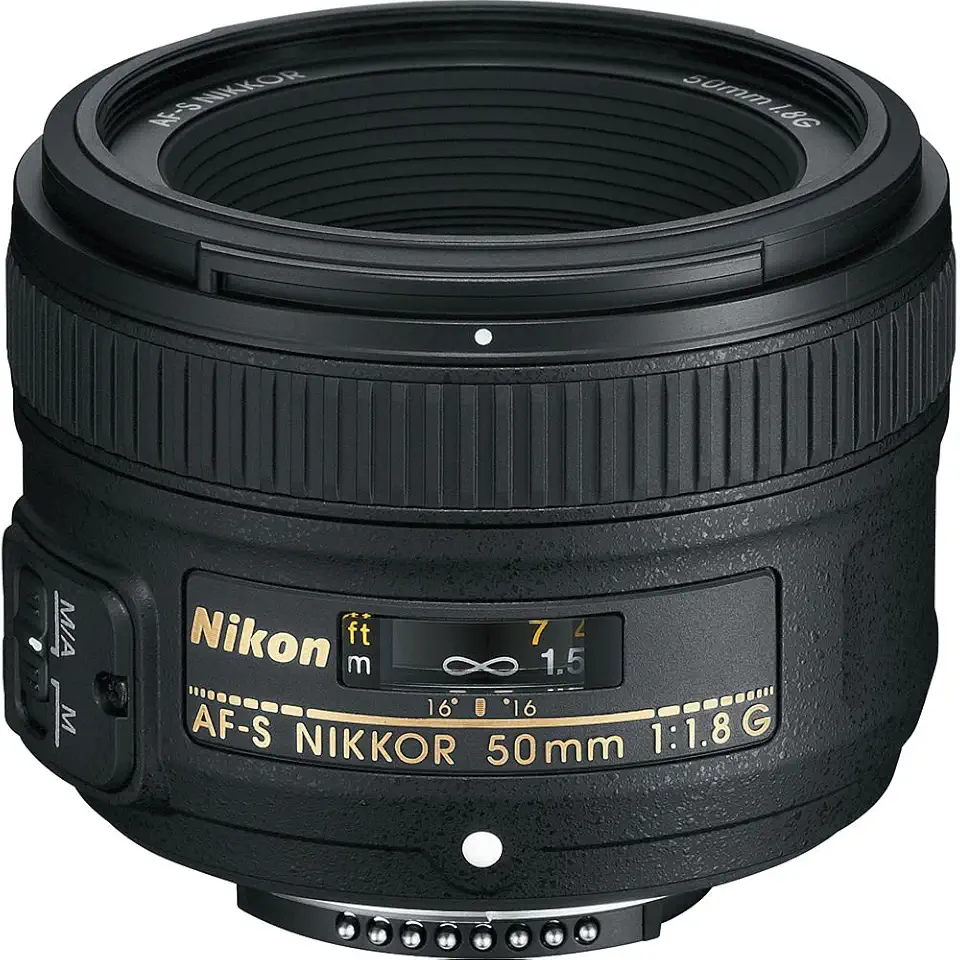
Nikon AF-S FX NIKKOR 50mm f/1.8G
Lightweight, versatile prime offering sharp detail, natural color and smooth background separation—ideal everyday lens for enthusiasts and beginners.
Check PriceThe Nikon AF-S 50mm f/1.8G is a popular, budget-friendly 50mm prime designed for Nikon DSLRs. As a working photographer I often reach for it when I need a reliable normal prime that won’t weigh me down.
Optically it punches above its price class — you get strong image quality and pleasing bokeh that works very well for portraits and everyday shooting. Expect slight softness wide open at f/1.8, but the lens sharpens noticeably when stopped down slightly.
Autofocus is one of its real strengths: a fast, quiet AF system with an internal focusing motor means it will autofocus on most Nikon DSLRs, even bodies that lack an internal drive motor. That makes it a great match for entry-level and mid-range Nikon users who want working AF without buying a pricier lens.
Handling is straightforward: the lens is compact and lightweight, which makes it easy to carry for travel, street work, and long shoots. Users consistently report solid optics and good contrast for the price, so it’s a dependable everyday tool when you want a classic 50mm perspective without breaking the bank.
If you want maximum subject separation or the silkiest bokeh possible, there are more expensive options — this lens sacrifices a little creaminess in the out-of-focus areas compared to premium 50mm primes. Still, for most shooters—beginners and enthusiasts alike—it’s one of the best value choices for an F-mount 50mm.
- Compact and lightweight
- Sharp and contrasty for a budget lens
- Fast, quiet AF (internal motor)
- Broad DSLR compatibility
- Bokeh less creamy than pricier lenses
- Slight softness wide open at f/1.8
3. Nikon Z MC 50mm f/2.8 Macro

Nikon NIKKOR Z MC 50mm f/2.8
True macro capability with close-focusing, impressive micro-contrast and stunning detail reproduction for capturing tiny subjects.
Check PriceThe Nikon Z MC 50mm f/2.8 Macro is a true 1:1 macro that doubles as a normal 50mm prime, which makes it one of the most versatile lenses you can add to a Z‑mount kit. Its ability to reproduce subjects at life size while still functioning well at normal shooting distances means you can switch between product shots and everyday work without swapping glass.
Optically the lens is built for detail: it delivers sharp optics with excellent resolution both at close distances and when used as a standard prime. That consistent sharpness makes it ideal for product, food, and small-subject photography where micro-detail really matters.
Physically it’s smaller and lighter than many longer macro lenses, which suits mirrorless setups nicely and keeps handheld shooting practical. The compact size also helps when you need to move quickly between tabletop setups or when working in tight spaces.
There are tradeoffs: the maximum aperture is f/2.8, so low‑light performance and extreme background separation are limited compared with faster primes. Also note the working distance at 1:1 is approximately ~20 cm, which can be tight for skittish subjects or when you need more breathing room from your light or camera.
In short, if you want a dual-purpose lens that excels at close-up detail without committing to a long, heavy macro, the Z MC 50mm f/2.8 is a practical and capable choice. It’s especially suited to product and food shooters, tabletop work, and anyone who values compactness and true 1:1 reproduction.
- True 1:1 macro + standard prime versatility
- Sharp with excellent detail
- Compact and lightweight
- Great for product/close-up photography
- Slower f/2.8 limits low-light use
- Short working distance at 1:1 (~20 cm)
4. Nikon AF 50mm f/1.4D

Nikon AF FX NIKKOR 50mm f/1.4D
Classic fast-aperture lens delivering dreamy bokeh, rich tonality and excellent performance in low-light and creative depth-of-field control.
Check PriceThe Nikon AF 50mm f/1.4D is a classic F‑mount 50mm prime built around a bright f/1.4 aperture and a characterful optical rendering. As a working photographer I appreciate how that wide aperture opens up creative choices in low light and gives images a distinct, vintage warmth.
Wide open it produces very shallow depth of field and smooth, creamy bokeh that flatters faces and isolates subjects beautifully, which is why many portrait shooters favor it. The rendering has a pleasing transition from sharp subject to soft background that helps produce images with strong subject separation.
Autofocus on the 50mm f/1.4D is fast, but it uses an older motor design that is noisier and less refined than modern AF‑S systems; on bodies without an internal focus motor you’ll need to focus manually. If your DSLR has the internal motor, AF performance is perfectly usable for most portraits and everyday work, but expect audible operation.
The tradeoffs are mostly optical: the older design can show softer corners and a touch of chromatic aberration compared with newer lenses. If you prioritize character, low‑light performance and subject isolation over clinical corner‑to‑corner sharpness, this lens is a great, practical choice that still delivers beautiful results in the field.
- Wide f/1.4 aperture
- Smooth, pleasing bokeh
- Very shallow depth of field
- Fast AF on compatible bodies
- Softer edges/corners than newer designs
- Louder, less precise AF than modern silent motors
5. VILTROX 50mm f/2.0

VILTROX AF 50mm f/2 Z
Affordable, compact autofocus prime providing sharp images, smooth bokeh and reliable performance for everyday shooting on mirrorless systems.
Check PriceAs a working photographer I appreciate lenses that give me usable results without breaking the bank, and the VILTROX 50mm f/2.0 fits that bill for Nikon Z shooters. It’s a native Z-mount 50mm prime with a bright f/2.0 aperture and a 9-blade diaphragm, which already tells you it’s designed with pleasing out-of-focus rendering in mind.
Handling is one of its strengths — the lens is very light and compact, so it disappears on smaller mirrorless bodies and is great for travel or everyday carry. Autofocus is driven by a fast, quiet STM motor, so it’s unobtrusive for run-and-gun video and polite in quiet shooting situations.
Optically the VILTROX punches above its price. Users report solid image quality for the cost, with generally smooth bokeh thanks to the 9-blade diaphragm, though the rendering isn’t quite as refined as higher-end first-party glass. Expect very usable images for portraits and street work, especially when you’re prioritizing weight and budget.
There are trade-offs to keep in mind. The AF can occasionally hunt in very challenging light or complex scenes, so it’s not the top choice if you need pin-point tracking under low light. Also, optical performance can be a bit less consistent than premium lenses, so if you demand absolute uniformity across every frame you might notice it.
Overall, if you want a light, affordable native Z 50mm with decent optics and video-friendly AF, the VILTROX 50mm f/2.0 is a very practical option. It’s mostly a good lens for travel, portraits, and everyday shooting when you value compactness and price.
- Affordable native Z option
- Fast, quiet STM AF — good for video
- Pleasant f/2 bokeh with 9-blade diaphragm
- Lightweight, compact design
- Optical performance less consistent than premium lenses
- AF can occasionally hunt in low light/complex scenes
How to Choose the Right 50mm Lens
Choosing a 50mm is less about the focal length and more about trade-offs: aperture, mount, and character. Think about how and where you’ll use it most — that decision will narrow everything else.
Aperture determines light and separation. Fast glass — f/1.2 or f/1.4 — gives creamy background separation but can be trickier to nail and sometimes softer wide open. Mid‑range apertures like f/1.8 hit a sweet spot; modern designs like Nikon’s Z 50mm f/1.8 S and the AF‑S 50mm f/1.8G are very sharp wide open.
Match the lens to the job. For portraits I prefer f/1.4 for smoother bokeh and subject isolation; for day‑to‑day the lighter, sharper f/1.8 options are more versatile. If you need true close‑up work the Nikon Z MC 50mm f/2.8 gives 1:1 macro flexibility while still behaving like a normal prime.
Mount compatibility matters. If you shoot on Nikon Z bodies, use native Z glass for the best autofocus performance and handling. Adapting F‑mount lenses to Z is possible, but expect compromises in AF speed and sometimes handling; if you’re on a DSLR stick with F‑mount lenses.
Think about build and feel. Older Ai‑S/manual lenses deliver metal barrels and buttery focus rings; modern G and S‑line lenses are lighter and have faster, quieter autofocus. Weather resistance varies, so if you shoot outdoors a lens with a gasket is worth it.
Decide if you want character or clinical perfection. Classic 50s have personality — flattering skin rendition and dreamier bokeh — while new designs prioritize edge‑to‑edge sharpness and low aberrations. Choose the rendering that matches the mood you’re trying to create.
If you’re unsure, start with a fast but practical f/1.8: it’s affordable, compact, and covers most situations well. Whenever possible try a lens in hand or rent it for a weekend; handling, autofocus behavior, and how a lens renders in your shooting style tell you more than specs.
Autofocus vs Manual Focus Lenses
Deciding between autofocus and manual focus is really choosing how you want to work. Autofocus gets you frames quickly; manual focus invites you to slow down and shape the image.
Autofocus lenses such as the AF-S 50mm f/1.8G or the Z 50mm f/1.8 S are built for that quick, reliable capture — quiet, accurate and great for moving subjects. On Z bodies, native Z glass typically outperforms adapted F lenses (even when using the FTZ adapter) for AF speed and tracking. If you adapt F‑mount lenses, remember AF‑D models need a camera body with an internal focus motor to autofocus, and older AF motors can be noisier or less precise.
AF isn’t flawless: in low contrast or very dim light some systems hunt, and budget third‑party options like the Viltrox Z 50mm f/2 can occasionally struggle in complex scenes. For video, however, modern Z lenses often reduce focus breathing and offer smooth AF useful for run‑and‑gun shooting.
Manual‑focus lenses — classic Ai‑S glass or the older AF 50mm f/1.4D when used manually — give a tactile, mechanical feel that changes how you compose. That physical connection helps when you’re crafting portraits, still life or macro work where precise plane‑of‑focus matters. Just be mindful that some vintage glass may not communicate focal data or metering to modern cameras.
Mirrorless cameras have changed the game: focus peaking and live‑view magnification make MF far more usable than it used to be. Many modern primes combine fast AF with a smooth manual ring so you can switch modes without compromise.
In practice I keep one reliable AF 50mm as my everyday workhorse and a characterful MF lens for portraits and creative projects. Try lenses on your own body before buying and test AF performance in the light you shoot in. That way you get the speed you need and the soul you want.
What People Ask Most
What is the best 50mm lens for Nikon full-frame cameras?
There is no single best lens; it depends on what you prioritize such as sharpness, bokeh, budget, or macro capability. Premium Z options are praised for modern optics and AF, while classic F‑mount and budget models offer character or value.
Which 50mm Nikon lens is best for portraits?
Choose a lens that delivers pleasing bokeh and subject separation. Lenses with wider maximum apertures or classic rendering are often favored for portrait work, while modern designs offer sharpness and reliable autofocus.
How does the Nikon 50mm f/1.4G compare to the 50mm f/1.8G?
The f/1.4 option typically gives stronger subject isolation and creamier rendering, while the f/1.8 model is lighter, more affordable, and performs very well when stopped down. Your choice should balance desired rendering, handling, and budget.
Can a Nikon 50mm lens be used on DX (crop sensor) cameras?
Yes, 50mm lenses can be used on DX bodies and will change the effective field of view compared to full-frame. Most Nikon lenses physically mount or can be adapted, though handling and framing will differ from full-frame use.
What are the best 50mm lenses for Nikon Z mirrorless cameras?
Native Z‑mount 50mm options are generally the best match for Z bodies due to optimized autofocus and handling. You can choose between premium Z primes for top image quality, macro-capable options for close work, or affordable third‑party native alternatives for value.
Which 50mm lens is best for low-light photography on Nikon?
For low-light work, prioritize lenses with wider maximum apertures and reliable autofocus. Faster-aperture lenses let in more light and provide stronger subject separation, but also consider autofocus performance and handling on your camera body.
Is the Nikon AF-S 50mm f/1.8G a good lens for beginners?
Yes, it is often recommended for beginners because it is lightweight, affordable, and versatile for many types of photography. It offers good optical quality and straightforward handling for learning photographic fundamentals.
Conclusion for Best 50mm Lenses for Nikon
We covered five distinct 50mm options across Z and F mounts — from budget and classic character to premium sharpness, macro capability, and a value-packed third‑party choice — giving you clear context on strengths, weaknesses, and real‑world use.
As a final tip, let your shooting style drive the choice: prioritize aperture and bokeh for portraits, a native mount and AF for fast everyday work, or macro ability and tactile manual focus for close‑up and creative projects.
If you want to deepen your technique and gear knowledge, explore more articles on the site to learn how different lenses affect composition, exposure, and storytelling.
Have questions or a lens experience to share? Leave a comment below — we usually reply within a few hours and love helping readers find the right 50mm for their needs.



0 Comments