
Ever shot a flawless scene only to have the audio ruin the entire take? Sound often decides whether audiences stay in the story or reach for the mute button. Finding the best audio recorder for filmmaking means balancing clarity, portability, and on-set resilience.
This guide reviews five standout field recorders selected through real-world user feedback, hands-on testing, and expert analysis. We prioritized devices that perform under pressure, not just on paper. Expect recommendations across budgets and workflows, from run-and-gun to multi-mic shoots.
We break down each unit’s ease-of-use, noise-control features, and on-set reliability. You’ll read about learning curves, mounting options, and the safety features that stop a take from being lost to distortion. All evaluations are grounded in practical field use, not spec sheets alone.
Whether you’re a solo shooter chasing crisp dialogue or a mixer managing multiple mics, this guide helps you choose smarter. We focus on what actually matters on set: clear captures, minimal fuss, and dependable backups. By the end, you’ll know which features earn their keep for your style of filmmaking.
Read on for pragmatic takes and field‑proven recommendations that respect both budget and craft. These are hands-on conclusions, drawn from user experience and expert ears. Let’s make sure your next shot sounds as good as it looks.
1. Zoom H8 Audio Recorder

Zoom H8 Multitrack Recorder
Record up to eight tracks simultaneously with modular capsules, touchscreen control, and pro-grade preamps for field, studio, and podcast workflows.
Check PriceAs a photographer who often steps into filmmaker roles, I appreciate the Zoom H8 for its professional-grade versatility when capturing location sound. It offers four XLR inputs plus two XLR/TRS combo jacks, which means you can run multiple lavs, a boom, and an ambient pair without juggling adapters or extra boxes.
The 2.4-inch color LCD is surprisingly helpful on set — it gives clear visual feedback and allows independent input monitoring and adjustment so you can trim levels quickly between takes. There are multiple built‑in apps for field recording, podcasting, and music, so the unit adapts to different workflows once you learn the app layout.
In real-world use the H8 stands out for its on-location flexibility; it handles different mic types simultaneously and feels rugged enough for regular field duty. I also like that it supports SD cards up to 512GB and records in WAV/MP3, so you won’t run out of storage on long shoots and your file workflow stays straightforward.
Be honest: it’s feature-rich, and that brings a learning curve — expect to spend a bit of time getting fluent with the apps and menus. It’s also slightly bulkier compared with ultra-compact recorders, so if minimal weight is your top priority this might not be ideal.
Overall, if you need a mid-level recorder that bridges run-and-gun and multi-input setups, the Zoom H8 is a strong, practical choice that delivers reliable, pro-standard recordings once you invest a little time learning it.
- Four XLR + two XLR/TRS jacks
- 2.4-inch color LCD for input control
- Supports SD up to 512GB; records WAV/MP3
- Pro-level, reliable recording quality
- Feature-rich interface has a learning curve
- Slightly bulkier size and weight
2. Zoom H1n Audio Recorder

Zoom H1n-VP Digital Recorder
Compact stereo handheld captures clear WAV/MP3 audio with easy one-touch recording, low-noise preamps, and built-in microphones for interviews and live demos.
Check PriceI’ve used the Zoom H1n on quick shoots and run-and-gun days when lugging a bag of gear simply isn’t an option. It’s a budget-friendly, ultra-portable recorder with built-in stereo condenser microphones that deliver surprisingly clean, distortion-free speech and ambient captures for its size.
It records both WAV and MP3, so you can choose lossy files for quick turnarounds or WAV for higher-quality editing later. Mounting is flexible—you can hold it, put it on a tripod, or camera-mount it (note: the shoe mount is sold separately), which makes it great for documentary-style work or on-camera interviews.
For a photographer or filmmaker who needs a lightweight backup recorder or a primary device for ENG, the H1n is ideal. Its simple operation means you can hand it to a PA or talent with minimal instruction, and the battery life is solid enough to cover extended field sessions without constant swapping.
Be realistic about limitations: it only has onboard mics and no XLR inputs, so if you plan to use professional lavaliers or shotguns regularly, you’ll hit a wall. Also, handling noise is noticeable if you don’t use a stand or shock mount, so factor in accessories for handheld work.
- Very compact and lightweight
- Simple operation with good audio quality for size/price
- Versatile mounting options
- Good battery life for extended field use
- Only onboard mics; no XLR inputs
- Handling noise without stand/shock mount
3. Sound Devices MixPre-3 II Audio Recorder

K-Tek Stingray MixPro Bag with Kickstand for Sound Devices MixPre-3/MixPre-6, Tascam DR-70D/DR-701D, Zoom F4/F8
Durable soft case with integrated kickstand, customizable pockets, and padded protection for portable mixers, recorders, and on-location audio rigs.
Check PriceAs a working photographer who often crosses into documentary filmmaking, I value gear that just works under pressure — the Sound Devices MixPre-3 II does that. Its pristine, low-noise preamps deliver incredibly detailed captures, and combined with 32-bit float recording you get virtually distortion-free audio even when levels surprise you.
The internal timecode generator is a game-changer on multi-camera shoots. It simplifies syncing in post and keeps everything locked to the same timeline, so you spend less time aligning tracks and more time telling the story.
Build quality matters on location, and the MixPre-3 II is built to take it. The solid, rugged design stands up to extreme environments and long days, while the ergonomic layout keeps controls accessible when you’re juggling mics, boom poles, or running-and-gunning a scene.
Be honest about your needs: this is a pro-level tool. It’s favored by professionals for clean multi-track recordings and reliability, but it assumes you bring external microphones — there are no built‑in mics — and it has a higher learning curve because of its advanced features and workflow.
If you’re shooting narrative, documentary, or commercial gigs where audio fidelity and sync reliability matter, the MixPre-3 II is worth the investment. If you need a simple, handheld recorder with onboard mics for run-and-gun work, this may be more capability than you require.
- Best-in-class preamps for highly detailed sound
- Robust, ergonomic design for field use
- Industry-standard timecode simplifies syncing
- 32-bit float expands dynamic range and reduces setup errors
- Higher learning curve due to professional features
- No built-in microphones — requires external mics
4. Tascam Portacapture X8 Audio Recorder

Tascam Portacapture X8 8-Channel Field Recorder
Eight-input field unit with studio-quality converters, touchscreen workflow, multitrack capture, and versatile mic/line connectivity for film and music production.
Check PriceThe Tascam Portacapture X8 is a versatile, high-end handheld recorder built for filmmakers and sound designers who need multitrack, high-resolution capture in the field. It feels like a portable studio — designed to grab detailed soundscapes and dialogue with confidence.
Technically it’s impressive: it records up to 8 tracks simultaneously at 32-bit float and 192 kHz, which gives you huge dynamic headroom and near-lossless detail for post. In practical terms that means fewer retakes for level mistakes and much cleaner material to work with during editing and mixing.
The modern touchscreen layout makes navigating inputs and settings quicker on set, so you spend less time fiddling and more time listening. Robust mic preamps and phantom power support mean you can run high-quality condenser mics straight from the unit, whether you’re in a controlled studio or a windy exterior.
If you’re a filmmaker who prioritizes audio fidelity and workflow efficiency, the Portacapture X8 is mostly a strong choice. Be honest about your needs: the feature set and price can feel steep for beginners, and its size and weight make it less ideal if you want something ultra-portable for run-and-gun shooting. For anyone needing multi-channel, pro-level handheld recording it’s hard to beat its combination of quality and usability.
- 8-track recording at 32-bit float / 192 kHz
- Intuitive touchscreen workflow
- Robust mic preamps with phantom power
- Durable, studio-quality field captures
- Steeper price and complexity
- Size and weight for ultra-portable use
5. Roland R-07 Audio Recorder

Roland R-07 Handheld Recorder
Portable high-resolution audio capture with Bluetooth control, onboard preset modes, and long battery life for musicians and journalists.
Check PriceAs a photographer who often doubles as a one-man filmmaker, the Roland R-07 is the kind of compact field recorder I reach for when simplicity and reliability matter more than channel count. It’s an entry-level, pocketable unit with features that speed setup: automatic level setting via the “Rehearsal” button and ten preset “Scenes” that tune the recorder for common environments. These presets let you move from an interview to ambient exterior sound with almost no fiddling.
Bluetooth remote control is a small but hugely practical addition. I can tuck the recorder out of frame, start and stop takes, and avoid handling noise during sensitive shots. The R-07 also records dual tracks — a primary level and a lower-level backup — which is a lifesaver when levels spike and you need a safety track without rerolling a take.
In practice the R-07 simplifies field recording for newcomers without totally sacrificing quality. Its portability and ease of use make it excellent for run-and-gun shoots, quick interviews, and reference audio on multi-day shoots. That said, it isn’t built for demanding multi-input setups. If you plan to run multiple XLR mics, record boom plus lavs, or need pro-level preamps, this unit will feel limiting.
If your work is largely single-source dialogue, voiceovers, or ambient capture — and you value speed and stealth — the Roland R-07 is a very good choice. If your work requires multi-channel, XLR connectivity, or top-tier preamps, you’ll outgrow it quickly.
- Very compact and lightweight
- Fast setup via scene presets
- Bluetooth remote useful for tricky positioning
- Reliable basic sound quality
- Audio quality not comparable to higher-end recorders
- Limited inputs; no XLR or multi-channel capability
Ease of Use
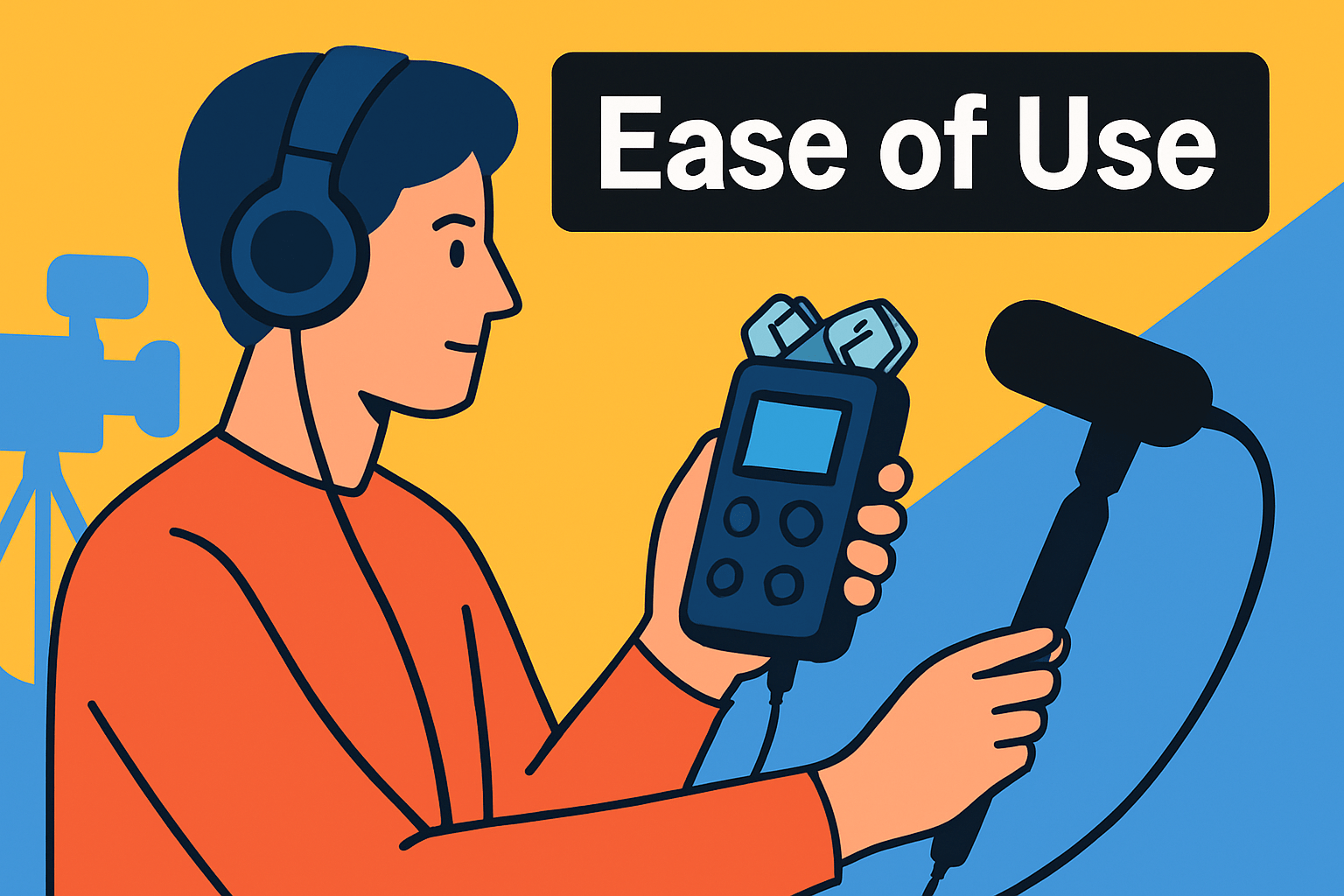
On a busy shoot, ease of use can matter more than raw specs. I look for recorders that let me make fast, confident changes without hunting through menus while the actors reset a scene. Clear displays and tactile controls save time; a 2.4″ LCD that lets you adjust each input independently is worth its weight in gold when levels need a quick tweak.
Touchscreens are lovely for scrolling through multi-track sessions and speeding configuration, but they can be fiddly with gloves or in bright sun. A hybrid setup—physical knobs for gain and a touchscreen for session management—gives the best real‑world balance. If you often work handheld or on a gimbal, compact units that mount on the camera or tripod cut setup headaches and reduce handling noise.
Presets and scene modes are lifesavers for newcomers or fast turnovers. I use scene presets for ambient captures or rehearsal takes, then switch to manual for dialogue. Bluetooth remote control is another small feature that pays back repeatedly when you need to start/stop a recorder tucked behind a set piece.
Safety features should be non-negotiable. Dual recording, safety tracks and decent peak limiters mean you won’t lose a usable take because someone hit a loud cue. For documentary or run‑and‑gun work, a recorder that creates a low-level backup track is a comfort I don’t skimp on.
Expect a learning curve with pro models that offer multi-channel routing and timecode. Spend an afternoon building a few typical session templates and labeling inputs. That prep turns intimidating menus into muscle memory and keeps your on-set workflow calm and repeatable.
Finally, pick to match your rhythm: choose compact, fast-to-deploy gear when speed matters, and opt for deeper feature sets when you need control and redundancy. Practice in realistic conditions, and you’ll save far more time during a shoot than you spend learning the unit.
Noise Reduction Features
On set, noise isn’t just an annoyance — it can wreck a usable take. Start by choosing gear with quiet preamps. Recorders with low self-noise give you clearer dialogue and more headroom, so you won’t be constantly hunting for gain. I’ve learned that a clean analog chain saves far more time in post than any fancy EQ trick.
32‑bit float recording is a game changer for unpredictable environments. With it you can survive sudden loud sounds without clipping, and still recover softer ambience later. It’s not a substitute for good gain staging, but it’s an excellent safety net when you’re shooting fast and living with imperfect levels.
Microphone choice and placement do most of the heavy lifting. Use shotguns for distance and lavs for close-up, and always pair them with proper wind protection outdoors. A dead cat or zeppelin plus a shock mount will eliminate wind and handling noise far better than cranking EQ in post.
On multi‑mic shoots, tools like automix and dual‑recording safety tracks reduce unwanted bleed and the risk of distortion. I set a secondary track about 6–12 dB lower as an insurance policy and keep a gentle limiter to tame transients. Those small habits have rescued countless takes when unexpected bangs or levels spike.
Don’t forget basic on-set filtering. A conservative high‑pass filter between 80–120 Hz removes rumble without thinning dialogue, and monitoring with closed-back headphones helps you catch wind, handling, or electrical hum early. If you hear a persistent tone, address it immediately rather than hoping to fix it later.
Finally, accept that post is part of the workflow. Good noise‑reduction plugins can clean ambience and reduce hiss, but they can’t create detail that never existed. Invest in low‑noise recording practices first, then use software to polish, not to rescue.
What People Ask Most
What is the best field recorder for filmmaking?
There is no single best recorder for every situation; the right choice depends on your workflow, mic setup, and portability needs. Pick a model that balances inputs, monitoring, and ease of use for the types of shoots you do most.
What features should you look for in an audio recorder for film?
Look for clean preamps, adequate and appropriate inputs, reliable monitoring, and solid storage options. Noise-reduction tools and intuitive controls improve on-set reliability and reduce post work.
Should filmmakers use portable field recorders or camera-mounted recorders?
Portable field recorders generally offer better sound quality and more flexibility, while camera-mounted recorders are convenient for fast, simple setups. Choose based on the complexity of your shoot and how much mobility you need.
How do I choose an audio recorder for location sound?
Consider the number and type of microphones you’ll use, the environmental challenges, and how you plan to monitor and sync audio. Prioritize low noise, reliable backup recording, and controls that are easy to operate on set.
Can a handheld audio recorder deliver professional film audio quality?
Handheld recorders can produce clean, usable audio for many productions, especially for dialogue and ambient tracks. For larger, multi-mic productions or very demanding environments, more advanced multi-channel setups are often preferred.
Which audio recorder is best for recording dialogue on set?
Choose a recorder with low-noise preamps, stable monitoring, and enough inputs for your microphone configuration. Durable build and simple controls help keep levels consistent during takes.
Do professional film productions use external audio recorders or mixers?
Many professional productions use external recorders or mixers to gain better control over multiple channels and improve sound quality. The decision usually depends on the production’s scale and the on-set workflow preferences.
Conclusion For Best Audio Recorder For Filmmaking
This guide was designed to help you match recorder features to real on-set needs so you can pick the right tool for your workflow, whether you prioritise pristine preamps, multitrack flexibility, or ultralight portability.
From pro-focused, timecode-ready recorders to versatile mid-range multi-track units and compact, beginner-friendly devices, the right choice comes down to the inputs you need, how much learning curve you can accept, and the noise-control features that matter for your shoots.
Consider your typical shoot environment, mic choices, and postproduction workflow when deciding, and remember that safety tracks, low-noise preamps, and simple preset modes can dramatically reduce headaches on location.
If you want to keep improving your location-sound skills, explore more articles on the site for practical tips, comparisons, and workflow ideas to level up your recordings.
Have questions or want to share your experience with a recorder you’ve used? Leave a comment below and we usually reply within a few hours.


0 Comments