
Ever wondered which camera can turn a drone flight into a cinematic aerial masterpiece? Choosing the right one can lift ordinary footage into something unforgettable.
Aerial photography blends motion, altitude, shifting light, and a lot of workflow friction. It demands gear that is reliable, lightweight, and capable of capturing crisp detail in less-than-ideal conditions.
Sensor performance and image stabilization matter more than marketing buzz. A sharp, well-exposed image at altitude depends on both hardware and sensible settings.
Lenses and weight constraints change the game. The wrong lens or an overly heavy setup can ruin flight time and framing options.
Portability and regulatory realities also influence what you can take aloft. For many shooters, simplicity and ease of use beat raw specs.
Professionals often favor interchangeable lens systems and advanced video features. Travelers and hobbyists usually choose compact, dependable packages instead.
This guide strips away the noise and focuses on practical trade-offs. You’ll get straightforward advice to match gear to mission, skill level, and budget.
Expect help deciding what features actually improve aerial images versus what’s just flashy marketing. Read on to find the best camera for aerial photography that fits your style and goals.
For photographers ready to elevate their aerial work, the right camera is an investment in better images. Let’s dive in and demystify what matters up in the sky.
1. DJI Mavic 3 Pro Overview

DJI Mavic 3 Pro with DJI RC
Professional cinematic drone with triple-camera imaging, extended flight time, and intuitive dedicated controller for precise aerial storytelling.
Check PriceAs a working photographer I’ve found the DJI Mavic 3 Pro to be a serious step up for aerial imaging. Its triple-camera system anchored by a 4/3 CMOS Hasselblad sensor delivers image quality that feels more cinematic and far cleaner than typical consumer drones.
Video capabilities are strong — it records 5.1K at 50fps, which gives you generous resolution and frame-rate flexibility for slow-motion or high-detail delivery. That resolution combined with the Hasselblad sensor makes it ideal for clients who demand sharp, color-accurate footage.
What really sells it for professional work is the flight endurance: a 46-minute flight time lets you stay airborne far longer and reduces interruptions during complex shots. Longer flights mean fewer battery swaps and more continuous coverage for real-estate walkthroughs or narrative b-roll.
Safety and reliability matter in paid shoots, and the Mavic 3 Pro’s advanced omnidirectional obstacle sensing gives confidence when flying near structures or in tight environments. The robust sensing can be the difference between a safe capture and a costly accident.
There are trade-offs. It’s heavier and larger than other Mavic models, so portability suffers and it’s not the best option for ultra-light travel or one-person run-and-gun shoots. Also, the multiple cameras and numerous settings add complexity — expect a learning curve to master all modes.
Bottom line: if you’re a professional videographer, filmmaker, or high-end real estate shooter who values image quality, flight time, and safety, the Mavic 3 Pro is a solid choice. If portability or simplicity is your priority, you might find it a bit cumbersome.
- Incredible image quality — Hasselblad 4/3 sensor
- Versatile triple-camera (wide to telephoto)
- 46-minute flight time
- Advanced omnidirectional obstacle sensing
- Heavier and larger — less portable
- Complex camera settings and modes
2. DJI Mavic 4 Pro Overview

DJI Mavic 4 Pro with DJI RC 2
Next-generation long-range drone with advanced obstacle sensing, high-resolution imaging, and responsive low-latency controller for confident flights.
Check PriceThe DJI Mavic 4 Pro is a solid choice if you want a compact aerial platform that punches above its weight in image quality. Its 25 MP Micro Four Thirds wide-angle camera delivers excellent dynamic range and, combined with a variable aperture, gives you real control over exposure and depth of field from the air.
For reach and detail, the Mavic 4 Pro pairs that wide-angle sensor with a 12 MP telephoto camera plus an additional telephoto camera. That multi-camera setup gives you flexible focal lengths for sweeping landscapes one moment and tighter inspection or city detail the next.
In the field I appreciate how stable it is in strong winds; that stability directly translates to sharper frames and more usable footage. The drone also uses OcuSync 4+ for a reliable transmission, so what you see on the controller tends to match what the camera records — critical when composing from altitude.
Battery performance is described simply as long battery life, which matters when you need extended coverage without constant landings. The Mavic 4 Pro is clearly aimed at prosumer photographers who want high-quality aerial images with versatility, rather than those needing an ultra-simplified or ultra-heavy professional rig.
Be aware of two practical caveats. First, the different sensors and settings can feel complex until you learn the workflow. Second, its C2 classification may force you to navigate additional regulatory steps in some regions.
- 25 MP Micro Four Thirds wide-angle camera
- 12 MP telephoto camera plus additional telephoto
- Stable in strong winds; excellent wide-angle image quality
- OcuSync 4+ reliable transmission and long battery life
- Complex camera settings across sensors
- C2 classification may require extra certifications
3. DJI Inspire 3 Overview

DJI Inspire 2
Cinema-grade aerial platform offering dual-operator control, high-speed performance, and professional camera compatibility for demanding film productions.
Check PriceThe DJI Inspire 3 is a purpose-built tool for cinematographers and production companies seeking top-tier aerial footage. It’s clearly aimed at professional workflows rather than casual hobbyists.
Hardware highlights are straightforward: it supports 8K ProRes RAW video, uses a full-frame sensor, and features an interchangeable lens system. Those specs are rare in the drone space and immediately mark this as a cinematic platform.
In practice, that means the Inspire 3 delivers what the outline calls “unparalleled image quality — best available for cinematic purposes.” If your projects demand the highest resolution and the latitude of ProRes RAW, this platform is built for that level of post work.
The interchangeable lens system gives creative control you don’t get on fixed-camera drones. The outline notes this flexibility is “ideal for professional cinematography,” which matters when you need specific focal lengths or optical characteristics for a shot.
Operationally, the Inspire 3 also brings professional-grade obstacle avoidance to complex shoots. That feature enhances safety during demanding maneuvers and on multi-operator sets, which is important on location shoots with lots of variables.
Be realistic about the trade-offs: the outline lists it as “expensive and complex” and says it “requires crew.” If you’re a solo shooter or have a tight budget, this rig may be overkill. But for production houses and cinematographers who need uncompromising aerial imagery, the Inspire 3 is a strong, purpose-driven choice.
- Supports 8K ProRes RAW video
- Full-frame sensor
- Interchangeable lenses
- Professional-grade obstacle avoidance
- Expensive and complex
- Requires crew
4. DJI Air 3 Overview

DJI Air 3 with DJI RC-N2
Compact powerhouse delivering versatile dual-camera imaging, intelligent flight modes, and a portable controller for effortless travel-friendly aerial creativity.
Check PriceAs a working photographer who regularly shoots from the sky, the DJI Air 3 immediately stands out for its pragmatic balance of performance and portability. Its dual-camera system gives you flexibility on a single flight, and the ability to shoot 4K at 100fps is a real boon when I need silky slow-motion for cinematic wedding clips or dramatic night sequences.
The 40-minute flight time is generous — it lets me plan longer passes and capture multiple angles without constantly swapping batteries. Pair that with the Air 3’s great low-light performance and you’ve got a machine that handles dusk, night ceremonies, and moody cityscapes far better than most drones in its class.
I also appreciate that there’s no forced geofencing, which makes flight planning less of a headache when clients want specific angles near controlled airspace (always still check local rules). The drone is more portable than many pro models, so it slips into my kit bag for on-location weddings and event work where I need speed and reliability.
There are a couple of practical caveats: the app experience isn’t as polished as I’d like, so expect a short learning curve and occasional workflow friction. It’s also slightly larger and heavier than some competitors, which matters if you prioritize the lightest possible carry kit — but for most professionals looking to shoot night work and weddings, the Air 3 is a very strong, versatile tool.
- Great low-light performance
- Shoots 4K at 100fps
- 40-minute flight time
- No forced geofencing
- App experience less polished
- Slightly larger and heavier than competitors
5. DJI Mini 4 Pro Overview
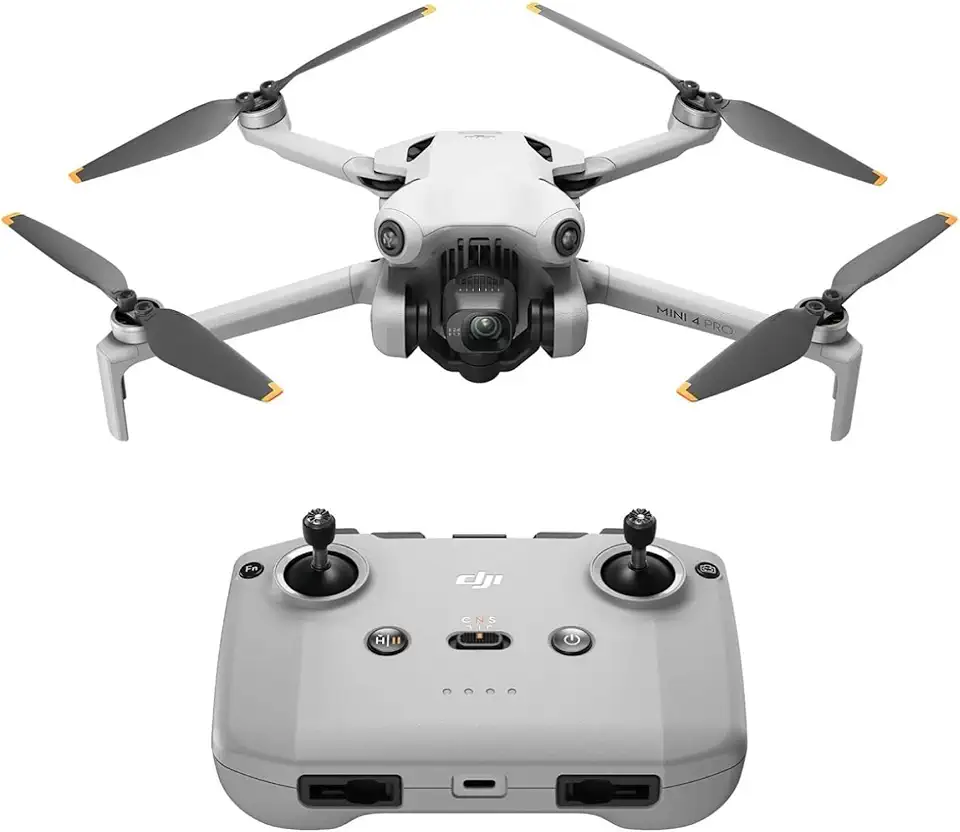
DJI Mini 4 Pro with DJI RC-N2
Ultra-lightweight, travel-ready quadcopter with advanced safety sensors, extended battery life, and high-quality imagery for casual and enthusiast pilots.
Check PriceAs a working photographer I often choose gear that balances image possibilities with real-world portability, and the DJI Mini 4 Pro fits that brief beautifully. Weighing under 249 g, it’s so light I barely notice it in my travel kit, which means I actually fly more often and capture spontaneous aerial moments I’d otherwise miss.
Its obstacle avoidance is impressively reliable for a drone this size, giving me the confidence to focus on composition rather than worrying about a low branch or rooftop. That safety net makes it ideal for beginners and for shooting in tighter urban or wooded environments where situational awareness matters.
Because it’s aimed at travel and casual aerial photography, the Mini 4 Pro is simple to operate and user-friendly — excellent if you’re just getting into drone work. Another practical advantage is that in many countries its sub‑249 g weight means no registration is required, so you can get in the air faster without administrative hassles.
There are trade-offs: flight time is generally shorter compared to larger drones, so plan your flights and be conservative with battery budgeting. Also, it lacks some advanced features found on bigger models, so if you need pro‑level controls, extended battery life, or the highest-end sensors, it may feel limiting.
- Portability — extremely lightweight and easy to carry (under 249 g)
- Obstacle avoidance — reliable detection enhances safety
- Ease of use — suitable for beginners
- No registration needed — in many countries due to weight
- Limited flight time — generally shorter compared to larger drones
- Less advanced features — lacks some advanced features found in larger models
Choosing Lenses for Aerial Photography
Picking lenses for aerial work is less about chasing extremes and more about picking practical tools that match the job. For most drone and aircraft shoots I reach for a mid-range zoom — think 24–105mm on full-frame (or roughly 15–70mm on crop sensors) — because it gives sweeping wide views and the ability to tighten the frame without swapping glass in the field.
Image stabilization matters more than many photographers realize. Lens-based stabilization (or reliable in-body stabilization) helps counter vibration and wind-induced shake, so prioritize stabilized optics whenever the platform allows. That extra sharpness can be the difference between usable frames and wasted battery life.
Avoid ultra-wide lenses below 24mm for aerials unless you specifically want dramatic distortion; they often capture parts of the aircraft and create difficult edge geometry. Standard zooms like 24–70mm are the happiest compromise: minimal distortion, flexible composition, and good results for both creative landscapes and photogrammetry tasks.
Telephotos — 70–200mm and longer — are fantastic for isolating distant features or inspections, but they bring real trade-offs. Expect increased atmospheric haze, more pronounced camera shake, heavier gear that reduces flight time, and slower coverage when mapping large areas; use them for detail work in clear weather rather than sweeping surveys.
Prime lenses reward you with superior sharpness and faster apertures, which can be very handy in low-light or for critical detail inspection, but they lack the flexibility of zooms. If weight and compatibility are concerns, match the lens to your camera and aircraft payload; a well-balanced mid-range zoom often gives the best return on flight time and framing options.
Ultimately, choose lenses based on the mission: medium zooms for mapping and landscapes, telephotos for inspections and isolated subjects, and stabilized optics to keep images crisp. That simple rule will keep your aerial shoots efficient and your files usable.
Using Long vs Medium Focal Lengths
Pick your focal length like you pick your vantage point: with a purpose. If you need sweeping landscapes, cityscapes, or fast, efficient coverage for mapping, a medium-range zoom in the 24–50mm equivalent gives the best balance. It captures wide context with minimal distortion and keeps photogrammetry accuracy reliable.
When you need to isolate a distant subject or inspect small details, reach for longer glass. Telephoto focal lengths (100mm and up) compress perspective and reveal features you simply can’t see wide. Expect trade-offs: more flight time, more frames to stitch, and a higher chance of atmospheric haze softening contrast.
Atmospheric conditions are the telephoto’s enemy. Heat shimmer, haze, and airborne particulates reduce clarity and color saturation as focal length increases. If you must use long lenses, schedule shoots in the clearest light — early morning or late afternoon often helps — and raise ISO or shutter speed to freeze motion when visibility permits.
Weight and handling matter in the air. Longer optics tend to be heavier and may reduce flight time or destabilize a gimbal setup. For drone work I usually opt for stabilized mid-range zooms; they’re lighter, versatile, and let me move quickly without changing lenses. Hand-held aerial work follows the same rule — heavier telephotos tire you and amplify shake.
For inspections and wildlife, prioritize detail: longer focal lengths or higher effective focal lengths on crop sensors. For mapping, surveys, and general landscapes, stick with moderate focal lengths around 24–50mm to maximize coverage and minimize distortion. And regardless of choice, keep image stabilization and lens quality high; they make more difference in the sky than on the ground.
What People Ask Most
What is the best camera for aerial photography?
There is no single best camera; choose one that balances image quality, weight, and reliability for your workflow. Consider how easy it is to mount, fly, and control from the aircraft while meeting your resolution and low-light needs.
What camera settings are best for aerial photography?
Use settings that minimize motion blur and preserve highlight detail while keeping exposure consistent across frames. Shooting in a format that allows flexible post-processing and using frame rates and shutter speeds suited to your flight speed will help produce usable images.
What focal length lens is best for aerial photography?
Mid-range focal lengths typically offer the best balance between coverage and detail without excessive distortion. Ultra-wide lenses can introduce aircraft parts into the frame while long telephotos magnify haze and complicate handling.
Do you need a full-frame camera for aerial photography?
A full-frame camera can offer advantages in low light and dynamic range but is not strictly necessary for strong aerial results. Smaller sensors can be lighter and more affordable while still delivering excellent images for many applications.
Are mirrorless cameras better for aerial photography?
Mirrorless cameras are often favored for their compact size and modern autofocus systems, but both mirrorless and DSLR systems can produce great results. Choose based on lens availability, weight, and how the system integrates with your aircraft.
Can you use a GoPro for aerial photography?
Action cameras like GoPros can be useful for wide-angle, lightweight setups and creative perspectives. They typically offer less flexibility and image quality than interchangeable-lens systems, so they are best for specific use cases rather than high-end imaging.
What features should I look for in a camera for aerial photography?
Prioritize reliable stabilization, good image quality, support for flexible file formats, and compatibility with the lenses you need. Weight, durability, and ease of control from the aircraft are also important factors to consider.
Conclusion for Best Aerial Photography Cameras
Choosing the right drone and optics is ultimately about matching tools to your project goals, weighing image quality, flight time, stabilization, and the trade-offs between coverage and detail.
Whether you value portability and simplicity or need professional cinematic capability, understanding those compromises helps you get consistent, usable results without unnecessary complexity.
Prioritize practical factors like stability, low distortion, and manageable weight so your flights are efficient and your images remain sharp in real-world conditions.
Keep improving your craft by reading more articles on the site to refine composition, settings, and workflow for aerial work, and practice regularly to make these choices instinctive.
If you have questions or want to share a recent shoot, leave a comment below — we usually reply within a few hours.


0 Comments