

Which lens will finally make your Canon R50 sing?
This quick guide distills five standout options into clear, practical advice.
This isn’t gear-head marketing fluff; it’s about real-world uses, honest pros and cons, and who each lens really suits.
Expect help choosing lenses for portrait work, wide-angle landscapes, run-and-gun video, travel convenience, and long-reach telephoto needs.
Every recommendation balances image quality, handling, and affordability.
I’ll flag practical trade-offs like stabilization, low-light ability, and how portable the glass is for day-long shoots.
I’ll also note which lenses pair best with the R50’s autofocus and small-body ergonomics.
These picks were tested on the R50 in real shooting scenarios, and we focused on images you can actually use rather than abstract lab numbers.
You’ll get clear buying advice whether you value portability or peak image quality, with suggestions that work for beginners, travelers, and enthusiasts alike.
1. Affordable Portrait Prime for R50

Canon RF 50mm f/1.8 STM
Fast standard prime delivering creamy bokeh, sharp low-light performance, and compact portability for everyday portraits and street photography.
Check PriceThe Affordable Portrait Prime for R50 is the Canon RF 50mm f/1.8 STM — a compact portrait workhorse that translates to roughly an 80mm equivalent on the R50’s APS‑C sensor. It’s aimed at portraits, street work, travel, and everyday use, and you can feel that intent the moment you pick it up: light in the hand and simple to compose with.
Optically it punches above its price. Images are already sharp at f/1.8 and become razor‑sharp by f/2.8, giving you crisp eyes and clean details for headshots and environmental portraits. The f/1.8 aperture also delivers very good low‑light capability and pleasing bokeh for strong subject isolation.
Autofocus is another area where this lens shines; the STM drive is smooth and quiet and proves reliable for both stills and video. That makes it an excellent interview or run‑and‑gun portrait lens when you want natural background separation without bulky glass. It’s also lightweight and compact, which means you can shoot long sessions or travel days without fatigue.
Who should buy it? Beginners through intermediate shooters who want a cheap, sharp prime for portraits and low‑light situations will find this lens hard to beat. If you need professional weather sealing, built‑in stabilization, or an ultra‑fast premium rendering, you may eventually look elsewhere — but for price, portability, and portrait performance, this lens is a very practical choice.
- Sharp even wide open (f/1.8)
- Razor‑sharp by f/2.8
- Lightweight and compact
- Smooth, quiet autofocus for photo/video
- Uncommon front filter thread size
- No image stabilization
2. Compact Stabilized Kit Zoom

Canon RF-S 18-45mm f/4.5-6.3
Compact wide-to-standard zoom ideal for travel and everyday shooting, offering versatile framing in a lightweight, pocketable design.
Check PriceThe Compact Stabilized Kit Zoom (Canon RF‑S 18–45mm f/4.5–6.3 IS STM) is the kind of lens I reach for when I want a no-fuss, ultra-portable setup on the R50. Its 18–45mm range translates to roughly ≈29–72mm full-frame equivalent on the R50, which covers everything from tight interiors to short telephoto portraits without changing lenses.
What makes it a practical partner for the R50 is the built-in stabilization — about 4 stops of image stabilization — which matters because the R50 doesn’t have in-body IS. That stabilization, combined with a lightweight body of only ~130g, lets you shoot handheld in lower light or slower shutter speeds more confidently than with an unstabilized kit lens.
Autofocus is fast, accurate and very quiet, so this lens is also comfortable for run-and-gun video and vlogging. Image quality is solid for an entry-level zoom and distortion is minimal for general use, so landscapes and street shots look good straight out of camera.
The trade-offs are predictable: the variable max aperture of f/4.5–6.3 limits shallow depth of field and low-light performance, so you’ll rely more on ISO or the stabilization when light gets scarce. Build quality is basic compared with premium glass, but that’s the compromise for extreme portability and a low price. If you want a light, stabilized everyday zoom for travel, street and video on the R50, this is an excellent, practical choice.
- Very compact and lightweight (~130g)
- About 4 stops of image stabilization
- Fast, silent autofocus
- Minimal distortion for general use
- Limited max aperture (f/4.5–6.3)
- Basic build quality compared to premium lenses
3. Lightweight Telephoto Reach for R50

Canon RF-S 55-210mm f/5-7.1 IS STM for APS-C RF mount
Telephoto zoom with image stabilization and quiet autofocus, perfect for capturing sports, wildlife, and distant subjects on crop-sensor cameras.
Check PriceThe Lightweight Telephoto Reach for R50 is an APS‑C telephoto zoom that gives you roughly ≈88–336mm full‑frame equivalent focal length on the R50, which is a real boon when you need reach without packing heavy glass. It’s aimed squarely at wildlife, sports, and any distant subjects where that extra reach matters most.
Weighing only ~270g, this lens stays comfortable on the R50 for long walks and quick hike‑outs. That portability makes it easy to carry as a single lens for trips where you expect to shoot subjects far away but don’t want the weight of full‑size telephotos.
Built‑in stabilization is a standout here — it helps immensely given the lens’s narrow max aperture range of f/5–7.1. That aperture range means you’ll need good light or be willing to push ISO, because low‑light performance is limited unless you sit on a tripod or accept higher noise.
Autofocus is adequate for stationary and slow‑moving subjects, so it’s a solid choice for birds at rest, distant landscapes, and casual sports where the action isn’t blazing fast. If you chase fast action or low‑light sports, note that AF can struggle and the slow aperture will bite you.
In short, this lens is mostly a great match for amateur R50 users who prioritize affordable, lightweight telephoto reach in good light. It’s a practical, pocketable way to extend your focal length without breaking your back — just be real about its limits in dim conditions and high‑speed shooting.
- Long telephoto reach (≈88–336mm)
- Very lightweight (~270g)
- Built‑in stabilization for handheld shots
- Affordable way to expand focal range
- Slow max aperture (f/5–7.1)
- AF can struggle with fast‑moving subjects
4. Ultra-Wide Prime for Travel

Canon RF 16mm f/2.8 STM
Ultra-wide, ultra-compact prime delivering expansive perspective and crisp optics—ideal for landscapes, architecture, and vlogging.
Check PriceThe Canon RF 16mm f/2.8 STM is a compact ultra-wide prime that I reach for on trips when I want dramatic landscapes, architecture, or a wide vlogging frame. On an APS‑C body like the R50 it behaves roughly like a 25.6mm equivalent, so you get a useful, slightly less extreme wide perspective that still feels roomy for interiors and cityscapes.
Optically it punches above its size: the lens is sharp with strong optical quality for wide-angle work, and it keeps distortion and vignetting to a minimum—exactly what you want for clean architectural lines and sweeping landscapes. The very good close focusing distance gives the lens surprising macro-style versatility, so you can mix wide environmental shots with tight, creative close-ups without switching glass.
The f/2.8 aperture provides reasonable low-light capability and helps with subject separation when you get close, but temper expectations if you frequently shoot in very dim conditions—there are conflicting user notes about limited low-light performance (some comparisons even reference much slower apertures like f/4.5–6.3). Build quality is lightweight and travel-friendly, though it isn’t as rugged as premium primes, so I treat it as a go-anywhere option rather than a workhorse for rough conditions.
If you want a truly pocketable ultra-wide that covers landscapes, vlogging, and creative close-ups on the R50, this lens is a fantastic, mostly forgiving choice. If you need absolute low-light speed or a tank-like build, consider that trade-off before buying.
- Sharp with strong optical quality
- Very good close focusing distance (macro versatility)
- Minimal distortion/vignetting
- Compact and easy to carry
- Some users report limited low-light capability (conflicting notes, mentions of f/4.5–6.3)
- Build quality less robust than premium primes
5. Versatile Pro Zoom With IS

Canon RF 24-105mm f/4L IS USM
Professional-grade constant-aperture zoom with outstanding optics, fast focusing, and dependable stabilization for versatile photo and video applications.
Check PriceIf you need one do-it-all lens for the Canon R50, this versatile pro zoom is a strong candidate. Its broad 24–105mm range covers wide landscapes, short telephoto portraits, events, and travel without swapping glass, so you can concentrate on the shot instead of changing lenses.
The constant f/4 aperture keeps exposure consistent across the zoom, which is especially handy for run-and-gun video work. Built-in image stabilization helps tame camera shake for handheld low-light or slower-shutter situations, giving you more keeper frames when you can’t use a tripod.
Optically it’s well regarded for sharpness, contrast, and color — the kind of performance that lifts a shoot from good to polished. Autofocus is fast and accurate for stills and video, so you won’t lose moments to hunting focus when subjects move or you’re composing quickly.
Be honest about size and budget: it’s heavier and larger than typical RF‑S options, and it costs more. If you’re an enthusiast or semi-pro who prefers one high-quality zoom over swapping several lenses, the trade-offs make sense; the weight buys you durability and optical consistency.
For photographers who want reliable image quality, consistent exposure for video, and usable stabilization in a single package, this lens is mostly a win. It’s best for those prioritizing convenience and optical performance over the last bit of low-light speed or pocketable size.
- Versatile focal range covering most scenarios
- Built-in image stabilization
- Sharp, high-quality optics with good contrast/color
- Fast, accurate autofocus for stills and video
- More expensive and heavier than RF-S lenses
- f/4 is slower than some primes for low light
Focal Length Equivalence on APS-C
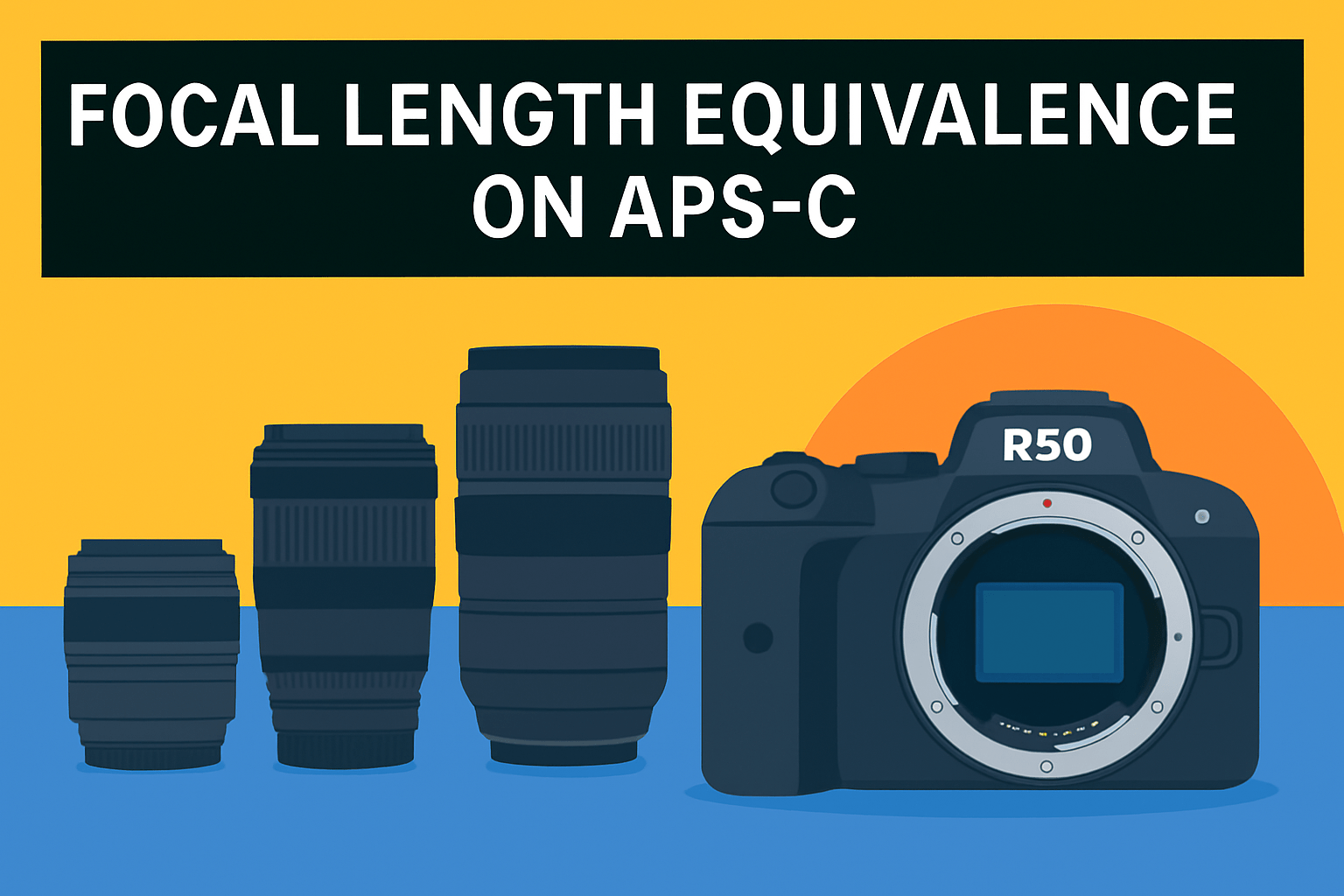
Shooting with the Canon R50 means you’re working on an APS‑C sensor, which crops the field of view compared with full‑frame by a factor of 1.6. Multiply any lens’s focal length by 1.6 to get the full‑frame equivalent and you’ll instantly know how a lens will frame. That little calculation saves a lot of guesswork when planning shots or buying glass.
Quick, practical conversions to keep in your head: 50mm becomes about 80mm, 16mm becomes roughly 25.6mm, 35mm about 56mm, and a 70–300mm zoom reads around 112–480mm. Those are the numbers you’ll effectively be working with on the R50 when composing in the field.
The obvious impact is on wide‑angle work: wide lenses become less wide. A 16mm on the R50 still gives a strong wide look, but it won’t match the ultra‑wide drama you get on full‑frame, so plan compositions and step back when you need more context.
Standard primes shift toward short‑telephoto territory, which is often a welcome change for portraits. The RF 50mm f/1.8 behaves like an ~80mm equivalent on the R50—perfect for flattering head‑and‑shoulders framing and subject separation. In other words, you get portrait‑friendly compression without swapping to a bigger lens.
Telephoto lenses gain obvious advantages: the RF‑S 55–210mm becomes roughly 88–336mm equivalent, giving you reach for wildlife and sports without heavy glass. That extra reach is one of the practical upsides of APS‑C, though many tele APS‑C zooms are slower, so good light helps.
Compatibility doesn’t change the math—the R50 natively takes RF and RF‑S lenses, and EF/EF‑S glass works via adapter. In every case the 1.6x crop factor still applies, and the aperture number stays the same, so low‑light capability is tied to the lens’s f‑stop even as framing changes.
My rule of thumb: mentally multiply lens numbers by 1.6 (or divide desired full‑frame focal lengths by 1.6) before buying or packing. Wide becomes less wide, standards lean toward portraits, and teles gain reach—think in equivalents and you’ll choose lenses that deliver the pictures you actually want on the R50.
Aperture Choices for Portraits
Aperture is the single most powerful creative control in portraiture. It sets depth of field and the character of the background blur. Master it and you turn ordinary shots into images with strong subject separation and mood.
For single-subject head-and-shoulders shots I recommend f/1.8–f/2.8. That range gives creamy bokeh and flattering compression while still letting you nail critical focus.
When you place two or three people in the frame stop down to f/4–f/5.6 so faces all fall into the focus plane. Small tweaks at these apertures keep everyone sharp without losing too much separation. Keep subjects roughly on the same plane to make life easier.
For larger groups or environmental portraits push to f/5.6 and smaller to keep people and surroundings readable. Distance to the background affects perceived blur—moving your subject farther from a busy backdrop increases separation even at smaller apertures. I use that trick when I can’t open wider.
Wide apertures also rescue low-light scenes but they create a razor-thin focus plane. I always prioritize the eyes—focus on the nearest eye and use single-point AF or eye AF where available. If a lens is very fast (f/1.8 or wider), stop down to f/2.2–f/2.8 if you see missed focus.
On the R50 a 50mm behaves like roughly an 80mm lens on full‑frame, which is great for portraits and background separation. If you want the look of a fast prime but need more depth, step back and use a slightly smaller aperture rather than creeping in too close. ND filters are handy in bright light when you want shallow DOF without blown highlights.
My workflow is to start at f/2.8 for single subjects and at f/4 for pairs, then adjust based on subject count and background. Train your eye to check for sharp eyes and background clutter—those small checks move snapshots into intentional portraits.
What People Ask Most
What are the best lenses for portraits on the Canon R50?
For classic portraits, a short telephoto prime with a wide aperture works best; the RF 50mm f/1.8 is highlighted for sharpness and pleasing bokeh. A standard zoom like the RF 24–105mm f/4L offers framing flexibility for different portrait styles.
What lenses are best for vlogging and video with the Canon R50?
Compact stabilized zooms and wide primes are ideal for run-and-gun and interview-style video; the RF‑S 18–45mm with image stabilization and the RF 16mm f/2.8 are commonly recommended. Quiet, reliable autofocus and lens stabilization are especially helpful because the camera lacks in-body stabilization.
Which wide-angle lenses work best on the Canon R50 for landscapes?
Ultra-wide primes like the RF 16mm f/2.8 are excellent for landscapes and architecture thanks to minimal distortion and strong sharpness. Wide-to-standard zooms such as the RF‑S 18–45mm and the wide end of the RF 24–105mm are practical for varied framing, keeping in mind the APS‑C crop factor reduces the true wide-angle view.
What are the best lenses for travel photography with the Canon R50?
For travel, prioritize compact, versatile lenses; the RF‑S 18–45mm is a common lightweight kit choice while the RF 50mm and RF 16mm cover low-light and ultra-wide needs. If you prefer fewer lens changes, a single high-quality zoom like the RF 24–105mm provides broad coverage at the cost of extra weight.
Can I use EF and EF-S lenses on the Canon R50 and which adapters are needed?
Yes, EF and EF‑S lenses can be used on the R50 with a compatible mount adapter, as compatibility is supported through an adapter. Keep in mind the APS‑C crop factor still applies when adapting those lenses and functionality can vary by lens and adapter combination.
What are the best low-light lenses for the Canon R50?
Fast primes such as the RF 50mm f/1.8 are the strongest low-light performers, with the RF 16mm f/2.8 also offering reasonable low-light capability. Lenses with image stabilization, like the RF 24–105mm, can further help in dim conditions even if their max aperture is more modest.
Which prime lenses are recommended for the Canon R50 for sharpness and bokeh?
Portrait-oriented primes such as the RF 50mm f/1.8 are singled out for sharpness and pleasing bokeh, while the RF 16mm f/2.8 is recommended for ultra-wide sharpness and close-focus creativity. Primes are generally valued for compact size and strong optical performance compared with kit zooms.
Conclusion for Canon R50 Lenses
This guide is meant to help you match lens options to real shooting needs on the Canon R50, weighing real‑world uses, trade‑offs, and who each option suits rather than just specs.
Focus your choice on the practical priorities that matter most to you—stabilization for handheld work, aperture for low light and bokeh, compactness for travel, or higher optical quality for portraits and landscapes.
If you want to sharpen your skills and make better gear choices, explore more articles on our site for practical tips, comparisons, and shooting ideas.
Have a question about which direction to take or want feedback on your setup? Leave a comment below and we usually reply within a few hours.





0 Comments