
Have you ever stood beneath a sky so crowded with stars that your eyes could barely take it in, only to discover your photos look flat, grainy, or missing the magic?
Night photography plays by different rules than daytime shooting, with far less light and much smaller margins for error.
The right lens is the single most powerful gear choice you can make; it shapes star sharpness, controls how much light reaches the sensor, and often dictates your workflow after dark.
This guide compares five lenses chosen specifically for night photography and astrophotography to help you decide which optics will perform best for your shooting style.
We evaluate both prime and zoom designs and translate optical performance into real-world outcomes like cleaner night skies, manageable noise, and easier framing.
Instead of an overwhelming spec sheet, you’ll get clear context about which characteristics matter most when the sun goes down and the stars come out.
Whether you chase Milky Way panoramas, aurora displays, or neon-soaked cityscapes, lens choice changes not only the look of your files but how you shoot them.
You’ll read experience-driven guidance on trade-offs between portability, field of view, and optical behavior in low light so you can match a lens to your needs.
After this overview you’ll be better equipped to choose optics that match your nighttime vision and help your images truly stand out.
1. Sony 14mm f/1.8 G Master Lens

Sony FE 14mm f/1.8 GM
Stunning ultra-wide perspective with exceptional low-light performance and ultra-sharp resolution for landscapes, astrophotography, and dramatic interiors.
Check PriceThe Sony 14mm f/1.8 G Master is a purpose-built ultra-wide prime for night and astrophotography, with an f/1.8 aperture that delivers exceptional low-light performance for bright, low-noise images. That wide aperture lets you keep exposures shorter and maintain cleaner files when shooting Milky Way or aurora scenes.
Optically it’s impressive — outstanding center-to-corner sharpness even at the widest aperture, and minimal coma and distortion mean stars stay crisp and round all the way into the corners. For pixel-peepers and those who crop, the edge performance is a real advantage when stitching large-sky compositions.
It’s also surprisingly practical in the field: lightweight and portable for travel and remote shoots, so you can carry it on long hikes without feeling weighed down. The trade-offs are clear — it’s a fixed focal length (no zoom), which limits generalist versatility, and it’s positioned as a premium, investment-grade lens.
Real-world users — especially astrophotographers on Sony full-frame bodies — consistently rank it as a top performer for Milky Way and large-sky compositions. If you prioritize image quality in very low light and plan to inspect 100% crops or print large, this lens is worth the investment; if you only shoot night scenes occasionally or never check tight crops, it can feel like overkill.
- f/1.8 aperture for exceptional low-light
- Outstanding center-to-corner sharpness
- Minimal coma and distortion — round stars
- Lightweight and portable for travel
- Fixed focal length (no zoom)
- Premium, investment-grade price
2. Sony 24mm f/1.4 G Master Lens

Sony FE 24mm f/1.4 GM
Fast wide-angle prime delivering creamy bokeh, outstanding edge-to-edge clarity, and reliable autofocus for environmental portraits and night scenes.
Check PriceThe Sony 24mm f/1.4 G Master is one of those lenses I reach for when I want a clean, high-quality nightscape without sacrificing composition control. Its very fast f/1.4 aperture excels at gathering light for Milky Way shots and star trails, letting you use shorter exposures and lower ISO for cleaner files.
Optically it shines: superb sharpness with low distortion keeps stars as points across much of the frame, and advanced coatings reduce coma and flare so bright points stay tight and contrasty. The 24mm focal length is a genuine “sweet spot” for Milky Way work — wide enough to take in a lot of sky, but with enough apparent scale to keep the galaxy dramatic in the frame.
In practice this lens balances speed and manageable file size, which is great for long nights of shooting and processing. It performs just as well for low-light urban scenes, giving you punchy images in city nights as it does under a dark sky.
Be aware of a couple limitations. Its field of view is narrower than ultra-wides, so extremely expansive sky panoramas may need multiple frames. Also, this is a premium product aimed at demanding users; if you only shoot nights casually it might be overkill.
Autofocus can hunt on older Sony bodies in very low light, so for true astrophotography I often switch to manual focus to nail the stars. If you want a fast, sharp 24mm that handles coma and flare well, this lens is a very strong choice.
- Very fast f/1.4 aperture
- Superb sharpness with low distortion
- Low coma and flare (advanced coatings)
- 24mm “sweet spot” for Milky Way
- Narrower field of view than ultra-wides
- Premium product aimed at demanding users
3. Canon RF 20mm f/1.4L VCM Lens

Canon RF 24mm f/1.4 L VCM
Bright wide-angle optic engineered for professional image quality, rugged handling, and smooth focus for landscapes and cinematic capture.
Check PriceThe Canon RF 20mm f/1.4L VCM is an ultra-wide prime that feels purpose-built for night work. With a fast f/1.4 aperture and a 20mm field of view it gathers light quickly, making Milky Way panoramas and northern lights much easier to nail in a single exposure.
Optically it’s impressive — the lens offers consistent corner-to-corner sharpness even at maximum aperture, so you won’t be sacrificing edge detail when shooting wide open. Users praise its fine night-sky rendering with minimal chromatic aberration or coma, so stars stay tight and true toward the frame edges.
Build quality matches the “L” badge: pro-grade, weather-sealed construction and the classic Canon L-series color rendition and contrast. That combination of durability and pleasing tones makes it a strong choice for overnight landscape sorties where conditions can change and you want reliable color straight from the camera.
There are trade-offs to consider. It’s RF-mount only, so it’s best for photographers already committed to Canon’s mirrorless system or willing to use an adapter. It’s also a bit bulkier than pancake primes, so if you’re ultralight hiking you may notice the weight. All told, for serious night photographers and landscape shooters on Canon’s latest system this lens is mostly a keeper — plenty of speed, excellent edge-to-edge performance, and the kind of build that survives long, cold nights under the stars.
- Ultra-wide 20mm with fast f/1.4
- Corner-to-corner sharpness at maximum aperture
- Pro-grade, weather-sealed construction
- Excellent color rendition and contrast (Canon L-series)
- RF-mount only
- Moderate size/weight (bulkier than pancake primes)
4. Nikon 14-24mm f/2.8G Lens

Nikon AF-S NIKKOR 14-24mm f/2.8G ED
Versatile ultra-wide zoom offering consistent sharpness, robust build, and superior control over distortion for architecture and sweeping vistas.
Check PriceThe Nikon 14-24mm f/2.8G is a workhorse for night and astrophotography thanks to its ultra-wide zoom range and bright f/2.8 aperture. It delivers exceptional sharpness with impressively low distortion, so your nightscapes and star fields stay clean from center to edge.
Across the zoom range the optical performance is remarkably consistent, which means you can reframe quickly without worrying about soft corners or ugly aberrations. That reliability makes it easy to shoot hand-held cityscapes at dusk and then switch to tripod-based Milky Way frames as darkness deepens.
Build quality is another major strength: the lens is rugged and weather-sealed, so it stands up to overnight shoots in rough conditions. That toughness reassures me on cold, windy nights when dew and dust are a concern.
There are trade-offs to consider. The lens is bulky and heavy compared with modern mirrorless primes, so it’s not ideal if you’re hiking long distances or want a minimal travel kit. Also, it lacks built-in stabilization (VR), which means you’ll typically rely on a solid tripod for the longest exposures.
Practically speaking, this lens has been a go-to for Nikon DSLR night shooters for over a decade. If you value zoom flexibility, top-tier image quality, and weather resistance — and don’t mind the weight or using a tripod — it’s an excellent night photography tool.
- Renowned ultra-wide zoom with exceptional sharpness and low distortion
- Reliable, consistent performance across the zoom range
- Rugged, weather-sealed build
- Versatile framing from ultra-wide to slightly tighter compositions
- Bulky and heavy compared with modern mirrorless primes
- No built-in image stabilization (VR); tripod usually preferred for night work
5. Sony 11mm f/1.8 APS-C Lens
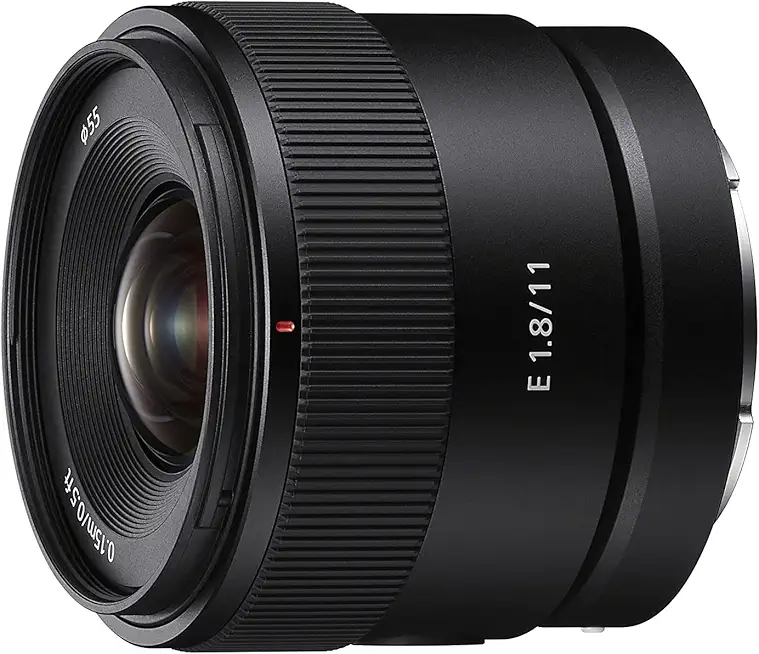
Sony E 11mm f/1.8 APS-C
Extreme ultra-wide lens for compact cameras, delivering dramatic perspectives, fast low-light performance, and crisp detail for creative shooters.
Check PriceThe Sony 11mm f/1.8 (APS-C) is an unusually fast ultra‑wide prime built for Sony’s APS‑C bodies, and that f/1.8 aperture makes a real difference for night work. It gathers light strongly on smaller sensors, letting you shoot shorter exposures with lower noise when chasing the Milky Way or night streets.
Optically it punches above its price. Low coma and sharp corners are uncommon at this class, so stars stay crisp toward the edges and night city lights don’t smear into distracting comatic tails. Real-world users commonly recommend it as the best wide‑angle for Sony APS‑C Milky Way and night cityscapes.
For travel and handheld scouting it’s a joy—lightweight and compact for travel and casual night shoots, so you won’t dread packing it for a multi‑hour hike. It’s also an affordable entry point for night/astrophotography on APS‑C systems, which makes it popular with beginners and enthusiasts seeking high performance without full‑frame cost or bulk.
There are tradeoffs to accept: it’s APS‑C only, and will vignette severely on full‑frame bodies, so it’s not a full‑frame upgrade lens. It’s a fixed focal length, which means you’ll need to move your feet rather than zoom, but for those who value optical quality, weight and price, it’s mostly a very sensible choice—especially on cameras like the Sony a6000‑series.
- Unusually fast f/1.8 for an APS-C ultra-wide
- Lightweight and compact for travel
- Low coma and sharp corners at this price/class
- Affordable entry point for night/astrophotography on APS-C
- APS-C only; severe vignetting on full-frame
- Fixed focal length lacks zoom flexibility
Benefits Of Wide Aperture Lenses
Wide-aperture lenses—those with maximum openings like f/1.4, f/1.8 or f/2—are a night photographer’s best friend because they let far more light hit the sensor than slower glass. That extra light translates directly into shorter exposures and lower ISO, which means cleaner files with less noise when shooting dim skies or neon-lit streets.
With a faster aperture you can use shorter shutter speeds to freeze elements that move, avoid camera shake when handholding, and capture brighter foregrounds without pushing ISO into the noise. In practice this makes the difference between a usable handheld shot and one that’s mushy or grainy at 3200–6400 ISO.
Another practical gain is autofocus and focusing flexibility. A wide maximum aperture passes more light to the AF system, making focus acquisition more reliable in near-darkness, and it lets you confidently work handheld when a tripod isn’t practical.
Wide glass also gives you creative control over depth of field. You can isolate a subject from busy city lights or render streetlights as creamy bokeh while keeping a sharp subject, which is great for editorial or portrait-style night work.
There are trade-offs, though. Shallow depth of field demands precise focus—especially on stars where a millimetre of error can ruin a shot—and some fast lenses show coma or softer corners wide open. I often stop down one to two stops (for example f/1.8 to f/2.8) for critical astro work to tighten star points while still retaining a big light-gathering advantage.
My practical routine is simple: start wide open to frame and expose, then use live-view magnification or focus peaking to nail focus and bracket an aperture or two if I’m unsure. For travel or handheld nights, choose a fast prime for its light weight; for maximum corner-to-corner stars, choose lenses known for low coma even if they cost or weigh more.
Choosing Lenses For Astrophotography
Choosing the right lens for astrophotography boils down to three things: how much sky you want in the frame, how much light the glass gathers, and how it renders stars. Balance those and the rest becomes easier to manage in the field.
Wide-angle lenses are your go-to — they let you include sweeping Milky Way arcs and use longer exposures before stars trail. On full-frame, aim for 24mm or wider; on APS-C look for the equivalent focal length (roughly 11–16mm) to get the same sky coverage.
A fast maximum aperture, ideally in the f/1.4–f/1.8 range, is invaluable for night work. It keeps exposures short and ISO down, but the trade-off is very shallow depth of field, so precise focus is critical.
Optical quality matters as much as speed. Look for lenses with low coma and good edge-to-edge sharpness so stars stay as points across the frame rather than smeared comets in the corners.
Primes often win on speed, weight, and raw star performance, while zooms give you framing flexibility at the cost of extra bulk and usually a slower aperture. If you hike into remote locations a lot, favor lighter fast primes; if you shoot varied scenes, a high-quality ultra-wide zoom can be the workhorse.
Image stabilization is unnecessary when you’re on a tripod, so don’t choose a lens for VR over optical quality. Weather sealing and robust construction, however, are worth paying for during long, cold nights outdoors.
Always check real-world night-sky samples and 100% corner crops before buying; specs won’t tell the whole story. If possible, rent or borrow a lens and shoot a real session — coma and edge performance reveal themselves under the stars.
Focus method matters: use live-view magnification on a bright star or distant light, lock manual focus, and mark the ring for repeatability. Also experiment with stopping down a stop — sometimes f/2 gives noticeably cleaner corners with minimal light loss.
In short, prioritize a wide field, a fast aperture, and low-coma optics, and then pick the form factor that matches how you shoot. The right lens makes the difference between “pretty sky” and a nightscape that feels alive.
What People Ask Most
What focal length is best for night photography?
Wide-angle lenses are generally best because they capture more sky and allow longer exposures before stars trail. On full-frame cameras, a focal length around mid-wide to ultra-wide is commonly recommended for Milky Way and large-sky shots.
What aperture is best for night photography?
A large maximum aperture is important to gather as much light as possible during short exposures. Fast apertures with small f-numbers are typically preferred for cleaner, brighter night images.
Are prime lenses better than zoom lenses for night photography?
Primes often offer wider maximum apertures and excellent optical performance, which helps in very low light. Zooms provide framing flexibility and can be a better all-around choice if you need multiple compositions without changing lenses.
What lens features are most important for night/low-light photography?
Look for wide framing, a large maximum aperture, and strong sharpness with good coma control so stars remain point-like. Weather resistance and solid build help for overnight outdoor shoots but optical performance is usually the priority.
Can I use a kit lens for night photography?
You can use a kit lens to learn and practice night techniques, but kit lenses often have smaller apertures and narrower wide-angle coverage than dedicated night lenses. A tripod and manual focusing will improve results when using a kit lens.
What lenses are best for astrophotography and star fields?
Ultra-wide or wide primes with large apertures and good coma control are well suited to capturing star fields and the Milky Way. Lenses that render sharp corners and minimal coma keep stars as points across the frame.
How do I choose a lens for low-light or night city photography?
Decide whether you need expansive wide views or tighter city compositions, then prioritize aperture, sharpness, and portability based on that use. A balance of speed and practical focal length will give the most versatile night city results.
Conclusion For Night Photography Lenses
In short, choose a lens that balances a wide focal length (24mm or wider on full-frame is ideal), a fast maximum aperture to gather scarce light, excellent edge-to-edge sharpness with low coma, and a build that suits overnight outdoor work.
Whether you favor a fast prime for maximum light gathering or a zoom for framing flexibility, prioritize optical performance and how you’ll actually use the lens in the field.
On the practical side, rely on a sturdy tripod, practice precise manual focusing, use a remote shutter or intervalometer, and experiment with exposure and composition until you find what works for your locations and style.
This comparison should help you narrow choices and focus on the features that truly affect night and astrophotography results rather than getting lost in numbers.
If you want to improve your night shooting skills, read more articles on our site to deepen your technique and gear knowledge, and please leave a comment below — we usually reply within a few hours.





0 Comments