

Which Nikon lens will keep you locked on a sprint, freeze a game‑winning play, and still perform under stadium lights? With both DSLR and mirrorless (Z‑mount) options on the market, and mounts and bodies evolving, picking the right glass can feel overwhelming. This guide pares the choices down to five standout Nikon lenses built for action, reach, and reliability, all vetted in real shooting conditions.
We tested each option not just on paper, but in real‑world situations you’ll face on fields, courts, tracks, and under tough stadium lighting. Expect clear highlights, candid pros and cons, and practical guidance on which shooter each lens fits best — from weekend enthusiasts to working pros. You’ll also get straightforward advice on the zoom versus prime tradeoffs, and on how lens stabilization and in‑body systems work together in the field.
Whether you hunt distant action from the stands or chase tight sideline drama, considerations like reach, aperture, autofocus reliability, stabilization, weight, and budget will steer your pick. We translate those technical priorities into plain recommendations so you spend more time shooting and less time second‑guessing gear or lugging unnecessary glass. Flip the dial and let’s find the Nikon lens that matches your sport, your shooting style, and your next decisive frame.
1. Nikon AF-S 200-500mm f/5.6E ED VR

Nikon AF-S FX NIKKOR 200-500mm f/5.6E ED VR
Affordable super-tele zoom delivering sharp wildlife and sports images, built-in vibration reduction and ED glass for crisp, long-reach performance.
Check PriceWhen I pick up the Nikon AF-S 200-500mm f/5.6E ED VR for a day of sports or wildlife work, it feels like a true utility telephoto: a constant f/5.6 aperture across the zoom keeps exposure predictable during long bursts. The lens uses an electromagnetic diaphragm so your exposure stays consistent frame-to-frame when you’re in continuous high-speed shooting.
Optically it’s impressive — sharpness is consistent across the entire zoom range so you don’t lose detail when you push out to 500mm. Autofocus is fast and reliable, and the lens’ stabilization is rated at 4.5 stops with a dedicated Sport VR mode that makes a real difference on fast-moving players or animals.
Handling surprised me the first time I tried handheld at long focal lengths; it’s relatively manageable for a super-telephoto zoom and balanced well on a crop or full-frame body. That makes it a great choice for enthusiasts and semi-pros who want reach without the bulk and cost of pro primes.
The trade-offs are clear: the 500mm maximum is slightly shorter than some 600mm options out there, so if ultimate reach is your top priority you may notice the limit. It’s also not fully weather-sealed, so I’m cautious in heavy rain or dusty environments and use extra protection when conditions get rough.
For most field sports, soccer, rugby, and open-air wildlife, this lens hits a sweet spot between performance, portability, and price. If you want reliable AF/VR, consistent sharpness across the range, and a telephoto zoom you can actually hand-hold in a pinch, this lens is hard to beat for the money.
- Fast AF and effective 4.5-stop VR with Sport mode
- Excellent image quality and consistent sharpness
- Good handling and manageable weight for a super-tele zoom
- Balanced performance-to-price
- Reach limited to 500mm
- Not fully weather-sealed
2. Nikon AF-S 180-400mm f/4E TC1.4 FL ED VR

Nikon AF-S NIKKOR 180-400mm f/4E TC1.4 FL ED VR
Pro-grade constant-aperture telephoto with integrated 1.4x converter, fast autofocus and premium optics for sports and action coverage.
Check PriceThe Nikon AF-S 180-400mm f/4E TC1.4 FL ED VR is a professional super-telephoto zoom built around a constant f/4 aperture and a built-in 1.4x teleconverter. With the TC engaged you effectively reach 560mm, which is a huge practical advantage when you need extra reach without changing lenses.
As a working pro I value how the internal 1.4x preserves AF speed and removes the awkwardness of attaching a separate teleconverter mid-event. That means faster reactions, fewer missed moments, and cleaner workflows during fast-paced matches or events.
The constant f/4 gives you better low-light performance and shallower depth of field than slower long zooms, making it easier to isolate subjects indoors or under stadium lights. The lens delivers excellent image quality both at full zoom and with the teleconverter engaged — sharpness and contrast hold up across the range.
Despite being a substantial lens it’s surprisingly manageable; Nikon uses fluorite elements to keep it lightweight for its class and to maintain top optical performance. It is slightly heavy compared with smaller zooms, but ergonomically it balances well for handheld shooting or on monopods during long shoots.
If you’re a professional sports photographer who wants one go-to telephoto zoom for both indoor and outdoor assignments, this is tailored for you. You get top-tier AF speed and accuracy, superb optics, and the convenience of an internal TC — at a premium, of course.
- Constant f/4 with built-in 1.4x TC (560mm reach)
- Outstanding AF speed and accuracy
- High image quality across focal lengths and with TC
- Lightweight for its class thanks to fluorite elements
- Heavier than smaller zooms
- Premium price
3. Nikon Z 70-200mm f/2.8 VR S (Mirrorless)

Nikon NIKKOR Z 70-200mm f/2.8 S
Fast, versatile short-telephoto for professionals: exceptional edge-to-edge sharpness, quiet AF and reliable low-light performance.
Check PriceThe Nikon Z 70-200mm f/2.8 VR S is a high-performance Z‑mount telephoto zoom built around a constant f/2.8 aperture, and it’s described as extremely sharp with top-tier optical performance in this focal range. It’s noticeably more compact and relatively lightweight for an f/2.8 pro zoom, which makes it easier to carry through long events without sacrificing speed or image quality.
Autofocus on this lens is outstanding — very fast and whisper‑quiet — which is a real advantage when you’re tracking unpredictable sports action and need reliable, silent tracking. In practice that means fewer missed frames and a more confident workflow for shooting rapid movement in both indoor and outdoor settings.
Optically it’s praised for sharpness, close‑focusing capability, and pleasing bokeh that helps isolate subjects against busy backgrounds. That combination of sharp center detail and smooth out‑of‑focus rendering makes it excellent for mid‑range sports where subject separation and low‑light performance matter.
Because of its compact size and constant f/2.8, this lens is ideal for Nikon mirrorless shooters who value mobility and need a versatile mid‑telephoto for indoor low‑light sports or long days on the sidelines. Be aware photographers often add teleconverters when extra reach is required, though AF can slow slightly with a TC attached.
- Constant f/2.8 for low light and shallow DOF
- Excellent sharpness and contrast
- Fast, quiet AF that tracks movement well
- Relatively lightweight and compact for an f/2.8 zoom
- Reach limited to 200mm without teleconverter (TCs can slow AF)
- Premium price compared with older 70–200 options
4. Nikon Z 400mm f/4.5 VR S (Mirrorless)

Nikon NIKKOR Z 400mm f/4.5 VR S
Lightweight super-telephoto for mirrorless shooters, superb resolution, fast handling and effective stabilization for distant subjects.
Check PriceAs a working photographer, I reach for the Nikon Z 400mm f/4.5 VR S when I need prime-level sharpness without the lugging. At roughly 1,145g it’s remarkably lightweight for a 400mm and lets me hand-hold for longer stretches during soccer, rugby, and track meets.
Optically it punches well above its class — image quality is said to be close to Nikon’s heavier 400mm f/2.8 but at a fraction of the size and weight. You get excellent sharpness, strong contrast, good flare resistance, and a pleasing bokeh that helps isolate fast-moving subjects against busy backgrounds.
Autofocus is fast and reliable, which is crucial when tracking athletes across a field. The lens feels confident on modern Z bodies and lets you lock on and keep shooting through decisive moments without bouncing focus.
If you need more reach, this lens accepts 1.4x and 2.0x teleconverters, giving you flexible coverage for tighter framing from the sidelines. That compatibility makes it a versatile choice for pros and advanced amateurs who want prime optics but still need occasional extra reach.
The trade-offs are real but reasonable: f/4.5 isn’t an f/2.8 for the dimmest indoor or evening situations, and being a prime means you’ll have to move or swap lenses to change framing. For lightweight, high-quality outdoor sports work this lens is mostly a winner.
- Exceptional optical performance rivaling heavier primes
- Lightweight (~1,145g), easy to handle for long shoots
- Fast, reliable AF for tracking action
- Compatible with 1.4x and 2.0x teleconverters
- f/4.5 is slower than f/2.8 in very low light
- Prime — no zoom flexibility
5. Nikon AF-S 500mm f/5.6E PF ED VR

Nikon AF-S NIKKOR 500mm f/5.6E PF ED VR
Compact, travel-friendly long lens with PF element, excellent sharpness and image stabilization for crisp wildlife and sports shots.
Check PriceThis 500mm prime is remarkable for how small and light it is. Nikon achieves that by using Phase Fresnel elements, which cut bulk without sacrificing reach. The result is a compact, lightweight 500mm prime that feels far friendlier on long shoots than traditional super-telephoto glass.
Optically it’s sharp with strong contrast and well-controlled chromatic aberration, so your action frames pop straight out of the camera. VR is effective and tuned for handheld shooting, letting you grab usable shots without always mounting a monopod. AF is fast and accurate, which matters when you’re tracking athletes or birds in motion.
In practice this lens shines on outdoor sports where mobility is key — sideline soccer, field hockey, rugby and similar events. The trade-off is the f/5.6 maximum aperture; it performs best in good light and will push you to higher ISOs or faster shutter speeds indoors or at dusk. Also remember it’s a prime: you can’t zoom, so you’ll need to move or carry extra glass for different framing.
If you prioritize portability and prime-level sharpness for outdoor sports, this lens is a strong choice. It gives you 500mm reach with far less weight than older 500mm primes, excellent VR for handheld work, and autofocus tuned for action. Just be realistic about low-light limits and the lack of zoom flexibility.
- Extremely lightweight and compact for a 500mm prime
- Excellent sharpness and contrast
- Effective VR for handheld shooting
- Fast, accurate AF
- f/5.6 limits low-light indoor or evening use
- No zoom flexibility—may require carrying additional lenses
Zoom Lenses vs Prime Lenses
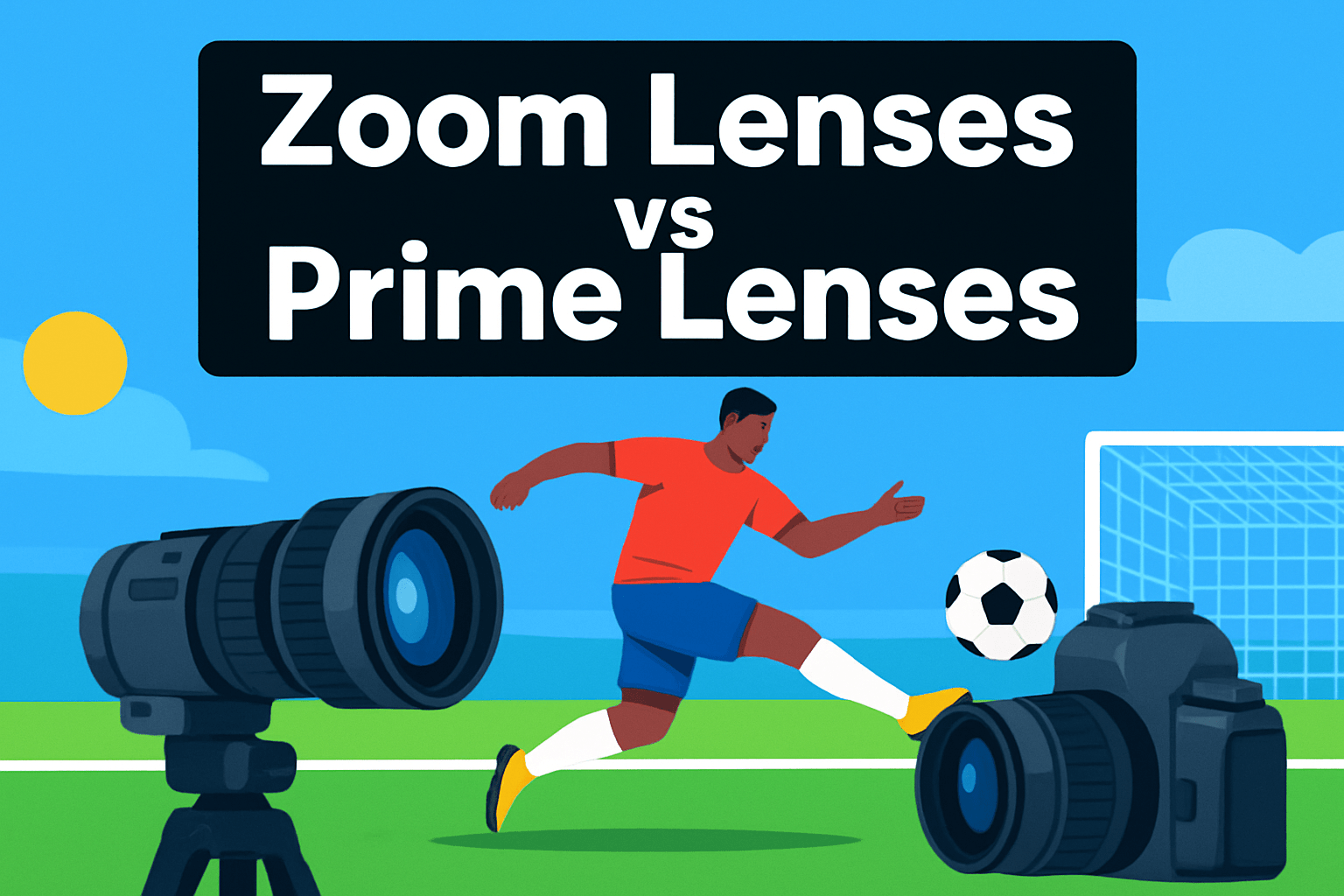
Deciding between zooms and primes is one of the first choices you’ll make when building a sports kit. Both can make fantastic images; the right pick depends on the sport, your shooting position, and how much gear you want to carry.
A prime is a fixed focal length (think 300mm f/4). A zoom covers a range of focal lengths, for example 70–200mm f/2.8, letting you reframe without moving.
Primes tend to win on pure image quality. You often get better sharpness, larger apertures for low light and cleaner background separation, and a lighter package that forces you to “zoom with your feet.” The downside is changing lenses during fast action can cost you shots.
Zooms shine in dynamic environments. They let you react quickly to shifting action and, with modern pro designs, can approach prime-level sharpness; a 70–200mm f/2.8 is a workhorse for a reason. Carrying one versatile zoom often beats juggling several primes when time and space are limited.
On modern Nikon bodies AF performance between top-tier primes and zooms is often very similar, so tracking performance rarely decides for you. Beginners usually start with zooms for convenience, while many experienced shooters add primes for the final IQ or wider aperture when needed.
In practice, match the lens to the job: long outdoor field sports often benefit from tele primes for reach and rendering, while sideline or indoor work favors a fast zoom. If you can only buy one lens, a fast mid-range zoom gives the most flexibility; add a tele prime or a converter when you need reach.
Don’t be dogmatic: test both approaches and let your comfort and shooting style guide you. Plan lens swaps, be mindful that teleconverters can slow autofocus, and choose the tool that helps you get the decisive moment.
Lens Stabilization for Sports Photography
Lens stabilization—Nikon’s VR/Optical Image Stabilization—works by shifting internal lens elements to counteract small camera movements. That optical compensation lets you handhold longer focal lengths or use slower shutter speeds with fewer discarded frames. For sports, where you often juggle reach, light and mobility, good stabilization is an underrated advantage.
One key detail: IS corrects camera shake, not subject motion, so you still need fast shutter speeds to freeze athletes. Stabilization is most useful for static or slowly moving subjects, or when you’re forced to dial back shutter speed because of light or ISO constraints. Modern Nikon VR ratings mean some lenses can buy you several stops of steadier shooting.
Use the right stabilizer mode for the action. Mode 1 is your everyday setting; Mode 2 is tailored for panning and stabilizes only perpendicular motion so you get a sharp subject with motion-blurred background. Some lenses and bodies also offer aggressive tracking modes that work better when you’re following a single target across the frame.
That said, there are times to switch IS off. When you’re shooting at very fast shutter speeds to stop rapid, erratic motion, stabilization adds little and some pros disable it to slightly speed up autofocus and save battery. Also turn it off on solid tripods or when a lens/body combo recommends it to avoid unnecessary correction.
On Nikon mirrorless bodies the combination of IBIS and lens VR can be powerful, often giving extra stops of effective stabilization and helping AF lock more reliably in tricky light. The exact benefit depends on the body and lens, so test your setup before a match and run panning and burst sequences to find the sweet spot. Learn your VR modes and practice them — that familiarity will net more keepers than theoretical charts on game day.
What People Ask Most
What is the best Nikon lens for sports photography?
There is no single best lens; the right choice depends on the sport, how far you are from the action, and your low-light needs. Prioritize lenses with reliable autofocus, suitable reach, and stabilization that match your shooting conditions.
Which Nikon lens is best for shooting indoor sports?
Indoor sports typically benefit from lenses with wide apertures and fast, accurate autofocus to handle low light and quick action. Look for pro-grade zooms or primes with those characteristics to improve subject isolation and tracking.
What Nikon telephoto lens is ideal for sports photography?
An ideal telephoto balances reach, weight, and handling for the venue you cover. Choose a super-tele zoom for flexibility or a telephoto prime for compactness and high optical performance, depending on whether you need zooming or prime-level optics.
What lens do professional Nikon sports photographers use?
Professionals often use a mix of pro-grade telephoto zooms and primes that offer fast autofocus and dependable stabilization. They pick lenses that match the event, alternating between versatile zooms and dedicated primes for reach or image quality.
Is a 70-200mm f/2.8 Nikon lens good for sports photography?
Yes, a 70–200mm f/2.8 is a popular mid-range sports lens thanks to its wide aperture and strong autofocus performance. It is especially useful for indoor events and closer sideline action, though it may lack reach for distant outdoor subjects.
Should I use a prime or zoom Nikon lens for sports photography?
Zooms are great for dynamic situations where quick focal-length changes are needed, while primes often offer better optical quality and wider apertures. Choose based on whether flexibility or maximum image quality and low-light performance matters more for your shooting style.
Which Nikon lens offers the fastest autofocus for sports and action?
The fastest autofocus is usually found in Nikon’s professional telephoto zooms and newer mirrorless S-series lenses designed for action. Prioritize modern pro-grade lenses known for tracking and responsiveness when speed is critical.
Conclusion for Best Nikon Sports Lenses
This roundup brings together five top Nikon telephoto options across mirrorless primes, a mirrorless zoom, and DSLR super-tele choices, with practical pros/cons, buyer fits, and real-world notes to help you decide.
Use the guiding trade-offs—reach, aperture for low light, autofocus and stabilization performance, and overall portability—to match a lens to your specific sport and shooting style.
If you photograph fast, unpredictable action prioritize AF and reach; if you shoot indoors or need subject isolation, favor faster apertures and lighter handling for long sessions.
Keep experimenting, practice your settings, and read more articles on the site to sharpen both technique and gear choices—these resources are designed to help you improve gradually.
Please leave a comment with your questions or gear experiences below; we usually reply within a few hours and welcome your feedback.




0 Comments