
Ever wondered why some clothing photos pop while others look flat? The difference is often not in the camera, but in how light shapes fabric, texture, and color. A ring light can tame reflections, even out shadows, and bring out the true tones of garments with very little fuss.
In this guide we’ll compare five top ring lights and judge them on how they perform in real clothing shoots. You’ll get practical buying advice and hands-on usage tips so your shirts, dresses, and accessories look faithful and flattering on camera.
We’ll evaluate the lights by their ability to render color accurately, sculpt fabric texture, and adapt to studio or on-location setups. Size, control, and portability will factor into which light fits your workflow.
Beyond product picks, expect straightforward advice on positioning, layering, and avoiding flat, washed-out results so fabrics retain depth and detail. This is about making practical choices that save time and improve consistency across shoots.
Start here, and you’ll spend less time guessing and more time shooting crisp, color-true clothing images. Ready to find the ring light that makes fabric color and detail sing?

Neewer RL-18 18-inch Ring Light 55W 5600K with Stand, Phone Holder, Soft Tube and Bag

Neewer RP19H 19-inch Ring Light with Stand and 3 Phone Holders, Touch Control, CRI97+, 42W
1. Neewer RP19H Ring Light Overview
Neewer RP19H 19-inch Ring Light with Stand and 3 Phone Holders, Touch Control, CRI97+, 42W
Powerful 19-inch LED illuminator with three phone mounts, touch dimming, excellent color accuracy and sturdy stand for flawless portraits and streaming.
Check PriceThe Neewer RP19H is a studio-focused ring light built around a large 19-inch diameter that gives broad, even coverage for full garments and mannequins. In practice that means fewer harsh shadows across fabric folds and a more consistent look from head to hem.
Color accuracy is a major strength here. With a CRI of 97+ and color temperature control from 3200K–5600K in 100K increments, it renders textile colors faithfully so you can trust what you see on camera and in post.
Exposure control is equally precise: brightness is adjustable in 1% increments, so you can dial in just enough light to preserve texture without blowing highlights. The three cold shoe mounts let you add small accessories like a mic, reflector, or secondary light for more nuanced setups.
Touch controls and remote operation make this a great option for solo shooters doing mannequin or flat-lay setups; you can tweak settings without running back to the light. Many pros pick this as a primary key light in a small studio because of that convenience and reliability.
There are trade-offs to consider. It’s fairly bulky and best suited to a dedicated studio — it won’t be your go-to for frequent travel or tight on-location shoots. Also, the output can be intense on delicate or high-sheen fabrics, so you’ll often need to diffuse or reposition the light to avoid hotspots.
- Excellent color accuracy (CRI 97+)
- Large 19-inch size covers full garments evenly
- Brightness in 1% steps and 3200K–5600K in 100K steps
- Three cold shoe mounts for accessories
- Bulky — best for studio use
- Can be too intense for delicate fabrics
2. Westcott 18″ Bi-Color LED Ring Light Overview

Westcott 18-inch Bi-Color LED Ring Light Kit with Batteries and Stand
Bi-color 18-inch LED kit delivers adjustable warmth, reliable battery power and portable stand for on-location shoots and versatile lighting control.
Check PriceI reach for the Westcott 18″ Bi-Color LED Ring Light when I need reliable, repeatable lighting for clothing and product shoots. Its bi-color LEDs and clear digital readout make dialing in the exact temperature and brightness fast, which is a huge time-saver when I need consistency across a batch of garments.
The ring mounts both phones and DSLRs, so you can shoot tethered or handheld without swapping rigs. The light produces a soft, even illumination that minimizes harsh shadows and preserves fabric texture and color — exactly what you want when showing true garment details.
What really makes this unit practical for location work is the inclusion of NP-F batteries. That gives you off-grid flexibility when a studio outlet isn’t available, though in practice you should plan for battery swaps on longer shoots. The digital display helps you reproduce settings shot-to-shot, which is essential if you’re styling multiple outfits and need matching light between setups.
Keep in mind the 18″ diameter and the soft wrap of the light make it less ideal in extremely tight corners or very small changing rooms. It’s a strong studio-or-on-location tool, but not the most discreet option for cramped spaces. Overall, if you want precise controls, soft flattering light for textiles, and the option to go battery-powered, this Westcott is a very practical choice.
- Digital controls for repeatable settings
- Soft, even light that reduces harsh shadows
- Includes NP-F batteries for on-location use
- Compatible with phones and DSLRs
- Battery life can be limiting on long shoots
- 18″ size may be cumbersome in tight spaces
3. Lume Cube Ring Light Pro Overview

Lume Cube Ring Light Pro Wireless with Tripod Mount and Carrying Case
Wireless pro-grade LED solution with tripod mount, rechargeable power and protective case for effortless mobile content creation and professional lighting.
Check PriceThe Lume Cube Ring Light Pro is a favorite on high-end clothing and fashion shoots thanks to its professional-grade build and clean light quality. It’s the kind of tool I reach for when I need dependable, studio-ready illumination that won’t let fabric colors lie.
Its high CRI and adjustable color temperature produce very natural-looking results, which is critical when you’re trying to reproduce true fabric tones for e-commerce or lookbooks. Accurate color rendering means fewer reshoots and less time fixing white balance in post.
I like that it’s compact and easy to position for detailed garment shots — think close-ups of seams, textures, and embroidery where you need precise light control. That compactness also makes it simple to add to a multi-light setup without crowding the scene.
App control allows remote adjustments, which is handy for solo shooting or fine-tuning without walking back to the light. The unit’s durable build stands up to regular studio use, so it’s a practical investment if you’re photographing clothing frequently.
Overall, this ring light is an excellent choice for photographers who prioritize color accuracy and portability within the studio. Just be aware the app control can be less intuitive than physical dials, and the light’s intensity can overwhelm delicate fabrics if not positioned carefully.
- High CRI and adjustable color temperature for accurate color representation
- Compact and easy to position for close-up/detail work
- App control enables quick, precise adjustments
- Durable build quality for regular studio use
- App control can be less intuitive than physical controls
- Intensity can overwhelm delicate fabrics; requires careful positioning
4. Neewer RL-18 Ring Light Overview
Neewer RL-18 18-inch Ring Light 55W 5600K with Stand, Phone Holder, Soft Tube and Bag
Bright 55W daylight-balanced LED delivers soft, even illumination; includes stand, phone mount, diffuser tube and travel bag for creators.
Check PriceThe Neewer RL-18 is a practical workhorse for clothing and product photography, thanks to its 18-inch size and high brightness that reliably cover full garments. With 240 LEDs and a CRI of 95, it gives you accurate color rendering so fabrics look true-to-life on camera.
Color temperature is adjustable from 3200K–5600K, so you can match tungsten or daylight scenarios without guessing. It also offers variable brightness control and includes a Bluetooth remote for hands-free adjustments during solo shoots.
Its portable design and included carrying case make it easy to move between studio and location work. That said, the supplied tripod may not feel as stable as heavier, professional stands, so plan for careful setup or an upgraded stand for windy or crowded locations.
In practice the RL-18 is ideal when you need even, broad illumination for full garments or mannequins; the 18-inch diameter reduces harsh shadows across fabric panels. However, the high output can be intense on delicate or shiny materials, so I usually add diffusion or back off power and distance to preserve texture and avoid hotspots.
Overall, the RL-18 is a solid, versatile choice if you want a balance of size, color accuracy (CRI 95), and portability with remote control. It’s especially useful for photographers who switch between studio and on-location shoots and need consistent, true colors without fuss.
- Large 18″ size covers full garments
- 240 LEDs with CRI 95 for accurate colors
- Adjustable 3200K–5600K + brightness
- Bluetooth remote and carrying case
- Can be too bright for delicate fabrics
- Included tripod may be less stable
5. Razer Ring Light Overview

Razer Right Light 12-inch Ring Light with Tripod Mount, USB Powered
Compact 12-inch USB-powered LED offering precise brightness control and easy tripod mounting for livestreaming, video calls, and content creation.
Check PriceThe Razer Ring Light is a solid choice if you shoot clothing in a small studio or tight setup. Its compact design makes it easy to position close to garments without dominating the space.
Brightness and color temperature are adjustable, which lets you dial in the exact light to bring out fabric texture and colors. That control is particularly useful when you need consistent results across multiple shots or when switching between fabric types.
Output is consistent and even, so you won’t get harsh hotspots or weird color shifts that can ruin a swatch or seam detail. That even illumination helps preserve the look of textiles and makes color correction easier in post.
Build quality is durable and reliable for frequent use, so it stands up to regular studio handling and on-location packing. For someone shooting daily product drops or catalog items, that durability matters more than flashy bells and whistles.
Where it falls short is scale: the compact size that’s its strength also limits coverage for full-body or large garment shots. If you regularly shoot mannequins, group shots, or full-length models, plan on adding supplemental lighting or choosing a larger fixture.
In short, the Razer Ring Light is mostly a very good, practical tool for clothing and product photographers working in constrained spaces who need reliable, controllable light. It’s not the best single solution for very large or complex setups, but as a primary light for detail and mid-distance shots it performs well.
- Compact design for small studio spaces
- Adjustable brightness and color temperature
- Consistent output and even illumination
- Durable build quality for regular use
- May be limiting for larger garments/full-body shots
- May be insufficient intensity for very large setups
Choosing Ring Lights for Clothing Photography
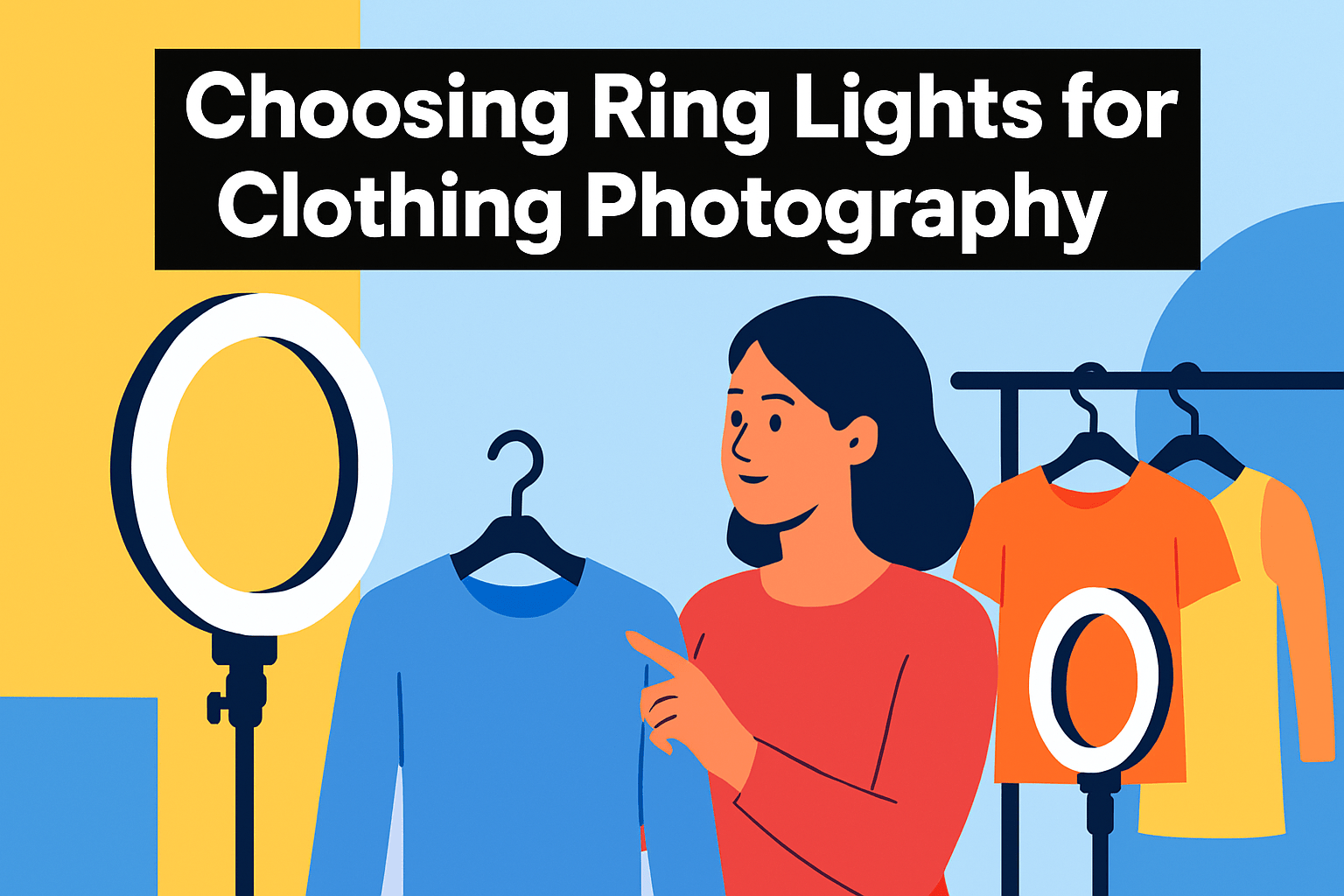
Choosing the right ring light for clothing photography is mostly about matching size and control to what you shoot. Bigger rings (roughly 19–21 inches) give broad, even coverage for full garments and mannequins, while smaller rings (10–12 inches) let you focus on texture and close-up details. Start by thinking which of those you do more often.
Fabric colors are unforgiving, so prioritize a high CRI—95 or above—for accurate tones. Pick a light with adjustable color temperature and aim near daylight (about 5500–5600K) when you want neutral whites. That flexibility saves painful color fixes later.
Brightness control is more useful than raw output. Smooth, fine-step dimming and remote or app control let you repeat exact settings across a series of shots and avoid blown highlights on shiny fabrics. If the lamp is too harsh, lower power, move it back, or add diffusion to preserve texture.
Mounting and compatibility matter for clean results. A central camera mount reduces unwanted shadows and keeps illumination uniform across the frame. Also check tripod stability and accessory mounts so you can add small modifiers, mics, or reflectors without wobble.
Decide whether you need studio permanence or on-location flexibility. In my experience, battery-powered rings are liberating for pop-up shoots, but watch battery life and output; studio rigs give consistent power and stability if you rarely move gear.
Don’t expect a ring light to solve every lighting problem by itself. Use it as a key source and add fill lights or reflectors to model garments and retain depth. Diffusers or scrims help tame hotspots on glossy fabrics and changing the angle will prevent distracting circular catchlights on accessories.
Finally, test with the actual fabrics and camera you’ll use. Shoot tethered with a gray card, lock your white balance, and tweak brightness until colors and textures read true—then save those settings for repeatable, consistent results.
Ring Light Tips for Clothing Photography
A ring light is an excellent tool for clothing photography because it delivers even wraparound illumination that reveals color and texture. But it’s not magic — size and quality matter. For full garments I reach for a larger ring (about 19–21 inches) so the light covers the subject evenly, and I always prioritize a high CRI (95+) so fabric colors aren’t misrepresented.
Positioning makes the difference between flat, washed-out images and ones with texture and life. I usually bring the ring fairly close and shoot with a wider focal length (30–40mm instead of 85mm) so the light covers the frame; central mounting reduces uneven shadows, but slightly angling the light or the model creates subtle depth.
Use the ring as your key light and then sculpt with fill or rim lights. A reflector or a soft fill on the opposite side prevents that “cutout” look and keeps shadows soft, while a back or hair light adds separation from the background and emphasizes fabric drape.
Consistency is critical for clothing work. Lock the color temperature to daylight (around 5600K) and avoid mixing lamps; high CRI and repeatable controls or a digital readout help you match settings across a shoot so colors hold up in edits.
Diffuse the ring when necessary—add a scrim, softbox, or thin muslin to tame hotspots on shiny fabrics. For accessories and reflective trims, change the angle or lower intensity to avoid distracting circular catchlights; sometimes simply moving the light a foot or two makes all the difference.
Remember the inverse-square law: small distance changes drastically change intensity, so tweak distance and power rather than pushing highlights in post. I mark stand positions or save settings on my remote/app so I can reproduce lighting quickly, and I always grab a test frame with a gray card to confirm white balance and exposure.
What People Ask Most
What size ring light is best for clothing photography?
Larger ring lights provide broader, more even coverage for full garments, while smaller lights are better for close-ups and detail work. Choose the size that matches the subject and shooting distance for consistent illumination.
What color temperature or lighting settings are best for photographing clothing?
Use a neutral, daylight-balanced setting to render colors naturally and maintain consistency across shots. Avoid mixing different light temperatures to prevent unwanted color casts.
Should I use a ring light or softbox for clothing photography?
Ring lights give even frontal illumination and convenient camera placement, while softboxes deliver softer, wraparound light that sculpts form. Many photographers combine both to balance evenness and dimensionality.
How do I position a ring light to photograph garments evenly?
Place the light to provide uniform coverage with the camera near the center of the ring and adjust height and angle to minimize hotspots. Add fill lights or reflectors when you need more control over shadows and depth.
Can a ring light be used for both model and flat-lay clothing photography?
Yes, ring lights can work for both by changing distance, angle, and support; repositioning and diffusion adapt the light to different formats. For flat-lays, overhead support and extra diffusion help eliminate reflections and maintain even exposure.
What accessories (diffusers, stands, mounts) improve ring light results for clothing photography?
Diffusers and soft fabrics soften harsh highlights, sturdy stands and reliable mounts ensure consistent framing, and camera adapters keep the shot centered. Useful extras include stable supports and simple modifiers to control spill and reflections.
How do I avoid reflections, hotspots, and color shifts when using a ring light on fabric?
Soften the light with diffusion, reduce intensity, and adjust angles to minimize direct reflections and hotspots. Control ambient lighting and use a consistent white balance to prevent color shifts across shots.
Conclusion for Best Ring Lights for Clothing
In short, the best ring light for clothing work is the one that matches your shooting needs—consider size, CRI, color-temperature control, adjustability, and how portable it needs to be for your workflow.
Testing different settings, distances, and light combinations will quickly show how fabrics, textures, and colors respond, so plan a few quick trials before a final shoot.
Use the ring light as part of a flexible setup: diffuse where highlights are harsh, add fill or side lights for depth, and keep color consistency across frames to accurately represent garments.
If you want to sharpen your technique, explore more guides and practical tips on our site to build confidence and speed in clothing photography.
Have a question or a setup to share? Leave a comment below and we usually reply within a few hours to help you dial in your lighting.




0 Comments