
Ever wondered why some night photographs leap off the screen while others look dim, noisy, and lifeless? Often the difference isn’t the camera body — it’s the lens.
A lens determines how much usable light actually reaches the sensor. It also affects sharpness, haloing around highlights, and how points of light render toward the edges of the frame.
This guide focuses on five broad lens approaches suited to Sony mirrorless shooters working after dark. An ultra-wide prime built for sweeping starfields, a bright pro‑grade wide option for extreme low light, a versatile wide prime that balances speed and portability, a flexible wide‑angle zoom for on‑the‑fly framing, and a compact third‑party wide lens for long hikes. Each takes a different approach to size, speed, and handling.
Those trade‑offs matter at night more than during daytime work. A heavier, faster lens may give cleaner exposures, while a lighter lens wins on long treks and handheld shooting. Autofocus behavior and flare control also shape practical results under streetlights and starry skies.
Whether you chase mountain starfields, neon cityscapes, or handheld portraits after dark, a thoughtful lens choice elevates results. This introduction teases the types of glass that will help you shoot cleaner, sharper, and more creatively in near‑darkness.
1. Sony 14mm f/1.8 G Master

Sony FE 14mm f/1.8 GM
Ultra-wide prime ideal for landscapes and astrophotography; exceptional edge-to-edge sharpness, fast aperture for superb low-light performance and dramatic perspective.
Check PriceThe Sony 14mm f/1.8 G Master is a purpose-built ultra-wide prime that really shines for night landscapes and the Milky Way. Its field of view is perfect for capturing sweeping skies like the Milky Way and northern lights without feeling cramped.
Optically it’s impressive — the lens delivers exceptional edge-to-edge sharpness even at wide apertures, so you don’t have to stop down to get crisp stars across the frame. Advanced coatings and XA elements help reduce ghosting and flare, which keeps contrast and color in starfields intact.
At f/1.8 you get a lot of light-gathering power for an ultra-wide, which means lower ISO settings and faster shutter speeds when you need them. Users report minimal distortion and no visible coma; stars stay as sharp points, which is exactly what you want for astrophotography.
Despite being a G Master, it’s compact and lightweight — photographers frequently praise its portability for hikes to dark-sky sites. The robust build feels solid in the hand, yet it’s not so heavy that it becomes a burden on long treks.
One thing to be aware of is the trade-off in flexibility: it’s a fixed focal length, so you’ll need to move to reframe scenes. It’s also a higher-cost option compared with non-G Master alternatives, so factor that into your kit budget.
- Ultra-wide field of view — excellent for Milky Way shots and northern lights
- Exceptional edge-to-edge sharpness, even at wide apertures
- Bright f/1.8 aperture — allows lower ISO and faster shutter speeds
- Compact and lightweight for a G Master lens — praised for portability
- Fixed focal length — less framing flexibility
- Higher cost vs. non-G Master options
2. Sony 20mm f/1.8 G

Sony FE 20mm f/1.8 G (SEL20F18G)
Lightweight wide-angle optic offering fast aperture, reliable autofocus, creamy background separation and excellent clarity for travel, video, and low-light shooting.
Check PriceThe Sony 20mm f/1.8 G is the kind of lens I reach for when I want a true wide perspective without going ultra-wide. Its field of view sits nicely between landscape and travel framing, making it versatile for nightscapes, street scenes after dark, and even wide-field astrophotography.
Optically it punches above its weight: excellent sharpness across the frame with minimal aberrations at f/1.8 means you can shoot wide open and still get usable corner detail for star fields or cityscapes. That sharpness, combined with minimal aberrations, keeps stars tight and city lights crisp without excessive correction in post.
In the field the lens is a joy to carry — lightweight and compact, it’s designed for nights when you don’t want a heavy kit. Weather-sealed construction gives confidence for damp, cold shoots and the fast, silent XD autofocus motor locks quickly and quietly in low light, which helps when framing fleeting scenes or recomposing under dim streetlamps.
User feedback backs up the real-world appeal: it’s praised as a jack-of-all-trades for night landscapes, astro, and travel thanks to its balance of sharpness, portability, and value. The smooth focus ring is handy for those times you switch to manual focus for pinpointing stars or neon-lit foreground elements. If you want an all-purpose wide that behaves well in the dark and doesn’t weigh you down, this lens is a very strong contender — just be mindful of a couple of trade-offs.
- Versatile field of view
- Excellent sharpness across the frame at f/1.8
- Lightweight and compact
- Weather-sealed with fast, silent XD autofocus
- ~2/3 stop less light-gathering than f/1.4 options
- Slightly more distortion and a plasticky feel vs. premium primes
3. Sony 24mm f/1.4 G Master

Sony FE 24mm f/1.4 GM (SEL24F14GM)
Bright wide prime delivering stunning resolution, beautiful bokeh, and precise autofocus—perfect for environmental portraits, night scenes, and professional low-light work.
Check PriceThe Sony 24mm f/1.4 G Master is a serious tool for night photographers who prioritize image quality and low-light capability. Its bright f/1.4 aperture gives you clear advantages for nightscapes and cityscapes — you can shoot at lower ISO or shorter exposures and still keep stars and street scenes clean.
Optically it shines: superb center-to-corner sharpness even wide open and minimal coma mean stars stay as tight points across the frame, which is exactly what you want for Milky Way work or long-exposure night panoramas. Add its strong control of flare and ghosting, and you’ve got a lens that handles bright urban lights and backlit scenes without messy artifacts.
The build is pro-grade and moisture-sealed, so you can confidently use it in chilly, damp nights or unpredictable weather. Autofocus is fast and quiet — handy for discreet street shooting or when you need reliable focus in low light without distracting noise.
That said, this lens leans toward the pro end: it’s heavier and bulkier than some lighter options, and it represents a significant investment. If you prioritize absolute optical performance, need pin-sharp stars, and don’t mind the weight or price, this is a top choice. If you’re packing ultra-light or on a tight budget, the trade-offs may matter.
- Superb center-to-corner sharpness
- Bright f/1.4 aperture
- Durable, moisture-sealed pro-grade build
- Fast, quiet focusing
- Heavier and bulkier
- Expensive — significant investment
4. Sony 16-35mm f/2.8 G Master

Sony FE 16-35mm f/2.8 GM (SEL1635GM)
Versatile ultra-wide zoom with constant aperture, pro-grade optics, smooth zoom action and stellar sharpness for landscapes, architecture, and cinematic video.
Check PriceThe Sony 16-35mm f/2.8 G Master is the versatile workhorse I reach for when a single lens needs to cover everything from sweeping night landscapes to tighter foreground compositions. Its zoom flexibility lets you reframe quickly on the fly, which is invaluable at night when light and conditions change fast.
That constant f/2.8 aperture is a solid compromise: it delivers good low-light performance across the entire zoom range without the exposure jumps you get with variable-aperture zooms. Combined with minimal aberrations and vignetting, it produces clean frames that require less cleanup in post—especially handy when shooting cityscapes or event scenes under mixed lighting.
Build-wise it’s moisture-sealed, so you can confidently work in dewy, cold, or damp night environments without worrying about immediate weather damage. Users praise it as a strong all‑rounder, and I agree—this lens shines when you need one dependable optic for night landscapes, events, and travel.
That said, there are trade-offs. It’s large and heavy, so you’ll notice it on long treks to remote dark-sky sites. It’s also not as fast as f/1.4–1.8 primes and can be slightly less sharp at the extreme edges compared with the very best G Master primes—so if your priority is absolute peak edge-to-edge sharpness for astrophotography, this is a compromise.
In short, pick this lens if you want flexibility, solid low-light performance across a range, and pro-grade weather sealing in one package. If ultimate aperture or the lightest pack is your top priority, consider alternatives—but for most night shooters who want one reliable tool, it’s an excellent choice.
- Zoom flexibility — covers ultra-wide to mild wide
- Constant f/2.8 aperture — good low-light performance
- Moisture-sealed build — reliable outdoors at night
- Minimal aberrations and vignetting — clean frames
- Large and heavy — noticeable on long treks
- Not as fast as f/1.4–1.8 primes — compromise for astrophotography
5. Zeiss Batis 25mm f/2
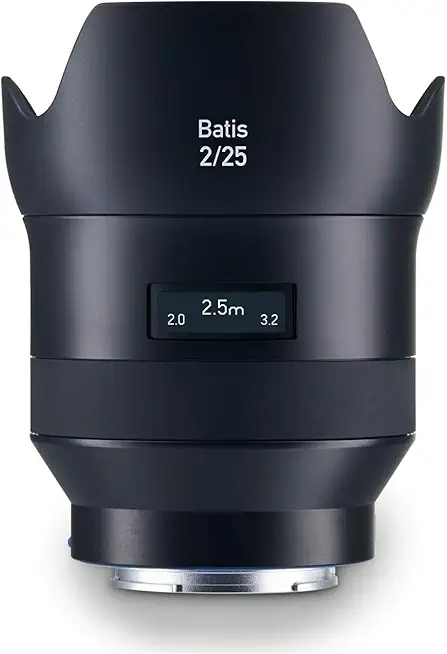
ZEISS Batis 25mm f/2.0 (Sony E-mount)
Premium wide-angle lens with Zeiss clarity, fast aperture, beautiful rendering, and fast, quiet autofocus—ideal for street, landscape, and documentary work.
Check PriceThe Zeiss Batis 25mm f/2 is a wonderfully practical choice for night shooters who prioritize portability without sacrificing image quality. At just 335 g it’s exceptionally lightweight, making it a no-brainer for long hikes to dark-sky sites or travel when you want minimal kit.
Optically it performs very well for low-light work: the Batis delivers excellent image quality with minimal aberrations and vignetting, so you get clean stars and sharp nightscapes without fuss. The lens’ OLED barrel display that shows focus distance and depth of field is genuinely useful when you’re working in the dark and need quick visual confirmation for manual focus or hyperfocal settings.
Handling is one of its quiet strengths. The smooth, sticky rubber focus ring gives precise manual focus in the dark, which is invaluable for astrophotography or composed night scenes when autofocus can struggle. It also balances nicely on Sony full-frame bodies, making handheld night shooting comfortable and stable for longer sessions.
Realistically, the one practical compromise is the f/2 maximum aperture — very capable, but not as “fast” as f/1.4 or f/1.8 options if you’re trying to squeeze every stop of light for extreme low-ISO astrophotography. You’ll also want to be aware of supply and support: being a third‑party option means firmware updates and availability can be less reliable than native-brand glass.
- Very lightweight — 335 g
- Excellent image quality; minimal aberrations/vignetting
- Smooth rubber focus ring for precise manual focus
- OLED barrel display shows focus distance & DOF
- Maximum aperture f/2 — not as fast as f/1.4 or f/1.8
- Third‑party lens — limited availability and firmware/support
Why Wide-Aperture Lenses Matter at Night
At night the most precious thing is light, and a lens’s aperture is your gatekeeper. Wide-aperture glass (f/1.4 to f/2) lets far more photons hit the sensor, turning scenes that would otherwise be murky into usable images.
That extra light means you can shoot with lower ISO and faster shutter speeds. Lower ISO preserves detail and reduces noise; faster shutters freeze motion from people, cars, or wind-blown foliage. In practice a bright lens often makes the difference between a tack-sharp handheld shot and a noisy blur.
Wide apertures also give you creative control. A shallow depth of field isolates a subject from messy urban backgrounds and produces creamy bokeh that sets mood for portraits and street scenes. Just be mindful that focus gets razor-thin at f/1.4–f/1.8, so take a little extra time to pin the focus or stop down if you need more depth.
For night landscapes and the Milky Way, a fast lens is essential. It gathers more starlight per second, so you can keep exposures short enough to preserve pinpoint stars without a tracker. High-quality fast optics also tend to control coma and edge aberrations better, so the stars remain points across the frame.
There’s a practical middle ground I use all the time. Open wide to collect light, then stop down a half or full stop when you want cleaner corners and sharper stars while still avoiding high ISO. The result is usually a cleaner, more detailed file than pushing a slower lens hard.
Finally, a bright lens gives you compositional freedom in near-darkness. You can frame by eye, isolate foregrounds with a single lamp, or create moody portraits without wrestling your ISO up to junky levels. If you shoot nights frequently, prioritizing aperture in your lens choice pays dividends in both image quality and creative possibilities.
Autofocus Performance in Low Light
Autofocus at night is often the difference between a wasted hike and a keeper. In very low light both contrast- and phase-detect AF can hunt, miss, or simply refuse to lock.
That’s why lens and body design matter as much as composition. Fast, accurate AF motors — like Sony’s XD linear systems — are noticeably quicker and quieter, which cuts down on hunting when there’s only a sliver of light to work with.
A bright aperture helps too. Primes at f/1.4–f/1.8 give the AF system more photons and will usually get a lock where slower glass struggles.
Wide-angle lenses are also your friend for low-light focusing. Because depth of field is larger at shorter focal lengths, focus is more forgiving and wide glass often settles faster than long telephotos.
For critical star work I still default to manual focus. Smooth, well-damped focus rings, focus peaking and live-view magnification make manual focusing fast and dependable; lenses like the Zeiss Batis with an OLED distance readout make that even easier in the dark.
In the field I use a simple workflow. Use the center AF point and pre-focus on a bright distant light or a star, then flip the lens to manual to lock focus. This avoids hunting during long exposures and keeps your composition intact.
If your subject is moving, switch to continuous AF but expect slower tracking and occasional re-locks in poor contrast. Briefly illuminating the subject with a flashlight or using the camera’s AF assist gives the system the contrast it needs without ruining the shot.
Lenses with fast motors are especially helpful for street or event night work where you need AF to react quickly and quietly. That responsiveness can be the difference between capturing a fleeting moment and missing it.
Practice these techniques before a shoot so you know when to trust AF and when to go manual. Between bright glass, a responsive AF motor and simple pre-focus habits you’ll consistently get sharper night images.
What People Ask Most
What are the best Sony lenses for night photography?
Look for lenses that gather a lot of light and offer good edge-to-edge sharpness and low aberrations. Match lens size and weight to how you plan to shoot, whether hiking to dark-sky sites or shooting handheld in the city.
Which Sony lenses are best for astrophotography and Milky Way shots?
Ultra-wide lenses with strong sharpness across the frame and minimal coma are typically preferred for sky work. Good light-gathering and low distortion help keep stars as sharp points.
Which Sony lenses perform best in low-light/night conditions?
Lenses with wide apertures, effective coatings, and reliable autofocus tend to perform best in low light. Durability and portability also affect real-world usability after dark.
Are prime or zoom Sony lenses better for night photography?
Primes often offer faster apertures and excellent sharpness, while zooms provide framing flexibility and convenience. Choose based on whether you prioritize maximum light-gathering or adaptability in the field.
What focal lengths are best for night photography on Sony full-frame cameras?
Ultra-wide and wide focal lengths work well for landscapes and star fields, while mid-wide and standard lengths suit street scenes and portraits at night. Select focal length based on the scene scale and your composition goals.
Is the Sony FE 35mm f/1.4 a good lens for night photography?
It can be a strong option when you want a normal perspective with good low-light capability. Consider its image quality, autofocus behavior, and handling for the types of night shots you take most.
Can the Sony FE 24mm f/1.4 or ultra-wide Sony lenses be used for night sky photography?
Yes, fast wide and ultra-wide lenses are commonly used for night sky photography because they capture broad scenes and gather more starlight. Check for good edge performance and low coma to ensure clean star rendering.
Conclusion for Best Sony Night Lenses
Choosing the right glass is the single most practical way to improve your night photography, since the right lens directly affects how much light, sharpness, and field of view you can work with.
This guide focused on the main strengths you’ll want to weigh—ultra-wide perspectives for sky shots, bright apertures for low light, compact designs for long hikes, and zooms for flexibility—so you can pick what fits your workflow and shooting conditions.
Match your choice to your style: prioritize maximum light for deep-sky and low-ISO work, choose portability for travel and handheld night walks, or opt for focal-range flexibility when composition matters on the fly.
If you want to sharpen your technique and gear knowledge, explore more articles on the site to learn practical tips, comparisons, and shooting workflows that will speed your progress.
Have a question about a setup or a shooting scenario? Leave a comment below and we usually reply within a few hours to help you refine your choices.
Ultimately, practice and experimentation with the right lens for your goals will produce the best night images, so get out there and start shooting.




0 Comments