
Ever missed the perfect wingbeat because your gear couldn’t keep pace with the action? If you crave crisp, cinematic footage of backyard visitors or rare migratory moments, finding the best video camera for bird watching makes all the difference.
This ultimate guide walks you through five standout video cameras, the practical buying criteria that matter, straightforward placement tips, and a helpful FAQ to answer common doubts. Whether you’re a weekend backyard birder, a teacher wanting nest-cam lessons for a classroom, or a wildlife videographer chasing flight sequences, you’ll find clear, usable advice.
We’ll demystify what truly impacts your results — from image clarity and autofocus responsiveness to low-light performance, power choices, and connectivity for remote viewing. Expect plain-language buying tips, real-world placement tactics for feeders and nest boxes, and guidance on balancing portability, battery life, and weatherproofing.
By the end you’ll know which camera class suits your space, budget, and shooting style, plus how to position it for compelling close-ups and natural behavior captures. Ready to bring the birds into sharp focus with the best video camera for bird watching? Let’s get started.
1. Bird Buddy Smart Bird Feeder Camera
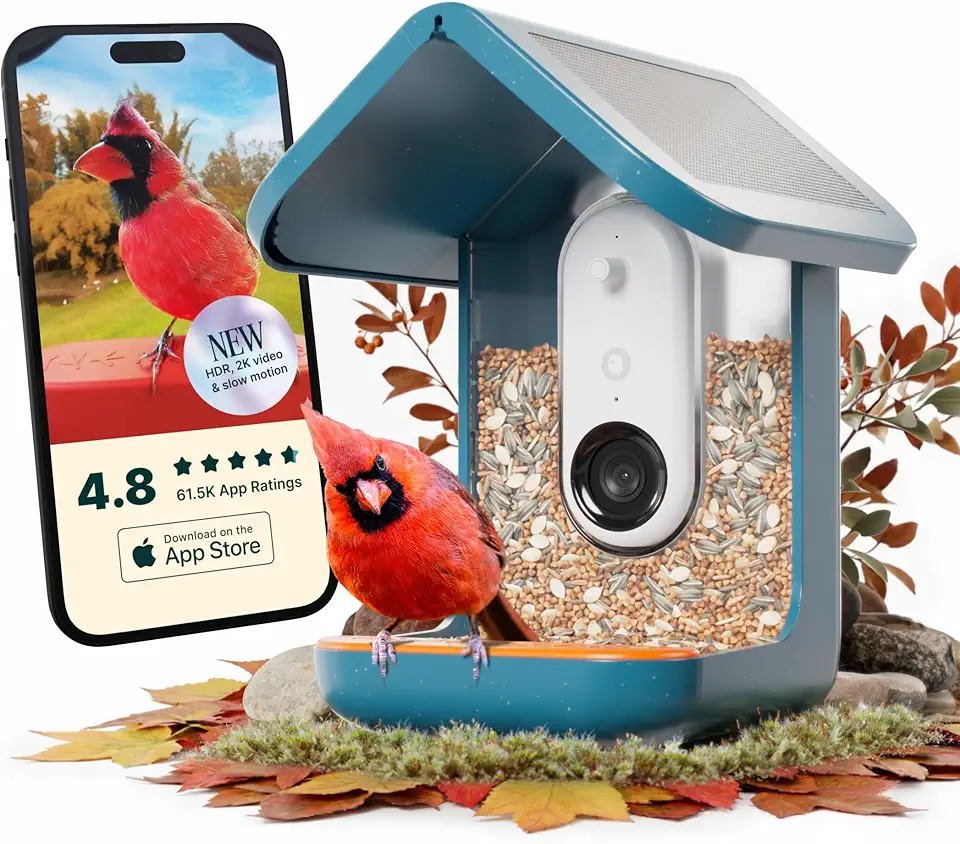
BirdBuddy PRO Solar Smart Bird Feeder with Camera
Solar-powered station captures high-resolution bird photos and livestreams, with AI alerts and easy app sharing for backyard nature enthusiasts.
Check PriceAs a photographer who spends hours watching backyard feeders, I appreciate gear that simplifies capture without getting in the way. The Bird Buddy Smart Bird Feeder Camera delivers a practical balance: 5MP stills with wide dynamic range and video from 720p up to 1080p. Image quality is tuned for feeders and close visits rather than long-distance telephoto work.
The 120-degree field of view is one of its strongest features. It frames the feeder and surrounding perches, so you catch approach behaviors and social interactions. That wide perspective makes it easier to tell a story in both stills and short video clips.
Its AI bird recognition is genuinely useful. It labels species automatically and reduces time spent trawling footage. Real-time visit notifications to your phone mean you rarely miss an interesting visitor and can start live viewing the moment birds arrive.
Power options are flexible. It runs on a rechargeable lithium-ion battery for easy maintenance, and there’s a solar roof option to extend operation and reduce frequent recharging. For regular backyard use, the solar option turns this into a near‑set‑and‑forget device.
The main trade-offs are connectivity and power without solar. The camera requires Wi‑Fi for storage and smartphone app compatibility, so remote sites without reliable connectivity will be limited. And battery life can be constrained if you skip the solar roof.
- AI bird recognition identifies species
- Wide 120-degree field of view captures surrounding action
- Solar roof option extends operation without frequent recharging
- Real-time notifications for live viewing
- Requires constant Wi‑Fi connection for storage/app use
- Battery life can be limited without the solar option
2. Technaxx TX-165 Full HD Birdcam Feeder

Solar Smart Bird Feeder with Camera 2K HD AI Bird Identification
2K HD imaging and AI identification deliver instant species recognition, motion-triggered recording, and cloud storage for effortless backyard wildlife monitoring.
Check PriceAs a photographer who spends hours watching and recording backyard birds, I appreciate the practical strengths of the Technaxx TX-165 Full HD Birdcam Feeder. It pairs an 8MP sensor with a 1/3.2″ CMOS and Full HD 1080p video, so footage is crisp and detailed for close-up feeder activity without needing a big camera rig.
The TX-165 has a 100-degree field of view, which gives you plenty of context around a feeder or perch while still keeping subjects large in frame. A 0.3 second trigger speed catches most visits reliably, so you won’t miss the quick hops and landings that make for compelling clips.
Night recording is handled by 940nm LEDs, which are effectively invisible to birds and let you capture nocturnal or crepuscular species without disturbing them. For placement and longevity, the unit is weather resistant and designed for outdoor use, so it stands up to rain and wind better than many indoor-focused designs.
Power is simple: 4 AA batteries can run the unit for up to six months depending on activity, which is a major convenience if you want long-term, low-maintenance monitoring. The trade-off is that there’s no Wi‑Fi connectivity, so you’ll retrieve footage from the camera rather than streaming live to a phone.
If you want a budget-friendly, hard-working feeder camera to record clear day and night footage with minimal fuss, the TX-165 is a solid choice. If you need real-time viewing or automated species ID, however, plan to complement this unit with a separate app-based system or manual cataloging of clips.
- Sharp, high-definition video day and night
- Budget-friendly option
- Long battery life with AA cells (up to six months)
- Durable and weather resistant
- No Wi‑Fi connectivity for real-time viewing
- No AI bird identification features
3. OM System OM-1 Mark II

OM SYSTEM OM-1 Mark II Micro Four Thirds Camera 20MP
Rugged mirrorless 20MP micro four thirds camera offering fast autofocus, pro-grade stabilization, and weather-sealed durability for demanding shooters.
Check PriceThe OM System OM-1 Mark II is a compact powerhouse for bird watching thanks to its 20MP Four Thirds Stacked BSI Live MOS sensor. That sensor gives you good detail and responsiveness, which helps when birds appear and disappear fast in the frame.
Autofocus is where this body really shines: a 1,053-point AI detect Quad Pixel AF with a dedicated bird-detection mode locks onto eyes and heads more reliably than generic AF systems. In practice that means you spend less time hunting focus and more time shooting decisive moments.
For action sequences, the burst rates are exceptional — up to 50fps with continuous AF and a whopping 120fps with fixed AF. Those speeds let you capture wingbeats and fleeting behaviors that normal frame rates miss. Pair that with 5-axis in-body stabilization and you get steadier handheld clips and cleaner frames when using longer lenses or shooting at slower shutter speeds.
Weather sealing rounds out the package, making the OM-1 Mark II a durable option for field work and damp mornings at the feeder. Low-light performance is strong, so dawn and dusk sessions are more usable without unacceptable noise.
There are a couple of practical caveats. Bird AF must be engaged manually, so you need to set it up before the action. Also, the menu system can feel complex at first, which may slow you down until you’ve customized key settings.
- Highly accurate bird-detection autofocus
- Very fast burst shooting (50fps C-AF, 120fps fixed AF)
- 5-axis in-body stabilization for steadier handheld work
- Weather-sealed and strong low-light performance
- Bird AF must be engaged manually
- Menus can be complex to learn
4. Nestera Birdhouse with Camera

Smart WiFi Birdhouse Camera 1440p HD Outdoor Bird Box
Crystal-clear 1440p livestreaming, motion alerts, two-way audio, and weatherproof design for immersive nesting observation from anywhere via WiFi.
Check PriceAs a photographer who loves documenting intimate bird behavior, the Nestera Birdhouse with Camera is a thoughtful, purpose-built option for anyone focused on nest activity. It’s designed to deliver detailed, close-up footage rather than sweeping landscape views, so expect it to excel at monitoring eggs, hatchlings, and parental visits. For backyard birders and educators it’s mostly a win — especially when you want approachable, hands-off observation.
The camera records at 2560×1440p video, which gives you crisp detail at close range that’s easy to crop or examine later. It supports live streaming capability so you can watch events in real time, and it saves footage to a microSD card for local archival and easy editing. The housing is an attractive wooden nesting box that blends into garden settings and doubles as a legitimate home for birds.
In practical use the high resolution pays off: you’ll capture feather patterns, bill interactions, and chick growth with clarity that lower-res boxes miss. The trade-off is the limited field of view — the camera is focused on the nesting box interior, so you won’t get much context around the site or distant perch behavior. Still, if your goal is detailed nest observation, that focus is what makes the footage compelling.
This setup is ideal for classrooms, citizen-science projects, and families introducing kids to natural history because the wooden box looks natural and the live stream lets groups watch together. Storage to microSD means you can keep a season’s worth of footage without relying on cloud subscriptions. Just remember it’s daytime-oriented work; there’s no night vision built in.
Mount the box in a sheltered spot with good morning light and a clear line of sight to entry holes to maximize image quality. Keep an eye on memory card capacity and weatherproofing of the mount, and you’ll have a reliable, educational window into nest life.
- 2560×1440p close-up video
- Live streaming for real-time monitoring
- Attractive, functional wooden nesting box
- Good educational value for kids and classrooms
- Limited field of view
- No night vision capability
5. Green Feathers 1080p WiFi Bird Box Camera

WIWACAM WiFi Bird Box Camera 4K Night Mode Live Streaming
Ultra-HD 4K video with low-light night mode, seamless live streaming, and remote access for vivid day-and-night birdwatching.
Check PriceThe Green Feathers HD 1080p WiFi Wildlife Bird Box Camera is a practical, photographer‑friendly option if your focus is on close-range nesting activity and backyard perches. It records in HD 1080p, which delivers clean, shareable footage without the file sizes of 4K—ideal for long monitoring sessions and quick uploads.
A 2.8mm wide‑angle lens gives a 110‑degree field of view, so you capture the entire interior of a bird box or a broad view of a feeder and nearby branches. That wide coverage makes composition forgiving; you’ll spend less time finessing the angle and more time watching behavior.
For low‑light conditions it includes four night‑vision LEDs with roughly a 1m effective range, so nocturnal visits or twilight activity inside a box are visible. Bear in mind that the night vision is designed for close proximity rather than long-range infrared surveillance.
Connectivity is straightforward: Wi‑Fi enables live streaming and recording to compatible apps or devices, which is excellent for remote monitoring or sharing clips with fellow birders. Installation is user‑friendly—mounting screws are included—and the camera ships with a 10m power cable to plug into a nearby outlet.
Plan your setup around that power lead; the 10m cable is convenient for many backyard installations but may require extension for larger properties. Overall, this camera is mostly a “set-and-forget” solution for nestboxes and close feeder work, balancing image quality, ease of use, and night capability.
- Wi‑Fi streaming and recording
- Night vision with four LEDs (≈1m range)
- Wide 110° field of view (2.8mm lens)
- Easy installation with mounting screws
- Resolution limited to HD 1080p
- 10m power cable may be insufficient
How to Choose the Right Camera
Start by matching the camera to where and how you’ll watch birds. If you’re focused on feeders or a nest box, a wide-angle 1080p camera (think 2.8mm ≈110°–120° FOV) gives context and captures arrivals without constant re-aiming. For distant perches or shorebirds, opt for a bridge camera or mirrorless body with a long telephoto—something with true optical reach rather than digital zoom.
Autofocus and tracking are the features that separate usable footage from frustrating blur. Modern mirrorless bodies with bird-eye detection or fast phase-detect AF will lock onto small, erratic targets and keep them sharp in flight. If your subject moves fast, prioritize AF performance and high burst rates over megapixel counts.
Think about smart features and power next. Motion detection, adjustable PIR sensors, and AI identification can save storage and battery by only recording meaningful activity, but they often require constant Wi‑Fi for alerts and cloud storage. For remote setups, consider solar options or cameras that run on replaceable batteries to avoid frequent climbs up the ladder.
Night vision and low-light sensitivity matter if you want dawn, dusk, or nocturnal footage. Infrared LEDs can record activity at night but change the look of the footage; color low-light sensors give more natural results at the cost of complexity. Balance your desire for 24/7 coverage with how much detail you actually need.
Durability isn’t glamorous but it’s essential. Choose weather-sealed, outdoor-rated units if the camera will face rain, wind, or heat, and pick models with flexible mounting—pole brackets, tree straps, or tripod threads make repositioning easy. A poorly mounted camera ruins good footage faster than any other mistake.
Finally, accept trade-offs and consider a two-camera approach if budget allows: one wide-angle for behavior and context, and one long-reach or high-resolution unit for close-ups. That combo gives you the best of both worlds without forcing one camera to be everything to everyone.
Camera Placement for Optimal Views
Think of camera placement the same way you frame a photograph. I often start by identifying where birds naturally congregate — feeders, baths, low shrubs, or favored perches — and make that my anchor point. Positioning the lens to capture those activity zones will reward you with far more usable footage than random mounting.
Height matters. Mounting the camera around six to seven feet high and angling it down at roughly 40–45° gives a natural, slightly elevated perspective that shows behavior without feeling intrusive. For feeders and baths try to keep the camera three to twelve feet away so you get both context and detail; too close and you lose composition, too far and you lose expression.
Light makes or breaks your video. Whenever possible face the camera north to avoid strong backlighting and blown highlights, and plan shoots for early morning or late afternoon when birds are active and colors look best. If you can’t avoid the sun, tilt the camera to minimize direct rays and use nearby shade or foliage to soften contrast.
Concealment and minimal disturbance are key. Camouflage the housing with natural materials or tuck it into dense foliage so birds ignore it, and do all installation quietly so they acclimate quickly. Keep cables tidy and out of sight to avoid creating perching hazards or visual clutter in the frame.
Think in layers. Use a wide-angle camera to establish context and a secondary close-up to capture bill-feeding, eye detail, or nest activity. Make sure the foreground is clear of branches and that the background is a few meters behind your subject to create pleasing separation and gentle bokeh.
Finally, treat placement as an iterative process. Review your footage regularly, note patterns in activity, and nudge the camera a few centimeters at a time until the framing, trigger reliability, and lighting all come together. Small adjustments pay big dividends in storytelling.
What People Ask Most
What is the best camera for bird watching?
There is no single best camera; the right choice depends on your goals, budget, and whether you prioritize reach, autofocus, or portability. Choose a model that balances reliable autofocus, a suitable field of view, and weather resistance for your typical shooting conditions.
What features should I look for in a bird watching camera?
Look for accurate autofocus, a versatile field of view, good low-light performance, and durable weatherproofing. Extras like motion detection, remote connectivity, and flexible power options make long-term monitoring easier.
Is mirrorless or DSLR better for bird watching and bird photography?
Both systems can deliver excellent results; mirrorless bodies often offer advanced autofocus and lighter handling, while DSLRs remain valued for ergonomics and lens availability. Pick the system that provides the lenses and handling you prefer.
How important is autofocus for bird watching cameras?
Autofocus is crucial for capturing quick, unpredictable bird movements. Reliable continuous autofocus and good tracking greatly increase the chances of keeping subjects sharp during flight and rapid activity.
Do I need a long zoom lens for bird watching?
A long zoom is helpful for distant subjects and tight framing, but it is not the only option; positioning cameras closer at feeders or using wide-angle box cameras can provide compelling footage. Balance reach with weight, cost, and how you plan to mount or carry equipment.
Can I use a camcorder or compact camera for bird watching?
Yes, camcorders and compact cameras can work well for casual observation and simple setups. They may lack some reach or advanced autofocus features of larger systems, but they are portable and often easier to operate.
What camera settings are best for filming birds in flight?
Use a fast shutter, continuous autofocus, and a frame rate that captures smooth motion while keeping exposure steady. Choose lenses and stabilization that help maintain a steady view as birds move through the frame.
Conclusion on the Best Bird-Watching Cameras
We compared five recommended bird-watching cameras and summarized their main features, pros, and trade-offs to help you choose gear suited to backyard birding, education, or wildlife videography.
Prioritize the capabilities that matter most to your goals—resolution and field of view, power and connectivity, autofocus and low-light performance, and ruggedness for outdoor use.
Before committing, test placements and angles, review sample footage, and tweak mounting and concealment until you capture the behavior and perspectives you want.
Use the buying criteria and FAQs as a checklist to refine your shortlist and feel confident in the camera that best matches your needs.
If you want to improve your filming and setup skills, read more articles on our site to learn practical tips and techniques at your own pace.
Have a question or a setup to share? Leave a comment below and we usually reply within a few hours.



0 Comments