
Looking for the best wireless mic for interviews to capture clean, natural-sounding voices without wrestling cables or distracting noise? This guide helps you choose wisely by cutting through marketing buzz and focusing on the real tradeoffs that affect clarity, reliability, and your day-to-day workflow, whether you’re shooting a quick vox pop or a multi-camera sit-down.
Whether you’re a journalist chasing sound on location, a vlogger shooting solo, a broadcaster handling live segments, or a documentary filmmaker recording fragile interviews, the right wireless system makes the difference in settings from cramped press conferences to windy rooftops. Interviews demand clear voice reproduction, minimal handling and ambient noise, and a wireless link you can trust when subjects move or schedules tighten. A single dropout or muffled line can ruin hours of work.
We’ll walk you through practical considerations and realistic tradeoffs so you can match a wireless mic to your environment, budget, and workflow. Expect plainspoken advice on what matters in the field, how to avoid common wireless headaches, and practical tips for keeping audio consistent across takes and locations under pressure. By the end you’ll be ready to pick the best wireless mic for interviews that fits your needs and lets the voices tell the story, whether you’re editing for fast turnaround or prepping a festival cut.
1. Shure ULXD2/KSM9 Overview

Shure ULXD2/KSM9 Handheld Transmitter with KSM8 Capsule (G50 band)
Premium digital wireless system delivering pristine vocal clarity, rugged build, and reliable RF performance for professional live sound and touring.
Check PriceShure ULXD2/KSM9 is my go-to recommendation when the interview audio has to be flawless under pressure. It’s positioned as a top-tier choice for live interviews, events and broadcast work, and you can hear that focus in the way it renders voices. If you need pristine, dependable vocal capture, this system was built for that job.
In practice the ULXD2/KSM9 delivers exceptional vocal clarity and a very natural reproduction, with negligible interference even in busy RF environments. Latency is virtually zero, which makes it safe for live broadcast or any sync-critical workflow where picture and sound must stay locked. For on-the-fly interviews and multi-camera shoots that depend on tight sync, that low latency is invaluable.
The build quality is rugged, designed for frequent setup and travel — think road-ready durability that survives daily shows and festival runs. Battery life is long enough for full-day events, so you rarely have to cut a session short to swap power. For shooters and audio techs who move between locations, that robustness and runtime reduce the number of things that can go wrong on set.
Technically it also supports multiple simultaneous channels, which is essential for large productions or panel interviews. The interchangeable KSM9 capsule gives you tonal flexibility to match different voices and environments, so you can tailor the mic to the talent rather than forcing the talent to adapt. This system is aimed at broadcast professionals, live-event producers and musicians who need absolute reliability and top-end sound.
- Industry-leading sound & RF reliability
- Rugged build for frequent travel
- Flexible multi-channel support
- Interchangeable KSM9 capsule
- High cost
- Steeper learning curve — aimed at pros
2. Audio-Technica ATW-T1002 Overview
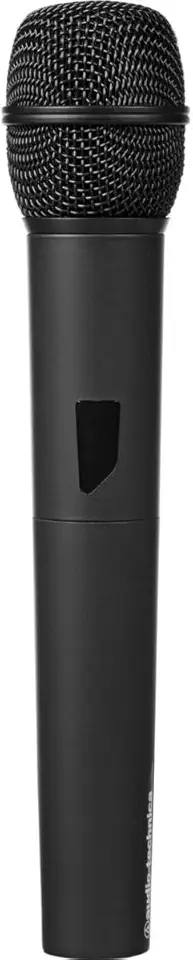
Audio-Technica ATW-T1002 System 10 Handheld Transmitter
Compact 2.4GHz wireless solution offering clear audio, intuitive setup, and battery-efficient operation ideal for presentations, interviews, and small performances.
Check PriceThe Audio-Technica ATW-T1002 is a dependable, no-nonsense wireless kit I often recommend for on-location interviews and run-and-gun shoots. It’s widely used by presenters and interviewers because the setup is fast and forgiving when you’re moving between locations.
Sound is clear and balanced with minimal noise or interference both indoor and outdoor, which is exactly what you want for conversational voice work. It won’t match flagship broadcast systems for absolute fidelity, but for journalism, corporate interviews, and indie filmmaking it delivers very usable audio without fuss.
Frequency management is handled automatically by the unit’s internal frequency selection, so you don’t need to spend time scanning and tuning in the field — a real time-saver in crowded RF environments. The system supports up to 8 simultaneous channels and is reliable with at least 4, making it practical for small multi-person interviews or quick panel setups.
Battery life averages about ~4 hours, so plan to swap batteries or carry spares for longer shoots or full-day events. Build quality is solid enough for travel and regular field use, and the straightforward controls mean you can hand the gear to a producer or assistant without a long briefing.
- Quick setup
- User-friendly operation
- Reliable connection (up to 8 channels)
- Solid build for travel
- Battery life ~4 hours
- Not top-tier sound vs pro systems
3. Sennheiser EW 500 Overview
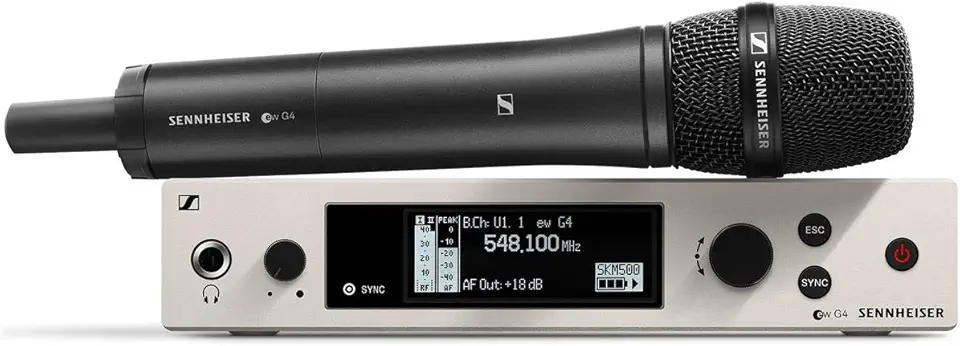
Sennheiser ew 500 G4-935 Wireless Vocal Set
Professional-grade wireless vocal kit with robust transmission, superior mic capsule, and versatile frequency options for consistent stage performance.
Check PriceAs someone who records interviews on location, I appreciate gear that just works when the cameras roll. The Sennheiser EW 500 is built for that reliability, with stable UHF transmission and high RF output that keeps feeds solid in crowded RF environments.
Audio is clean and natural with low noise and plenty of headroom, so voices sound true without harsh coloration. That transparency makes it easy to match handheld, lavalier, or broadcast sources in post.
Where the EW 500 really shines is scale: it supports up to 32 channels simultaneously and offers 3,520 selectable frequencies across a fully tunable UHF range. For multicamera shoots, panel interviews, or festival stages, that tuning flexibility is a lifesaver against interference.
The unit is also made for field work — durable housing and rugged connectors mean it survives travel and repeated setups. The high RF output gives you confident range and fewer dropouts when subjects move around.
It’s not perfect for every run-and-gun scenario, though. Setup is more complex than compact plug-and-play systems, and the package is pricier and bulkier than small creator-focused kits. If you’re a broadcast engineer or professional audio team running large productions, this system is mostly ideal. If you’re a solo vlogger, it may feel like overkill.
In short, choose the Sennheiser EW 500 when you need professional RF stability, large channel counts, and tunable UHF performance for interviews at scale. It’s a workhorse for production crews who prioritize reliability over compactness.
- Exceptional RF stability and range
- Up to 32 channels simultaneous
- 3,520 selectable UHF frequencies
- Durable field-ready build
- More complex setup
- Higher price; bulkier than compact systems
4. Rode Interview PRO Overview

RØDE Interview PRO Wireless Handheld Microphone
Portable interview microphone offering plug-and-play wireless connectivity, crisp dialogue capture, and long battery life for journalists and content creators.
Check PriceAs a photographer who often records sit-down and run-and-gun interviews, the Rode Interview PRO feels purposely built for that workflow. It’s a robust handheld with an omnidirectional pickup, so you don’t need perfect mic placement to get usable audio from your subject.
Soundwise it leans neutral and natural, which is exactly what I want for voice reproduction. Handling noise is minimal and the off-axis performance is excellent, so the mic remains forgiving if the subject turns or the hand position shifts.
The feature that really sold me is the internal 32-bit float recording. That gives a massive dynamic range and makes clipping virtually impossible, so you get a safety net on every take. The Interview PRO also transmits to a receiver while recording internally, so you effectively have a live feed and a backup file without changing workflow.
Battery is USB-C rechargeable with a practical runtime in real-world use, although reviews didn’t quote an exact hour figure. One notable limitation is monitoring: there’s no headphone output on the mic, so you must rely on the record indicator light rather than listening in to confirm levels on location.
In short, this is a great handheld for journalists, documentary filmmakers and solo shooters who want a rugged mic with built-in redundancy. It’s not as discreet as a lavalier and lacks onboard monitoring, but if you value a tough, forgiving handheld that records safely while sending a wireless feed, it’s a very strong choice.
- Forgiving off-axis pickup
- Internal 32-bit float backup
- No handling noise
- Durable build
- No onboard headphone monitoring
- Internal battery not user-replaceable
5. DJI Mic 2 Overview

DJI Mic 2 (1 TX + 1 RX) Wireless Microphone
Ultra-compact dual-unit wireless lavalier kit delivering clear, low-latency audio, secure transmission, and simple mobile-ready integration.
Check PriceThe DJI Mic 2 is clearly aimed at mobile creators — vloggers, journalists and podcasters who need a compact, reliable kit for on-the-go interviews. As a photographer who often doubles as an interviewer, I appreciate gear that balances sound quality with fast setup and portability.
Audio comes through clear and crisp, and the effective AI noise cancellation really helps in busy, uncontrolled environments. The system includes dual transmitters with internal backup recording (up to 14 hours), which gives practical redundancy for two-person interviews or when you can’t afford a dropout.
The touchscreen receiver is a standout for field use: you get real-time gain control and a headphone output for monitoring, so levels are easy to nail before rolling. Connectivity is flexible — it works with cameras, smartphones (included adapters), and computers — making it plug-and-play across most shooting rigs.
Battery life is solid for a compact system, and the charging case extends field usability so you can shoot multiple interviews without hunting power. The unit is lightweight and portable, with magnetic attachments that make fast lav placement and retrieval simple during run-and-gun shoots.
If you’re primarily a content creator or mobile journalist, the DJI Mic 2 is mostly a win — feature-rich, tolerant of noisy locations, and built for two-person workflows. Be aware it’s bulkier than a single-mic setup when both transmitters are in use, and it sits at a premium price compared with basic lavalier kits.
- Strong AI noise cancellation
- Dual-transmitter redundancy with 14-hour internal recording
- Intuitive touchscreen + real-time monitoring
- Compact, portable design with magnetic attachments
- Bulkier when using both transmitters
- Premium price vs basic lavs
Key Features in Wireless Interview Mics
When choosing a wireless interview mic, audio quality should be your first concern. Look for clear, broadcast-grade reproduction with a wide frequency response and strong dynamic range so soft whispers and loud exclamations both come through without distortion. In real shoots this saves hours in post because you’ll spend less time EQing and fixing noise.
Wireless performance is the invisible backbone of any field setup. Aim for systems that offer at least 100 meters line-of-sight and solid interference resistance — either a robust 2.4GHz digital link or a tunable UHF system — and check whether the unit supports multiple simultaneous channels if you run more than one mic. Automatic frequency management is a lifesaver in crowded RF environments, but always sweep and lock channels before you start.
Compatibility and convenience determine how smoothly a mic fits your workflow. Prefer units with USB-C, Lightning or 3.5mm outputs and reliable adapters if you plug into phones or cameras, and target batteries that give 7+ hours or a charging case for all-day work. Look for simple auto-pairing and intuitive controls so you can focus on framing and directing, not fiddling with menus.
Durability and form factor matter in the field. Lavalier mics score for discreteness and mobility, shotguns for controlled sets, and handhelds for live events; choose the type that matches the scene. Insist on rugged connectors, good wind protection, and secure mounting; clip lavaliers tightly, use thin tape under clothing to stop rustle, and always carry a foam or fur windshield.
Finally, build redundancy into your plan. Headphone monitoring and internal recording on transmitters give you immediate feedback and a safety track if the link drops. Before you roll, do a quick hood-to-hood test: monitor, record a short take, and verify levels — that small ritual prevents most on-set audio disasters.
Wireless Mic Types: Lavalier, Shotgun, Handheld
When I rig for interviews I first pick the mic type that matches the scene. A lavalier is my go-to for run-and-gun interviews and walk-and-talks because it clips close to the mouth, stays discreet, and gives consistent, intimate audio as the subject moves. Be mindful of clothing rustle and jewelry; pin the mic to a stable layer about 6–8 cm below the chin, hide the cable, and use a small foam or fur windshield outdoors. In noisy environments I often swap to a cardioid lav for better off-axis rejection.
On controlled sets where I want the cleanest possible dialogue, a shotgun on a boom shines. Its narrow pickup pattern rejects side noise and delivers rich, clear sound when positioned correctly. The catch is you need an experienced boom operator, a shock mount, and proper wind protection; even an inexpensive shotgun will outperform a lav if you can place it just out of frame and aimed toward the mouth.
Handheld mics remain invaluable for live events, panels, and vox-pop work. With cardioid or supercardioid patterns they focus on the speaker and are easy to pass between people. They’re visible and that’s sometimes desirable — the traditional, authoritative look for on-camera interviews — but remember to manage handling noise and maintain consistent distance from the mouth.
In practice most single-subject interviews are best served by a wireless lav for balance of audio, mobility, and discretion. For higher-end productions or noisy locations, prioritize a boom-mounted shotgun. For group discussions, Q&As, or fast-paced street interviews, a handheld is the reliable choice. Match your gear to subject movement, the environment, and your workflow, and always plan for wind protection and secure mounting—good placement will rescue more recordings than the fanciest mic ever will.
What People Ask Most
What is the best wireless microphone for interviews?
There is no single best choice — pick a system that matches your use case and workflow. Broadcast professionals often prioritize RF reliability and multichannel capability, while mobile creators may prefer compact, feature-rich systems for on-the-go use.
What is the best wireless lavalier mic for interviews?
For discreet wearable setups, choose lavalier‑capable systems that are specifically designed for body‑worn use. Compact dual‑transmitter kits and dedicated lavalier kits are common options for reliable, unobtrusive interview audio.
How do I choose the right wireless mic for interviews?
Prioritize audio quality, wireless stability, and compatibility with your camera or phone, and consider battery life and ease of use. Match the mic type — lavalier, shotgun, or handheld — to the environment and the subject’s movement.
Are lavalier wireless microphones better than handhelds for interviews?
Lavalier mics are typically more discreet and offer consistent close‑source audio, making them great for most sit‑down or moving interviews. Handhelds are better when you need to pass the mic between speakers or want a visible, traditional look.
How do you connect a wireless microphone to a smartphone or camera for interviews?
Use systems that offer plug‑and‑play connectivity with USB‑C, Lightning, or 3.5mm outputs and use the included adapters where provided. When available, use the receiver’s headphone output or onboard monitoring for real‑time audio checks.
What is the typical range of a wireless interview microphone?
Reliable consumer and prosumer systems commonly provide line‑of‑sight range around ~100 meters / 330 feet, while professional gear is noted for extended range and RF stability. Actual range depends on environment and obstructions.
How can I avoid interference and dropouts with wireless interview microphones?
Choose systems with strong interference resistance, such as digital transmission with encryption or tunable UHF options, and prefer gear with automatic frequency management. Where possible, use redundancy and backup recording to protect critical interviews.
Conclusion for Best Wireless Mic for Interviews
Choosing the best wireless mic comes down to matching model and microphone type to your interview context and production priorities, whether you need broadcast reliability or a compact creator-friendly setup.
Prioritize clear audio, stable wireless performance, dependable battery life, and a form factor that fits your workflow, and always test equipment in the field before a critical shoot.
Keep the intended use in mind — discreet lavaliers for mobility, shotguns for controlled sets, and handhelds for live or panel situations — and let movement, aesthetics, and monitoring needs guide your choice.
If you want to improve your interview audio and overall technique, explore more of our guides and reviews on the site to build confidence with different systems and setups.
Leave a comment with your situation or questions — we usually reply within a few hours and are happy to help you narrow down the right wireless mic for your needs.



0 Comments