
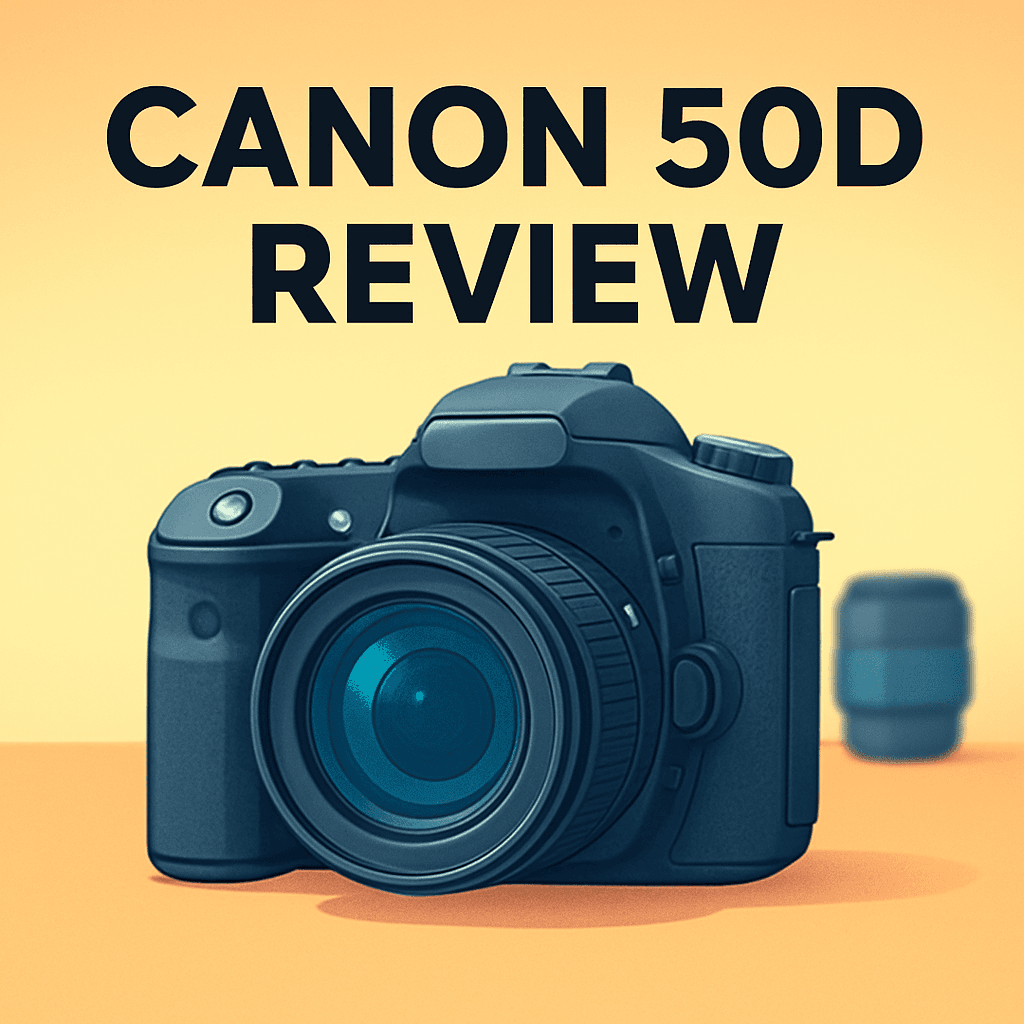
Want to know if an older DSLR can still improve your images and fit into a modern workflow?
I’ve field-tested the Canon EOS 50D Camera to see how this stills-first body holds up in real shooting conditions. It’s aimed at photographers who own Canon glass and don’t need video or in-body stabilization.
You’ll find straightforward handling, a fast shutter for basic action, and battery life that keeps you shooting all day. I’ll evaluate build, autofocus, noise limits, and everyday usability—make sure to read the entire review as I break down when this classic stills body still makes sense, so keep reading.

Canon EOS 50D Camera
Classic mid-range DSLR offering reliable image quality, durable magnesium-alloy construction, responsive autofocus, and an ergonomic grip. Ideal for enthusiast photographers seeking dependable performance and creative control in varied shooting conditions.
Check PriceThe Numbers You Need
| Spec | Value |
|---|---|
| Sensor | 15.1 MP APS-C |
| Processor | DIGIC 4 |
| Continuous Shooting | 6.3 fps |
| LCD Size | 3.0″ |
| Image Stabilization | None (in-body) |
| ISO Range | 100–3200 |
| Shutter Speed | 1/8000s to 30s |
| Autofocus Points | 9-point AF |
| Memory Slot | 1 × CompactFlash (CF) |
| Battery Life | Approx. 800 shots |
| Weather Sealing | Moderate |
| Lens Mount | Canon EF / EF-S |
| Aspect Ratio | 3:2 |
| Weight | Approx. 730 g |
| Dimensions | 5.7 × 4.3 × 2.9 in |
How It’s Built
In my testing the Canon EOS 50D feels like a classic DSLR — solid in the hand and built for shooting, not for showing off. The body has a reassuring heft that helps steady longer lenses, and the control layout is of its era: straightforward and right where you expect it. For beginners that means less fuss and more time composing shots.
I really liked the direct-access buttons and dials. In real use that lets you change exposure or ISO on the fly without digging through menus, which keeps you in the moment. The menus themselves are simple and quick to learn, so new shooters get up to speed fast.
Sealing around the body is modest but practical for field work; I had no trouble in light rain or dusty trails when I took it out. It’s not built to be dropped in a downpour, so I treated it like a partner you trust outdoors but still cover when the weather turns ugly.
The fixed rear screen and single CompactFlash slot show the camera’s age and are the one area I’d improve. That setup means no flip-out viewing angles and no card redundancy, so plan your workflow accordingly and bring a good CF card reader. On the plus side, the EF/EF‑S mount gives you a huge lens playground to grow into.
In Your Hands
The Canon EOS 50D’s modest multi-point phase-detect AF is dependable for single-point work and predictable in steady light, but it doesn’t match the subject-tracking smarts of newer bodies and can falter on erratic motion or low-contrast scenes.
Its burst capability is more than adequate for casual action, wildlife flurries, and event moments, yet buffer clear times and the simpler AF logic make prolonged sequences less practical than with contemporary sport-focused cameras.
Being a DIGIC-era design, menu navigation and exposure adjustments feel snappy in the hand, though write times to legacy media become noticeable during heavy shooting and influence how you pace captures.
Battery endurance is a real advantage for day-long outings, while the lack of in-body stabilization means you’ll lean on stabilized lenses or faster shutter speeds to keep images sharp in lower light.
As a stills-first camera it offers minimal movie capability, and its CompactFlash workflow fits into modern setups only with readers or adapters and a little patience for slower transfers; paired with Canon glass, the 50D rewards photographers who value tactile controls and dependable, classic DSLR performance.
The Good and Bad
- 1/8000s shutter speed for fast action and bright-light control
- 6.3 fps burst for basic action shooting
- Approx. 800-shot battery life for all-day stills
- EF/EF-S lens compatibility with a wide lens ecosystem
- Pre-video design with no modern video capability
- No in-body image stabilization
Ideal Buyer
The Canon EOS 50D remains a sensible tool for photographers obsessed with stills. If video is a nonstarter, this DSLR delivers the fundamentals—solid image quality, direct controls and rugged handling. It ages well as a second body or learning camera.
Best fit for shooters already invested in Canon EF and EF-S glass who want to squeeze extra life from older lenses. Pairing it with sturdy primes or a good zoom keeps costs down and sharpness high.
Action and outdoor shooters who prize a 1/8000s shutter, 6.3 fps burst and roughly 800-shot battery life will find it practical for long days. The straightforward, tactile layout favors photographers who prefer speed-of-use over touchscreen complexity.
Comfort with CompactFlash workflows and a fixed 3.0-inch rear LCD is part of the bargain. If you expect Live View autofocus, Dual Pixel benefits or 4K video, this isn’t the body for you.
It also suits field photographers who want modest weather sealing without flagship bulk. If simplicity, durability and access to the vast EF/EF-S lens ecosystem rank higher than modern AF and high-ISO performance, the 50D is a practical, affordable stills workhorse.
Better Alternatives?
We’ve gone over the Canon 50D and what it does well as an older, stills-first APS-C DSLR. It’s a solid, sturdy camera for people who care about shutter speed, a long battery, and a familiar Canon lens mount. But since the 50D is from an earlier era, many shooters will want to know what else is out there that fixes its limits—like better AF, higher resolution, Live View and video, or cleaner high-ISO files.
Below are a few real-world alternatives I’ve used in the field. I’ll explain how each one shoots differently than the 50D, what each does better and worse, and what kind of buyer will get the most out of it.
Alternative 1:

Canon EOS 90D Camera
High-resolution APS-C powerhouse with fast continuous shooting, 4K video capture, advanced autofocus subject tracking, and a versatile articulating touchscreen—designed for wildlife, sports, and hybrid content creators who demand speed, detail, and flexibility.
Check PriceI’ve used the Canon 90D a lot for birding and fast-moving subjects, and the first thing you notice compared to the 50D is the detail. The 90D’s much higher resolution and sharper modern sensor let you crop harder and still keep usable files — that’s a practical advantage over the 50D when you can’t get close. The autofocus and continuous shooting are also far more reliable, so tracking a subject through a scene feels less like guesswork.
Where the 90D is worse than the 50D is in file size and complexity. Those big files fill cards and hard drives faster, and the camera has more menus and features to learn. It’s also a bit heavier and more expensive. If you liked the 50D for its simple handling, the 90D’s extra bells and whistles can feel like overkill.
This is the camera I’d recommend to someone who shoots action, wildlife, or wants one body that can do both stills and video. If you need better AF, Live View, and 4K for hybrid work, the 90D is the clear step up from the 50D — just be ready for larger files and a higher price tag.
Alternative 2:

Nikon D7500 Camera
Advanced DX-format body delivering excellent low-light sensitivity, quick burst performance, accurate metering, and refined ergonomics. Perfect for enthusiasts seeking weather-sealed reliability, dynamic range, and sharp results across travel and action photography.
Check PriceIn real use the Nikon D7500 feels like a big step up from the 50D when shooting in dim light and when you need headroom in shadows. Its files clean up better at higher ISO, so you can push exposure in low light without the same noise you see on the 50D. The AF and burst speed are also stronger, so for sports or fast wildlife it simply nails shots that the 50D would miss or struggle to focus on.
The D7500’s downsides versus the 50D are mostly about lens choices and the user transition. If you’re deep in Canon glass, moving to Nikon means changing or adapting lenses. Also, the D7500 needs modern AF-S/AF-P lenses for silent, full AF support — older screw-drive lenses won’t autofocus on this body. And the menu feel and handling take some getting used to if you’re coming from Canon.
If you shoot a lot in low light, do action work, or want cleaner files for prints, the D7500 is a strong pick. It’s for photographers who want better dynamic range and high-ISO performance than the 50D and who don’t mind switching lens ecosystems or investing in modern Nikon glass.
Alternative 3:
Nikon D7500 Camera
Compact, rugged DSLR combining responsive autofocus, tilting touchscreen, long battery life, and broad lens compatibility. Offers balanced handling and dependable image quality for portraiture, adventure, and everyday shooting with confident performance.
Check PriceUsing the D7500 for travel and portraits shows another side of the camera: it’s compact and comfortable in hand, with a tilting screen that makes low-angle and street shooting easier than the 50D’s fixed LCD. Battery life is solid in real shoots, and the body feels well built in mixed weather — more confidence than the older 50D when you’re out in the field all day.
On the downside, the D7500 still doesn’t have Canon’s EF lens ecosystem, so you’ll trade the 50D’s wide lens choice for Nikon’s own range. Its video and Live View are more modern than the 50D, but if you want ultra-smooth autofocus for video you’ll need to pair it with the right lenses. Also, the D7500’s autofocus, while good, can still be outpaced by the newest mirrorless systems for tracking very erratic subjects.
Pick this version of the D7500 if you want a rugged, all-around camera that handles portrait, travel, and everyday shooting better than the 50D. It fits photographers who value a lighter, more modern shooting experience and cleaner images in a wider range of light — as long as they’re okay with Nikon lenses and the small learning curve that comes with switching brands.
What People Ask Most
Is the Canon 50D still worth buying?
Yes — it’s a solid, rugged APS‑C DSLR with good image quality for a low price, but skip it if you need modern features like Wi‑Fi, live‑view AF, or video recording.
How does the Canon 50D compare to the Canon 60D?
The 50D has a more professional, durable build and slightly snappier handling, while the 60D adds a vari‑angle LCD, better ergonomics and newer features, making the 60D more user‑friendly.
What are the pros and cons of the Canon 50D?
Pros: solid build, 15MP sensor, responsive controls and reliable performance; Cons: no video, older AF and ISO performance, and lacks modern connectivity.
Does the Canon 50D shoot video?
No — the Canon 50D does not record video and is designed for still photography only.
Is the Canon 50D good for low-light photography?
It’s usable at moderate ISOs, but noise rises quickly above ISO 800–1600, so newer cameras outperform it in very low light.
Is the Canon 50D a good camera for beginners?
It can be a great learning tool because of its manual controls and durability, but beginners may prefer a newer model with video, guides and wireless features.
Conclusion
The Canon EOS 50D Camera is a resolute stills-first DSLR that favors tactile controls and a straightforward shooting experience over modern bells and whistles. It feels built for photographers who want a dependable, no-nonsense tool rather than the latest tech. That vintage character is part of its appeal and its limitation.
Its strengths are obvious in the field: solid ergonomics, long-lasting battery behavior, a shutter and drive system that handle action when called upon, and broad access to Canon’s lens ecosystem. Paired with good glass and careful exposure, it still produces satisfying results for prints and web use. For many shooters those attributes are more than enough.
The compromises are equally clear. Autofocus and low-light latitude trail contemporary bodies, there’s no in-body stabilization or modern video features, and the camera relies on an older media and workflow. If you need cutting-edge AF, high-ISO performance, Live View flexibility or video, newer bodies are the smarter choice.
If you already own Canon glass and want a rugged, familiar stills platform the 50D remains a practical buy. If you crave future-proof versatility, opt for a modern APS-C option instead. In short: classic, capable, and niche — choose it for simplicity, not for everything.
Canon EOS 50D Camera
Classic mid-range DSLR offering reliable image quality, durable magnesium-alloy construction, responsive autofocus, and an ergonomic grip. Ideal for enthusiast photographers seeking dependable performance and creative control in varied shooting conditions.
Check Price

0 Comments