
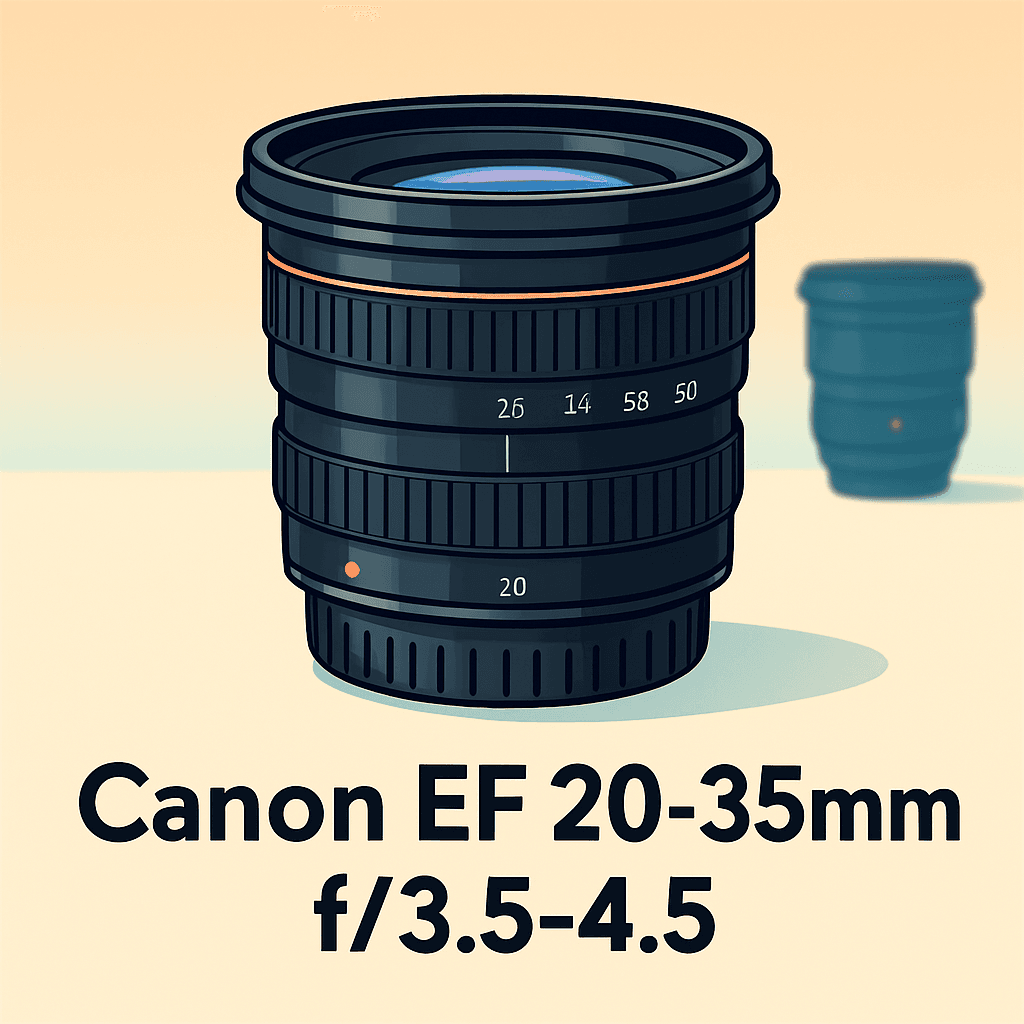
Want to know if the Canon EF 20-35mm f/3.5-4.5 is the wide-angle lens that’ll actually change how you shoot? It’s a compact EF full-frame zoom that promises simple, lightweight coverage and filter-friendly handling.
I’ve shot a lot of Canon wide-angle glass and put this one through real field work, so I’m focusing on how it feels and performs in everyday shoots. You’ll get hands-on notes about handling, real-world shooting, and optical behavior across the zoom range.
If you’re a travel, landscape, or interior photographer who values portability and filter compatibility over fast apertures or stabilization, this review’s for you. Make sure to read the entire review as I break down what it does best and where it trips up — keep reading.

Canon EF 20-35mm f/3.5-4.5
Versatile wide-angle zoom offering flexible framing from ultra-wide to standard wide, compact and lightweight build, smooth focus, ideal for travel and environmental landscapes capturing expansive scenes with natural perspective.
Check PriceThe Numbers You Need
| Spec | Value |
|---|---|
| Focal Length | 20–35mm |
| Maximum Aperture | f/3.5–4.5 |
| Lens Mount | Canon EF |
| Compatible Sensor Format | Full-frame |
| Lens Type | Wide-angle zoom |
| Lens Construction | 12 elements in 10 groups |
| Diaphragm Blades | 6 |
| Minimum Focus Distance | 0.38 m (1.25 ft) |
| Maximum Magnification | 0.23x |
| Filter Size | 77 mm |
| Autofocus | USM (Ultrasonic Motor) |
| Image Stabilization | None (relies on camera body) |
| Dimensions (Diameter x Length) | approx. 83.5 x 85 mm |
| Weight | approx. 530 g |
| Aperture Ring | No |
How It’s Built
In my testing the Canon EF 20-35mm f/3.5-4.5 felt compact and easy to carry. It sits nicely on full-frame bodies and stays balanced instead of feeling front-heavy. That made long walks and travel shoots a lot less tiring for me.
The zoom and focus rings are pleasant to use with a reassuring, smooth action. USM autofocus was quiet and fast enough for stills in everyday scenes. Because there’s no image stabilization, I found myself reaching for a tripod or bumping ISO more often in low light.
The build shows its age but in a useful way — mostly plastic, yet solid for field use if you treat it with care. One thing I really liked was the common filter thread that fits standard filters easily. One thing that could be better is modern weather sealing and tougher materials for rough conditions.
Beginners will like how straightforward this lens is: no confusing aperture ring and simple controls from the camera. After using it for a while I found it an honest, friendly wide zoom for travel, interiors, and landscapes so long as you accept its older design and lack of stabilization.
In Your Hands
The USM autofocus is one of the lens’s stronger practical assets: it feels brisk and hushed for stills, locking reliably on high-contrast subjects and rarely drawing attention in quiet environments. In low-contrast or dim scenes the system can hesitate a touch, which shows during run-and-gun video where you’ll notice occasional hunting compared with modern cinematic optics.
Because the maximum aperture is modest, the lens asks you to think about shutter speed and ISO earlier than faster zooms do. Without any stabilization in the optics, handheld shooting benefits from bracing or higher ISOs at dusk; on bright days and wider angles it’s forgiving, but tighter compositions demand either support or faster camera settings.
Close-focusing behavior is unexpectedly useful for environmental detail work: you can fill the frame with foreground elements to create strong sense-of-place while keeping context intact. It isn’t a macro lens, but that near-focus range makes it convenient for textures, doorway details, and storytelling close-ups.
Optically the personality is classic wide-angle — pronounced widening at the short end that straightens as you zoom toward longer focal lengths, which affects architectural lines and interiors unless corrected in post. Vignetting softens when stopped down and the coatings handle bright light well, though a hood and careful framing go a long way to minimize flare; color and contrast stay pleasing and consistent across the range.
For video, manual focus feels usable but not cinema-smooth, with a modest focus throw that favors quicker pulls over micro-adjustments. Expect some focus breathing and plan on using a tripod, gimbal, or in-body stabilization to achieve the smooth handheld motion modern shooters often want.
The Good and Bad
- Compact, relatively lightweight for a full-frame wide-angle zoom (approx. 530 g; 83.5 x 85 mm)
- 77mm filter thread for easy filter ecosystem integration
- USM autofocus
- Full-frame EF compatibility
- Variable f/3.5–4.5 maximum aperture (not a low-light or fast-action specialist)
- No image stabilization
Ideal Buyer
If you shoot on a full-frame Canon and want a compact, no-fuss wide-angle zoom, this is the lens. The Canon EF 20-35mm f/3.5-4.5 gives that classic wide coverage in a lightweight package that won’t slow you down. It’s for photographers who prefer practical field tools over headline specs.
Travel shooters, landscape photographers and anyone who frames interiors will appreciate its 20–35mm reach and easy handling. The 77mm front thread plugs into common filter systems, making graduated filters and polarizers simple to use without adapters. USM autofocus is quick and unobtrusive for stills and run-and-gun documentary work.
If you can work around a variable f/3.5–4.5 aperture and no image stabilization, the lens rewards with portability and reliable optics. That usually means shooting in decent light, embracing higher ISO settings, or using a tripod for longer exposures. It isn’t for low-light action or those who demand tack-sharp corners at every focal length.
Budget-minded photographers who favor simplicity, filter convenience and modest weight will find the 20–35mm a sensible, characterful choice. If you plan to prioritize the widest apertures, modern edge-to-edge sharpness, or in-body stabilization, newer L or third-party options are better fits. But for straightforward wide coverage with familiar handling, this lens still makes a lot of sense.
Better Alternatives?
We’ve looked at the Canon EF 20-35mm f/3.5-4.5 and what it brings to the bag: light weight, simple wide coverage, and a usable walkaround wide zoom for full-frame bodies. It’s a solid old-school lens, but many shooters ask whether there’s something wider, tougher, or sharper that still feels similar in real use.
Below are three realistic alternatives I’ve used in the field. I’ll point out what each one does better and where it trades off, and who I’d recommend it to based on real shooting situations like landscapes, interiors, travel, and video.
Alternative 1:

Canon EF 16-35mm f/4L
Professional-grade ultra-wide zoom with constant aperture and premium optics delivering sharpness edge-to-edge, robust weather-sealed construction, excellent for landscapes, architecture, and video work requiring consistent exposure.
Check PriceThe 16-35mm f/4L is the most obvious step up from the 20-35. In the field I noticed the 16mm end gives a much bigger sense of space for landscapes and tight interiors — you can get dramatic skies and full-room shots without stepping back. The L glass also reads as cleaner and more contrasty on modern bodies, with better edge-to-edge sharpness when you stop down compared to the older 20-35.
That nicer performance does come with trade-offs. The 16-35L is heavier and feels more solid in the hand, and it costs more. You’ll also carry a little more weight on long hikes or city days. In low light the constant f/4 is helpful for consistent exposure, but it’s not a fast lens, so you still need higher ISO or a tripod for very dim scenes.
If you shoot landscapes, architecture, or video and want weather sealing and that wider 16mm view, this is the one I’d pick. It’s for photographers who value sharper corners, better flare control, and a tougher build enough to justify the extra size and price.
Alternative 2:

Canon EF 17-40mm f/4L
High-performance wide-angle zoom tuned for serious photographers, combining excellent image quality with relatively lightweight design, refined color rendition, and close-focusing for dramatic landscapes and interior scenes.
Check PriceThe 17-40mm f/4L feels like a practical upgrade from the 20-35. I appreciated the extra reach at 17mm over 20mm — enough to make a difference in cramped interiors and more dramatic landscape framing. The L coatings and build give more reliable color and better control of flare in backlit scenes than the older 20-35.
Where it’s not as strong is in absolute corner sharpness at the widest setting; like the 20-35, you’ll want to stop down a bit for the best results. It also doesn’t have image stabilization, so handheld low-light work still forces higher ISO or a tripod. Compared with the 16-35L, it’s a little softer and lacks the newer lens refinements.
This lens suits the photographer who wants L-series durability and better colors without the extra cost or weight of the 16-35L. I’d recommend it to travel shooters and interior photographers who want a dependable, portable wide zoom that improves on the 20-35 in everyday shooting.
Alternative 3:
Canon EF 17-40mm f/4L
Reliable pro-series wide zoom prized for its balance of portability and optical clarity, featuring fast autofocus, durable build, and versatile focal coverage perfect for travel, street, and architectural photography.
Check PriceUsed on a few trips, the 17-40 feels like a workhorse. Autofocus is quick and reliable for both street and event work, and the zoom range covers most needs from environmental portraits to buildings. Compared to the 20-35, it’s just a bit more flexible in framing and handles tough light better thanks to L-series coatings.
The downsides are familiar: no stabilization and slightly weaker corner performance wide open. In real shoots I still stopped down to f/8 for tight architectural work to get the best corners. It’s not a big step up in low-light speed — you won’t gain shutter speed over the 20-35 — but you do get a more solid, professional feel in the field.
Pick this one if you want a reliable, low-fuss L lens that won’t weigh you down like some modern pro glass but still gives you more confidence than the older 20-35. It’s great for travel, street, and architecture shooters who want a durable, versatile walkaround wide without paying for the newest, heavier options.
What People Ask Most
Is the Canon EF 20-35mm f/3.5-4.5 compatible with full-frame Canon cameras?
Yes — it’s an EF-mount lens designed for full-frame Canon bodies and also works on APS-C bodies with a crop factor.
Is the Canon EF 20-35mm f/3.5-4.5 a good lens for landscape photography?
Yes — the wide field of view is great for landscapes, but you’ll get the best results stopped down to improve corner sharpness and control distortion.
How sharp is the Canon EF 20-35mm f/3.5-4.5 across the frame?
Center sharpness is decent, but corners are noticeably soft wide open at 20mm and improve when stopped down around f/8.
Does the Canon EF 20-35mm f/3.5-4.5 have autofocus and how fast is it?
Yes — it has autofocus (older motor design), which is fine for stills but not as fast or quiet as modern USM/STM systems.
What filter size does the Canon EF 20-35mm f/3.5-4.5 use?
It uses 72mm screw-on filters, which are still a common and easy size to find adapters for.
Is the Canon EF 20-35mm f/3.5-4.5 worth buying used today?
Yes if you find a good used deal and want an affordable full-frame wide angle, but if you need top-notch sharpness or weather sealing, consider newer alternatives.
Conclusion
The Canon EF 20-35mm f/3.5-4.5 remains a compact, straightforward wide-angle tool for full-frame shooters. It pairs nimble handling with reliable USM autofocus and easy integration into common filter systems. It won’t impress those chasing modern low-light speed or in-body stabilization, but it delivers predictable results where portability matters.
What stands out is the lens’s practicality: modest optical character, light weight, and straightforward operation that suit travel, interiors and documentary work. Its limits are equally plain — a variable aperture and no stabilization mean you’ll need faster glass or a tripod for low-light or action. And while it renders color and contrast pleasingly in many scenes, newer designs beat it for edge-to-edge sharpness and flare control.
My advice is clear: choose the Canon EF 20-35mm f/3.5-4.5 if you prioritize compact wide coverage, filter convenience and a simple, dependable tool over the latest optical refinements. If you need stabilization and crisper corners, look to the 16-35 f/4L IS; if you want rugged build at a similar trade-off, the 17-40 f/4L is a sensible step up. For wider field or low-light needs, the Sigma 15-30 f/2.8 will open different possibilities at the cost of size and handling.
Canon EF 20-35mm f/3.5-4.5
Versatile wide-angle zoom offering flexible framing from ultra-wide to standard wide, compact and lightweight build, smooth focus, ideal for travel and environmental landscapes capturing expansive scenes with natural perspective.
Check Price


0 Comments