
Want one lens that covers almost every shoot without constant lens swaps?
The Canon EF 24-105mm f/4L IS II USM is Canon’s full-frame L-series standard zoom, offering a versatile 24–105mm range, constant f/4, built-in IS, USM focus and weather sealing.
After taking it on editorial and travel shoots, I can tell you it’s aimed at photographers who need one reliable, weather-resistant workhorse for travel, events, documentary and portraits at 105mm.
Expect convenience and coverage over maximum low-light speed — a second-generation update that lives in many pros’ kits as a main or grab-and-go lens; we’ll dig into the trade-offs with faster glass, so make sure to read the entire review as I break down where it truly shines — keep reading.

Canon EF 24-105mm f/4L IS II USM
All-purpose professional zoom delivering consistent performance across wide-to-tele ranges with a constant f/4 aperture, powerful optical stabilization, fast autofocus and weather-sealed construction—ideal for travel, weddings and everyday shooting.
Check PriceThe Numbers You Need
| Spec | Value |
|---|---|
| Mount | Canon EF |
| Lens construction | Canon L-series |
| Focal length | 24–105 mm |
| Maximum aperture | f/4 |
| Minimum aperture | f/22 |
| Optical stabilization | Yes (Image Stabilizer) |
| Autofocus | Yes (USM motor) |
| Aperture blades | 9 |
| Elements / Groups | 17 elements, 12 groups |
| Minimum focus distance | 0.45 m |
| Filter size | 77 mm |
| Weather sealing | Yes (Dust and moisture resistant) |
| Weight | Approx. 795 g |
| Diameter | Approx. 83.5 mm |
| Length | Approx. 118 mm |
How It’s Built
In my testing the Canon EF 24-105mm f/4L IS II USM feels like proper L-series glass — solid, weighty, and built to last. The finish and mount give you confidence when you’re out shooting. That heft translates to durability and a professional feel.
The zoom and focus rings are smooth with just enough resistance to make precise framing easy. The lens focuses internally with a quick, quiet AF system, so it never surprises you with noisy hunts. Mounted on a midsize Canon body it sits well; on a very small body it can feel a bit front-heavy.
Weather sealing actually mattered in my testing — light rain and dusty streets didn’t force me to pack up. For beginners that means less worry about shoots when the forecast isn’t perfect. Just remember to wipe contacts and keep the rear cap handy when changing lenses.
One thing I really liked was the common filter compatibility which makes adding a polarizer or ND filter simple. One thing that could be better is the weight during long handheld days — you’ll notice it after hours. A strap or monopod fixes that, and the build makes it worth carrying.
In Your Hands
The Canon EF 24-105mm f/4L IS II USM hits the sweet spots I use every day — wide vistas, interiors, street work, and tighter portraits at the long end. The constant f/4 keeps exposure consistent while zooming, and the extra reach often saves a lens change. For fast-paced assignments that convenience is a genuine workflow advantage.
The image stabilizer is the practical hero on real shoots: it lets you hold slower shutter speeds and still bank sharp frames in mixed light, and it smooths handheld pans for run-and-gun video. It performs reliably for general use, though for deliberate long exposures or cinematic moves I still reach for a tripod or gimbal. At events and on documentary days the IS noticeably reduces wasted frames and expands creative shutter choices.
Close-focusing capability brings you into detail work and tight environmental portraits without feeling like a macro tool, and the rounded diaphragm renders highlights pleasingly soft when backgrounds fall away. That bokeh character makes subject isolation easier in busy scenes.
In hand it feels robust and balances well on Canon bodies, though long handheld days make the heft noticeable. The common filter thread lets you add ND or polarizers for long exposures and run-and-gun video, and it’s often the only lens I carry on travel and event shoots.
The Good and Bad
- Versatile 24–105 mm range in one lens
- Constant f/4 aperture
- Image Stabilizer for handheld stills and video
- L-series build with weather sealing
- f/4 maximum aperture is not as fast as f/2.8 or faster primes
- Weight/size can be fatiguing for long handheld sessions
Ideal Buyer
If you want one do-it-all lens for travel, events, documentary work and everyday coverage, the Canon EF 24-105mm f/4L IS II USM is built for that role. Its L-series construction, weather sealing and Image Stabilizer mean it survives a long day in the field and keeps shots steady. Use it as a primary walkaround on shoots or a reliable second body lens for pros who don’t want to fumble lens swaps.
Weddings, corporate gigs, city travel and family trips are where its 24–105mm range really pays off. The extra reach out to 105mm often removes the need to swap from a 24–70mm, letting you capture headshots, candid moments and tighter details without missing the flow. The constant f/4 keeps exposure predictable across focal lengths, which is handy when light changes fast.
Video shooters gain from the IS and consistent aperture during zooms, making smooth handheld moves easier. If your work demands maximum low‑light speed or very shallow background blur you’ll prefer faster primes or an f/2.8 zoom instead. For anyone prioritizing coverage, durability and fewer lens changes, this is a pragmatic, pro‑grade choice.
Better Alternatives?
We’ve already gone through the Canon EF 24-105mm f/4L IS II and what makes it such a handy all-in-one lens: the useful 24–105 range, constant f/4, image stabilization and the solid L-series build. That lens is a great single-lens solution for travel, events and run-and-gun work where you want to avoid swapping glass.
If you want something different—lighter carry, more speed, or a step up in image punch—there are a few natural alternatives that change the trade-offs. Below I’ll walk through three lenses I’ve actually used and tell you what each does better and worse than the 24-105, and who I think should pick each one.
Alternative 1:

Canon EF 24-70mm f/4L IS USM
Compact standard zoom offering reliable image stabilization and steady f/4 brightness, combining lightweight handling with sharp optics and quick AF for portraits, street and documentary work where portability and control matter.
Check PriceCompared to the 24-105 f/4L II, the 24-70 f/4L IS is noticeably more compact and lighter in the hand. On the range where they overlap (24–70mm) I found the 24-70 a touch punchier in contrast and a bit easier to carry all day. It keeps image stabilization like the 24-105, so for low shutter speeds and walkaround video it behaves very similarly.
What it gives up is the 70–105mm portion of the zoom: you lose that reach that can be handy for tighter portraits and detail shots without changing lenses. If you often find yourself wishing for longer telephoto, that shorter range will be a real downside compared with the 24-105.
I recommend the 24-70 f/4L IS for shooters who value lighter carry and want a high-quality everyday zoom for city work, street, documentary or travel where weight matters more than the extra 35mm of tele. I’ve used it on full days of sightseeing and weddings where balance and stamina were the priority, and it makes for a very comfortable, sharp walkaround lens.
Alternative 2:
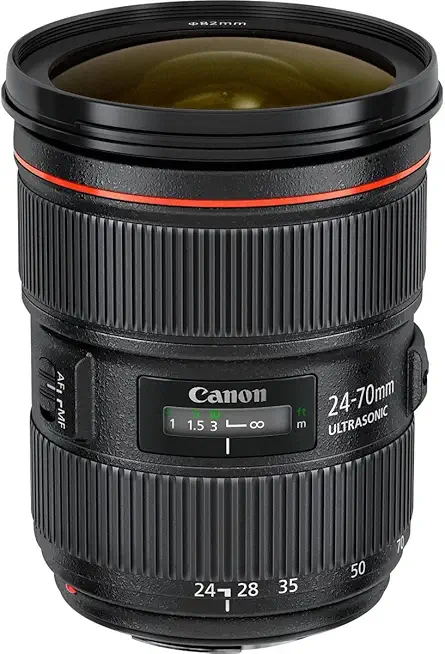
Canon EF 24-70mm f/2.8L II USM
Pro-grade fast standard zoom with a bright f/2.8 aperture for exceptional low-light capability, outstanding edge-to-edge sharpness and smooth background separation; built for demanding shooters who need consistent, high-resolution results.
Check PriceThe 24-70 f/2.8L II is a different kind of trade-off: one full stop faster than the 24-105, which I felt immediately in low light and when trying to separate subjects from backgrounds. Wide open it produces creamier bokeh and gives you faster shutter speeds—something you notice at dim receptions or tight indoor spaces. Optically it also looks more micro-contrasty and “snapper” sharp on faces and details.
On the downside, it has no image stabilization and it’s heavier than the 24-105. That means for slow handheld video or working at very slow shutter speeds the 24-105’s IS can be more practical. You also still lose the 70–105mm reach the 24-105 offers, so you trade reach and stabilization for speed and shallow depth.
This is the lens I reach for when the shoot demands top image quality and low-light performance—weddings, editorial work, and portrait sessions where background separation matters. I’ve shot whole receptions with the 24-70 f/2.8 and trusted the higher ISO and wider aperture rather than relying on stabilization; if you need that extra stop and don’t mind the weight, this is the choice.
Alternative 3:
Canon EF 24-70mm f/2.8L II USM
Workhorse professional zoom featuring a constant bright aperture, rapid autofocus and rugged, weather-resistant build; produces creamy bokeh and pin-sharp detail across the range—perfect for weddings, editorial shoots and events.
Check PriceSeen as a workhorse, the 24-70 f/2.8L II feels very different from the 24-105: it’s built to take punishment, autofocuses quickly and consistently, and delivers very predictable results frame after frame. In practice I found it gives a more “pro” look straight out of the camera on portraits and headshots compared to the 24-105 at the same focal lengths.
The trade-offs are the same as above—no IS, more bulk, and no extra reach past 70mm. If you shoot events where the light is low and you need to keep the shutter speeds up, the faster aperture wins. If you need stabilized video or that extra 105mm reach to avoid swapping lenses, the 24-105 remains more flexible.
Pick the 24-70 f/2.8L II if you’re a pro who prioritizes image quality and speed over travel weight and reach. In my kit it’s the lens I grab for high-stakes jobs where I want the best results on demand; I’ll accept the heavier load or pair it with a telezoom when I need more reach.
What People Ask Most
Is the Canon EF 24-105mm f/4L IS II USM a good lens?
Yes — it’s a versatile, well-built all‑purpose L-series zoom with improved optics and stabilization that’s great for travel, weddings, and everyday shooting.
How sharp is the Canon EF 24-105mm f/4L IS II at 24mm, 50mm and 105mm?
At 24mm it’s very good in the center with some edge softness wide open, 50mm is the sharpest sweet spot, and 105mm is slightly softer but sharpens up well when stopped down.
What are the main differences between the Canon 24-105mm f/4L IS and the Mark II?
The Mark II adds improved optics and coatings, better image stabilization and AF performance, plus reduced aberrations and slightly improved close-focus behavior.
Is the Canon EF 24-105mm f/4L IS II weather-sealed?
Yes, it has dust- and moisture-resistant sealing for light rain and tough conditions, but it’s not fully waterproof or submersible.
Is it worth upgrading from the Canon 24-105mm f/4L IS USM (Mark I) to the Mark II?
If you need better sharpness, IS and AF reliability it’s a worthwhile upgrade, but if your Mark I still meets your needs you can hold onto it without major loss.
What cameras and bodies is the Canon EF 24-105mm f/4L IS II compatible with?
It’s an EF-mount lens so it works natively on Canon full‑frame and APS‑C DSLRs, and it can be used on Canon mirrorless bodies with an EF‑to‑RF adapter.
Conclusion
The Canon EF 24-105mm f/4L IS II USM is a workhorse zoom built around practical versatility, pro-level sealing, steadying image stabilization and quick USM focusing. It’s the kind of single-lens solution that keeps you shooting through travel days, events and run-and-gun assignments without constant lens swaps. Expect convenience and coverage ahead of outright low‑light speed.
In the field it earns its keep by reducing kit, smoothing handheld stills and video, and handling a wide range of subjects with reliable results. The trade-offs are clear: it won’t deliver the shallowest backgrounds or the ultra-fast shutter headroom of faster glass, and long handheld days reveal its modest heft. For many shooters those compromises are acceptable for the payoffs in flexibility.
Compared to closer-in choices, it sits between a lighter 24–70 f/4 option for weight-conscious shooters and a faster 24–70 f/2.8 for those chasing ultimate speed and subject isolation. The Sigma 24–105 Art remains a tempting value play with strong image quality, but native Canon pairing and proven durability keep the Canon attractive for pros.
Bottom line: buy this lens if you want one reliable, weather‑sealed zoom to cover most assignments with steady stabilization. Skip it if low‑light speed or extreme shallow depth is your priority. If you do buy, complement it with a fast prime for dim conditions or a longer tele for portrait and tight-framing work.
Canon EF 24-105mm f/4L IS II USM
All-purpose professional zoom delivering consistent performance across wide-to-tele ranges with a constant f/4 aperture, powerful optical stabilization, fast autofocus and weather-sealed construction—ideal for travel, weddings and everyday shooting.
Check Price



0 Comments