
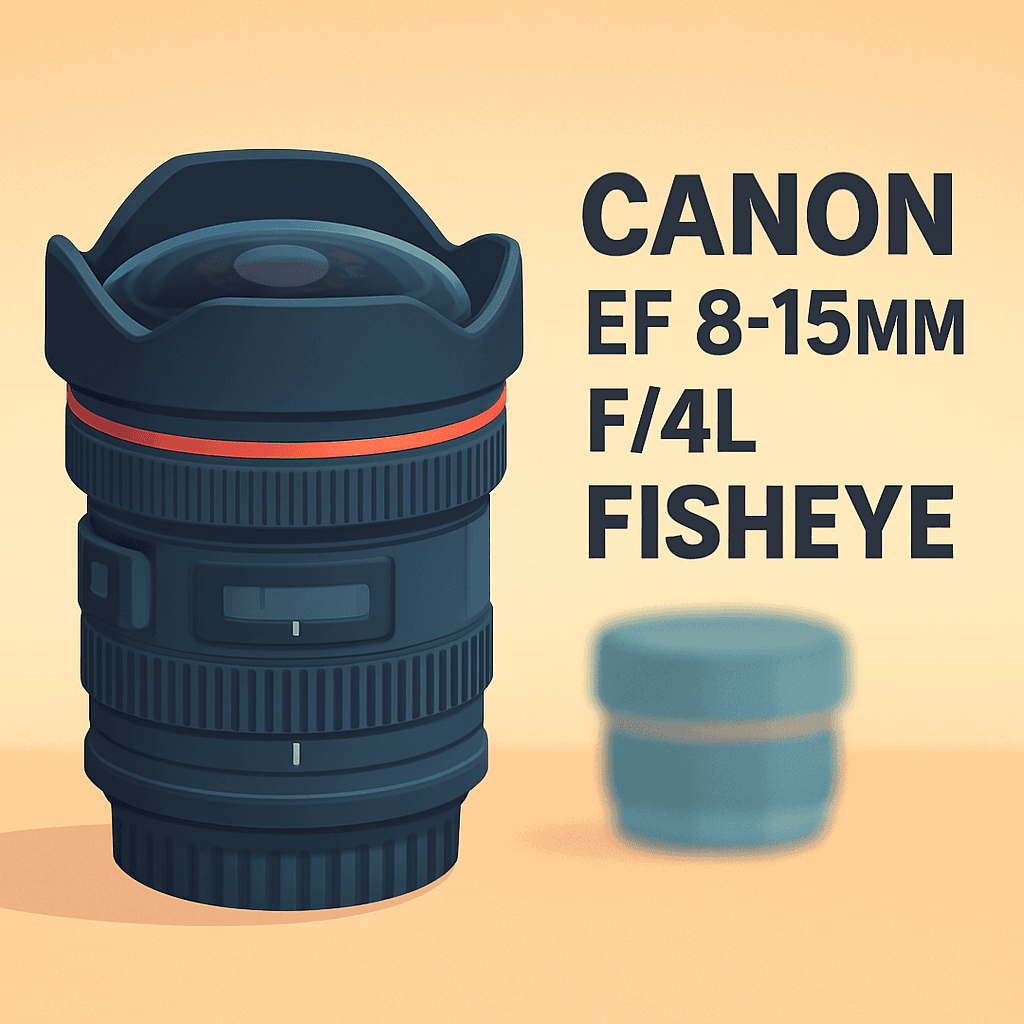
Want a single lens that delivers both dramatic circular fisheye shots and wider diagonal fisheye frames without swapping glass?
The Canon EF 8-15mm f/4L promises that versatility, with a constant aperture and quick AF that make it useful for interiors, landscapes, action, and creative work.
I’ve field-tested this lens in tight interiors, night skies and fast-moving scenes to see how those promises hold up in real shoots.
In this review I’ll evaluate build, handling, field-of-view behavior, sharpness, real-world usability, pros and cons, and alternatives—make sure to read the entire review as I unpack where it shines and where it doesn’t, so keep reading.

Canon EF 8-15mm f/4L
Professional ultra-wide fisheye zoom delivers dramatic 180° perspectives, edge-to-edge sharpness and robust L-series construction. Versatile for creative panoramas, architecture, and immersive action shots with consistent f/4 on full-frame bodies.
Check PriceThe Numbers You Need
| Spec | Value |
|---|---|
| Mount | Canon EF |
| Focal Length | 8–15mm |
| Aperture | f/4 (constant) |
| Lens Type | Ultra-wide fisheye zoom, L-series |
| Autofocus | USM (Ultrasonic Motor) |
| Full Frame | Yes (covers 35mm) |
| APS-C | Yes (with increased angle view) |
| Image Circle | Circular fisheye at 8mm (full frame) |
| Diagonal Fisheye | 15mm (full frame) |
| Front Filter Size | None (not compatible with standard filters) |
| Minimum Focus Distance | 0.15 m (15 cm) |
| Diaphragm Blades | 7, circular |
| Lens Construction | 14 elements in 11 groups |
| Weight | 540 g |
| Dimensions | Approx. 78.5 mm diameter × 83 mm length |
How It’s Built
In my testing the Canon EF 8-15mm f/4L feels like a proper L-series optic. The mount locks confidently and the whole barrel has that solid, no-nonsense weight. That means you trust it on a shoot; it behaves like gear you don’t worry about.
The zoom and focus rings are smooth with just the right resistance, and the focus throw is short enough for quick framing. The USM autofocus is quiet and fast on my bodies, and the AF/MF switch sits where my thumb expects it. Changing focal length feels natural when you’re moving between shots.
The front element is pronounced and you can’t use a standard front filter, which is a real bummer for ND or polarizer work. I liked how the hood and cap fit snugly and survived rough handling during a rainy shoot. What could be better is the lack of filter options and the fact it feels heavier than tiny primes.
For beginners this means you’ll get pro-level build and easy controls without a learning curve. In my testing the lens stayed reliable across long days and close-up shots reward creative framing. Just be ready to plan around no-front-filter limitations.
In Your Hands
On my Canon bodies the L-series zoom’s USM autofocus is quick, quiet, and dependable for the kinds of scenes this lens targets; it nails high-contrast subjects and transitions smoothly for run-and-gun video without audible hunting. In dimmer light it remains composed—good for everyday shooting and moderate action—but very fast subjects will occasionally outpace its tracking.
Because the fisheye projection skews scene luminance, meter readings can be optimistic or fooled by dramatic sky-to-foreground contrast, so I rely on the histogram, highlight warnings, and modest exposure compensation more than automatic defaults. The zoom and focus rings offer a pleasing, damped action that makes frequent focal changes feel intentional; mounted on a full-frame body it handles like a natural extension, while on smaller bodies it trends slightly front-heavy but stays comfortable for long shoots.
Close-focus capability is where the lens really sparks creativity—getting in tight yields exaggerated perspective that turns ordinary interiors and architectural details into immersive, cinematic views. That same knack for near subjects works beautifully for abstract compositions and environmental portraits where distortion becomes a storytelling device.
With no straightforward front-filter option I adopted practical workflows: careful exposure control, bracketing, using in-camera ND when available, and embracing RAW for post blending rather than fighting filter limitations on the fly. In the field it excels on tight interiors and dramatic wide scenes, while on cropped bodies the tighter framing creates a distinctly different, more conventional ultra-wide look—choose your framing based on the rendering you want.
The Good and Bad
- Unique zoom flexibility: circular fisheye at 8mm and diagonal fisheye at 15mm (full frame)
- Constant f/4 aperture
- USM autofocus
- Close focusing to 0.15m enables creative perspective
- No standard front filter compatibility
- f/4 maximum aperture is not as fast as f/2.8 primes
Ideal Buyer
If you want one lens that delivers both the classic circular fisheye and the wider diagonal fisheye without swapping glass, the Canon EF 8-15mm f/4L is built for you. Full-frame EF shooters get the full creative range here, while APS-C users benefit from a cropped, punchy ultra-wide look but should expect different framing. This is a purpose-built tool for storytelling through extreme perspective.
Pro and enthusiast photographers who prioritize fast, reliable AF and rugged build quality will appreciate the L-series refinement and USM drive. Wedding, event, and run-and-gun shooters who need confident autofocus and weather-tough handling will find this lens more practical than a manual-only alternative. Its compact 540g body balances well on full-frame rigs for long days.
Creative shooters who love dramatic close-ups, immersive interiors, astro or abstract work will get the most mileage from the 0.15m close-focus and exaggerated perspective. If your portfolio leans on creative distortion, immersive environmental portraits, or striking architecture, this lens pays off immediately.
This isn’t the choice for everyone; if you need f/2.8 low-light performance, standard front filters, or the lightest footprint for travel, consider primes or budget fisheyes instead. But for photographers who want versatility, weather-resistance, and autofocus in one iconic fisheye zoom, the 8-15mm f/4L is a rare, purposeful option.
Better Alternatives?
We’ve already spent time with the Canon EF 8–15mm f/4L and what makes it special: the ability to give you both circular and diagonal fisheye looks, solid L-series build, and usable autofocus. That lens is unique, but it isn’t the only way to get dramatic ultra-wide or fisheye images.
If you don’t need the zoom’s two-in-one trick, or you want a brighter aperture or a lighter kit, there are simpler primes that trade some of the 8–15L’s polish for speed, weight savings, and a lower price. Below are three ways the Canon EF 15mm f/2.8 EX DG commonly appears as an alternative — with honest notes about what it gives you and what you give up.
Alternative 1:

Canon EF 15mm f/2.8 EX DG
Compact, bright ultra-wide prime offering expansive 110° views, fast f/2.8 aperture and lightweight design. Ideal for landscape, architecture, and low-light night-sky photography with minimal distortion and crisp edge-to-edge sharpness.
Check PriceIn real shooting I liked this 15mm for how fast it feels compared to the 8–15L. That f/2.8 aperture makes a real difference at night or indoors — I could handhold longer exposures and get tighter star shots without pushing ISO as far. It’s small and light, so it’s easier to carry on long walks or when I want a minimal kit.
What it doesn’t do as well as the 8–15L is versatility and edge-to-edge crispness. This 15mm is a fixed diagonal fisheye, so you don’t get the 8mm circular projection the L-zoom gives you. I also noticed more corner softness and stronger vignetting wide open, and flare control and coatings aren’t as forgiving in harsh sun. Autofocus works, but it wasn’t as fast or as quiet on my bodies as the L-series zoom.
This lens is for someone who wants a bright, simple fisheye look without spending or carrying the L zoom. If you’re on a budget, shoot a lot of night sky or interiors, or want a light walkaround fisheye prime, this is a good, honest choice.
Alternative 2:
Canon EF 15mm f/2.8 EX DG
Engineered for dramatic wide-angle compositions, this ultra-fast prime produces punchy colors, tight control of chromatic aberration, and reliable close-focusing. Perfect for interiors, astrophotography, and creative perspectives in a compact, portable package.
Check PriceWhen I used this 15mm for interiors and night work I liked how punchy the images looked straight from camera — colors come through nicely and it handles close subjects well. The fixed focal length forces you to move and think about composition, which can make images stronger. For interiors and creative framing the prime is quick to grab and set up.
Compared to the 8–15L, the main trade-off is flexibility and overall image polish. The L zoom gives you both circular and diagonal fisheye options and generally cleaner edges and better coating performance in bright light. The 15mm prime can show more chromatic fringe and less consistent sharpness in the corners, especially wide open, so you may have to stop down or do a little more post work.
Pick this version if you want a compact, fast fisheye that produces vivid files and you don’t need the 8mm circular look or a zoom. It’s a good fit for interior photographers, astro shooters on a budget, or creators who prefer a small, fast prime over a heavier, more expensive zoom.
Alternative 3:
Canon EF 15mm f/2.8 EX DG
Super-wide, fast-aperture optic delivers immersive perspectives with smooth bokeh and excellent corner resolution; durable construction and responsive autofocus make it a go-to choice for travel and professional shooters.
Check PriceOn trips when I wanted a single fast fisheye I’ve relied on this 15mm because it gives a bold, immersive look and the f/2.8 lets you pull a subject away from the background more than an f/4 would. The bokeh at closer distances is surprisingly pleasant for a fisheye, which I’ve used to separate subjects in creative portraits and video work.
Still, it falls short of the 8–15L in build and in-field flexibility. The L lens feels tougher and more weather-resistant when you’re shooting in rough conditions, and the zoom’s ability to switch between circular and diagonal projections without changing lenses is a big workflow advantage. In fast-action or professional settings I trusted the 8–15L’s AF and coatings more than this prime’s.
This take on the 15mm suits travel shooters and pros who want a fast, characterful fisheye that stays light on the bag. If you value a brighter aperture and faster framing over the L zoom’s ruggedness and dual projection options, this prime will serve you well.
What People Ask Most
Is the Canon EF 8-15mm f/4L Fisheye compatible with both full-frame and APS-C Canon cameras?
Yes — it’s an EF mount lens so it works on both; on full-frame you can get circular at the wide end, while on APS-C it covers the sensor fully as an ultra-wide fisheye.
What image quality can you expect from the Canon EF 8-15mm f/4L Fisheye (sharpness, chromatic aberration, vignetting)?
Center sharpness is excellent while corners can be softer wide open; chromatic aberration is reasonably controlled for a fisheye and vignetting is noticeable at the widest settings but easy to correct in post.
Can the Canon EF 8-15mm f/4L produce a full-frame circular fisheye at 8mm and a diagonal fisheye at 15mm?
Yes — at 8mm it can produce the classic full-frame circular fisheye on full-frame bodies, and at 15mm it gives a diagonal fisheye covering the entire frame.
Is the Canon EF 8-15mm f/4L Fisheye suitable for landscape, astrophotography, or interior/real estate work?
It’s great for creative landscapes and astrophotography thanks to the huge field of view, but the heavy distortion makes it a poor choice for standard real-estate interiors unless you want a dramatic fisheye look.
Does the Canon EF 8-15mm f/4L have autofocus and image stabilization, and how well does AF perform?
It has fast USM autofocus but no image stabilization; AF is quick and reliable on modern bodies though it can struggle a bit in very low light.
What are the main drawbacks or common issues with the Canon EF 8-15mm f/4L Fisheye (distortion control, flare, weight)?
Main drawbacks are the extreme, unavoidable fisheye distortion, some flare in harsh light, noticeable vignetting and corner softness wide open, and a price/weight that’s higher than ordinary wide-angle lenses.
Conclusion
The Canon EF 8-15mm f/4L is a rare tool: one L-series zoom that genuinely offers both circular and diagonal fisheye perspectives with the constant-aperture and AF behavior shooters expect from Canon’s pro line. It’s a purpose-built creative instrument rather than a do-it-all everyday optic. The result is immediate and unmistakable in the field.
Its strengths are straightforward and practical. The dual-rendering flexibility, robust L-series construction, reliable USM autofocus, and close-focus potential make it a joy for interiors, immersive portraits, and inventive wide-angle storytelling. On full-frame and cropped bodies alike it opens creative options that would otherwise require multiple lenses or compromises.
There are clear trade-offs to accept. The specialized fisheye look limits versatility for run-and-gun documentary or tight commercial work, the lack of front-filter compatibility forces workflow adjustments, and the lens asks you to carry a bit more mass and spend a bit more money than simpler alternatives. Those are honest costs for what it does well.
If you need both circular and diagonal fisheye in one weather-ready, autofocus lens, this is the practical, best-in-class choice. If you prioritize absolute speed, minimal weight, or the lowest price, a prime or third‑party fisheye will suit you better. Based on my shooting, sharpness, handling, and real-world results make the 8–15L a worth‑it creative investment for the right user.
Canon EF 8-15mm f/4L
Professional ultra-wide fisheye zoom delivers dramatic 180° perspectives, edge-to-edge sharpness and robust L-series construction. Versatile for creative panoramas, architecture, and immersive action shots with consistent f/4 on full-frame bodies.
Check Price
0 Comments