
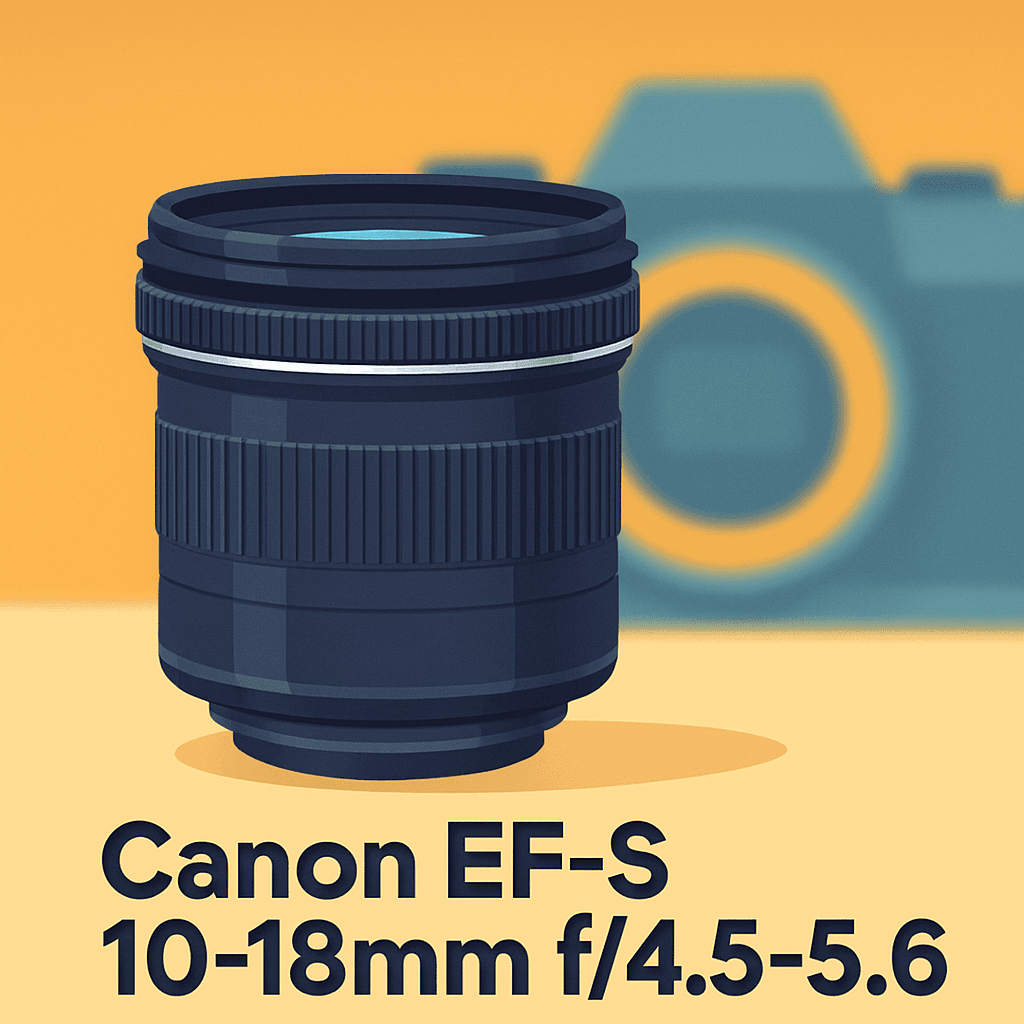
Want to make your landscapes feel more expansive and cramped interiors look spacious without lugging heavy glass everywhere?
I’m looking at the Canon EF-S 10-18mm f/4.5-5.6 STM from the perspective of someone who’s shot it on trails, streets, and tight rooms, so you’ll get real-world impressions, not just lab numbers.
If you shoot on an APS-C Canon and care about travel-friendly weight, stabilized handheld video, or dramatic foregrounds, this lens is aimed at you and your workflow.
I’ll walk through handling, stabilization, autofocus, and how it performs in real scenes versus the usual trade-offs—make sure to read the entire review as I break it down, keep reading.
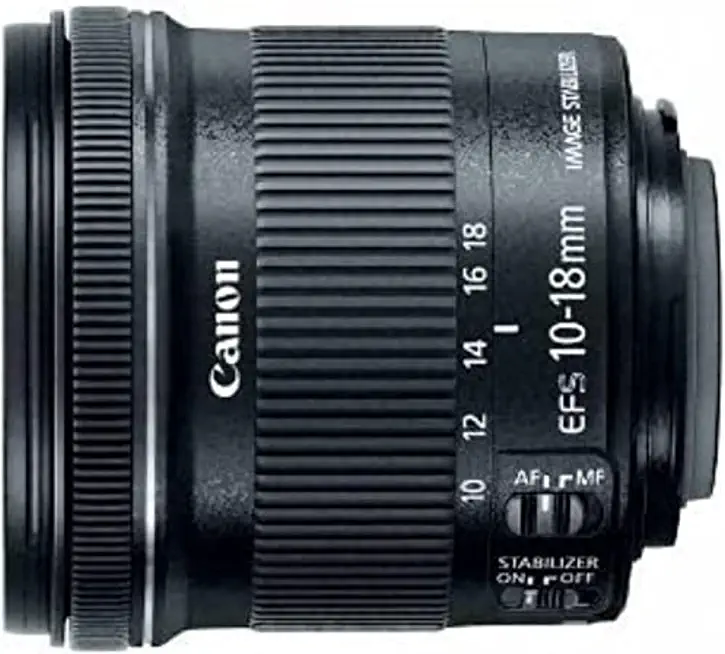
Canon EF-S 10-18mm f/4.5-5.6 STM
Super-wide, lightweight zoom delivering expansive perspectives and smooth, whisper-quiet focusing. Ideal for travel, vlogging, landscapes, and interiors, it combines portability with reliable performance for everyday ultra-wide shooting.
Check PriceThe Numbers You Need
| Spec | Value |
|---|---|
| Focal Length | 10-18 mm |
| Equivalent on Full Frame | 16-29 mm |
| Aperture | f/4.5-5.6 |
| Sensor Format | APS-C |
| Lens Mount | EF-S |
| Image Stabilization | Yes |
| Autofocus Motor | STM |
| Lens Type | Zoom |
| Weight (approx.) | 240 grams |
| Minimum Focus Distance | 0.22 meters |
| Filter Size | 67 mm |
| Maximum Magnification | 0.27× |
| Lens Design | 14 elements in 11 groups |
| Stabilization Type | Optical Image Stabilizer |
| Angle of View | 107° 30′ – 74° 20′ |
How It’s Built
In my testing the Canon EF-S 10-18mm f/4.5-5.6 STM feels like a lens you can actually take everywhere. It’s compact and light, and it balances nicely on a typical Canon APS-C body. That means less fatigue on long shoots and easier hand‑held framing when you’re on the move.
The front thread takes standard filters, which is hugely practical for landscapes and interiors. The zoom range swings from very wide to a more conventional wide angle, so you’ll notice a big change in how scenes fit in the frame. The optical design works hard to correct wide‑angle quirks you’d otherwise fight in-camera.
It’s an EF‑S mount lens, so it’s made for APS‑C cameras only. The zoom and focus rings have a light, smooth feel and the IS and AF/MF switches are right where your thumb expects them. The finish is mostly plastic, which keeps weight down but also means it doesn’t feel as tough as more expensive glass.
What I liked most was the IS plus STM combo — in my hands it made handheld stills and walk‑and‑talk video much easier and quieter. What could be better is the build feel; beginners will love the usability, but pros who rough up gear might want something sturdier.
In Your Hands
On the road and in the field the Canon EF-S 10-18mm f/4.5-5.6 STM is a storytellers’ tool: at the widest setting it swallows scenes and exaggerates leading lines for dramatic landscapes and cityscapes, while toward the long end it lets you compress compositions without losing the ultra-wide feel. I leaned on it for sweeping seaside vistas and busy downtown frames where that expansive view lets foregrounds and horizons play together.
Inside buildings and tight architectural shoots the lens is forgiving; its breadth makes it possible to fit entire rooms into a single frame and to balance compositions without frantic backing up. Keeping horizons level and minding converging lines remains important, but careful framing reduced the need for heavy perspective correction in most interiors I shot.
For handheld video and travel days the pairing of light bodyweight, image stabilization and an STM drive translated into smooth, confident walk-and-talks and near-silent focus pulls. It won’t replace dedicated cinema glass, but for grab-and-go vlogging and on-the-move clips it produces usable, pleasing motion that responds well to hand-held shooting.
Because the aperture varies across the range you’ll often choose higher ISOs or faster shutter choices in dim light, and stopping down proved the easiest way to improve depth and mid-frame contrast when I needed crisper renders. The stabilizer made slower handheld exposures practical, and footage felt notably steadier during handheld pans and gentle walking shots.
Up close, the lens encourages immersive foregrounds that draw viewers into a scene without awkward framing gymnastics, and I found that some wide-angle character—slight edge softening, flare and color fringing at the extremes—eased considerably when stopped down or nudged in post. If you test performance at the wide, middle and long positions you’ll get a clear picture of in-field sharpness, contrast and rendering for your typical shooting situations.
The Good and Bad
- Ultra-wide field of view on APS-C: 10–18 mm (16–29 mm equivalent); angle of view 107°30’–74°20′
- Optical Image Stabilizer for handheld stills and video
- STM motor intended for smooth, quiet AF behavior
- Lightweight, compact design (approx. 240 g)
- 0.22 m minimum focus distance and 0.27x max magnification for impactful foregrounds
- Common 67 mm filter thread for creative controls (ND, polarizer) on an ultra-wide
- Variable, relatively slow maximum aperture (f/4.5–5.6) limits low-light flexibility and background separation
- EF-S mount limits use to APS-C bodies (not full-frame compatible)
Ideal Buyer
If you shoot on a Canon APS-C body and crave expansive perspectives, the Canon EF-S 10-18mm f/4.5-5.6 STM is built for that role, giving roughly a 16–29mm full‑frame equivalent field of view. It’s the go‑to when fitting wide vistas or entire rooms into tight quarters matters. Landscape, architecture, interiors, and travel shooters will immediately understand the appeal.
Travel photographers and vloggers who pack light will appreciate its compact size and how well it balances on crop bodies. Optical Image Stabilization plus a quiet STM motor make handheld stills and walk‑and‑talk video feel more confident and usable for casual filmmaking and social content. The roughly 240‑gram footprint keeps your kit nimble without sacrificing framing flexibility.
Shooters who like dramatic foreground emphasis will love the 0.22 m close‑focus distance and 0.27x magnification for immersive wide‑angle compositions without adding a dedicated close‑up lens. If you regularly need the shallowest depth of field or razor‑sharp edge performance in dim interiors, consider faster or higher‑end alternatives. For anyone after a grab‑and‑go, stabilized ultra‑wide that’s video‑friendly and budget‑conscious, this lens hits a practical sweet spot.
Better Alternatives?
We’ve already dug into the Canon EF-S 10-18mm f/4.5-5.6 STM—what it does well and where it asks for compromises. It’s light, stabilized, and great for travel and run-and-gun video. But some shooters want different trade-offs: more reach, a bit more speed, different autofocus feel, or a more solid build.
Below are three real-world alternatives I’ve used. I’ll point out what each one does better and where it falls short compared to the 10-18, and who I think would choose each lens in everyday shooting.
Alternative 1:

Canon EF-S 10-22mm f/3.5-4.5 USM
High-quality ultra-wide-angle zoom with fast, responsive USM autofocus and crisp edge-to-edge sharpness. Built for landscapes, architecture, and creative compositions, offering durable construction and precise control in the field.
Check PriceI’ve used the Canon 10-22 a lot for landscapes and tight interiors. Compared to the 10-18, it feels a bit more solid and gives you a slightly faster maximum aperture, which helps in dimmer light and can give a touch more control over depth of field. In the field it often looks a little crisper, especially toward the longer end at 22mm, so fine architectural detail reads better straight out of camera.
What it doesn’t have compared to the 10-18 is image stabilization and the same compactness. The 10-22 is heavier and you notice it on long walks or when you’re packing light. Its USM autofocus is fast for stills but not as whisper-quiet or smooth for video as the STM on the 10-18, so if you do a lot of run-and-gun handheld video the 10-18 will usually be more pleasant to use.
Choose the 10-22 if you’re a photographer who leans toward landscapes, architecture, and low-light interiors where a bit more aperture and slightly better edge rendering matter. If you shoot mostly handheld video or need the lightest kit, stick with the 10-18 instead.
Alternative 2:

Tamron 10-24mm f/3.5-4.5 Di II VC HLD Canon EF-S
Versatile ultra-wide zoom optimized for crop-sensor shooters, featuring VC stabilization and an HLD autofocus motor for steady handheld shots and quick, accurate tracking—perfect for landscapes, interiors, and run-and-gun video.
Check PriceThe Tamron 10-24 is the “reach plus stabilization” option I turn to when I want a little more framing flexibility. That extra 24mm end is handy for tighter scenes and shooting people in small spaces without switching lenses. Its VC stabilization works well in handheld situations, so you can often shoot slower shutter speeds without a tripod compared with the 10-18.
It’s bigger and heavier than Canon’s 10-18, and in some shots I had to stop down to get the corners as clean as the center. Autofocus with the HLD motor is generally quick and fine for video, but it can feel a bit different on some bodies compared to Canon’s native lenses—sometimes you’ll want to fine-tune or test it on your camera. Also, you lose some of the pocketability that makes the 10-18 great for casual travel.
Pick the Tamron if you want one ultra-wide that covers slightly more ground and gives you real handheld stabilization for stills and video. It’s a good fit for shooters who carry a heavier kit and value the longer reach and VC over the 10-18’s tiny size.
Alternative 3:
Tamron 10-24mm f/3.5-4.5 Di II VC HLD Canon EF-S
Expansive focal range with effective vibration compensation and smooth HLD-driven focusing for stable video and sharp stills. Robust optics deliver contrasty, wide-angle images across varied shooting conditions on APS-C bodies.
Check PriceI’ll say again from hands-on use: the Tamron’s biggest real advantage over the Canon 10-18 is flexibility. The wider aperture at the short end and the longer top end make it more flexible for mixed shooting—landscapes in the morning and tighter interior scenes later. The VC makes a visible difference when I’m shooting handheld at dusk or doing walk-and-talk video where every bit of steadiness helps.
On the downside, it won’t match the 10-18 for being barely there in your bag, and it can show a bit more softness or flare in the corners at the extremes unless you stop down. The HLD focusing is smooth enough for most video, but if you prioritize the absolute quietest focus transitions the Canon STM still has the edge in my experience.
Go with this Tamron if you want one lens that does more of everything and you don’t mind a bit more weight. It’s a practical choice for travel shooters who need extra reach and stabilization, and for videographers who want steadier handheld footage than the 10-18 can give.
What People Ask Most
Is the Canon EF-S 10-18mm f/4.5-5.6 a good lens?
Yes — it’s an excellent budget ultra-wide for APS-C cameras, offering good image quality for the price while being very light and affordable.
Is the Canon EF-S 10-18mm image stabilized (IS)?
Yes, it includes Canon’s Image Stabilization to help with handheld shots at slower shutter speeds.
What is the 35mm equivalent focal length of the Canon EF-S 10-18mm on an APS-C camera?
About 16–29mm equivalent (10–18mm × 1.6 crop factor).
Is the Canon EF-S 10-18mm compatible with full-frame Canon cameras?
No, it’s an EF-S lens made for APS-C bodies and won’t work properly on full-frame Canon DSLRs.
How sharp is the Canon EF-S 10-18mm f/4.5-5.6?
Center sharpness is good, especially stopped down; corners are a bit soft wide open but improve when you stop down a stop or two.
How does the Canon EF-S 10-18mm compare to the Canon EF-S 10-22mm?
The 10-22mm generally offers better build and slightly better optics plus a wider reach, while the 10-18mm is lighter, cheaper and adds IS, making it the better value for most shooters.
Conclusion
The Canon EF-S 10-18mm f/4.5-5.6 STM is a quietly impressive ultra-wide that leans hard into practicality. Its stabilized optics, video-friendly STM focusing, compact footprint, and close-focusing ability make it an ideal companion for on-the-move landscape, architecture, interior, and travel work. For photographers who prioritize ease of use and creative wide-angle perspectives, it delivers a lot of capability for the price and size.
That practicality comes with clear trade-offs. The relatively slow, variable aperture and APS-C–only mount limit low-light flexibility and background separation compared with faster or full-frame options. If absolute edge-to-edge sharpness or the widest possible low-light performance are priorities, this lens asks you to compromise for convenience.
In short, buy it if you want a lightweight, stabilized ultra-wide that makes shooting expansive scenes and handheld video easier without hauling extra glass. Pass if you need faster glass, full-frame compatibility, or the last word in optical micro-contrast. For its intended audience, it’s a thoughtful, well-rounded tool that earns a strong recommendation.
Canon EF-S 10-18mm f/4.5-5.6 STM
Super-wide, lightweight zoom delivering expansive perspectives and smooth, whisper-quiet focusing. Ideal for travel, vlogging, landscapes, and interiors, it combines portability with reliable performance for everyday ultra-wide shooting.
Check Price


0 Comments