
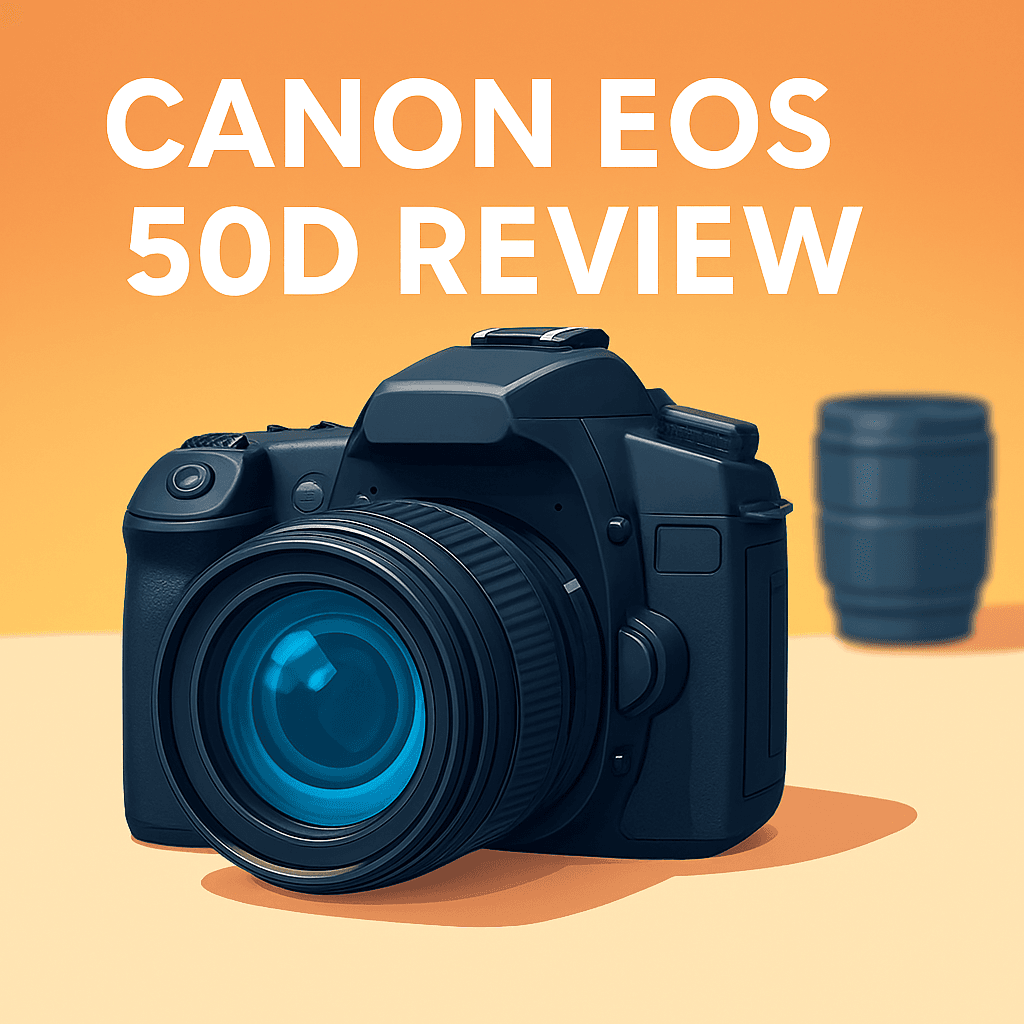
Want to know if the Canon EOS 50D Camera is still worth shooting with today?
If you’re a stills photographer who prefers an optical viewfinder and sturdy handling, this is the question that matters.
I tested the 50D in the field on real shoots. This review’s focused on practical results you’ll use, not just spec lists.
You’ll see whether its rugged build and reliable handling help in portraits and events. Make sure to read the entire review as I break it down—keep reading.

Canon EOS 50D Camera
Compact, rugged DSLR delivering sharp 15MP images, responsive autofocus and speedy continuous shooting. Ideal for enthusiast photographers seeking reliable performance, precise exposure control and solid build for demanding shooting environments.
Check PriceThe Numbers You Need
| Spec | Value |
|---|---|
| Sensor | 15.1 MP APS-C CMOS |
| Image Processor | DIGIC 4 |
| ISO Range | 100–3200 (expandable to 12800) |
| Continuous Shooting | 6.3 fps |
| Autofocus | 9-point (all cross-type) |
| Metering | 35-zone TTL |
| Viewfinder | Pentaprism, 95% coverage |
| LCD | 3.0" Clear View, 920,000 dots |
| Shutter Speed | 1/8000 to 30 sec |
| Max Sync Speed | 1/250 sec |
| Memory | CF Type I/II (UDMA supported) |
| Video | No video recording |
| Weight | 730 g (body only) |
| Battery | LP-E6 |
| Connectivity | USB 2.0, Video out |
| Durability | Magnesium alloy body, weather-sealed |
How It’s Built
In my testing with the Canon EOS 50D Camera, the first thing that hits you is the solid metal body and weather sealing. I found it gave real confidence shooting in messy conditions. That means less worry when the weather turns.
It’s a chunky camera but the grip sits nicely in your hand. In my testing I found it balances very well with everyday EF lenses, which makes longer shoots less tiring. Beginners will appreciate the straightforward feel.
The optical viewfinder is bright and easy to use outdoors. I found you have to watch your edges since the view doesn’t show every last bit of the frame. For real-world shooting, leave a little margin for safety.
The rear screen is sharp enough for quick checks and menu navigation. In my testing I used it a lot for reviewing shots between sets and it held up well in sunlight. Novices will like the clear, no-nonsense layout.
Controls fall naturally under your fingers and the top plate shows key info at a glance. In my testing I found file workflow felt dated with legacy card types and older transfer ports. One thing I really liked was the rock-solid handling, and one thing that could be better is faster, modern connectivity for moving files.
In Your Hands
In real-world shooting the Canon EOS 50D feels brisk enough for moderate action, events and candid sequences; its continuous burst mode lets you lock onto decisive moments without feeling compromised by outdated frame rates. It isn’t a modern high-speed specialist, but for weddings, sports sidelines and street work it delivers usable runs that keep you in the story.
The shutter is versatile in the field, capable of freezing fast motion and letting you explore longer exposures when the light falls away, while on-location strobe work is straightforward within ordinary sync limits. That balance makes it a practical choice for photographers who need both ambient control and flash on assignment.
Autofocus behavior is dependable rather than revolutionary: the cross-type AF layout nails focus quickly on well-placed subjects but asks you to be mindful of composition and point placement when tracking erratic movers. Metering is generally honest across varied scenes, though in high-contrast situations you’ll sometimes dial in a touch of exposure compensation for client-ready frames.
Burst sustainability holds up nicely when you feed the camera fast memory cards, while wired transfers are noticeably slower than modern alternatives—using a card reader speeds workflow considerably. The battery will carry you through a typical stills day, though heavy use and cold conditions warrant a spare on hand.
Field reliability is a strong suit: the solid construction and sealing inspire confidence when weather or dust threaten a shoot, and controls and ports stood up to repeated use during assignment work. Overall, it behaves like a workhorse designed for photographers who prioritize dependable stills performance.
The Good and Bad
- Magnesium alloy body with weather sealing
- 15.1 MP APS-C CMOS sensor
- 6.3 fps continuous shooting
- 9-point autofocus, all cross-type
- No video recording
- CF card media (legacy format compared with SD-centric workflows)
Ideal Buyer
If you shoot stills and never need video, the Canon EOS 50D Camera is built for you. It favors classic DSLR ergonomics and an optical viewfinder over live‑view or hybrid features.
Field shooters who value a rugged, weather‑sealed magnesium‑alloy body will feel at home. The 50D’s heft and controls were designed for work, not for fleeting trends.
Photographers already invested in CF cards or comfortable with legacy workflows will appreciate the compatibility. This camera rewards those who prefer tactile controls and straightforward menus.
If your action is moderate—events, sports at a mid pace, or candid sequences, the 50D handles it well. Its 6.3 fps cadence and 9‑point cross‑type AF give dependable captures. Flash shooters will like the 1/250s sync and 1/8000s top shutter for ambient control.
Budget‑minded photographers looking for a stills‑capable APS‑C body for portraits, events, and general work will find strong value here. If you don’t need modern video, dual‑pixel AF, or the latest connectivity, this camera is a sensible, photographer‑centric choice.
It’s also a fine second body for pros who need a weatherproof backup they can trust on shoots. Students and hobbyists who prefer learning on a tactile DSLR will appreciate the controls and durability.
Better Alternatives?
We’ve gone through what the Canon EOS 50D is good at: a sturdy, stills-first DSLR with a solid viewfinder, reliable handling and a focus on photography more than video. If that profile fits you, the 50D still makes sense — but many readers will want to know what newer cameras bring to the table.
Below are a few real-world alternatives I’ve used in the field. I’ll point out what each one does better and where it falls short when stacked against the 50D, and who would get the most from choosing each camera.
Alternative 1:

Canon EOS 90D Camera
High-resolution APS-C powerhouse offering 32.5MP detail, fast 10fps continuous shooting and uncropped 4K video. Advanced autofocus and ergonomic controls deliver versatile performance for enthusiasts and hybrid photographers pursuing creativity on the go.
Check PriceIn the real world the Canon EOS 90D feels like a full step up from the 50D. It gives you much more resolution and faster burst shooting, so you can crop tight or pull extra detail from a landscape or portrait without losing image quality. Autofocus and continuous shooting are noticeably better for moving subjects, and the addition of 4K video and modern live-view focusing makes it a true hybrid if you want stills and video from one body.
Where it’s worse than the 50D is simplicity and workflow. The higher-resolution files need more storage and slower editing on older laptops, and that modern feature set adds menus and options that can feel busy compared with the straightforward 50D controls. Also, if you loved the tactile, classic DSLR feel and CF-card workflow of the 50D, the 90D’s modern approach may take a little getting used to.
Buyers who should consider the 90D are enthusiasts and hybrid shooters who want modern AF, higher resolution and video without leaving the Canon lens ecosystem. If you need better tracking for action, more detail for prints or a camera that can do both stills and video on assignments, the 90D is the more flexible, everyday tool.
Alternative 2:

Nikon D7500 Camera
Durable DX-format body with 20.9MP sensor, impressive low-light sensitivity and 8fps burst for action. 4K video and robust weather sealing make it a dependable choice for adventurous shooters.
Check PriceThe Nikon D7500 beats the 50D in low-light shooting and overall image cleanliness. In practical terms that meant I could push ISO more on dimly lit events and still keep usable shots where the 50D struggled. Its 4K video, faster continuous shooting and improved AF help when I need to capture moving subjects or shoot mixed photo/video assignments.
It’s not perfect compared to the 50D: the handling and menu layout feel different if you’re coming from Canon, and switching systems means thinking about lenses and accessories. The D7500’s autofocus and burst are better than the 50D in most cases, but some photographers will miss the 50D’s simple process and the feel of that older Canon viewfinder when they first use the Nikon.
This camera suits shooters who want a stronger low-light performer and modern features but don’t mind learning Nikon controls. Travel, event and wildlife shooters who value cleaner high-ISO images and an articulating screen for tricky angles will prefer the D7500 over the 50D.
Alternative 3:
Nikon D7500 Camera
Responsive autofocus and an articulating touchscreen simplify composition and playback. Long-lasting battery life, rugged construction and versatile feature set support travel, wildlife and sports photography with reliable professional-grade results.
Check PriceFrom hands-on use the D7500’s responsive AF and articulating touchscreen make a real difference when composing and reviewing shots in the field. I used the tilting screen for low-angle street work and high-angle climbing shots, and the camera returned clear, reliable frames without fuss — something the fixed-screen 50D can’t match.
On the downside, the D7500’s feature set and menus feel busier than the 50D’s straightforward layout. Battery life and rugged build are better in the D7500, so it will outlast the 50D on long trips, but if you prefer a very simple, purely stills-focused camera the extra features might be unnecessary.
Choose this if you travel a lot, shoot wildlife or sports, or want a camera that will run long days and handle rough conditions while giving you modern conveniences like a touchscreen and better autofocus. If you value simplicity and the old-school Canon DSLR experience, you might still prefer the 50D, but for field reliability and flexible shooting the D7500 is a solid alternative.
What People Ask Most
Is the Canon EOS 50D a good camera?
Yes — it’s a solid, well-built APS-C DSLR with good still-image quality and fast handling, but it’s dated and missing modern features like video and Live View.
Is the Canon EOS 50D worth buying used?
Yes, if you want an affordable, rugged DSLR for stills and learning; just check shutter count, battery life, and cosmetic condition before buying.
Does the Canon EOS 50D have video recording or Live View?
No — the 50D does not offer video recording or Live View.
How many megapixels / what sensor does the Canon EOS 50D have?
It uses a 15.1‑megapixel APS‑C (approx. 22.3 x 14.9 mm) CMOS sensor.
Is the Canon EOS 50D full frame?
No, the 50D is an APS‑C sensor camera, not full‑frame.
How does the Canon EOS 50D compare to the Canon 60D?
The 60D is newer with an 18MP sensor, Live View, video, and a vari‑angle LCD, while the 50D offers a tougher build and fast handling but fewer modern features.
Conclusion
The Canon EOS 50D Camera remains a purposeful, stills-focused DSLR that favors substance over flash. It feels built to take punishment and to keep delivering reliable, straightforward shooting for photographers who live behind the optical viewfinder. In hand it rewards discipline and classic DSLR ergonomics rather than chasing every modern feature set.
That solidity brings trade-offs you can’t ignore. There’s no modern video capability and the connectivity and media choices feel dated for contemporary workflows. The autofocus coverage and viewfinder framing demand a more deliberate approach than today’s tracker-heavy systems, so expect to work around those limits rather than be carried by them.
If your priority is durable, no-nonsense stills performance and a tactile shooting experience, the 50D still makes sense on a budget or as a second body. If you need hybrid flexibility, better low-light reach or next-gen AF, consider the Canon EOS 90D, Nikon D7500, or Pentax K-3 Mark III instead. For steady hands and serious stills work the 50D is honest and competent; for everything else, newer models will serve you better.
Canon EOS 50D Camera
Compact, rugged DSLR delivering sharp 15MP images, responsive autofocus and speedy continuous shooting. Ideal for enthusiast photographers seeking reliable performance, precise exposure control and solid build for demanding shooting environments.
Check Price


0 Comments