
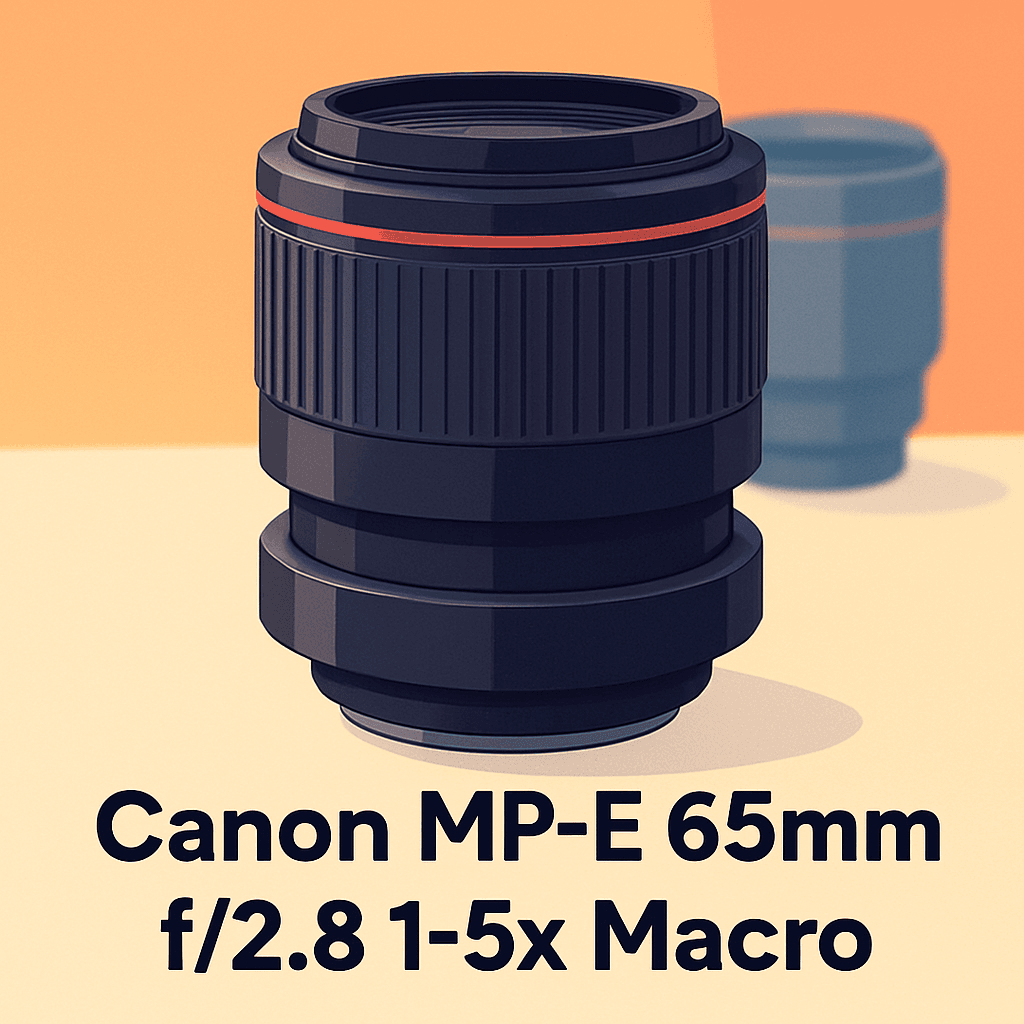
Want to reveal details no standard macro can capture? The Canon EF 65mm f/2.8 MP-E 1-5x is a purpose-built extreme macro that stretches from life-size to astonishing micro magnifications.
If you’re a macro specialist, studio shooter, or anyone needing micro-detail beyond 1:1, this lens is designed for that world. I’ve pushed it in controlled shoots and in the field, and it rewards careful technique with revealing texture and structure.
In this review I’ll cover build, handling, DOF behavior, the 1–5x range, real-world workflow, and how it stacks up against more versatile macros. Make sure to read the entire review as I break down when this tool truly pays off and when it demands more from you.

Canon EF 65mm f/2.8 MP-E 1-5x
Extreme close-up optic delivering up to 5x life-size magnification with precision manual focus and sharp optics—perfect for insects, textures, and scientific macro work where unparalleled detail and creative magnification matter.
Check PriceThe Numbers You Need
| Spec | Value |
|---|---|
| Lens type | Macro |
| Focal length | 65mm |
| Maximum aperture | f/2.8 |
| Magnification ratio | 1× to 5× (life-size to 5× life-size) |
| Mount type | Canon EF |
| Minimum focusing distance | Approx. 235 mm (varies with magnification) |
| Focus type | Manual focus only |
| Depth of field | Extremely shallow; varies with magnification |
| Infinity focus | No infinity focus capability |
| Lens construction | 8 elements in 5 groups |
| Front filter size | 58 mm |
| Dimensions | Approx. 74 mm diameter × 85 mm length |
| Weight | Approx. 710 g |
| Aperture diaphragm blades | 6 |
| Compatible cameras | Canon full-frame and APS-C DSLRs with EF mount (no native RF support; adapter required) |
How It’s Built
In my testing the MP‑E is unmistakably purpose‑built for extreme close‑ups and nothing else. It feels solid and well‑made — compact, a bit heavy in the hand, and clearly built to sit on a tripod or rail for long sessions. That means it inspires confidence for meticulous work, but it isn’t a grab‑and‑go lens for everyday shooting or quick walkaround use.
The magnification control is firm and precise, and in my use you set the reproduction ratio on the lens then move the camera to find focus. I really liked that repeatable, mechanical feel; it makes dialing in the same framing across multiple shots much easier when you’re stacking or shooting series. Beginners should know this is a manual‑only workflow, so you’ll rely on rails, live view magnification, or careful camera movement instead of autofocus.
On a DSLR the lens balances fine, though you’ll want a solid tripod, a geared head, or a macro rail for predictable results. I found the front element pushes forward as you increase magnification, so working distance shrinks fast and lighting becomes a major creative puzzle — that proximity is the part that could be better for field use. Luckily the front accepts common filters and diffusers, so in the studio you can quickly attach soft modifiers and small flashes to shape light without hacking together rigs.
In Your Hands
The Canon EF 65mm f/2.8 MP-E is unapologetically manual: you pick the magnification dial, then move the camera until the plane of focus lines up with your subject. In practice that means a focusing rail or precision macro stage becomes part of your essential kit, turning awkward hand movements into repeatable, millimeter-precise adjustments.
In the studio the lens shines, where controlled lighting and stable mounts turn its extreme reproduction into fine art-level detail. In the field it demands compromises—working distances shrink and the tiniest breeze or insect twitch will betray your focus, so patience and planning are mandatory.
The depth-of-field is hairline thin and forces deliberate composition; stopping down helps a bit, but gains are limited and softness can creep in if you push too far. For many shoots I balanced a modest stop with focus stacking on a rigid rail to recover usable depth without surrendering micro-contrast.
Lighting is the other half of the equation: twin flashes, small ring lights and carefully placed diffusers let you sculpt highlights and reveal texture, while angled illumination brings out relief without blowing out speculars. Expect to work close and tailor your modifiers to the shrinking working space as magnification increases.
On full-frame bodies the lens gives a cinematic slice of micro-worlds, while smaller-sensor cameras crop tighter and change framing expectations; RF shooters will add an adapter which slightly alters balance. Keeper rates jump in a controlled setup and when stacking is practical, while single-frame wins require rigor, a solid tripod, and disciplined technique.
The Good and Bad
- Extreme magnification capability: 1–5x (life-size to 5x)
- f/2.8 maximum aperture
- Purpose-built macro design for high-magnification specialization
- Canon EF mount compatibility with Canon full-frame and APS-C DSLRs
- Manual focus only; no autofocus
- No infinity focus capability; single-purpose macro tool
Ideal Buyer
The Canon EF 65mm f/2.8 MP-E 1-5x is for photographers who chase detail that standard macros can’t reach. If you need true micro magnification — up to five times life-size — and your work depends on revealing structure rather than context, this is the tool that delivers those obsessively sharp, intimate results. It’s a specialist’s instrument, not a multipurpose lens.
Think studio bench, copy stand or a field rig with rails and flashes, not handholding on a hike. You should enjoy dialing magnification by hand, planning light carefully, and trusting a tripod and focusing stage to hold infinitesimal planes of focus. Control and patience pay dividends with this lens.
This lens suits scientific, product, jewelry, and insect micro-photographers, plus anyone doing high-magnification focus stacking for publication-grade detail. If you’re comfortable with manual focus-only workflows, patient composition, and a steeper keeper-rate curve in exchange for unprecedented resolution, you’ll thrive with the MP-E. It rewards meticulous technique.
Skip it if you need autofocus, image stabilization, infinity focus, or a walkaround macro that doubles as a portrait lens. For generalists, wildlife shooters, or casual hobbyists, a conventional 1:1 macro or a longer-working-distance 2:1 option is a smarter, less frustrating choice. Buy the MP-E only if extreme magnification is the mission.
Better Alternatives?
We’ve gone deep on the Canon MP-E 65mm — its insane 1–5x reach, the razor-thin depth of field, and the way it forces you to shoot in a controlled setup. That lens is a very specific tool: amazing when you need micro-detail, but awkward if you want more working distance or an easier shooting workflow.
If the MP-E’s extreme magnification and single-purpose design don’t fit your work, there are a few alternatives that trade away some of its strengths for better handling, longer reach, or easier lighting. Below I’ll lay out three real-world options I’ve used, what they do better and worse than the MP-E, and who I’d recommend each to.
Alternative 1:

Laowa Nikon F 25mm f/2.8 Ultra Macro 2.5-5x
Ultra-macro wide-angle capturing expansive close-up scenes at 2.5–5x magnification with apochromatic correction, surprising depth control, and creative perspective—ideal for product detail, tiny dioramas, and scientific imaging.
Check PriceThe Laowa 25mm 2.5–5x goes after micro-detail from a very different angle — literally. Its wide focal length gives you a wider view at high magnification, so you can include more of the scene or tiny diorama context. In practice that means you can show a little environment around the subject while still getting extreme close-ups. Compared to the MP-E, it starts at about 2.5x (so no 1:1 life-size) and you get a different, almost dramatic perspective that can be creative for product or art shots.
Where it’s harder than the MP-E is working distance and lighting. The 25mm sits extremely close to the subject, closer than the MP-E at similar magnifications, and that makes lighting and positioning fiddly. I found I needed very thin diffusers and small flashes tucked in at angles to avoid glare. Also it’s manual-focus like the MP-E, so you still need rails and patience — but the wide view can make composition easier when you want context.
Buyers who will like this one are creative macro shooters who want a different look — think tiny scenes, jewelry with surrounding detail, or scientific shots where context matters. If you need 1:1 close-ups or plan to shoot insects in the field with more working distance, the MP-E or a longer macro will serve you better. But if you want to experiment with perspective at extreme magnification, the Laowa 25mm is a fun, studio-focused tool.
Alternative 2:

Laowa Canon EF 100mm f/2.8 2x Ultra Macro APO
Tele-macro delivering true 2:1 magnification with APO optics to minimize chromatic aberration, a long working distance, and crisp edge-to-edge resolution—excellent for jewelry, insects, and high-resolution product photography.
Check PriceThe Laowa 100mm 2x is a much more practical tool for real-world macro work. It tops out at 2:1 magnification (so less than the MP-E’s 5x), but it gives you lots more working distance and a comfortable reach for lighting and for skittish insects. In my hands it felt easier to use outdoors and in mixed setups because you don’t have to shove lights into microscopic gaps.
Optically it wins on color and edge-to-edge sharpness for many subjects — the APO design cuts down on color fringing I sometimes saw with the MP-E at extreme magnification. It also focuses to infinity, so you can use it as a normal macro lens for flowers or detail shots, which the MP-E can’t do. The trade-off is obvious: you give up the MP-E’s 3–5x extreme detail. If you need to see micro-structures beyond 2x, this lens won’t replace the MP-E.
This is the lens I recommend to most working macro shooters who want a balance: you get high magnification without the MP-E’s full-on difficulty. If you need a studio lens that also does field work, or you want easier lighting and stacking for insects or jewelry, pick the Laowa 100mm. If your job demands 3–5x detail and you can manage a lab-like setup, stick with the MP-E instead.
Alternative 3:
Laowa Canon EF 100mm f/2.8 2x Ultra Macro APO
Studio-grade 2:1 macro with apochromatic design, smooth focus throw, and comfortable working distance; tailored for focus stacking, inspection, and fine-art detail capture with consistent contrast and color fidelity.
Check PriceRepeating the Laowa 100mm here because it really does fill a different role from the MP-E depending on how you shoot. Used in the studio it gives a calm, controlled feel: a long focus throw for precise manual adjustments, very reliable color, and consistent contrast across the frame. For focus stacking it’s easier to get repeatable steps than with the MP-E where tiny movements have huge focus shifts at 3–5x.
The downside versus the MP-E is the ceiling on magnification — you’ll never reach 3x, 4x or 5x detail with this lens. But that limitation turns into a big advantage for many shooters: fewer lighting headaches, higher keeper rates, and more chance to work handheld or with lighter support. I often chose this 100mm when I needed crisp, stackable images without the drama of ultra-high magnification.
If you’re a product shooter, jeweler, or a field macro photographer who sometimes needs more than 1:1 but wants an easy workflow, this lens is a top pick. If you’re chasing microscopic surface texture at 3–5x or need the unique look of the MP-E, then the MP-E stays unmatched — but the Laowa 100mm will make your life a lot easier for everyday macro work.
What People Ask Most
What is the magnification range of the Canon MP-E 65mm f/2.8 1-5x Macro?
It covers 1x to 5x life-size (1:1 to 5:1) magnification, letting you reproduce subjects up to five times their actual size on the sensor.
Does the Canon MP-E 65mm f/2.8 have autofocus?
No, it is manual-focus only, built for precise close-up work.
How do you focus the Canon MP-E 65mm f/2.8 1-5x Macro?
You focus by turning the long manual focus ring and for fine adjustments at high magnification use a precision focusing rail or tiny camera movements.
Can I use the Canon MP-E 65mm f/2.8 on full-frame and APS-C cameras?
Yes, it works on both full-frame and APS-C Canon bodies; on APS-C the field of view is cropped (about 1.6x tighter).
How close do you need to be to your subject for 5x magnification with the MP-E 65mm?
Very close — the working distance at 5x is only a few centimeters (often under 2–3 cm) from the front of the lens to the subject.
What lighting and techniques are recommended for shooting with the Canon MP-E 65mm 1-5x Macro?
Use dedicated macro lights like a ring or twin flash or diffused continuous LEDs, mount the camera on a tripod with a focusing rail, and use small apertures and focus stacking to increase depth of field.
Conclusion
The Canon EF 65mm f/2.8 MP-E 1-5x is a purpose-built extreme macro tool defined by its 1–5x reach, manual-focus-only operation, and lack of infinity focus. At higher magnifications the depth of field collapses, so plan on a studio-style workflow and meticulous subject control.
I admire it for delivering uncompromising micro detail and optical intent that simply can’t be matched by generalist macro lenses. Its drawbacks are obvious — demanding lighting, razor-thin focus, and no AF or stabilization — which will frustrate anyone expecting a jack-of-all-trades performer. This is a specialist’s instrument, not a walkaround lens.
Value is measured by purpose here; for macro specialists, lab photographers, and serious collectors of micro detail it is often indispensable. If your work is done on rails, tripods, and controlled stages, the investment pays off in images you simply can’t make otherwise. Casual shooters and fast-paced field photographers should look elsewhere.
My advice: pair it with a solid rail, directional lighting, and a focus-stacking plan before you buy. If ultimate magnification is the goal, the MP-E is unmatched; if you want more working distance or everyday versatility, options like longer-working-distance macros or the Canon 100mm-style lens are smarter choices. Buy it only when micro-detail is your primary objective, and it will reward the effort.
Canon EF 65mm f/2.8 MP-E 1-5x
Extreme close-up optic delivering up to 5x life-size magnification with precision manual focus and sharp optics—perfect for insects, textures, and scientific macro work where unparalleled detail and creative magnification matter.
Check Price



0 Comments