
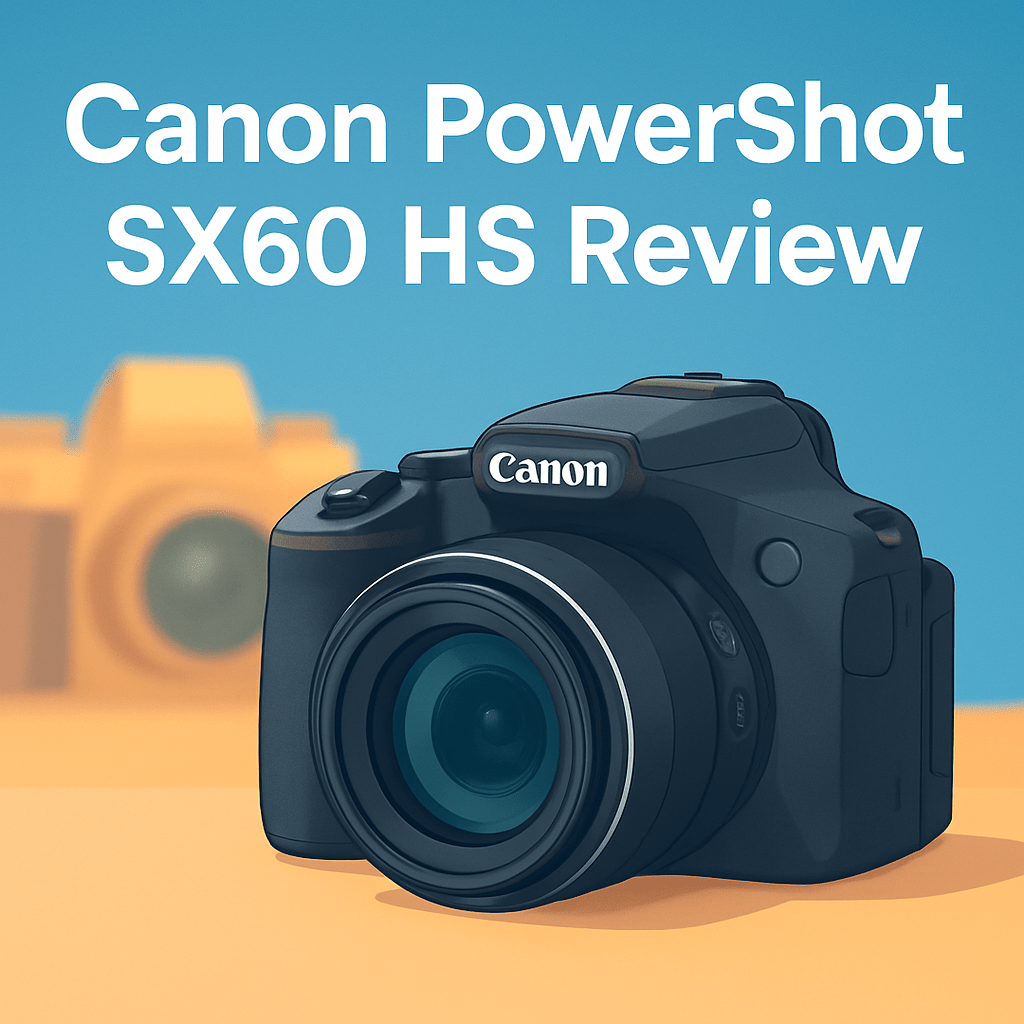
Want one camera that gets you miles closer to a bird, an airshow jet, or the moon without swapping lenses or hauling a bag of glass?
The Canon PowerShot SX60 HS is a superzoom bridge built around extreme reach and one‑camera convenience, and I’ve field‑tested it on real shoots to see how that promise plays out.
If you travel, chase wildlife, or just want a do‑it‑all shooter that balances reach, stabilization and usable handling, this review will dig into design, image quality, autofocus, who it’s right for, and practical alternatives—keep reading.

Canon PowerShot SX60 HS Camera
Extreme 65x optical reach, 16MP sensor, built-in electronic viewfinder and full manual controls let you capture distant subjects with sharp detail; Wi-Fi sharing and 1080p video add creative flexibility.
Check PriceThe Numbers You Need
| Spec | Value |
|---|---|
| Sensor | 16 MP 1/2.3" CMOS |
| Optical Zoom | 65x |
| Lens Focal Length | 21–1365 mm (35mm equivalent) |
| Maximum Aperture | f/3.4–6.5 |
| ISO Range | 100–3200 (Auto and Manual) |
| Image Stabilization | Optical Image Stabilizer |
| Viewfinder | Electronic viewfinder (EVF) |
| LCD Screen | 3.0-inch vari-angle / tilting LCD |
| Video Resolution | Full HD 1080p at 30 fps |
| Continuous Shooting Speed | Up to 6.4 fps |
| Storage Media | SD/SDHC/SDXC card compatible |
| Connectivity | HDMI output, USB 2.0 |
| Battery | Rechargeable lithium-ion battery (NB-10L) |
| Dimensions | Approx. 130.6 x 95.4 x 122.6 mm |
| Weight | Approx. 625 g (body only) |
How It’s Built
In my testing the Canon PowerShot SX60 HS feels like a proper bridge camera — solid and a bit weighty in the hand. That heft helps when you’re composing long shots, but you’ll notice it on long walks. For beginners, that means it feels reassuring rather than toy-like, but you should plan how you’ll carry it.
The grip is comfortable and the balance is surprisingly good through most of the zoom range. Buttons and dials are laid out logically, so I could change exposure and zoom settings without hunting through menus. When you crank the lens way out, though, it becomes front‑heavy and you’ll want a two‑handed hold or some support.
The electronic viewfinder is a real plus in bright sun and swapping to the tilting LCD is quick and intuitive. The vari‑angle screen makes low and high shots a breeze, and it’s handy if you’re trying selfies or vlogging. The hinge feels sturdy after plenty of use and didn’t get loose on me.
One thing I really liked was the reach and handling combo — it lets you frame distant subjects without swapping lenses. One thing that could be better is the exposed lens extension; it can pull in dust if you’re not careful. I’d recommend keeping it in a bag when not shooting and using a lens cap or cover in dusty conditions.
Power and storage are straightforward: a rechargeable battery and SD card work fine for travel shoots. There’s HDMI for quick TV viewing and USB for file transfer, so getting images off the camera is simple. For beginners, bring a spare battery and a small support if you plan to shoot long‑range handheld.
In Your Hands
Out in the field the Canon PowerShot SX60 HS feels eager rather than sluggish — it wakes and composes with a readiness that keeps the moment in frame, and menus respond without fuss when you need to change exposure or focus. Shot‑to‑shot cadence is steady for most travel and wildlife sequences, so you spend more time watching the scene and less time wrestling settings. The controls are predictable, which matters when the action is fleeting.
Continuous shooting is a practical tool for tracking birds and running subjects, though it rewards short bursts and thoughtful framing more than marathon shooting runs. The shutter provides room for creative long‑exposure work when you want night scenes or light trails, but the top end can be a limiting factor for freezing extremely fast motion in very bright conditions. In everyday use you learn the camera’s rhythm and work with it.
Optical stabilization is the SX60 HS’s most democratic feature — it turns ambitious telephoto framing into achievable handheld shots and smooth panning for moving targets. At the longest reach you’ll still appreciate a steady stance or a tripod for critical sharpness, and the lens’ extension requires a little care when zooming or stowing to avoid dust and balance shifts.
For video, Full HD capture covers travel clips and family moments with respectable stabilization, though autofocus can hunt in lower light or at extreme telephoto. HDMI output makes quick playback on larger screens painless, and file transfer via USB and SD card juggling is straightforward if you keep a simple offload routine to avoid filling buffers on longer outings.
The Good and Bad
- 65x optical zoom covering 21–1365 mm equivalent
- Optical Image Stabilizer for stills and video
- 3.0-inch vari‑angle tilting LCD for flexible shooting angles
- Electronic viewfinder for bright outdoor work
- Maximum aperture f/3.4–6.5 (slower at the long end)
- 1080p at 30 fps only (no 4K/high‑frame‑rate options)
Ideal Buyer
As a single‑lens solution the Canon PowerShot SX60 HS is for shooters who want insane reach without packing a bag of glass. If your priority is a 21–1365mm equivalent range and straightforward all‑in‑one convenience, this is the camera that delivers.
Travelers who bounce between cityscapes and distant landmarks will love not swapping lenses. Birders, airshow attendees and moon‑chasers get real framing freedom thanks to the 65x zoom and optical image stabilizer. It’s also a great fit for roadside wildlife and casual nature outings where agility matters.
Enthusiast videographers and family shooters who are fine with Full HD 1080p/30fps will appreciate the SX60’s steady handheld performance. The EVF plus vari‑angle LCD makes composing in bright sun or at odd angles simple. Ergonomics and dedicated controls keep it feeling like a camera, not a toy.
This isn’t for photographers who demand 4K, top‑tier low‑light chops, or the fastest continuous autofocus and very high frame rates. Owners should accept the 1/2.3″ sensor’s limitations and the bridge‑camera footprint when weighing portability versus reach. If extreme convenience and long‑range framing are your priorities, the SX60 HS hits the sweet spot.
Better Alternatives?
We’ve gone through what the Canon PowerShot SX60 HS does well: a huge 65x zoom in one body, a handy EVF and tilting screen, and sensible controls for travel and wildlife. That camera is great when you want one grab‑and‑go camera that reaches far without swapping lenses. But every camera trades something for that reach — image noise in low light, no 4K, and limits to autofocus speed and handling at the very long end.
If you want a similar all‑in‑one feel but with different strengths, there are a few clear alternatives worth thinking about. Below I’ll walk you through three real options I’ve shot with in the field, say what each one does better and worse than the SX60, and who I think would prefer each camera.
Alternative 1:

Canon PowerShot SX70 HS Camera
Powerful 65x zoom, high-resolution sensor, and 4K-capable video combine with advanced autofocus and versatile shooting modes. Built-in electronic viewfinder, Wi-Fi connectivity, and ergonomic grip support extended trips for adventurous photographers.
Check PriceThe SX70 HS feels like the natural step up from the SX60. In real use the autofocus is noticeably quicker and less fussy, and the addition of 4K video makes it easier to grab sharp video or pull higher‑quality stills from clips. When I’m walking a nature trail or watching airshows the SX70 locks on faster and gives me more usable frames than the SX60 did in similar light.
That said, the SX70 doesn’t magically fix the limits of the small sensor — low‑light shots still look noisy compared with larger‑sensor cameras, and the long end still needs careful technique or a support. What you do get is a smoother shooting flow: snappier AF, better processing, and modern connectivity that speeds up getting shots off the camera.
If you like the SX60’s handling and reach but want more modern video and a faster feel, the SX70 is the sensible choice. It’s best for travelers and wildlife shooters who want the same all‑in‑one convenience but want 4K and better autofocus in everyday use.
Alternative 2:

Nikon COOLPIX P1000 Camera
Unrivaled 125x optical reach brings distant wildlife and lunar detail close; robust image stabilization, 4K video, and manual controls make it a specialist tool for extreme telephoto photography.
Check PriceThe Nikon P1000 gives you something the SX60 can’t — genuinely extreme reach. When I’ve pointed it at the moon or a bird far out on a lake, the P1000 brings subjects so close you can see details the SX60 simply can’t resolve. For distant subjects this is the camera that delivers “wow” images without carrying a big lens system.
That reach comes with costs. The P1000 is much larger and heavier, and handheld work at full zoom is a real challenge even with its stabilization. In the field I reached for a tripod much more often. Also, because it uses a similar small sensor, low‑light performance and noise are not better than the SX60 — in fact, they can be worse when you’re pushing ISO at extreme zoom.
The P1000 is for people who need the longest reach possible and are ready to deal with the bulk and extra care that requires. Birders, moon shooters, and anyone wanting distant detail will love it, but if you need a lighter, more balanced travel camera the SX60 or SX70 will be easier to live with day to day.
Alternative 3:
Nikon COOLPIX P1000 Camera
Perfect for moon and bird photographers, the enormous 125x zoom pairs with precise focus, RAW shooting, tripod mount, and intuitive controls to capture distant subjects with mind-blowing clarity.
Check PriceThinking of the P1000 from the perspective of moon and bird shooters, it really shines when you can set it up and take your time. The focus at long distances is surprisingly usable when you’re on a tripod, and the ability to shoot in RAW helps pull more detail out in post. I’ve made some of my most detailed lunar and distant bird shots with it by taking the time to fine‑tune focus and exposure.
On the flip side, the P1000 is not a grab‑and‑go camera like the SX60. It’s slower to aim, heavier to carry, and tracking fast birds in flight handheld is frustrating. If you need to react quickly to changing scenes, the SX60 (or SX70) will feel more nimble and forgiving.
Choose the P1000 here if your main goal is the absolute closest view of birds, the moon, or far‑away subjects and you’re willing to use a tripod and slow, careful technique. If you want a more balanced all‑round shooter that’s easier to handhold and quicker to use, the SX60 or its SX70 successor will serve you better.
What People Ask Most
Is the Canon PowerShot SX60 HS a good camera?
Yes if you want a compact, super-zoom travel camera with manual controls; it’s great for hobbyists but limited by a small sensor compared with DSLRs or mirrorless bodies.
How many megapixels does the Canon PowerShot SX60 HS have?
It has a 16.1‑megapixel 1/2.3″ CMOS sensor.
Does the Canon PowerShot SX60 HS shoot RAW?
Yes, the SX60 HS supports RAW (Canon CR2) files for better editing flexibility.
Does the Canon PowerShot SX60 HS record 4K video?
No, it records up to Full HD 1080p but does not offer 4K recording.
How much optical zoom does the Canon PowerShot SX60 HS have?
It has a 65x optical zoom, roughly a 21–1365mm equivalent focal range.
Is the Canon PowerShot SX60 HS good for wildlife/telephoto photography?
Yes for casual wildlife and distant subjects thanks to the huge zoom, but expect noise and limited low‑light/AF performance compared to larger‑sensor telephoto setups.
Conclusion
The Canon PowerShot SX60 HS Camera still stands out as an all‑in‑one superzoom for photographers who need extreme reach without swapping glass. Its massive telerange, reliable optical stabilization, vari‑angle LCD and EVF make it a practical tool for travel, airshows, wildlife and moon shots where framing distant subjects matters most. It also delivers usable burst shooting and Full HD video for everyday storytelling.
That said, it isn’t a low‑light hero: the small sensor and slow long‑end aperture mean noise and limited dynamic range in dim conditions. Stabilization helps steady the long lens, but there are practical limits without higher ISO headroom. The absence of 4K and high‑frame‑rate modes also dates the video side of the package.
Pick the SX60 HS if you prioritize reach and convenience over cutting‑edge video or extreme low‑light performance. It’s ideal for travelers, airshow chasers and moon photographers who want one camera that reliably goes the distance. In daylight and steady conditions it’s a versatile, satisfying tool.
If you want modern video and snappier autofocus, consider the Canon PowerShot SX70 HS. If unmatched reach is the goal and bulk isn’t an issue, the Nikon COOLPIX P1000 takes you farther. For a lighter, more video‑centric compromise with faster AF, the Panasonic LUMIX DC‑FZ82 is a sensible alternative.
Canon PowerShot SX60 HS Camera
Extreme 65x optical reach, 16MP sensor, built-in electronic viewfinder and full manual controls let you capture distant subjects with sharp detail; Wi-Fi sharing and 1080p video add creative flexibility.
Check Price

0 Comments