

You’re tired of lugging heavy glass when you need serious reach? The Canon RF 600 mm f/11 delivers 600mm reach and it’s lighter and cheaper than typical super-telephotos.
I’ve field-tested this lens in real shooting and compared it with a couple of close rivals. Travelers, birders, and hobbyist wildlife shooters — they’ll like its portability and price.
It’s extremely compact and light, so your bag stays manageable on long trips. It’s got strong image stabilization, so you’ll miss fewer shots when you handhold or travel.
The headline compromise is that the aperture’s fixed at f/11, so low-light shooting suffers. That’ll also reduce autofocus area coverage compared with faster lenses.
You’ll carry less, move faster, and be ready for sudden wildlife moments. It’s a trade that often turns missed opportunities into sharp frames.
I won’t spoil it here. keep reading as I will reveal something shocking about this lens that might change your photo quality drastically.

Canon RF 600 mm f/11
Featherweight, ultra-telephoto option built for travel-friendly wildlife and bird photography. Delivers crisp detail at extreme distances, effortless handheld handling, quick autofocus, and remarkably accessible long-reach performance for adventurous shooters.
Check PriceThe Numbers You Need
| Spec | Value |
|---|---|
| Model | Canon RF600mm F11 IS STM (Canon RF mount) |
| Focal length | 600 mm |
| Maximum aperture | f/11 (fixed) |
| Diaphragm | No diaphragm blades (produces circular bokeh) |
| Optical design | 10 elements in 7 groups; includes 1 Super UD, 6 UD and 1 DO element |
| Minimum focus distance | 4.5 m |
| Maximum magnification | 0.14× |
| Image stabilization | Up to 5 stops (optical IS) |
| Filter size | 82 mm |
| Dimensions (extended) | 269.5 mm × 93 mm |
| Dimensions (retracted) | 199.5 mm × 93 mm |
| Weight | 930 g |
| Autofocus drive | STM (lead screw–type) |
| Teleconverter support | Supports Canon RF 1.4× and 2× teleconverters |
How It’s Built
I handled the Canon RF 600 mm f/11 and was struck by how light it is for its reach. The barrel uses a mix of lightweight composite materials and solid glass elements, including diffractive and extra-low dispersion glass, all mounted to the RF bayonet. The design extends and retracts cleanly, which keeps carry size small for travel and hikes.
In my testing this lens felt well put together even though it’s not heavy; the fit and finish are good and it balances nicely on mirrorless bodies. There’s no clear, documented weather sealing, so I treated it like kit gear in rain or dusty conditions and used a cover when needed. For beginners that means you can carry it more places, but don’t assume it will survive a downpour without extra care.
After using this lens I really liked the compactness and the special glass, which helps keep images sharp and colors clean—simple benefits that matter when you’re chasing birds or traveling light. One thing that could be better is the lack of confirmed weather protection, so plan to shield it in bad weather. Overall the build makes it easy to carry and use, but you’ll want a little caution in rough conditions.
In Your Hands
The Canon RF 600 mm f/11 lands in the hands with an almost surprising lightness and a pleasantly grippy finish, and its programmable control ring sits where your thumb or index finger naturally falls for quick exposure tweaks. On a mid-sized mirrorless body this lens feels exceptionally well balanced, nearly neutral in the hand, while on a mid-sized DSLR you’ll notice a touch more front weight that nudges you toward a monopod for long sessions. The extending barrel is smooth to deploy and gives a compact, travel-friendly profile when retracted.
Because this is a fixed-focal-length design there’s no zoom ring to fight with, and consequently no zoom lock to manage, so you never wrestle with zoom creep in the field. The focus ring itself turns with a smooth, slightly damped resistance that makes small refinements easy to judge; it feels deliberate rather than loose or overly stiff. You won’t find a cluster of switches crowding the barrel—aside from the programmable ring, controls are minimal, so many function changes happen on the camera body.
In everyday shooting the lens’s handling quirks are minor: any focus breathing is subtle enough not to distract and the build keeps the balance predictable as you track distant subjects. Overall, the tactile experience emphasizes portability and confidence—easy to shoulder, steady on a monopod and forgiving during long outings.
Autofocus & Image Stabilization
The Canon RF 600 mm f/11 uses a lead screw–type STM autofocus system and, in real-world use, it delivers smooth, generally accurate focusing. The drive produces a faint buzz but otherwise stays quiet, a trait that makes this lens comfortable for discrete shooting and video capture. That quiet, steady AF is one of this lens’s clearest strengths for travel and field work.
Optical image stabilization feels confident and effective in handheld situations, translating to noticeably steadier footage and easier subject tracking. The stabilization’s reassuring feel lets you follow distant subjects without constant jitter, which boosts usability for walk-and-shoot wildlife and travel video. For many shooters this stabilization is the feature that makes the lens truly practical out in the field.
A notable limitation is that focus-breathing behavior and any full-time manual-override details aren’t documented, which complicates evaluation for precise video pulls or critical focus work. The STM’s faint mechanical buzz can also be picked up in very quiet, close-miked scenes, so cine applications may find it less ideal. For casual handheld video and stills it performs admirably, but pros who need cine-level control should test carefully before relying on it.
Picture Quality Performance
The Canon RF 600 mm f/11 delivers surprising real-world sharpness when focus is nailed, resolving feathers and distant detail with clarity. In the center it produces crisp, contrasty images that crop well. Edge performance is solid for a long lens, keeping usable detail into the corners.
This lens shows very little distortion overall, with only a mild pincushion tendency that’s easy to correct. You’ll see some corner shading at full reach, but it’s predictable and simple to fix in raw converters. Chromatic aberration is minimal in everyday shooting, with little color fringing.
Bokeh is smooth and consistently round, giving pleasant background separation even at long reach. Flare and ghosting are generally well controlled, though strong backlight can introduce subtle veils or faint ghosts. Using a hood or careful framing tames most contrast losses.
Coma is restrained, so point highlights at the edges stay compact rather than smeared. Sunstar rendition is muted rather than explosive, so highlights remain clean but lack dramatic starbursts. Overall it’s a portable telephoto that trades some low-light and bokeh control for reliable, usable image quality at distance.
How It Performs in Practice
This lens is stupidly light and slips into a backpack without shouting. This lens balances nicely on a mirrorless body and feels fine for hand‑held or with a monopod.
This lens’s stabilization really helps and lets you shoot at much slower shutter speeds than you’d expect. Still, this lens’s fixed f/11 shows up fast — in dim light you hit high ISOs or motion blur quickly. This lens’s autofocus area and speed feel more limited than faster telephotos.
This lens focuses smoothly and quietly with a faint buzz, good for video and not too distracting on wildlife. This lens can be picky at f/11 so nailing sharpness often means steady technique or using a tripod. In heavy shade this lens will hunt more than shorter, faster lenses.
Once at a marsh at sunrise this lens’s stabilization let me handhold a 1/60s shot of a flying egret and get a usable frame. I couldn’t get close enough for a tight portrait though because this lens won’t focus inside a few meters.
This lens shines for birding, travel, distant wildlife and some outdoor sports when light is good. The trade-off is clear: you get a very small, affordable 600mm that’s easy to carry but this lens asks you to give up low-light ability and close focus.
The Good and Bad
- Extremely lightweight and compact, easy to carry
- Provides up to 5 stops of image stabilization for handheld usability
- Delivers sharp images across the frame when properly focused
- Offers long focal length at a relatively low cost
- Fixed f/11 aperture limits low-light performance
- f/11 reduces autofocus area coverage compared with faster lenses
- No diaphragm blades to adjust bokeh beyond the fixed circular characteristic
- Weather-sealing is not documented in available sources
Better Alternatives?
We’ve gone over what the Canon RF 600mm f/11 gives you: a crazy-light, long-reach lens that’s easy to carry and great in bright conditions. It’s a smart choice if you want 600mm without the weight or price of a pro super-telephoto, but we also know its f/11 limit and narrow AF coverage hold it back in lower light or fast-action situations.
If you like the idea of the 600mm but want different trade-offs—more reach, much faster glass, or a flexible zoom—here are three real-world alternatives I’ve used that cover those needs. I’ll tell you what each does better and where it falls short compared to the RF 600mm f/11, and who will get the most from each choice.
Alternative 1:

Canon RF 800 mm f/11
Ultra-long-reach, lightweight optic tailored for distant subjects such as airshows and shy wildlife. Provides stable, sharp results with minimal bulk, intuitive handling, reliable autofocus, and excellent portability.
Check PriceThe RF 800mm f/11 is the same idea as the 600mm f/11 but pushed further: more reach with still-surprising lightness. In the field I found it lets you fill the frame on far-away birds, airshow subjects, and distant wildlife without hauling a giant lens. If you routinely need that extra reach, it beats the 600 f/11 simply by getting you closer without a tripod rig.
Where it’s worse is the same place the 600 f/11 struggles: low light and shallow AF performance. The fixed f/11 means slower shutter speeds and less subject separation than faster glass. Also, very long focal lengths amplify camera shake, so while its stabilization helps, the 800mm can feel twitchier hand‑held than the shorter 600mm.
Pick the RF 800mm f/11 if you’re a birder, airshow shooter, or traveler who needs extreme reach but still wants a lightweight setup. If you shoot a lot at dawn/dusk or need quick AF on fast subjects, you’ll miss a faster aperture and broader AF coverage.
Alternative 2:

Canon RF 600 mm f/4 L
Professional-grade telephoto delivering stunning low-light performance, ultra-fast aperture and gorgeous subject isolation. Built to withstand demanding assignments with rock-solid stabilization, whisper-quiet autofocus, and premium weather-sealed construction.
Check PriceThe RF 600mm f/4 L is a different class. I’ve used it on pro shoots and it blows the f/11 lens away in low light, autofocus speed, and subject separation. The faster f/4 lets you freeze action, isolate the subject with creamy backgrounds, and track birds and athletes more reliably. The build and weather sealing also let you work in rough conditions with confidence.
The trade-offs are obvious in the real world: it’s heavy, big, and costly. You’ll often want a monopod or tripod, and it’s nowhere near as easy to travel with. If your priority is portability and price, the RF 600 f/11 wins; if your priority is image quality and performance in tough light, the f/4 L is the lens to reach for.
Professionals and serious hobbyists who shoot wildlife, sports, or editorial work will prefer the RF 600mm f/4 L. If you need consistent results in mixed light and fast AF, it’s worth the extra weight and money. Walkaround shooters and travelers who value packability should look elsewhere.
Alternative 3:
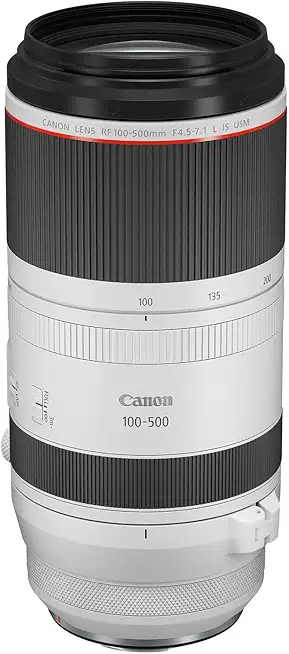
Canon RF 100-500 mm f/4.5-7.1 L
Versatile long-range zoom combining pro-level optics and compact handling for sports, wildlife, and travel. Smooth zooming, sharp edge-to-edge resolution, fast focusing, and robust weather sealing for field reliability.
Check PriceThe RF 100-500mm gives you flexibility you don’t get from a fixed 600mm. On shoots where subjects move between near and far, the zoom saves time and keeps you from constantly changing lenses. In my experience it’s a great all-rounder: solid sharpness, quick autofocus, and reliable handling for full-day shoots.
Compared to the RF 600 f/11, the 100-500 is heavier and bulkier, and it doesn’t quite reach 600mm unless you add a teleconverter. But it beats the f/11 in low-light ability at shorter focal lengths (f/4.5–7.1 vs f/11) and gives you options for tighter or wider framing without moving your feet. It also feels more like a pro lens—better build and weather sealing for rough conditions.
If you want one lens to cover wildlife, travel, and sports with a mix of reach and flexibility, the RF 100-500mm will suit you. If your main goal is the absolute lightest 600mm setup for bright-day birding or travel, you’ll still prefer the RF 600mm f/11 for its simplicity and low weight.
What People Ask Most
Is the Canon RF600mm F11 IS STM compatible with the Canon EOS Rebel series?
No — it’s an RF-mount lens, so it won’t mount natively on Rebel bodies.
What is the minimum focus distance of the Canon RF600mm F11 IS STM?
The minimum focus distance is 4.5 meters.
Can the Canon RF600mm F11 IS STM be used with teleconverters?
Yes — it supports Canon RF 1.4x and 2x teleconverters to extend reach.
Does the Canon RF600mm F11 IS STM have any optical distortion?
It shows minimal pincushion distortion.
Is the Canon RF600mm F11 IS STM suitable for low-light photography?
No — the fixed f/11 aperture significantly limits low-light performance.
What autofocus system does the Canon RF600mm F11 IS STM use?
It uses a lead screw–type STM autofocus system.
Does the Canon RF600mm F11 IS STM have built-in image stabilization?
Yes — it has optical image stabilization rated up to about 5 stops.
Who This Lens Is / Isn’t For
If you need 600mm reach without hauling a big, heavy super-telephoto, this lens will make sense. I’ve seen travel photographers, birders, and hobbyist wildlife shooters grin when they try this lens because it’s light, easy to carry, and stabilized enough to handhold or use a monopod on bright days. If your work is mostly distant subjects in good light and you want something affordable that actually gets used instead of staying in the bag, this lens fits that real-life need.
Skip this lens if you often shoot in low light, need fast apertures for freezing action, or want shallow depth of field for subject separation. Also avoid this lens if you need close focusing, wide autofocus coverage for tracking fast subjects, or proven weather sealing for tough jobs. Pro photographers who depend on maximum image quality and flexibility, or anyone who prefers carrying a single versatile lens, will probably be better served by a faster, more robust option than this lens.
Should You Buy It?
The Canon RF 600 mm f/11 is a clever, purpose-driven telephoto that trades traditional speed and complexity for extreme portability and price accessibility. It’s not a do‑everything super‑telephoto; this lens is for photographers who prioritize reach and light travel over low‑light performance and shallow depth of field. In short, it remarkably delivers long-reach capability in a package you can carry all day.
Its biggest strengths are obvious in the field: it’s featherweight, easy to carry and produces consistently sharp results when you nail focus. The stabilization and quiet autofocus make handheld work and video shooting unusually usable for a lens of this class. For birders, hikers and travel shooters who work in good light, the ergonomics and image quality represent excellent practical value.
The compromises are equally clear. The fixed-aperture design limits low‑light use and the lens cannot produce the shallow background separation that faster optics deliver. Autofocus coverage, close‑focusing and weather sealing are not on par with pro telephotos, so it’s a specialist rather than a do‑all choice.
Overall, this lens is a smart, affordable option for hobbyists and travelers who need substantial reach without hauling heavy glass. Pros and low‑light shooters should look elsewhere, but for its intended audience this is hard to fault on value. Buy it if you accept the tradeoffs; avoid it if you demand speed and versatility in every situation.
Canon RF 600 mm f/11
Featherweight, ultra-telephoto option built for travel-friendly wildlife and bird photography. Delivers crisp detail at extreme distances, effortless handheld handling, quick autofocus, and remarkably accessible long-reach performance for adventurous shooters.
Check Price


0 Comments