
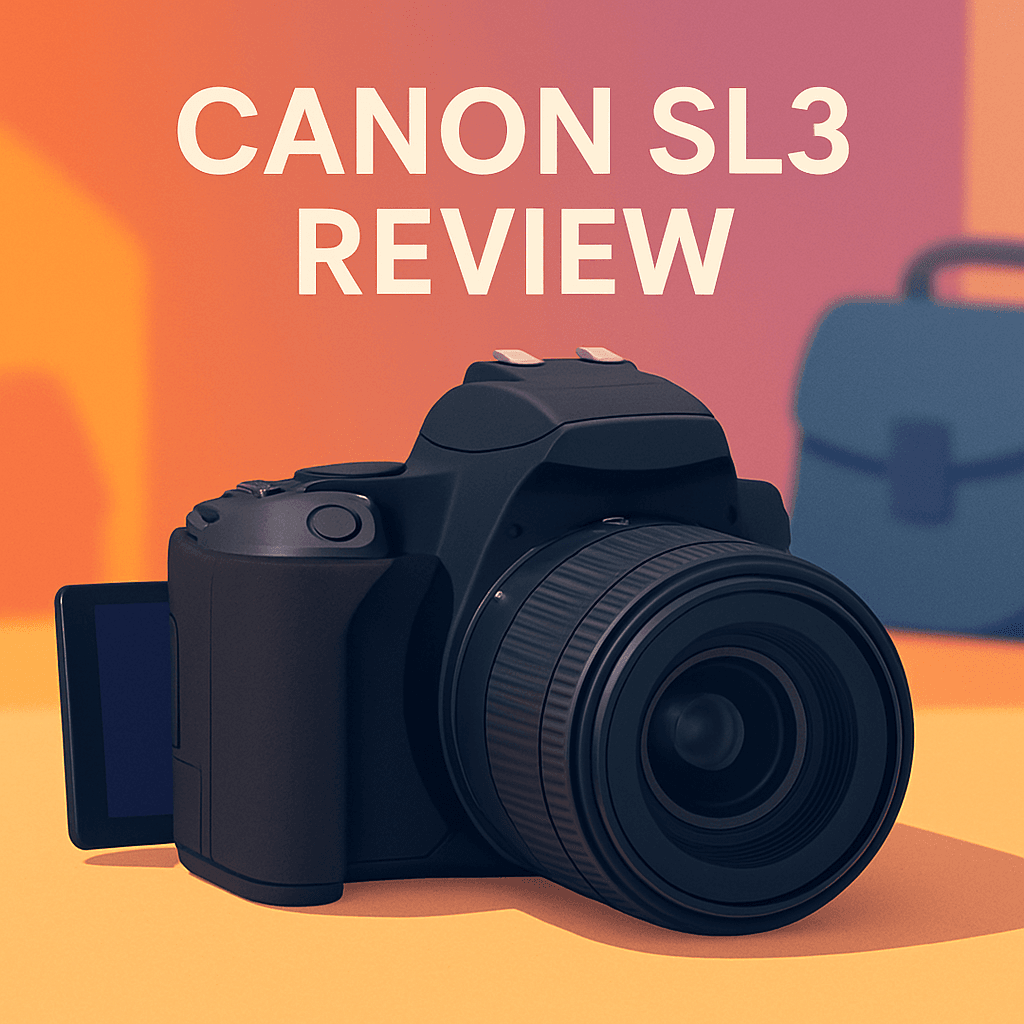
Tired of lugging a bulky camera for photos and vlogs?
I’ve personally field-tested the Canon Rebel SL3 Camera on location and compared it with “a couple of close rivals”.
It’s built for beginners and vloggers who need portability, easy controls, and a flip-out touchscreen.
You’ll love quick, confidence-boosting autofocus, battery life, and a camera that actually fits your bag.
The headline compromise is video; high-res footage is cropped.
There’s no in-body stabilization, so handheld clips can look shaky and that affects travel and run-and-gun vlogging.
You’ll get a tiny body that accepts many Canon lenses for creative growth.
It’ll encourage more shooting, more angles, and faster learning.
Autofocus in live view is reassuringly fast, so you won’t miss eyes or smiles.
They’ll make framing and publishing quicker.
I’ll explain real shooting tradeoffs and how to get the most from this small DSLR.
There’s one easy tweak that can improve Canon Rebel SL3 Camera images dramatically — keep reading.

Canon Rebel SL3 Camera
Compact, lightweight DSLR with a high-resolution APS-C sensor and intuitive vari-angle touchscreen—perfect for beginners and travelers. Delivers sharp images, reliable autofocus, long battery life, and seamless wireless sharing for storytelling.
Check PriceThe Numbers You Need
| Spec | Value |
|---|---|
| Sensor | 24.1 MP APS-C CMOS |
| Image processor | DIGIC 8 |
| Body type | Compact, lightweight DSLR (entry-level) |
| Lens compatibility | Canon EF, EF-S, TS-E, MP-E |
| Autofocus (Live View) | Dual Pixel CMOS AF with Eye Detection |
| AF system (viewfinder) | 9 AF points |
| Continuous shooting | Up to 5 fps |
| ISO range | 100–25,600 |
| Video recording | 4K at 24/25 fps; 1080p at 60/50/30/25 fps |
| 4K crop factor | Approximately 2.64× crop |
| Image stabilization | No in-body stabilization; digital stabilization for video |
| Rear screen | Vari-angle touchscreen |
| Weight | Approx. 449 g (15.84 oz) |
| Dimensions | 122.4 × 92.6 × 69.8 mm (4.82 × 3.65 × 2.75 in) |
| Ideal buyer | Beginners and vloggers seeking portability and lens flexibility |
How It’s Built
In my testing the Canon Rebel SL3 Camera felt noticeably small and light compared with other DSLRs I’ve carried. I walked around a city all day with it and barely noticed the weight, which made shooting for long stretches way less tiring. For beginners that means you’re more likely to bring it along and actually use it.
I found the vari-angle touchscreen to be a real game changer for vlogging and odd-angle shots. It flips out and turns toward you, and the touch controls make framing fast and simple. That flexibility really helps when you’re learning composition or filming yourself.
The body is mostly plastic, which keeps weight down but also means it doesn’t feel rock-solid like higher-end models. In real use that means you should be a bit careful in rough weather and with heavy lenses, and I wished the grip was a touch bigger for long lens setups. That’s the one thing I’d like to see improved.
Overall I liked how portable and easy the SL3 is to live with every day. After using it for a while I found it perfect for travel, street work, and beginner vlogging, while still needing a few small improvements for serious field use.
In Your Hands
In the field, the Canon Rebel SL3’s 4K capability is a double-edged sword: it records pleasing detail but applies a heavy crop that tightens wide-angle framing and pushes you toward longer focal lengths. Autofocus in Live View is where the camera truly performs—smooth, intuitive, and reliable for still subjects and typical vlogging setups. That said, AF tracking softens when subjects move quickly in 4K, so rapid action can expose its limits.
Canon skipped in-body stabilization, so handheld video depends on lens stabilization or the camera’s digital correction. The digital option does help steady casual clips but can introduce subtle reframing and never quite replaces optical systems or a gimbal for demanding work. For many run-and-gun creators it’s useful; for serious shooters it’s a compromise.
As a stills camera the SL3 feels nimble: responsive menus, quick Live View capture, and a modest burst capability that handles everyday moments well. It’s ideal for travel, street, and family shooting, while fast-paced sports or wildlife will reveal where the camera falls short.
Image quality at low to mid sensitivities is pleasant—clean rendering, good color and fine detail—though noise becomes noticeable as sensitivity climbs, so careful exposure pays off. Owners consistently praise the compact body and broad lens compatibility, even as video-focused users temper expectations around the crop and stabilization.
The Good and Bad
- Compact and lightweight design
- Good autofocus performance, especially in Live View
- Wide range of compatible lenses (EF/EF-S/TS-E/MP-E)
- 4K video capability at 24/25 fps
- Limited 4K video functionality, including a strong crop factor and restricted 4K workflow
- No in-body stabilization; relies on digital stabilization for video
Ideal Buyer
The Canon Rebel SL3 Camera is perfect for beginners who want a modern, forgiving DSLR to learn on. Its Dual Pixel CMOS AF and intuitive menus reduce the learning curve and help deliver consistently sharp images. Lightweight handling and a vari-angle touchscreen make experimentation with angles and composition effortless.
Vloggers who travel light will appreciate the SL3’s compact body and flip-out screen for framing selfie and talking-head shots. It offers 4K recording, though the heavy crop and lack of in-body stabilization mean you should plan lens choice and framing carefully. For many solo creators the camera’s autofocus and color rendition make everyday clips look professional with minimal setup.
Enthusiast photographers who value access to Canon’s extensive EF/EF‑S lens library will find the SL3 a capable, small-footprint platform. It balances respectable stills performance, an ISO range suited to low- and mid-light situations, and a 5 fps burst for casual action. The compact footprint also makes it an excellent travel, street, and second-body option.
This isn’t the best pick for videographers demanding uncropped 4K, in-body stabilization, or higher-end video codecs. If you prioritize portability, dependable Live View AF, and lens flexibility while staying budget-conscious, the SL3 is an ideal, practical choice. It serves as a friendly stepping stone into Canon’s ecosystem.
Better Alternatives?
We’ve covered the Canon Rebel SL3 in detail — its small size, flip screen, Dual Pixel AF in Live View and that awkward 4K crop. It’s a great starter DSLR for vloggers and beginners who want a light package with access to lots of Canon EF/EF-S glass.
If you’re thinking beyond the SL3, there are a few other cameras I’ve used that solve some of its pain points or offer a different shooting feel. Below are three practical alternatives and why you might pick each one over the SL3.
Alternative 1:

Canon EOS 850D Camera
Versatile enthusiast DSLR featuring a high-resolution APS-C sensor, fast continuous shooting and autofocus. Intuitive controls and a fully articulating touchscreen make capturing sharp photos and smooth video effortless for growing creators.
Check PriceI’ve shot weddings and travel with the Canon EOS 850D (T8i) and it feels like a more grown-up version of the SL3. In real shooting the 850D’s viewfinder AF and overall handling feel more confident — it locks on subjects quicker when using the optical viewfinder and the extra buttons make switching settings faster on the fly. You can also push it a bit harder in continuous shooting for action sequences.
Where it falls short compared to the SL3 is that it’s not a dramatic leap in video. The 850D still shares many of the same video quirks as Canon’s entry models (you won’t get stable in-body stabilization), and the camera is a touch bigger and a little heavier than the SL3, so it’s not as pocketable for long handheld vlogs. Battery life is similar or slightly better but expect the usual DSLR trade-offs when you want a tiny setup.
This is the camera I’d recommend to a beginner who wants a DSLR that feels a bit more capable and ergonomic for photos and some video — someone who values a faster feel in the hand and a stronger viewfinder experience, but still wants to stay in Canon’s EF/EF-S lens world.
Alternative 2:

Canon EOS M50 Mark II Camera
Compact mirrorless designed for creators and vloggers: high-quality APS-C imaging, flip-out touchscreen, reliable autofocus, and easy vertical video and live-streaming support. Lightweight, fast, and ideal for social content on the go.
Check PriceThe M50 Mark II is what I grab when I need the smallest, lightest kit for a day of run-and-gun shooting or vlogging. Its electronic viewfinder and silent shooting make it feel modern, and the flip-out screen plus good autofocus in normal video make framing and recording fast and easy. For everyday social video it’s more convenient than the SL3 and easier to use for live streams and vertical video.
Compared to the SL3, the M50 Mark II’s drawbacks are real: lens choice is smaller unless you use an adapter, and its 4K mode is still limited and cropped — autofocus in 4K can be weaker. Battery life is shorter than the SL3’s DSLR endurance, so expect to swap batteries during long shoots. Also, if you rely on Canon EF lenses, you’ll need an adapter which adds bulk and complexity.
Pick the M50 Mark II if you’re a content creator who wants the smallest, most portable camera for vlogging and quick social video, or if you like silent shooting and an EVF. It’s great for creators who value convenience and size more than deep lens choices or long battery life.
Alternative 3:

Nikon Z 50 Camera
Compact, high-performance mirrorless with a large-format mount adapted for APS-C imaging—produces crisp photos and 4K video. Comfortable grip, fast autofocus, and robust build make it perfect for travel and everyday shooting.
Check PriceWhen I switched to the Nikon Z 50 for a few trips, what stood out was the build and the viewfinder. The EVF is sharp, the autofocus is quick and steady across stills and video, and native Z-mount glass gives very clean, sharp results. In practical terms it handles low light and moving subjects well and the body feels balanced for long handheld shoots — it’s a very satisfying mirrorless option compared to the SL3.
The Z 50 does have downsides versus the SL3: if you already own Canon EF lenses you’ll lose the plug-and-play compatibility, and Nikon’s DX lens range is smaller than Canon’s EF/EF-S ecosystem. Also, battery life on mirrorless tends to be shorter than a DSLR like the SL3, so you’ll carry spares. It also doesn’t add in-body stabilization, so for shaky video you’ll still need stabilized lenses or a gimbal.
Choose the Z 50 if you want a mirrorless body with a great electronic view and fast autofocus for travel, street, and everyday shooting — ideal for photographers who want a modern feel, sharp lenses, and better EVF-assisted framing, and are open to moving away from Canon glass.
What People Ask Most
Does the Canon SL3 shoot 4K video?
Yes — it records 4K video at 24 and 25 fps.
Is the SL3 good for vlogging?
Yes — its compact size and vari-angle touchscreen make it well suited for vloggers.
What is the crop factor when shooting 4K on the SL3?
The 4K mode applies roughly a 2.64x crop compared to full frame, which limits wide-angle coverage.
Does the SL3 have in-body stabilization?
No — there’s no in-body image stabilization; the camera only offers digital stabilization for video.
What lenses are compatible with the SL3?
It’s compatible with Canon EF, EF-S, TS-E, and MP-E lenses.
Conclusion
The Canon Rebel SL3 Camera is a clear, practical choice for photographers and vloggers who prioritize size, simplicity, and the Canon ecosystem. It blends modern usability with classic DSLR handling in a way that feels approachable and intentional. For many users that combination is exactly what they need.
Its biggest strengths are portability, an intuitive live-view autofocus experience, and the flexibility of Canon lenses. The vari-angle screen makes real-world framing and selfie-style shooting effortless. Those strengths translate to fast adoption and satisfying everyday results.
On the downside, 4K is hampered by limited coverage and the body lacks built-in stabilization, which constrains handheld video workflows. Serious videographers will find these compromises frustrating when compared with more video-forward models. For still photographers and casual vloggers, however, those trade-offs are manageable.
Bottom line: if you want a compact, beginner-friendly DSLR that delivers dependable autofocus and broad lens options, the Canon Rebel SL3 Camera is a strong value. If advanced video features or in-body stabilization are priorities, you should look elsewhere. For its intended audience it’s a confident, well-rounded pick.
Canon Rebel SL3 Camera
Compact, lightweight DSLR with a high-resolution APS-C sensor and intuitive vari-angle touchscreen—perfect for beginners and travelers. Delivers sharp images, reliable autofocus, long battery life, and seamless wireless sharing for storytelling.
Check Price



0 Comments