
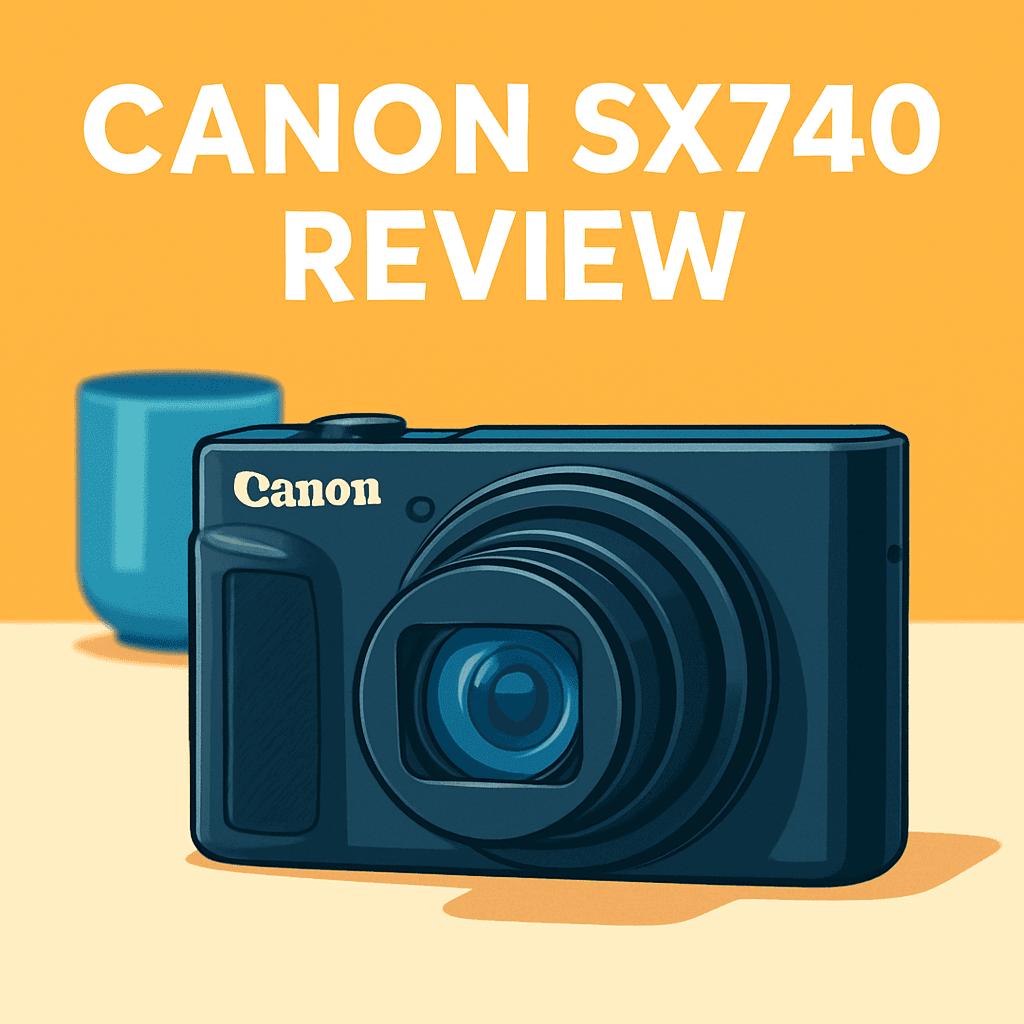
Want better travel photos without hauling heavy gear? In this canon sx740 review I look at the Canon PowerShot SX740 HS Camera to see if its long reach and 4K video hold up in real life.
This compact appeals to travelers, families, and anyone who wants big zoom in a pocket. You’ll care about reach, stabilization, handling, and easy sharing more than lab specs.
After field-testing the camera across streets, hikes, and family gatherings, I’ll walk you through real‑world payoffs and practical limits. Make sure to read the entire review as you’ll want to know when the SX740 shines — keep reading.

Canon PowerShot SX740 HS Camera
Travel-ready pocket model offering 40x optical zoom and 4K video recording. Fast autofocus, optical image stabilization, and Wi‑Fi sharing deliver crisp telephoto shots and easy social sharing on the go.
Check PriceThe Numbers You Need
| Spec | Value |
|---|---|
| Sensor | 1/2.3″ CMOS |
| Effective pixels | 20.3 MP |
| Lens | 40x optical zoom (24–960mm equivalent) |
| Aperture | f/3.3–6.9 |
| Video | 4K UHD 30p |
| ISO range | 100–3200 (expandable to 6400) |
| Shutter speed | 1/3200–15s |
| LCD | 3.0″ tilting touchscreen |
| Wi-Fi / Bluetooth | Yes |
| Battery | NB-13L |
| Dimensions | 110.1 × 63.8 × 39.9 mm |
| Weight | Approx. 299 g (including battery and card) |
| Image stabilization | Optical (Intelligent IS) |
| Maximum continuous shooting | 10 fps with AF |
| Zoom Framing Assist | Yes (re-finds subject lost at high zoom) |
How It’s Built
In my testing the Canon PowerShot SX740 HS Camera feels like a true travel buddy. It’s compact enough to slip into a jacket pocket or small bag, yet still gives you that long-reach zoom without lugging a big lens. For real trips this means less gear stress and more moments caught.
The handling is straightforward and friendly for beginners thanks to the tilting touchscreen. I used the screen for low-angle shots and quick selfies, and touch focus made framing painless. One catch: there’s no built-in viewfinder, so in bright sun you’ll be shading the screen with your hand.
Wi‑Fi and Bluetooth made sharing shots fast in the field, which I appreciated on short outings. The camera runs on an NB‑13L battery, and in my experience you’ll want a spare for full-day use. Bringing a second cell is a small habit that saves frustrating cutoffs.
I really liked how the Intelligent IS steadied long-zoom shots during hand-held shooting. It won’t replace a tripod at extreme telephoto, but it kept far-off subjects usable far more often than I expected. What could be better is battery life and the lack of an EVF for eye-level shooting.
Build quality felt solid and well put together in my hands, with clean fit and finish you’d expect from Canon. It’s not built for drops or water, so treat it like regular travel gear. For beginners that means a dependable, easy-to-carry camera that’s ready to go out of the bag.
In Your Hands
Out in the field the Canon PowerShot SX740 HS Camera lives up to its travel-zoom promise, letting you capture sweeping street scenes wide, flattering portraits in the mid range, and distant details—birds on a wire or architectural ornament—at the long end. Zoom Framing Assist is genuinely helpful for re-acquiring subjects once you get used to its timing.
Responsiveness is aimed at everyday action rather than pro bursts; the camera can track and deliver short sequences of kids, pets, and street moments with decent autofocus performance. Expect reliable capture for brief, decisive moments, though long sustained bursts aren’t its strong suit and there’s a slight learning curve to maintain focus through long zooms.
Image quality is punchy in bright light where fine detail and color pop, but in dimmer scenes noise and softening become noticeable as sensitivity is raised. The variable aperture means you’ll see true depth-of-field control at wider framings, while the telephoto end sacrifices light and subject isolation—so favor wider angles for low-light shots.
Stabilization is a real asset at long reach, letting you handhold shots and steady walk-and-talk footage more often than not. Still, simple bracing, deliberate breathing, and faster shutter choices make the difference between usable tele shots and blurred misses.
The Good and Bad
- 40x optical zoom (24–960mm eq.) in a truly compact body
- 4K UHD 30p video
- 10 fps continuous shooting with AF for brief action
- Optical Intelligent IS helps at long focal lengths and in video
- No built-in electronic viewfinder
- Small 1/2.3″ sensor limits low-light and dynamic range performance
Ideal Buyer
For travelers and everyday shooters who want massive reach without a tripod bag, the Canon PowerShot SX740 HS Camera is a sweet spot. Its 40x optical zoom, 4K video and tilting touchscreen put landmarks, distant wildlife and tight travel moments in easy reach, while Intelligent IS helps steady handheld shots. The pocketable body and Wi‑Fi/Bluetooth sharing make it a grab‑and‑go companion that slips into a jacket or daypack and favors convenience over studio‑grade image quality.
Families and casual photographers will appreciate the 10 fps burst performance for kids and street action, plus straightforward touch framing and fast wireless transfers for social sharing. Zoom Framing Assist and stabilized video help when subjects wander or you’re handholding at high magnification, and simple menus keep setups moving on the go. Just expect the small 1/2.3″ sensor to prefer daylight and for higher ISO shots to show visible grain.
If you live for low‑light shooting, prefer eye‑level composition with an EVF, or rely on RAW for heavy editing, this isn’t your camera. Choose the SX740 if maximum telephoto reach in a truly pocketable package with simple 4K capture and instant sharing matters more than low‑light performance or extensive post‑processing.
Better Alternatives?
We’ve already gone through the Canon PowerShot SX740 HS — its huge 40x reach, pocketable body, 4K video and the compromises that come with a small sensor. If you liked the idea of extreme zoom in a small camera but are wondering about other ways to balance reach, handling, and image control, there are a few good alternatives worth considering.
Below are three cameras I’ve used in real shooting situations that give you different mixes of features — some trade a little reach for a viewfinder and RAW files, others keep things very compact. I’ll stick to how they actually feel in the hand and what they do out in the field compared to the SX740.
Alternative 1:

Panasonic LUMIX DC-ZS70 Camera
Versatile travel shooter with 30x zoom and 4K capture, a flip-up touchscreen for selfies, RAW support, and responsive autofocus—designed for detail-rich images and flexible framing in tight spaces.
Check PriceThe Panasonic ZS70 shines where the SX740 falls short for many shooters: it has a built-in electronic viewfinder and true RAW capture. In bright sun the EVF makes composition much easier, and when I needed to rescue shadows or tweak color later, RAW files gave me more room to work than the SX740’s JPGs. The flip-up screen is also handy for selfies and low-angle shots, so it’s more flexible for varied travel framing.
Where it loses to the Canon is reach — the ZS70’s zoom doesn’t get as far as the SX740, so I found myself closer to subjects or needing to crop more for distant wildlife or distant city detail. Low-light behavior felt very similar to the SX740 because both use small sensors; stabilization and video are solid, but you don’t get noticeably better night performance just because it shoots RAW.
If you want an EVF for bright conditions, like to edit photos later, and don’t absolutely need the SX740’s longest tele range, pick the ZS70. It’s for the shooter who values framing control and editing flexibility over squeezing down every extra millimeter of zoom.
Alternative 2:

Nikon Coolpix A1000 Camera
Compact powerhouse with 35x optical reach, built-in electronic viewfinder and 4K video capabilities. Intuitive controls, multiple shooting modes, and steady stabilization make it ideal for travel and everyday telephoto needs.
Check PriceThe Nikon Coolpix A1000 is an easy-to-use travel camera with an EVF and a long but not extreme zoom. In the field I liked its balanced handling — it feels stable to hold while zooming and the viewfinder helps keep shots steady in bright light or when you want a steady stance for long tele shots. The menus and controls are straightforward, so it’s quick to change settings when you’re on the move.
Compared to the SX740 it doesn’t reach as far, and image quality at high ISO behaves similarly — noisy and soft once light gets scarce. Autofocus and stabilization are competent, but I noticed the SX740 pulls ahead a bit for the very longest distances and slightly faster continuous bursts when you need them for quick action.
Choose the A1000 if you want a travel-friendly camera with a proper viewfinder and easy handling, and you prefer a simple shooting experience over the SX740’s maximum zoom. It fits someone who shoots a lot outdoors and wants more reliable composition in bright sun without needing the absolute longest reach.
Alternative 3:
Nikon Coolpix A1000 Camera
Pocket-sized all-in-one featuring long-range optical zoom, effective image stabilization and an electronic viewfinder for precise composition. Simple menus and connectivity options streamline shooting, editing, and sharing while traveling.
Check PriceComing back to the A1000 with a slightly different view: it’s a good pick for people who care about portable all-in-one convenience with the help of an EVF. On trips where I wanted a single camera to handle landscapes, portraits and occasional long shots, the A1000 was comfortable to carry and quick to recompose thanks to the viewfinder and steady stabilization.
Where it falls short versus the SX740 is mostly raw reach and a bit of low-light punch — at dusk or indoors both cameras show the same small-sensor limits. Also, if you need the fastest autofocus tracking for moving subjects at long distances, the SX740’s zoom and responsiveness can be an advantage in my experience.
Pick the A1000 if you want an all-in-one that’s easy to live with on a trip: good stabilization, an EVF for tight composition, and simple controls. It’s aimed at travelers who want one camera that does most jobs well without chasing the maximum zoom the SX740 offers.
What People Ask Most
Is the Canon PowerShot SX740 HS good?
Yes — it’s a very capable compact travel zoom with long reach and 4K video, though the small 1/2.3″ sensor limits low‑light performance and dynamic range.
What is the zoom range of the Canon SX740?
It has a 40x optical zoom covering roughly 24–960mm equivalent, great for distant subjects and travel flexibility.
Does the Canon SX740 shoot 4K video?
Yes — it records 4K video (up to 30p), useful for sharp clips on the go though with some rolling shutter and limited stabilization.
How long is the battery life on the Canon SX740?
Expect around 250–270 shots per charge under CIPA testing, and noticeably fewer if you use 4K, Wi‑Fi, or frequent review playback.
How many megapixels does the Canon SX740 have?
It uses a 20.3‑megapixel 1/2.3″ CMOS sensor, which delivers good detail for web and prints but less fine detail than larger‑sensor cameras.
Does the Canon SX740 have Wi‑Fi and Bluetooth?
Yes — it includes built‑in Wi‑Fi and Bluetooth for easy image transfer and remote control via Canon’s Camera Connect app.
Conclusion
The Canon PowerShot SX740 HS Camera is the pocket-friendly superzoom that puts serious reach in a jacket pocket. It pairs confident stabilization with intuitive handling, useful framing tools, and reliable daylight image quality. For travelers who want easy 4K capture and fast sharing, it’s a hard camera to beat.
Those advantages arrive with familiar compromises, most notably a small sensor and a slow telephoto aperture that limit low-light latitude and fine detail in dim conditions. There’s also no viewfinder and no RAW option, so editing latitude and eye-level shooting are concessions. Stabilization helps a lot, but it can’t mask motion blur from slow shutter speeds—so plan your shots accordingly.
In short, pick the Canon PowerShot SX740 HS Camera if maximizing reach in a truly pocketable body, simple 4K recording, and effortless wireless sharing are your priorities. If you need an EVF or RAW workflow, consider the ZS70, the A1000 for straightforward travel ergonomics, or the HX99 if ultimate pocketability with an EVF matters most. For most vacationers and family shooters, this camera delivers the best balance of reach, convenience and results.
Practically speaking, treat it as a daylight and travel specialist rather than a low-light miracle worker. Bring a spare battery for long days, favor wider angles when light is low, and learn the zoom re‑acquire tools to make long‑range shooting dependable. That approach will get you the most value from the Canon PowerShot SX740 HS Camera on the road.
Canon PowerShot SX740 HS Camera
Travel-ready pocket model offering 40x optical zoom and 4K video recording. Fast autofocus, optical image stabilization, and Wi‑Fi sharing deliver crisp telephoto shots and easy social sharing on the go.
Check Price


0 Comments