
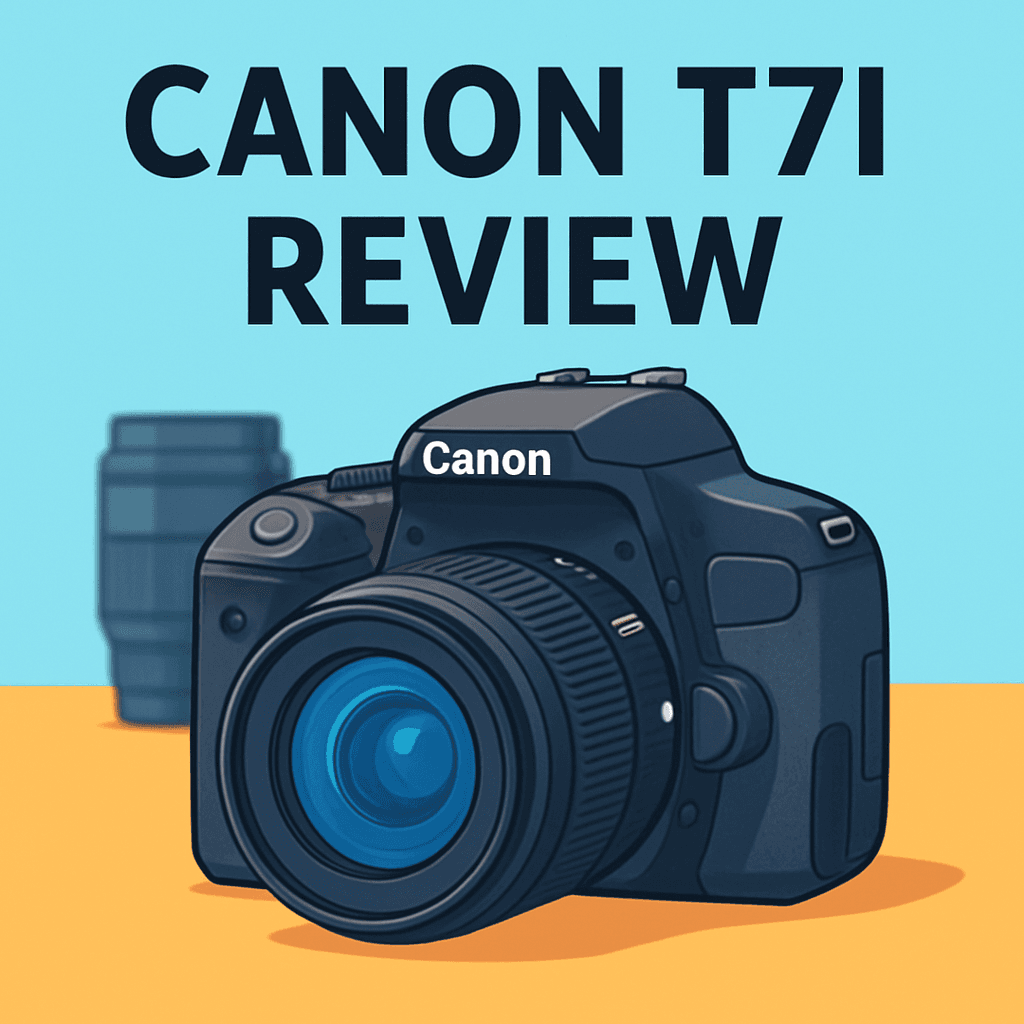
Want to know if the Canon EOS Rebel T7i Camera will actually improve your photos and fit your shooting style?
I’ve shot with it in the field, testing portraits, family action, travel street work, low light, and quick run‑and‑gun video.
This stills‑first DSLR suits beginners and enthusiastic dabblers who want dependable autofocus, a vari‑angle touchscreen, long battery life, and simple HD video for everyday use.
I’ll evaluate handling, AF in both viewfinder and live view, image quality, and low‑light performance—Make sure to read the entire review as…

Canon EOS Rebel T7i Camera
Versatile APS-C DSLR delivers sharp 24MP stills and smooth Dual Pixel autofocus for confident tracking. Intuitive vari-angle touchscreen, fast 45-point AF and creative controls make it perfect for growing photographers.
Check PriceThe Numbers You Need
| Spec | Value |
|---|---|
| Sensor | 24.2MP APS-C |
| Processor | DIGIC 7 |
| Autofocus | Dual Pixel |
| ISO Range | 100-51200 |
| Shutter Speed | 1/4000s to 30s |
| Continuous Shooting | 6 fps |
| Video | 1080p at 60fps |
| Viewfinder | Optical |
| Screen | 3″ Vari-angle Touchscreen |
| Battery Life | Approx. 600 shots |
| Memory Slots | 1x SD/SDHC/SDXC |
| Lens Mount | EF/EF-S |
| Weight | Approximately 532 g |
| Dimensions | 131.0 x 99.9 x 76.2 mm |
| Metering Modes | Evaluative, Partial, Spot, Center-weighted average |
How It’s Built
From the moment I picked up the Canon EOS Rebel T7i it felt like a DSLR that won’t slow you down. It’s compact and light enough to carry all day without a sore shoulder. That means more shooting on walks, trips, and family outings.
Shooting through the optical viewfinder was a joy — clear, immediate, and easy to compose quickly. In my testing it kept up with fast moments and felt comfortable for long sessions. For anyone learning the basics of framing, that instant feedback matters.
The vari-angle touchscreen is the highlight for me; after using it for a while I could nail low and high angles and flip to face myself for quick clips. Touch menus, scene modes, and focus worked intuitively, which helps beginners get usable results fast. I really liked this flexibility for creative shots.
On the flip side, there’s only a single memory card slot, so I always backed up after shoots instead of relying on in-camera redundancy. The EF/EF-S lens mount, however, gives access to a huge range of lenses, so you can grow without swapping systems. Overall the body feels well laid out for beginners, even if the materials lean a bit plasticky.
In Your Hands
Shooting with the Canon EOS Rebel T7i feels immediately reassuring thanks to its Dual Pixel AF in live view and video—focus is fast, smooth and predictably locks onto faces, making run-and-gun clips and quick portraits feel effortless. In challenging contrast situations it can hunt briefly, but for everyday family moments and casual content creation it stays surprisingly sticky and dependable.
The optical viewfinder experience trades the live-view perks for immediacy; the camera’s dense phase-detect AF array lets you pick and hold focus points comfortably, and subject tracking holds up well for most moving targets. For decisive stills it’s the more instinctive option, offering quicker response when the scene unfolds fast.
Continuous shooting is brisk enough for kids, pets and amateur sports, and in good light you’ll come away with a solid keeper rate without overthinking technique. Performance softens in low light, where slower shutter and increased noise mean you’ll lean on technique and lens choice to maintain usable shots.
Battery life is generous in real use, so full-day photo walks and event coverage rarely force conservative shooting habits. That endurance makes the T7i a comfortable companion for travel and family outings where charging opportunities are sparse.
For video the camera produces clean, fluid HD motion that’s great for B-roll and home movies, with generally natural AF transitions and usable touch-to-focus. Expect occasional focus breathing and a bit of hunting in cluttered or dim scenes, but overall it’s very user-friendly for casual filmmakers.
Choosing between viewfinder and live view becomes a creative decision: use the finder for speed and feel, and live view when framing awkward angles or vlogging. Metering is trustworthy across mixed scenes, though I often nudged exposure or used selective metering when highlights threatened to clip or skin tones needed protection.
The Good and Bad
- Dual Pixel AF in live view/video for fast, accurate focusing
- 45-point viewfinder AF system for stills
- 3″ vari-angle touchscreen with touch focus and intuitive operation
- 24.2MP APS-C sensor with DIGIC 7 processing
- No 4K video capture
- Single SD card slot (no in-camera redundancy)
Ideal Buyer
The Canon EOS Rebel T7i Camera is ideal for photographers stepping up from a smartphone or point‑and‑shoot who want a stills‑first DSLR that can grow with their skills. Its 24.2MP sensor, DIGIC 7 processing and access to Canon’s EF/EF‑S lens ecosystem give you room to learn and upgrade.
If you make family photos, travel imagery and casual video your priority, the T7i’s Dual Pixel AF makes live‑view and 1080p/60 recording feel reliable and easy. The vari‑angle touchscreen is great for low/high angles or self‑recording, while the optical viewfinder keeps that familiar DSLR workflow.
Battery life of roughly 600 shots means a full day of walks, events or vacations without constant recharging. Paired with easy‑to‑use scene modes and comfortable handling, it’s a camera that rewards practice rather than punishes mistakes.
It’s also a pragmatic choice for creators who are fine with 1080p/60 video instead of 4K, and who can live with a single SD card slot and a 1/4000s top shutter speed. If you want modern video specs or dual‑card redundancy, consider alternatives — but for everyday photography and dependable autofocus, the T7i is hard to beat.
Better Alternatives?
We’ve gone through the Canon EOS Rebel T7i and what it gives you for everyday shooting — great Dual Pixel live‑view AF, a friendly vari‑angle screen, solid stills, and easy handling for beginners. If that sounds right for you, you’re probably set. But some shooters will want something a bit different: a lighter travel body, a smaller kit for vlogging, or a camera with a different feel in the hand.
Below are a few real-world alternatives I’ve used enough to know how they stack up against the T7i. I’ll point out what each one does better and where it falls short, and who I think would prefer each option in the field.
Alternative 1:

Nikon D5600 Camera
Lightweight APS-C camera pairs high-resolution sensor with responsive autofocus and a swiveling touchscreen for flexible framing. Bluetooth connectivity keeps images synced for easy sharing; ideal for travel and enthusiast shooters.
Check PriceI’ve shot with the D5600 on a few trips and it feels plain and comfortable to use. The images have a pleasing color that I liked straight out of camera, especially for landscapes and portraits. In bright light it keeps up well with the T7i for detail, and the touchscreen swivel is handy for overhead or low angles when I don’t want to fuss with settings.
Compared to the T7i the D5600 is a bit better for long days — the grip and balance feel nice and the battery seemed to last a long time when I wandered through markets and parks. Where it lags is live‑view and video autofocus; it’s not as quick or as smooth as the T7i’s Dual Pixel system, so I got fewer keepers when trying to follow moving subjects in video or quick run‑and‑gun shots. The Nikon phone app/connectivity can be handy, but I’ve had it drop a transfer a time or two more than Canon’s pairing did.
If you’re mostly into stills, travel shoots, and want a camera that’s light on your neck for a full day, the D5600 is a solid pick. If you need the best live‑view AF for video work or fast moving subjects, the T7i will serve you better.
Alternative 2:

Canon EOS Rebel SL2 Camera
Ultra-compact beginner DSLR combines a bright sensor with smooth live-view autofocus and an easy-to-use vari-angle touch display. Lightweight design and creative guides help new shooters gain confidence quickly.
Check PriceI carried the SL2 for a week when I wanted the lightest kit possible, and it’s surprising what you can do with such a small body. The Dual Pixel live‑view AF is essentially the same pleasant experience as the T7i for photos and 1080p video — focus is quick and predictable in most situations. Because it’s tiny, it’s great for casual street work and travel when you don’t want to look like you’re hauling heavy gear.
Where the SL2 gives up to the T7i is in handling and endurance. The smaller grip and fewer buttons make long shoots a bit tiring and slower to adjust settings. Battery life is shorter, so I had to think about spare batteries more than I did with the T7i. The optical viewfinder AF feels more basic in tricky action scenes, so for photographing fast kids or sports the T7i’s system is more forgiving.
Pick the SL2 if you want Canon image look and Dual Pixel AF in the smallest DSLR package — it’s great for beginners, vloggers on a budget, or travelers who value weight above all. If you shoot long events, lots of action, or want more direct controls, the T7i will make your life easier.
Alternative 3:

Canon EOS Rebel SL3 Camera
Tiny but powerful DSLR offers sharp images, advanced DIGIC processing, and a flexible articulating touchscreen. Adds 4K video capabilities for content creators wanting great quality in a pocketable body.
Check PriceThe SL3 is the one I reached for when I wanted the smallest Canon body but needed a bit more for video. It’s pocketable and easy to hold for walk‑around shooting, and the 4K option gave me better looking clips for short social videos. For stills and 1080p clips, the live‑view experience is very close to the T7i — snappy focus and usable touch controls.
What the SL3 does better than the T7i is size plus the extra reach of 4K for creators who want sharper frames straight from camera. The trade‑off I noticed is that 4K shooting can be a bit less smooth with autofocus compared to the T7i’s very reliable 1080p Dual Pixel performance, so if smooth AF transitions in video are your priority the T7i still feels nicer. Also, in long handheld shoots the tiny grip gets tiring faster than the T7i’s larger body.
Choose the SL3 if you want Canon handling but need 4K in a very small package — good for vloggers, travel creators, and anyone who wants a true pocketable DSLR with modern video. If you rely on long sessions, big bursts of action, or the easiest possible live‑view AF, the T7i remains the more comfortable, all‑round choice.
What People Ask Most
Is the Canon EOS Rebel T7i worth buying?
Yes — it’s a solid value for beginners and hobbyists thanks to good image quality and easy controls, especially if you buy used or on sale, but it lacks newer features like 4K and the latest AF tech.
Is the Canon T7i good for beginners?
Yes — the intuitive menus, touchscreen, and helpful auto modes make it easy to learn photography with.
What are the pros and cons of the Canon T7i?
Pros: good image quality, Dual Pixel AF, vari-angle touchscreen and beginner-friendly features; Cons: no 4K video, older sensor, and slower continuous shooting than newer models.
Does the Canon T7i shoot 4K video?
No — it records up to 1080p Full HD only.
How is the autofocus performance on the Canon T7i?
Autofocus is very good for stills and live view thanks to Dual Pixel AF, but it’s not as fast or capable in low light or fast action as newer cameras.
What lenses are best for the Canon T7i?
Start with a 50mm f/1.8 for portraits, a 24–70mm or the 18–55mm kit for general use, and a 55–250mm or 70–200mm for telephoto; use Canon EF or EF‑S lenses for full compatibility.
Conclusion
The Canon EOS Rebel T7i Camera is a practical, stills‑first DSLR that excels where it matters most for everyday shooters. Its live‑view Dual Pixel AF and flip‑out touchscreen make portraits, family moments and run‑and‑gun video simple and reliable. Add dependable 1080p/60 video, a 6 fps burst pace, an optical viewfinder, approximately 600‑shot battery life for day outings, and access to the vast EF/EF‑S lens ecosystem, and you’ve got a flexible, forgiving tool for beginners and enthusiastic hobbyists.
That said, it’s not a camera for every situation. Lack of 4K, a single memory card slot, and limited top shutter speed are real constraints for creators who demand future‑proof video, in‑camera redundancy or aggressive bright‑light shooting without filters. Those tradeoffs keep it squarely in the beginner‑to‑enthusiast camp rather than the pro toolkit.
If you want an easy‑to‑learn, responsive DSLR with great live‑view AF and room to grow, choose the Canon EOS Rebel T7i Camera without hesitation. If your priorities tilt toward slightly better ergonomics or battery life, the D5600 is worth a look; if pocketability and vlogging ease matter most, the SL2 is a sensible alternative; and if weather sealing and in‑body stabilization are musts, consider the K‑70. For most shooters stepping up from a phone or compact, the T7i delivers the best mix of usability and image‑making capability at its level.
Canon EOS Rebel T7i Camera
Versatile APS-C DSLR delivers sharp 24MP stills and smooth Dual Pixel autofocus for confident tracking. Intuitive vari-angle touchscreen, fast 45-point AF and creative controls make it perfect for growing photographers.
Check Price

0 Comments