
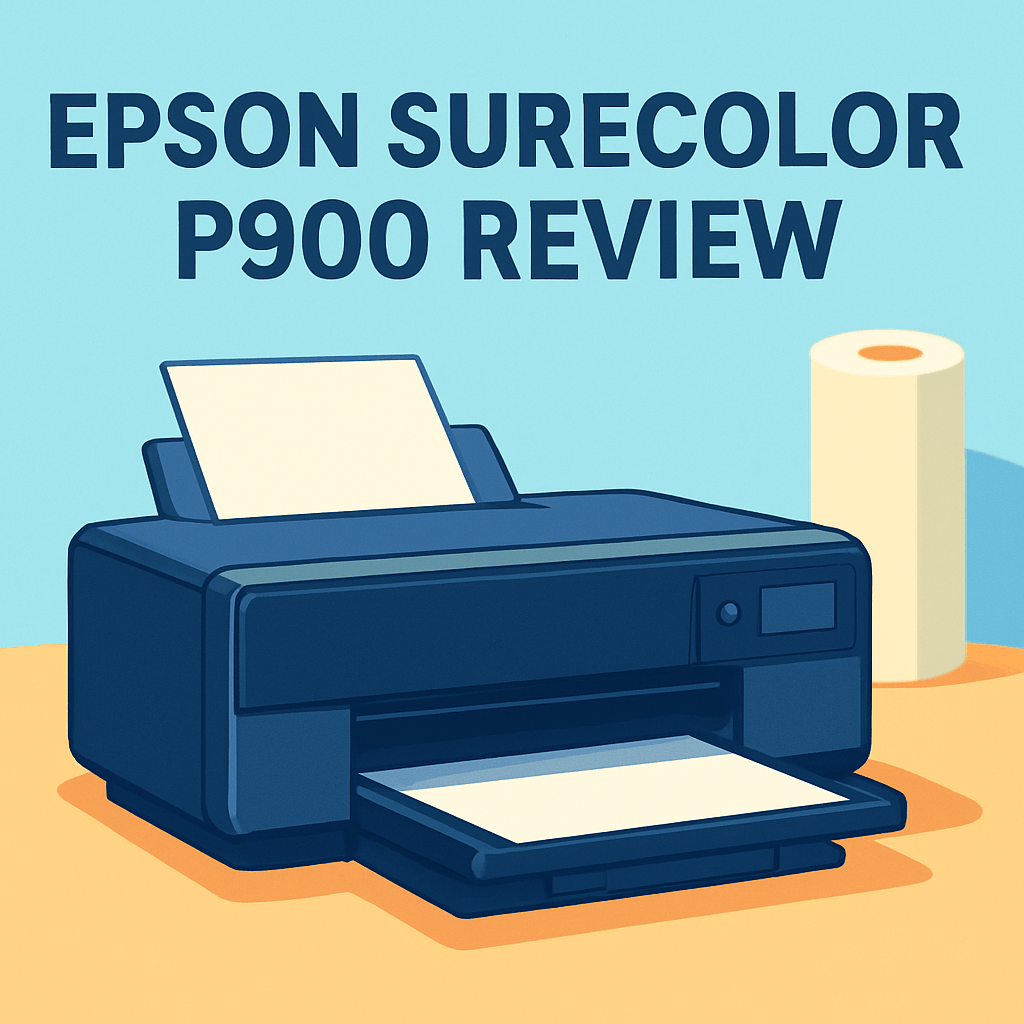
Looking for a straight-shooting epson surecolor p900 review to decide whether a 17-inch pro printer belongs in your studio?
The Epson SureColor P900 Printer aims at serious enthusiasts and pros who want gallery-quality color and B&W prints.
On paper it promises a 10-color UltraChrome PRO10 ink set, MicroPiezo AMC head, 17-inch width, roll support and borderless output.
I’ve run it in the studio and field-tested prints, and I’ll evaluate design and build, workflow, image quality, media versatility, connectivity, and ink cost.
If you print fine art, portraits, landscapes or long panoramic work, you’ll want to see the tradeoffs and real payoffs. Make sure to read the entire review as I dig into prints, workflow and costs — keep reading.

Epson SureColor P900 Printer
Produce museum-quality, archival prints with breathtaking color accuracy, deep blacks, and smooth tonal transitions. Ideal for fine-art and photographic portfolios, with flexible media handling and intuitive controls for consistent results.
Check PriceThe Numbers You Need
| Spec | Value |
|---|---|
| Printer type | 17-inch professional photo printer |
| Ink system | 10-color pigment inks (UltraChrome PRO10) |
| Print resolution | Up to 5760 x 1440 dpi |
| Max print width | 17 inches |
| Supported media types | Cut sheets and roll paper (including fine art papers) |
| Supported media lengths (roll) | Up to 1.5 meters |
| Max paper thickness | Up to 1.3 mm |
| Printer technology | MicroPiezo AMC print head |
| Color gamut | Expanded color gamut with UltraChrome PRO10 ink set |
| Black ink types | Photo Black and Matte Black |
| Borderless printing | Available on supported media sizes |
| Connectivity | USB, Ethernet, Wi‑Fi |
| Operating systems | Compatible with Windows and macOS |
| Printer size (WxDxH) | Approx. 29.6 x 16.5 x 7.1 inches |
| Weight | Approx. 19.4 kg (42.8 lbs) |
How It’s Built
In my testing the Epson SureColor P900 Printer felt like a proper studio workhorse that wants a dedicated spot, not just a crowded shelf. The chassis and front panel are well put together, and the controls are clear and responsive. For beginners that means setup is less intimidating, though you do need to leave room behind and above for paper and roll paths.
I found loading cut sheets and thick fine art papers straightforward, and roll loading is thoughtful with guides that help keep long prints straight. Borderless printing worked reliably on supported papers, but very thick stock sometimes needed a tiny alignment nudge. I liked how it handled heavy paper with confidence, but I’d like a simpler way to fine-tune alignment for the thickest boards.
Connectivity via USB, Ethernet, and Wi‑Fi installed easily and Epson’s driver and layout software got me printing quickly. The fit and finish feel professional, cable routing is handled smartly, and printing runs produce low hum rather than a disruptive roar. After using it for a while the quiet operation impressed me, though occasional maintenance pauses can interrupt a busy session.
In Your Hands
Initial setup with the Epson Print Layout and the onboard driver is refreshingly straightforward; loading ICC profiles and selecting media presets felt like second nature after a quick soft-proofing pass. I built custom presets for favorite papers and relied on soft-proof comparisons to tame saturation and contrast before sending jobs to the P900.
Switching between glossy, luster and thick fine‑art sheets was handled with minimal fuss—thicker papers seated cleanly and alignment stayed true through multiple passes. Roll loading is ergonomic and predictable, tracking long panoramas without noticeable skew, while borderless prints emerged with clean edges and only occasional faint misting near the very edge on ultra-smooth surfaces.
On the connectivity side, wired Ethernet was rock‑solid for heavy files and steady spooling, while Wi‑Fi held up for routine studio work with the usual brief pauses you expect when waking the host computer. USB was reliable for single-job transfers and macOS and Windows behaved similarly, with the driver offering clear prompts when attention was needed.
Throughput feels geared toward quality over speed; you’ll notice maintenance cycles at predictable intervals but they’re unobtrusive and quick to resolve. Routine cleaning and occasional cartridge swaps introduced minimal downtime, and overall the unit stayed highly productive across a week of mixed gallery and panoramic prints.
The Good and Bad
- Seventeen-inch professional photo printer with roll support for long panoramas
- Ten-color UltraChrome PRO pigment ink system with expanded color gamut
- Dedicated Photo Black and Matte Black inks for smooth tonal transitions and flexible glossy and matte workflows
- High-resolution output with MicroPiezo AMC print head and strong fine detail reproduction
- Large and heavy compared to smaller class printers, requiring ample workspace
- Maximum print width limited to seventeen inches, which may be restrictive for larger gallery pieces
Ideal Buyer
The Epson SureColor P900 Printer is built for photographers who sell gallery-grade prints up to 17 inches wide. Serious enthusiasts and working pros who demand expanded gamut and consistent color on fine-art, glossy, or luster stocks will get the most from it. If you want museum-ready output from a compact 17-inch platform, this is the machine to consider.
Black-and-white specialists will value the separate Photo and Matte Black inks for neutral tonality and smooth midtone gradation. Wedding and portrait shooters who need subtle skin rendering and deep, clean shadows will also benefit. Landscapers chasing long tonal roll-offs and fine shadow detail will find the P900 especially capable.
Small studios and print shops that produce panoramas or long runs gain from roll support to 1.5 meters and media handling that accepts thick fine-art sheets up to 1.3 mm. Borderless printing on supported sizes speeds up ready-to-frame workflows and reduces finishing time. The P900 suits makers who need in-house flexibility without outsourcing large-format work.
If you rely on Ethernet or Wi‑Fi and work across macOS and Windows, the P900 fits into networked studios and mixed-platform pipelines with ease. It’s ideal for creators who prioritize predictable proofs, color management, and efficient throughput. If you rarely print wider than 13 inches, consider a 13-inch sibling for a smaller footprint and lower cost.
Better Alternatives?
We’ve gone deep in this epson surecolor p900 review and walked through how it handles color, black-and-white, roll work, and heavy fine‑art sheets. If you liked what you read but want to see other options before you decide, here are a few real alternatives I’ve used in the studio and on shoots.
Each choice below has real trade‑offs — some give warmer skin tones, others save space, and some are easier on certain paper types. I’ll point out what each does better and worse than the P900 and who I’d recommend it to, based on hands‑on use.
Alternative 1:

Canon imagePROGRAF PRO-1100 Printer
Achieve gallery-ready images with exceptional color fidelity, subtle gradations, and precise detail. Designed for professional studios, it delivers reliable, long-lasting prints on diverse media types with easy workflow integration.
Check PriceI’ve spent time printing portraits and landscapes on the Canon PRO‑1100, and the thing that jumps out is how pleasing skin tones and midtones look right out of the box. If your work is heavy on people or fine‑art color where you want a “printed” look without a lot of profiling, the PRO‑1100 tends to get you there faster than the P900.
Where it falls short vs the P900 is media flexibility and studio throughput. The P900’s roll support and thicker media handling make it better for long panoramas and heavy fine‑art boards. I found the PRO‑1100 excellent for single sheets and gallery prints, but not as handy if you need long roll prints or very thick board stock.
Buyers who should consider the PRO‑1100 are portrait and fine‑art photographers who prize out‑of‑printer color, want great skin tones without chasing profiles, and mostly print single sheets. If you need roll work or thicker media often, stick with the P900 instead.
Alternative 2:
Epson SureColor P900 Printer
Create stunning, high-resolution photographs featuring rich color gamut and lifelike detail. Built for artists and photographers seeking consistent archival quality, seamless borderless printing, and simplified color management.
Check PriceThis is the Epson SureColor P900 — the exact printer this review focuses on. In hands‑on use it’s the baseline for comparison: strong B&W tone, wide color range for tricky hues, roll capability, and reliable heavy‑sheet handling that many studios depend on.
Comparing it to itself is easy: you get the roll support, thicker media acceptance, and the particular color and B&W rendering I describe in the review. The trade‑offs vs other printers are what we’ve already covered — it’s a bit larger than the 13‑inch models and ink cost and footprint are things to consider if you don’t need 17‑inch output.
If you want the exact mix of roll printing, 17‑inch width, and the color/B&W character I tested, the P900 is the printer to buy. If your needs are smaller prints or different color bias (like Canon skin tones), look at the other options below.
Alternative 3:

Epson SureColor P700 Printer
Compact yet powerful, this desktop solution produces fine-art prints with remarkable clarity, smooth blacks, and vibrant hues. Perfect for small studios wanting professional-quality output, easy setup, and efficient media handling.
Check PriceI use the P700 when I need P900 image quality but in a much smaller package. For prints up to 13 inches the P700 gives nearly identical color and B&W results — same smooth gradations and detail — and it fits on a small desk without sacrificing much in the way of final look.
What the P700 can’t do as well as the P900 is larger work and roll printing. If you want 17‑inch gallery pieces or long panoramas from roll media, the P900 handles those jobs. The P700 is better if you don’t need those larger sizes and want a quieter, smaller footprint with lower initial cost.
Choose the P700 if you mainly print 13×19 or smaller, work from a compact studio, or want most of the P900’s image quality without the extra space and handling for big papers. If your work requires 17‑inch prints or regular roll panoramas, stick with the P900.
What People Ask Most
Is the Epson SureColor P900 worth buying?
Yes — for serious photo and fine‑art shooters it offers excellent print quality, modern connectivity and a compact workflow-friendly design that justify the price for professionals and advanced amateurs.
How does the Epson SureColor P900 compare to the Epson P800?
The P900 upgrades the P800 with a newer 10‑ink set, improved color gamut and quieter operation while keeping the same 17″ print width and overall professional output quality.
What is the print quality of the Epson SureColor P900?
Print quality is outstanding, delivering deep blacks, smooth tonal transitions and a wide color gamut suitable for gallery‑quality photo and fine‑art prints.
What ink does the Epson SureColor P900 use and how many cartridges does it have?
It uses Epson’s pigment-based UltraChrome Pro10 ink system with 10 individual cartridges, including switchable photo and matte blacks for optimal results on different papers.
Can the Epson SureColor P900 print archival or long-lasting prints?
Yes — with pigment inks and quality archival papers it produces prints meant to last decades under normal display conditions.
What paper sizes and media types does the Epson SureColor P900 support?
It handles up to 17″ wide cut sheets and roll media, and works with glossy, matte, fine‑art, baryta and canvas media for versatile output.
Does the Epson SureColor P900 have wireless connectivity and is it easy to set up?
Yes — it offers Wi‑Fi, Ethernet and USB connectivity and is straightforward to set up using the printer’s menus and Epson mobile/desktop apps.
Conclusion
The Epson SureColor P900 Printer is a 17‑inch‑class studio workhorse built around an expanded pigment ink set and a precision print head. It delivers gallery‑grade color and black‑and‑white prints with consistent fine detail. Media handling is flexible, with support for heavy fine‑art sheets, roll panoramas and borderless output.
Strengths are its predictable tonality, broad gamut handling, and robust workflow options with wired and wireless connectivity. The trade-offs are its larger footprint and the inherent limit of a 17‑inch maximum width for those who need larger canvases. Also, very rigid board‑mounted pieces may push it beyond its intended media comfort zone.
If you routinely produce gallery work up to 17 inches, pro monochrome and panoramic prints, this is hard to beat for the combination of image quality and practical studio features. If you rarely exceed smaller widths or want the lowest entry cost, the smaller sibling or mature predecessors are sensible alternatives.
Match your choice to the largest prints you plan to make, the paper types you favor, and your studio workflow. Profile your favorite papers and run both color and monochrome proofs to exploit the printer’s ink set and head technology. Buy with confidence if you need reliable 17‑inch quality and roll capability.
Epson SureColor P900 Printer
Produce museum-quality, archival prints with breathtaking color accuracy, deep blacks, and smooth tonal transitions. Ideal for fine-art and photographic portfolios, with flexible media handling and intuitive controls for consistent results.
Check Price

0 Comments