
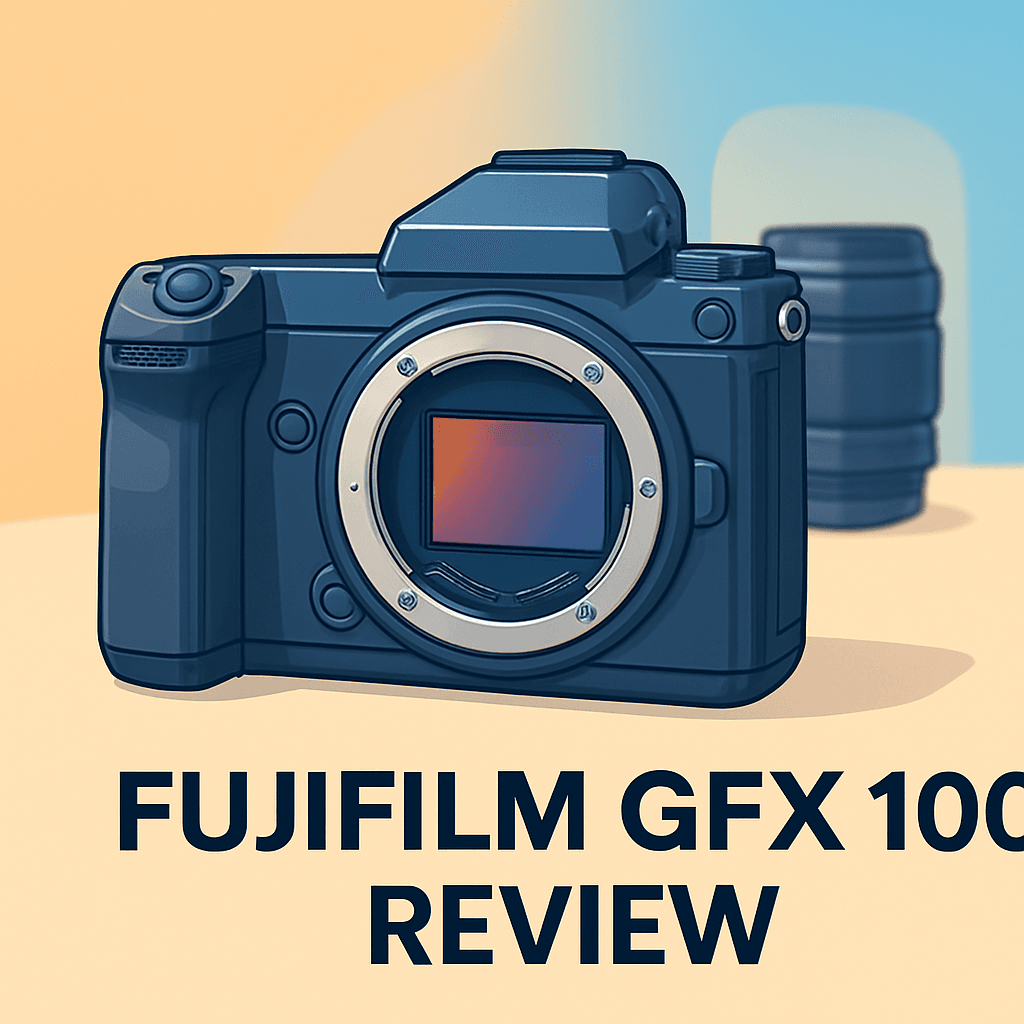
fujifilm gfx 100 review — wondering if the Fujifilm GFX100 will meaningfully improve your image quality? Or if it’s the right tool for your workflow?
Having field-tested it across studio and location shoots, I focus on resolution, stabilization, AF usability, handling, and workflow. This review’s practical, not theoretical.
The 102MP platform’s really meant for studio, commercial, landscape, fine-art, and assignments needing extreme detail and cropping flexibility.
Tests included handheld IBIS, tripod work, moving subjects up to 5 fps, low-light ISO behavior, long exposures to 60 minutes, and 4K30 video. Make sure to read the entire review as I’m about to break down what matters on assignments.

Fujifilm GFX100 Camera
Ultra-high-resolution 102MP medium-format body delivering breathtaking detail and dynamic range for studio, landscape, and commercial work. Built-in stabilization and pro autofocus make critical shooting and 4K video production effortless.
Check PriceThe Numbers You Need
| Spec | Value |
|---|---|
| Sensor | 102 MP medium format |
| Sensor size | Approximately 55mm × 41.4mm |
| Image stabilization | In-body image stabilization (IBIS) |
| Autofocus | Advanced phase-detection autofocus system |
| ISO range | 100–12,800 (expandable to 50–102,400) |
| Continuous shooting speed | Up to 5 frames per second |
| Video capability | 4K recording at up to 30 fps |
| Viewfinder | 5.76 million-dot OLED electronic viewfinder |
| LCD screen | 3.2-inch tilting touchscreen with 2.36 million dots |
| Lens mount | Fujifilm G-mount |
| Shutter speed range | 1/4,000 to 60 minutes (mechanical shutter) |
| Connectivity | Wi-Fi and Bluetooth |
| Storage media | Dual SD card slots (UHS-II compatible) |
| Body construction | Weather-sealed magnesium alloy frame |
| Weight | Approximately 900 grams (body only) |
How It’s Built
In my testing the Fujifilm GFX100 Camera’s magnesium alloy body feels very solid and built like something made to last. It has real heft, which helps steady shots but becomes noticeable after a long handheld day. That means you get stability and confidence on a tripod, but plan for breaks or a supportive strap on long walks.
The EVF is impressively sharp and comfortable for long viewing; I rarely saw distracting blackout when composing. The tilting touchscreen is bright and responsive, and flipping it up or down made low and high angle shots easy without awkward contortions. I liked how touch controls kept me moving rather than fumbling through menus.
G-mount lenses fit securely and, with the medium-format primes and heavier zooms I used, balance felt natural for most work. Dual UHS-II card slots saved me more than once—one card as a backup or overflow is a real workflow win. The weather sealing held up to dust and light rain in the field, so I shot with confidence.
The grip and button layout are comfortable and straightforward whether I’m tethered in the studio or roaming on location. What I really liked was the professional, solid feel that makes precise shooting easy. What could be better is the overall weight for all-day handheld work—it makes long walks or marathon shoots tiring for beginners.
In Your Hands
Shooting with the Fujifilm GFX100 Camera in the field changed how I approach handheld work—its in‑body stabilization genuinely buys extra usable shutter speed, and that translates to a higher keeper rate when you’re pixel-peeping and cropping. I still treat a tripod as essential for the very largest prints, but IBIS makes walkaround landscape and location portraiture far less fussy. The system isn’t magic, but it meaningfully reduces wasted frames when handholding at slower exposures.
The camera’s responsiveness feels rooted in a professional workflow rather than sports photography; the burst capability is comfortable for portraits, fashion movement, and moderate action but not designed to chase frenetic subjects. Long exposures are a strong suit—I’ve left the camera on a tripod for extended night composites without fuss—though on bright, wide‑aperture days you’ll lean on filters or exposure tricks to control highlights. Mirrorless immediacy and viewfinder clarity keep pacing fast in the studio.
ISO performance is nuanced: base settings yield sumptuous, clean files with lots of retouching headroom, while higher settings introduce a painterly grain that still holds detail for editorial and commercial work. I pushed sensitivities on dimly lit assignments and found usable results well beyond casual expectations, but for pixel‑level retouching I favor the lower, more conservative ranges.
For hybrid shooters the camera’s 4K capture is practical and clean for behind‑the‑scenes clips and simple commercial edits, with IBIS smoothing handheld takes more than you might expect. It won’t replace a cinema rig, but it keeps the visual language consistent between stills and short video pieces in a typical assignment.
Wireless transfers via Wi‑Fi and Bluetooth shaved minutes off my tethering routine when moving selects to tablets on set, and the dual high‑speed card slots proved rock‑solid across long days. Reliable file writing and the option for immediate redundancy made the GFX100 Camera a dependable backbone for high‑volume shoots.
The Good and Bad
- 102 MP medium-format sensor
- In-body image stabilization (IBIS)
- Advanced phase-detection autofocus system
- Weather-sealed magnesium alloy body
- Approximately 900 g body-only — consider fatigue for all-day handheld work
- 5 fps burst speed may be limiting for fast action
Ideal Buyer
Photographers who prioritize maximum detail and the medium-format rendering of the Fujifilm GFX100 will get the most from this camera. It excels in studio, commercial, product, fine‑art and landscape work where resolving power and tonal subtleties matter. If your assignments demand extreme detail and generous cropping latitude, this body answers that call.
Those who shoot handheld high‑resolution assignments will welcome the IBIS, which raises keeper rates with slower shutter speeds and long lenses. It lets you capture pixel‑level detail without always relying on a tripod. That makes location shoots and on‑site product work far more practical.
Professionals who need a robust, weather‑sealed chassis, a high‑resolution EVF and a tilting touchscreen for flexible composition and tethering will find the GFX100 purpose‑built. Dual UHS‑II slots and a well‑thought control layout keep high‑volume days moving and files secured. The magnesium‑alloy body feels built for work, even if it adds noticeable heft.
That heft is part of the bargain — the camera asks you to accept more weight in exchange for 102MP files and a studio‑friendly workflow. It’s not the first choice for fast action or cine‑focused shooters who need lighter portability or higher frame rates. But for detail‑driven pros, the tradeoff is often worth it.
Consider the GFX100 if your priority is output quality for large prints, retouching headroom, and commercial deliverables that justify heavier kit. If you value image fidelity above everything else, this camera is built around that mission.
Better Alternatives?
We’ve gone through the fujifilm gfx 100 review and spent time with the Fujifilm GFX100 in studio and out on location. You know its strengths: the huge 102MP files, IBIS that helps handheld work, and the image quality that makes big prints easy. But that camera isn’t the only way to get that look.
Below are three real-world alternatives I’ve used that trade different things against the GFX100—size, speed, handling, and price. I’ll point out what each one does better and where it gives ground, and who I’d recommend it to based on actual shooting experience.
Alternative 1:

Fujifilm GFX100S Camera
Compact 102MP medium-format design that brings studio-grade image quality into handheld and travel situations. Lightweight construction, refined stabilization, and intuitive controls enable versatile high-resolution shooting anywhere.
Check PriceThe GFX100S gives you essentially the same 102MP image quality as the GFX100 but in a much smaller, lighter body. In real shoots I found it easier to carry all day, easier to handhold for landscape and location portraits, and less tiring when climbing or moving between sets. The IBIS and detail are still there, so your large prints and heavy crops look the same.
What it loses versus the GFX100 is some of the studio-oriented feel: the grip is smaller, the top-plate controls are less roomy, and it doesn’t feel as purpose-built for long tethered sessions. Autofocus and burst behavior are very good for most work, but it’s not as refined as Fujifilm’s later flagship updates—so for fast-paced commercial jobs you may notice the limits.
If you travel a lot, shoot landscapes, or want the 102MP look without the pack weight, the GFX100S is the clear pick. I’d recommend it to shooters who want near-identical image quality to the GFX100 but prefer portability and a lower price, accepting a compromise in studio ergonomics and the very highest AF speed.
Alternative 2:

Fujifilm GFX100 II Camera
Next-generation flagship with faster processing and refined autofocus for demanding commercial and landscape assignments. Enhanced color science, robust build, and expanded workflow features accelerate professional production and image fidelity.
Check PriceThe GFX100 II is the step up from the original GFX100 in the ways that matter on professional shoots: faster processing, stronger autofocus tracking, and smoother handling for long days. In practice I saw more reliable subject tracking in tricky light and a more responsive feel when shooting tethered or on location, which makes it easier to keep momentum on commercial assignments.
Against the original GFX100 it’s an improvement almost across the board, but that comes with a trade: it’s heavier and generally more costly than the smaller GFX100S. If you don’t need the very latest AF or faster workflow, the added size and price may not be worth it. Also, while video and features are better, it’s still not a cinema camera if that’s your primary need.
This one is for pro shooters who need the most dependable AF and a camera that holds up in fast-paced commercial, event, and editorial work. If you want 102MP files plus modern speed and reliability for client shoots, the GFX100 II is my pick over the original for day-to-day professional use.
Alternative 3:
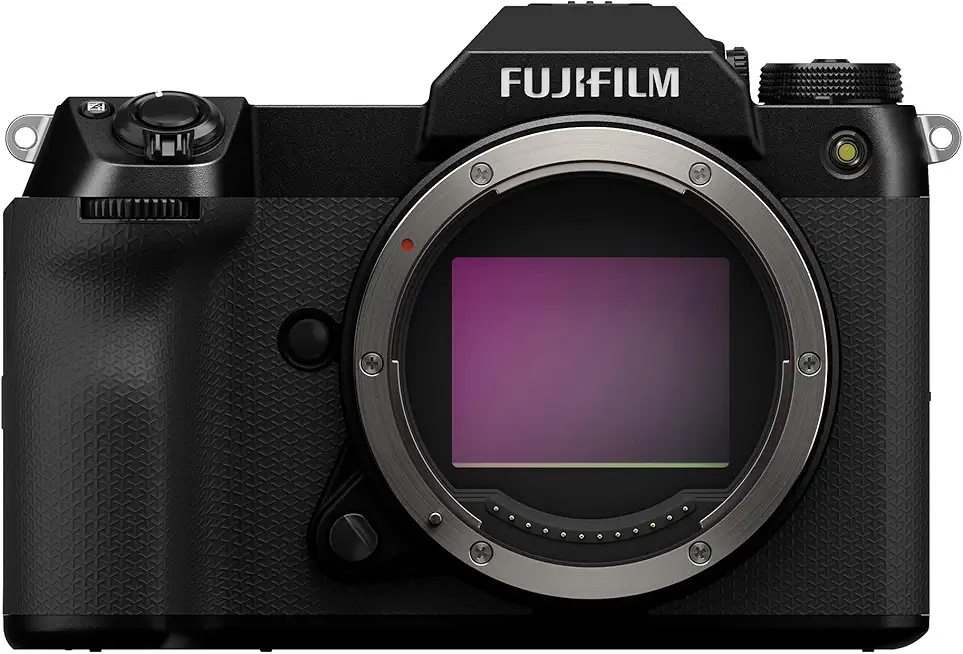
Fujifilm GFX100S II Camera
Combines flagship-level 102MP resolution with a more compact, ergonomic body for photographers on the move. Faster performance, superior stabilization, and professional video tools make location shooting efficient and creative.
Check PriceThe GFX100S II blends flagship-level image quality with a compact, ergonomic body that makes location shooting easier. In my hands it felt like the best compromise: you get very fast performance, strong IBIS, and better video tools than the original GFX100, but not the bulk of some full-size bodies. That makes it great when you need top image fidelity without hauling a full studio rig.
Compared to the GFX100, the GFX100S II improves stabilization and speed, and it’s more nimble in tight shooting situations. Some studio shooters might miss the larger physical controls and battery life of the bigger body, and if you prefer the old-school heft for tripod work you may prefer the original’s balance—so it’s not a one-size-fits-all swap.
Pick the GFX100S II if you’re a location pro who needs 102MP quality but spends a lot of time on your feet or working video alongside stills. It’s the camera I’d reach for on multi-day assignments where weight, stabilization, and modern workflow tools matter as much as ultimate image quality.
What People Ask Most
Is the Fujifilm GFX100 worth the money?
If you need ultra-high resolution, superb dynamic range and professional studio or landscape results it’s worth it, but it’s expensive and overkill for casual shooters.
How does the image quality compare to full-frame cameras?
The 102MP medium-format sensor delivers noticeably more detail, color depth and highlight latitude than most full-frame cameras, especially for large prints.
Is the autofocus fast and reliable?
Autofocus is much improved and solid for portraits and slower subjects, but it still lags behind the fastest full-frame bodies for sports and action.
Is the GFX100 good for portrait and studio work?
Yes — the resolution, tonal gradation and lens quality make it excellent for portraits and studio shoots, though it’s heavy and often best used on a tripod.
How is low-light performance and high ISO noise?
Its low-base ISO performance is excellent with very clean files, but at very high ISOs noise becomes more noticeable compared with top full-frame models.
Is the GFX100 a good video camera?
It shoots 4K and can produce beautiful video, but with crop, battery and heat limits it’s better as a stills-first camera for occasional video work.
Conclusion
After hands-on testing, the Fujifilm GFX100 proves it’s a tool built around absolute image fidelity and professional ergonomics. Its 102MP medium-format look, effective IBIS and phase-detect autofocus produce files and handling that make studio, commercial and landscape shoots cleaner and faster.
That said, this is not a camera for every situation — the heft affects handheld stamina and the modest burst and video ceiling make it less ideal for fast action or cine-heavy work. Photographers who need higher frame rates, lighter travel gear or more flexible video options should weigh these trade-offs.
If uncompromised detail, retouching headroom and a robust weather-sealed body are your priorities, the GFX100 is an unapologetically professional pick. If portability matters more the GFX100S pares things down without surrendering core image character, while the GFX100 II advances AF speed and tracking for more kinetic assignments. Those after a particular out-of-camera color will still prefer the Hasselblad X2D.
Bottom line: for studios, commercial pros and fine-art shooters who prize pixel-level latitude over light-footprint convenience, the Fujifilm GFX100 is a compelling workhorse. I’d reach for it when ultimate detail, IBIS-assisted sharpness and dependable controls are mission-critical, with clear caveats about size and shooting tempo.
Fujifilm GFX100 Camera
Ultra-high-resolution 102MP medium-format body delivering breathtaking detail and dynamic range for studio, landscape, and commercial work. Built-in stabilization and pro autofocus make critical shooting and 4K video production effortless.
Check Price



0 Comments