
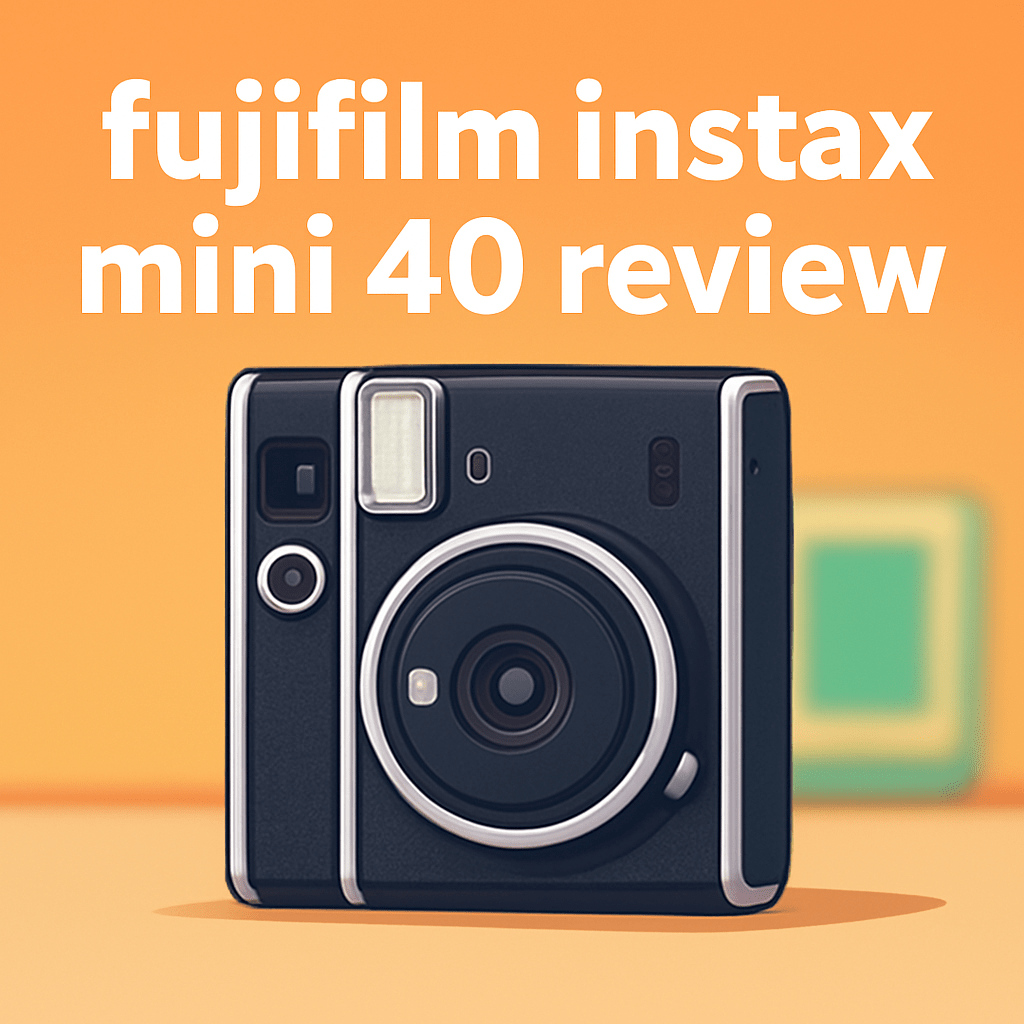
fujifilm instax mini 40 review — wondering if this retro instant camera is the right grab-and-go companion for the trips and parties you’re trying to capture?
It’s a retro-styled point-and-shoot that uses Instax Mini film to produce credit-card-size prints. You get tangible shots seconds after pressing the shutter.
If you’re after simple, stylish instant photos with automatic exposure, a built-in flash, and selfie-friendly touches, this camera is aimed at you. It’s ideal for casual shooters, travelers, and anyone who loves analog immediacy over fiddly menus.
I’ve taken it into low-light rooms, bright daylight, quick selfies, and close-ups at events to see how it really performs. This review walks through design, handling, image quality, real-world scenarios, pros and cons, and alternatives.
If you’re weighing style, simplicity, and shoot-to-print immediacy, you’ll want to know where the Mini 40 shines and where it doesn’t. Make sure to read the entire review as I break down those trade-offs and when to pick this camera — keep reading.

Fujifilm Instax Mini 40 Camera
Retro-inspired instant camera with built-in automatic exposure, textured leatherette finish, easy one-button operation, produces credit-card-sized prints for instant keepsakes and nostalgic fun at gatherings.
Check PriceThe Numbers You Need
| Spec | Value |
|---|---|
| Film Format | Instax Mini instant film |
| Print Size | Credit card size (62 × 46 mm) |
| Lens | 60 mm fixed‑focus |
| Aperture | f/12.7 |
| Shutter Speed | Approx. 1/60 sec |
| Exposure Control | Automatic exposure |
| Flash | Automatic built-in flash; range 0.4–2.7 m |
| Viewfinder | Optical viewfinder with frame projection |
| Power Source | 2 × AA batteries |
| Body Material | Retro leather-style design with metal accents |
| Shooting Modes | Simple point-and-shoot; selfie mode with confidence mirror |
| Self-timer | Yes — approx. 10 sec delay |
| Weight | Approx. 293 g (including batteries and film) |
| Size (W×H×D) | 116 mm × 118.3 mm × 58.7 mm |
| Accessories | Wrist strap and close-up lens included |
How It’s Built
In my testing the Fujifilm Instax Mini 40 Camera immediately stands out with its retro leather-style covering and metal trim. It feels like a little vintage camera you actually want to carry, and I really liked that premium, classic look right away. That styling makes it approachable for beginners who want something that looks as good as it behaves.
The body shape is simple and friendly in the hand, with a textured surface that helps you keep a grip while shooting. Controls sit where you expect them, so there’s almost no learning curve. After using it for a while I found it compact enough to toss in a small bag and take out without fuss.
Practical touches like the optical viewfinder, selfie mirror, built-in flash, and the automatic film ejection all add to a smooth shoot-to-print flow. The included close-up lens snaps into the routine easily, making tighter shots feel natural. For real-world use this means fewer fiddly steps and more moments captured as they happen.
I appreciated the wrist strap attachment and the use of common batteries that are easy to replace on the go. One thing that could be better is the viewfinder accuracy at very close distances, so you’ll want to rely on the selfie mirror or close-up lens for near subjects. That small quirk aside, the design is forgiving for new users.
Overall, the Mini 40’s build feels honest and well thought out, offering a tactile, stylish instant camera experience without overwhelming settings. If you want something pretty, simple, and reliable to hand to friends at a party, this one delivers.
In Your Hands
The Fujifilm Instax Mini 40 Camera is unapologetically simple: point, frame, and press. Its automatic exposure system delivers consistent, predictable results that are ideal for snapshots and social moments, though it deliberately removes most manual levers photographers use to shape an image.
Indoors and at twilight the built‑in flash is the camera’s workhorse, rescuing portraits and table‑side scenes with dependable illumination, but it’s happiest with subjects kept relatively close. Outdoors the automatic metering tends toward conservative exposures, favoring usable prints over dramatic latitude in high‑contrast situations.
The fixed‑focus optic is tuned for everyday distances, so portraits and candid shots come out sharp without fuss; when you want tighter framing the supplied close‑up lens does the job, albeit with the typical softness toward the edges that instant lenses can show. The little selfie mirror is a surprisingly effective tool for arm’s‑length framing and makes spontaneous self‑portraits much easier to nail.
Shooting feels rhythmic: a short self‑timer helps with group setups, and the instant ejection of a warm print creates an addictive, immediate workflow. Powering the camera on common AA cells keeps logistics simple in the field — carry spares and you’ll stay ready for whatever the day hands you.
The Good and Bad
- Simple point-and-shoot operation with automatic exposure
- Retro leather-style design with metal accents for a premium, vintage look
- Built-in automatic flash with 0.4–2.7 m range for dependable indoor use
- Compact size and modest weight for carry-everywhere convenience
- Fixed 60 mm lens and fixed f/12.7 aperture limit creative control and focusing flexibility
- Approx. 1/60 sec shutter can introduce motion blur in low light without stabilization
Ideal Buyer
If you want a no-fuss instant camera that looks and feels special, the Fujifilm Instax Mini 40 is the pick. It’s for people who prefer a tactile, analog experience over menus and previews. Setup is minimal and the results are immediate and charming.
Casual shooters who live for parties, travel snapshots, and everyday moments will appreciate how it just works. Automatic exposure, a helpful built-in flash, and automatic film ejection keep the flow fast and social. Bring it to gatherings and you’ll be printing smiles in seconds.
Selfie fans and close-up shooters get real value from the integrated mirror and the included close-up lens. The roughly 10-second self-timer also makes group shots easier without juggling tripods. These features make tighter compositions and arm’s-length portraits more reliable.
This camera is ideal for photographers who want tangible prints and instant gratification instead of manual controls or larger formats. It’s also great for anyone who values AA-battery convenience and a grab-and-go design. If you want creative exposure tools or big, detailed enlargements, look elsewhere.
Better Alternatives?
In this fujifilm instax mini 40 review we’ve gone over how the Mini 40 feels and performs in real shoots — the retro looks, the simple auto exposure, the built‑in flash and the little rituals of shoot-to-print. If you like that basic instant camera flow but want something a bit different in feel, control, or workflow, there are a few clear alternatives worth thinking about.
Below I’ll point out three cameras I’ve used alongside the Mini 40, what they do better or worse in real use, and what kind of shooter will prefer each one. I’ll keep it practical and focused on how they actually behave when you’re taking pictures, not just on paper specs.
Alternative 1:

Fujifilm Instax Mini 11 Camera
Youthful, simple instant shooter with auto exposure and built-in selfie mode; close-up lens for portraits, lightweight pastel body, ideal for quick snapshots and playful instant photo sharing.
Check PriceI’ve used the Mini 11 at birthday parties and family gatherings when people just want instant photos with zero fuss. It does the one-button, point-and-shoot thing even more simply than the Mini 40 — the selfie mode and auto exposure are easy and predictable, and it’s lighter to carry. In real life that means faster hand-offs, less fiddling when kids want a print, and fewer “how do I use this?” questions.
Where it falls short versus the Fujifilm Instax Mini 40 Camera is mostly build and feel. The Mini 11 is more plastic and toy-like in your hand; it doesn’t have the faux-leather and metal trim that give the Mini 40 a more premium vibe. In shooting terms both make the same small Instax prints and behave similarly with flash and focus, but the Mini 40 feels nicer to hold during longer shoots.
Pick the Mini 11 if you want the simplest, lightest option for casual events, kids, or party favors. It’s the camera for buyers who want quick fun prints without caring about a vintage look or heavier build — great for first-timers and people who want something they won’t worry about getting bumped around.
Alternative 2:

Fujifilm Instax Mini 90 Camera
Advanced instant camera with programmable shooting modes—double exposure, bulb, macro—plus high-speed and party settings; rechargeable power, sophisticated styling, and creative control for enthusiast photographers.
Check PriceThe Mini 90 is the one I reach for when I want to push Instax into creative territory. In real shoots its long-exposure, bulb, and double-exposure modes let you make images the Mini 40 simply can’t — light trails, motion blur, layered portraits, and better low-light control. Using those modes takes a bit more thought, but the results can be far more interesting than straight snaps.
What it doesn’t do as well as the Fujifilm Instax Mini 40 Camera is simple, grab-and-shoot ease. The Mini 90 is heavier, a bit fussy to learn, and I’ve seen people hesitate at a party when they just want a print. It’s also pricier and overkill if you only want quick selfies and straightforward prints. The Mini 40 wins for instant, effortless shooting and nicer retro finish for casual users.
Choose the Mini 90 if you’re an enthusiast who likes to experiment with creative effects and low-light work on instant film. If you enjoy slowing down, trying double exposures, or making night-time shots with intentional blur, the Mini 90 will reward you — but it’s not the best pick if you want pure simplicity.
Alternative 3:

Fujifilm Instax Mini EVO Camera
Hybrid instant system merging digital framing and analog printing; customizable lens and film effects, Bluetooth connectivity, touch controls, and high-quality pocket-sized prints for on-the-go creative output.
Check PriceThe Mini EVO mixes digital preview with instant printing, and that changes how you shoot. I liked being able to frame on a screen, apply filters or crop, and only print the shots that worked — it saves film and avoids wasted exposures. For street work or travel, having a quick digital view before committing to a print makes the whole process less risky and more flexible.
On the flip side, the EVO loses some of the pure analog charm and speed of the Fujifilm Instax Mini 40 Camera. It’s more complex to use, needs charging, and the workflow can slow you down if you’re trying to hand out prints fast. The printed look can also feel subtly different because the image is captured digitally first, so if you want the straight optical/film aesthetic of a fully analog camera, the Mini 40 still has the edge.
Go for the Mini EVO if you want a modern, hybrid approach — photographers who like to edit a bit, preview frames, or tether to an app will appreciate it. It’s ideal for people who want control and less wasted film, but if you want the simplest, most analog shoot-to-print feeling, stick with the Mini 40.
What People Ask Most
Is the Fujifilm Instax Mini 40 worth buying?
Yes — it’s a stylish, easy-to-use instant camera that’s great for casual shooters and parties, though it’s not meant for professional-quality prints.
How does the Instax Mini 40 compare to the Instax Mini 11 or Mini 9?
The Mini 40 offers a more premium metal-look body and slightly nicer handling while keeping the same basic image quality and features like automatic exposure and flash.
What film does the Instax Mini 40 use and how much does it cost?
It uses Fujifilm Instax Mini film (credit-card size), which typically costs about $0.50–$1.00 per print depending on pack size and retailer.
Does the Instax Mini 40 have automatic exposure and a usable flash?
Yes — it has automatic exposure and a built-in flash that’s reliable for everyday indoor and outdoor snapshots.
How is the picture/print quality of the Instax Mini 40?
Prints have the classic Instax look: warm colors and soft detail with some vignetting, which is charming for instant photos but not sharp for fine detail.
What are the battery requirements and battery life for the Instax Mini 40?
The camera uses two AA batteries and will last anywhere from dozens to a few hundred shots depending on how often you use the flash, so bring spares for long outings.
Conclusion
If you want a tactile, retro instant camera that delivers immediate prints with minimal fuss, the Fujifilm Instax Mini 40 Camera is an easy recommendation. It’s tailored to casual shooters who value style, simplicity, and the instant-analog experience.
Its strengths are obvious in real use: the comfortable, premium-feeling build makes it pleasant to carry and the automatic shoot-to-print workflow removes friction from events and travel. The selfie mirror and included close-up lens actually help get usable compositions without extra fiddling. The built-in flash and automatic exposure do a dependable job for most everyday snapshots.
The trade-offs are equally clear. Creative control is minimal, and the camera’s automation and fixed settings limit what you can coax from tricky lighting or action. The small credit-card prints and viewfinder parallax mean it’s not for detail-oriented, experimental shooters.
Choose a Mini 11 if you want the simplest, lightest option; pick the Mini 90 for creative modes; or go LiPlay if you need digital preview and flexibility. For anyone after a straightforward, stylish point-and-shoot that turns moments into immediate tangible prints, the Mini 40 delivers real value. That is my final word on the fujifilm instax mini 40 review.
Fujifilm Instax Mini 40 Camera
Retro-inspired instant camera with built-in automatic exposure, textured leatherette finish, easy one-button operation, produces credit-card-sized prints for instant keepsakes and nostalgic fun at gatherings.
Check Price



0 Comments