
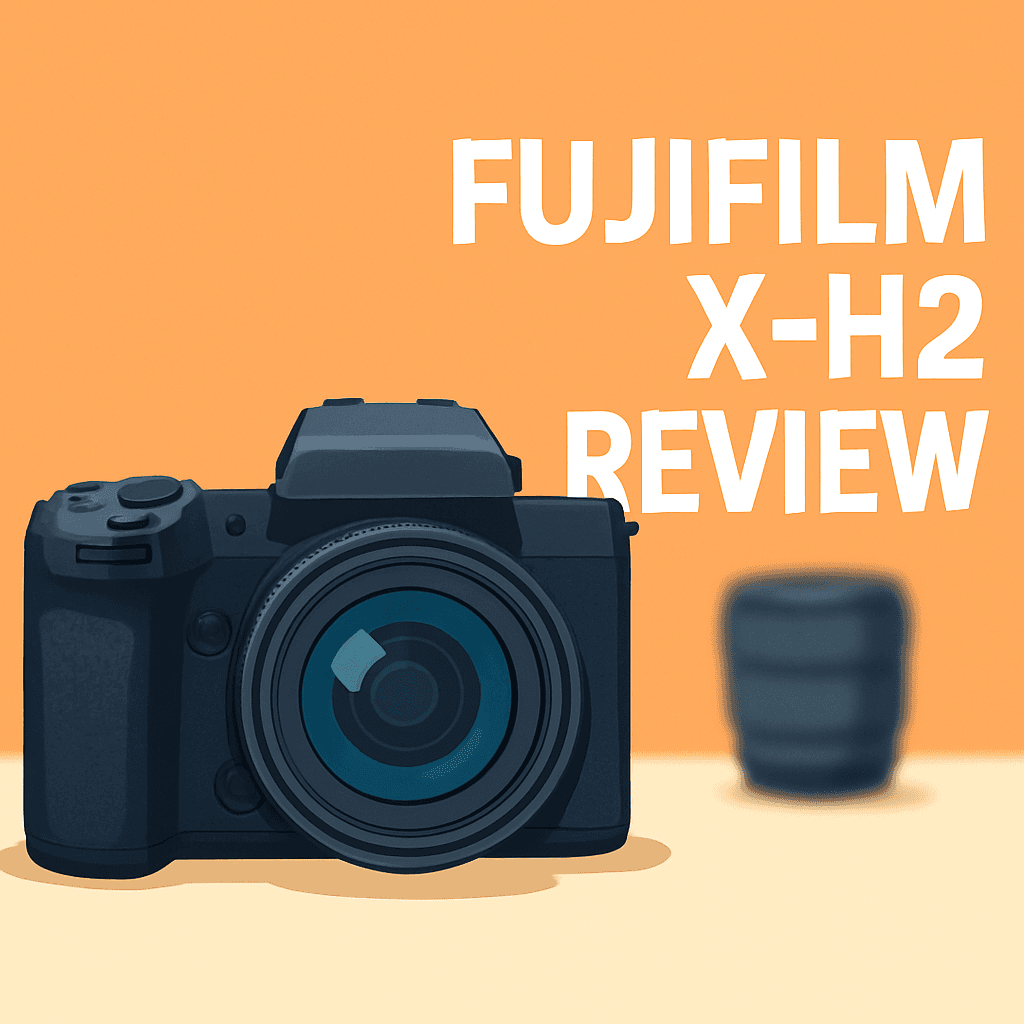
Want sharper photos and cinema-grade video from a single camera?
The Fujifilm X-H2 promises high-resolution APS-C stills and serious video in one body. I took it into real shoots to see how it holds up.
Expect a 40.2MP sensor, 7-stop IBIS, internal 8K/4K 10-bit recording, and advanced subject-detection AF — real-world payoffs like detail, steadiness, and smarter tracking.
I’ll cover handling, image and video performance, pros and cons, and practical alternatives. Make sure to read the entire review as I reveal when it’s worth it — keep reading.

Fujifilm X-H2 Camera
A professional-grade hybrid combining a high-resolution 40MP sensor with advanced IBIS and cinema-quality video, delivering razor-sharp stills, reliable autofocus and rugged weather-sealed durability for demanding shoots.
Check PriceThe Numbers You Need
| Spec | Value |
|---|---|
| Sensor | 40.2 MP APS-C X-Trans CMOS 5 HS stacked |
| ISO | 125–12,800 (extendable to 64–51,200) |
| Continuous shooting | 15 fps mechanical, 20 fps electronic (full AF/AE) |
| In-body image stabilization | 7 stops |
| Autofocus | Intelligent Hybrid AF; subject detection (face/eye, animal, bird, motorsport, etc.) |
| Video resolution/frame rates | 8K 30p; 4K 60p; 4:2:2 10-bit internal |
| Video formats | ProRes 422 HQ; Blackmagic RAW via HDMI |
| Card slots | Dual UHS-II SD; single CFexpress Type B |
| Viewfinder | 5.76 million-dot OLED, 120 fps refresh |
| LCD | 3-inch, 1.62 million-dot, vari-angle touchscreen |
| Weather sealing | Yes |
| Battery | NP-W235; approx. 720 shots (LCD), 600 shots (EVF) |
| Weight | 660 g (body, battery, card) |
| Lens mount | Fujifilm X mount |
| Durability | Magnesium alloy body |
How It’s Built
In my testing the Fujifilm X-H2 feels seriously well-built — the magnesium-alloy shell and weather sealing give you confidence to shoot in rain, dust, or a windy overlook. It’s a camera that doesn’t worry you when you’re out working, which I really liked. The trade-off is its heft; you’ll notice it after a long day on your shoulder.
Hand-feel and controls are thoughtfully laid out for both stills and video. The grip is comfortable and the main dials and buttons fall under my fingers without hunting, so I could switch settings quickly during shoots. With typical XF lenses the balance is solid, but pairing it with big telephoto glass makes it front-heavy for long handheld sessions.
The electronic viewfinder is a standout in everyday use — sharp, responsive, and smooth while tracking moving subjects, which helped a lot in fast-paced street and event work. The vari-angle touchscreen is great for low and high angles and makes video framing easy for beginners. I found the screen articulation especially useful for tripod and vlogging setups.
Storage and power choices affect real-world workflow: the dual SD plus CFexpress layout lets you separate photo and heavy video files, but it does mean higher media cost if you want the fastest performance. Battery life held up well in mixed shooting, though I still carried a spare and a USB-C charger for long days. The X mount plays nicely with Fujifilm glass, so lens balance and pairing felt natural.
In Your Hands
The X-H2’s Intelligent Hybrid AF feels confident and assured in everyday shooting, snapping onto faces and eyes quickly and holding through subtle subject movement with pleasing accuracy. Push it into wildlife and motorsport scenarios and its tracking remains tenacious most of the time, though extremely fast or erratic subjects occasionally demand fine-tuning of AF sensitivity and tracking parameters.
During continuous bursts the EVF stays composed and usable, which makes following sequences far less fatiguing than on many rivals. Buffer clearing clearly favors the faster media choices, so your card selection becomes a practical part of staying in the moment, and the electronic shutter is great for stealth shooting while showing some skew on very abrupt pans.
IBIS makes a genuine difference in handheld work, letting me shoot at much slower shutter equivalents with light primes and long zooms and delivering impressively stable walk-and-talk video without a gimbal. For the smoothest cinematic pans and the longest tele shots, I still reach for gentle support or electronic stabilization as a complement.
In the field the high-refresh viewfinder and articulating screen speed up creative framing and tracking, and the weather sealing proved reliable in damp, dusty conditions. For workflow I lean on face/eye detection and single-point continuous modes for portraits and events, flip to animal/bird detection for wildlife, and assign AF-ON plus quick custom buttons to switch profiles on the fly—practical choices that keep shoots moving.
The Good and Bad
- 40.2 MP APS-C sensor for high-detail stills
- 7-stop in-body image stabilization
- Advanced subject-detection AF for people, animals, birds, and motorsport
- 8K 30p and 4K 60p with 4:2:2 10-bit internal recording
- Weight at 660g, which can cause fatigue for travel and street shooting
- Long-form video recording reliability concerns due to heat and thermal behavior in 8K/high-bitrate modes
Ideal Buyer
If your work demands pixel-level detail, the Fujifilm X-H2 Camera is built for landscape, product, and studio shooters who need large files for big prints and tight crops. Its 40.2MP sensor rewards sharp glass and patient technique. It’s ideal for creatives who sell detail-rich commercial images.
Hybrid creators who shoot both stills and high-end video will appreciate 8K30p and 4K60p 10-bit capture paired with 7-stop IBIS. Reliable subject-detection AF keeps people, animals, and motion locked during mixed workflows. It handles heavy video workflows without sacrificing stills quality.
Event and portrait photographers find its AF accuracy, solid battery life, and weather-sealed magnesium-alloy body reassuring on long shoots. The balance between resolution and responsiveness makes it practical for client work. That resilience pays off in unpredictable locations.
Photographers already invested in Fujifilm X-mount lenses get the best return, as the X-H2 extracts extra resolving power from modern XF glass. The high-resolution EVF and vari-angle touchscreen make framing and run-and-gun video much easier. Lens choice matters, and the X-H2 rewards premium glass.
If you prize ultimate low-light speed or the lightest all-day carry, consider the X-H2S or X-T5 instead. But if your priority is detail-first stills with serious video capability, the X-H2 is the smarter, more versatile choice. It’s the camera for shooters who want one body to elevate both images and motion.
Better Alternatives?
We’ve already dug into what the X-H2 does well and where it can trip up in the field. Before you decide, it’s worth looking at a few Fujifilm siblings and options that might suit a different style of shooting or a different budget.
Below are three real-world alternatives I’ve used plenty: a smaller stills-first body, a speed-first action body, and a quick recap of the X-H2 itself so you can weigh the trade-offs side-by-side. I’ll tell you what each one does better and where it gives ground to the X-H2, and who’s likely to prefer each one.
Alternative 1:

Fujifilm X-T5 Camera
Classic rangefinder styling meets modern performance: a compact, lightweight body housing a 40MP sensor, refined autofocus, in-body stabilization and beloved film simulations for expressive, versatile image-making.
Check PriceIn my hands the X-T5 feels more like a photographer’s camera — small, light and fun to use. Compared to the X-H2 it’s easier to carry all day, the dials are tactile and it encourages a slower, more deliberate shooting style. If your work is travel, street, or portrait sessions where you want to move fast and stay nimble, the X-T5 is nicer to lug around.
Where the X-T5 falls short compared with the X-H2 is in video and long, heavy-duty shoots. It’s still capable, but I found it didn’t handle extended high-bitrate recording or the thermal strain of long 8K takes as well as the X-H2. Autofocus is good for stills, but for very fast action the X-H2 feels a touch more tuned for tracking over long bursts.
Buyers who will like the X-T5 are photographers who put stills first — travel shooters, portrait photographers, and anyone who hates carrying weight. If you want a lighter camera that still delivers excellent detail and film-like colors, choose the X-T5; if you need bulletproof video or longer high-speed runs, the X-H2 is the better pick.
Alternative 2:

Fujifilm X-H2S Camera
Engineered for speed: a fast stacked sensor and lightning autofocus enable blazing continuous burst rates, low-light reliability and pro-grade video capture for action, sports and wildlife photographers.
Check PriceThe X-H2S is my go-to when subjects don’t sit still. In real shoots it nails fast autofocus tracking and lets you keep shooting long bursts without the same stutter you can feel on higher-megapixel bodies. For sports, wildlife or motorsport work it simply feels more responsive than the X-H2 — you’ll catch more usable frames when things move quickly.
Where it gives ground to the X-H2 is resolution and fine detail. Because it’s built for speed, images are lower in pixel count, so you lose some of the cropping and fine-texture advantages the X-H2 offers for landscape and studio work. If you need huge files for big prints or tight crops, the X-H2’s extra detail is the clear win.
Pick the X-H2S if you shoot action, wildlife, or a lot of handheld run-and-gun video and need reliable AF and long recording sessions. If you’re a landscape, product, or studio shooter who needs max detail, the X-H2 remains the better choice.
Alternative 3:
Fujifilm X-H2 Camera
Ultimate high-resolution tool for detail-oriented creators, delivering exceptional dynamic range, 8K-capable video workflows, responsive controls, and robust connectivity—ideal for studio, landscape and commercial assignments.
Check PriceThis entry is the camera we’ve been reviewing: the Fujifilm X-H2. In real-world use it beats the X-T5 on sustained video work and beats the X-H2S on sheer image detail — that extra resolution pays off for landscapes, product shots and any work where you need to pull every bit of texture from a frame.
On the flip side, the X-H2 isn’t the lightest or the fastest. Compared with the X-T5 it’s heavier to carry all day. Compared with the X-H2S it’s not as snappy for long action bursts and can be more susceptible to heat limits during very long, heavy video sessions. In short: you trade some speed and endurance for image detail and richer video options.
If you want the best balance of high-resolution stills and pro-level video in the APS-C line, the X-H2 is the camera to pick. Choose it if your work needs large files and solid video features; choose the X-T5 or X-H2S instead if you want lighter handling or top-tier speed and tracking.
What People Ask Most
Is the Fujifilm X-H2 worth buying?
Yes if you want very high-resolution APS-C stills and advanced video features; it’s a strong hybrid for pro shooters, but may be overkill if you don’t need 40MP files or 8K video.
What are the main features and specifications of the Fujifilm X-H2?
It pairs a high-resolution 40MP X-Trans sensor with fast autofocus, in-body image stabilization, a robust weather-sealed body, and pro-grade video options like 8K and high-frame-rate 4K.
Is the Fujifilm X-H2 good for video and filmmaking?
Yes — it offers 8K and high-rate 4K capture, professional codecs and heat management features that make it suitable for serious run-and-gun and studio video work.
Does the Fujifilm X-H2 have in-body image stabilization (IBIS)?
Yes — it includes 5-axis IBIS that gives several stops of stabilization, which helps for handheld stills and video.
What is the battery life of the Fujifilm X-H2?
Battery life is solid for mixed stills use and a full day for many shooters, but heavy video or high-frame-rate recording will drain it faster, so bring spares for long shoots.
Is the Fujifilm X-H2 weather-sealed and durable?
Yes — the camera has a sturdy magnesium-alloy body with comprehensive weather sealing for dust and moisture suited to professional field use.
Conclusion
The Fujifilm X-H2 Camera is the high-resolution workhorse Fujifilm should be proud of. It marries exceptional stills detail with serious video chops, solid stabilization, tenacious subject detection, a sharp viewfinder, and a weatherproof build.
Those gains come with compromises — it isn’t the smallest or lightest choice and media and workflow costs climb for heavy shooters. In very fast-action or marathon recording scenarios, rivals tuned for speed or thermal endurance feel more assured.
If your priority is pixel-level detail for landscapes, product, studio work, or you’re a hybrid creator pushing high-resolution video, this is the camera I’d recommend buying and keeping. Choose the slimmer X-T5 when you want lighter, more traditional handling for stills. Opt for the X-H2S or a value-focused APS-C body when outright speed, sustained high-frame recording, or budget-friendly action AF matters most.
Overall value is strong for photographers who build around Fujifilm glass and want one body that excels at both stills and video. My practical advice: invest in fast media, dial in subject-specific AF presets, and pair it with lenses that truly exploit its resolving power.
Fujifilm X-H2 Camera
A professional-grade hybrid combining a high-resolution 40MP sensor with advanced IBIS and cinema-quality video, delivering razor-sharp stills, reliable autofocus and rugged weather-sealed durability for demanding shoots.
Check Price



0 Comments