
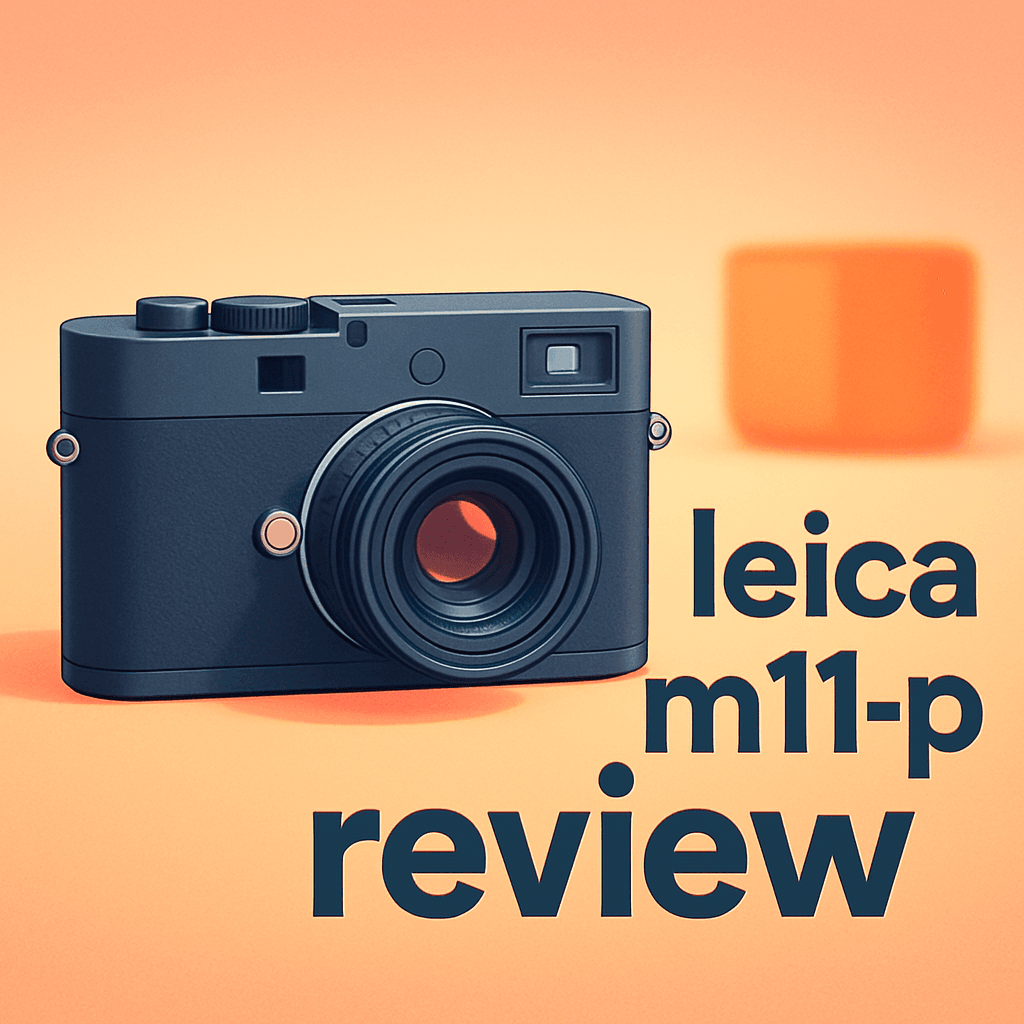
Want to know if the Leica M11‑P Camera will actually improve your image quality and shooting flow?
I’ve shot with a lot of rangefinders and different pro bodies, and I took the M11‑P into streets, studios, and travel shoots to see how it behaves in real life.
If you care about manual rangefinder pacing, discreet quiet operation, rock‑solid build, and trustworthy image provenance, this camera is aimed squarely at you — and its high‑resolution capture matters in the field.
This review’ll dig into real‑world payoffs, the tradeoffs you’ll live with, and who should buy one versus passing — make sure to read the entire review as I break it all down, keep reading.

Leica M11-P Camera
Stealthy, ultra-quiet rangefinder designed for unobtrusive shooting; delivers exceptional image quality, refined controls, and modern sensor performance wrapped in a discreet finish—perfect for street, portrait, and documentary photographers seeking subtlety.
Check PriceThe Numbers You Need
| Spec | Value |
|---|---|
| Sensor | 60 MP full frame |
| Shutter | Mechanical and electronic (hybrid) |
| ISO | 64–50,000 |
| Dynamic Range | 14+ stops |
| EVF | None (optical rangefinder only) |
| LCD | 2.3M-dot touchscreen (non-articulating) |
| Storage | SD/SDHC/SDXC (UHS-II); internal 64 GB |
| Video | 4K up to 30p |
| Battery Life | Approx. 700 shots |
| Weight | 530 g (body only, chrome finish) |
| Dimensions | 139 × 42 × 80 mm (W × D × H) |
| Construction | Magnesium alloy body |
| Weather Resistance | Weather sealed |
| Connectivity | USB-C, Wi‑Fi, Bluetooth, GPS |
| Metadata | Content Authenticity Initiative support |
How It’s Built
In my testing the Leica M11-P Camera immediately felt familiar and reassuring in the hand. The body has a dense, all-metal feel and it’s sealed against splashes and dust so you can shoot in messy city weather without sweating it. That kind of build means real-world travel and street work are less stressful.
It’s a true optical rangefinder camera, so you focus by eye rather than relying on an electronic viewfinder. The rear screen is a touchscreen but it doesn’t tilt, so you’ll use live view for odd angles or low shots. USB-C makes a big difference for my workflow — I used it to tether, charge, and move files during shoots.
There’s an SD card slot plus internal storage, which I leaned on as a backup and quiet overflow when swapping cards wasn’t convenient. Pairing to a phone via Wi‑Fi and Bluetooth was straightforward, and geotagging worked well for travel logs. Expect wireless transfers to be handy but slower than a direct cable.
What I really liked was how quiet and discreet it is — perfect for candid street and ceremony work. What could be better is the fixed screen and lack of an EVF, which makes low-angle framing and pinpoint focusing trickier. For beginners: spend time with the rangefinder and use live view when you need precision; it pays off.
In Your Hands
The Leica M11‑P’s sensor delivers remarkably detailed stills with a wide exposure latitude that lets you recover deep shadows and ease off highlights without losing tonal subtlety. Shooting at the camera’s native sensitivity rewards careful metering and preserves that refined highlight roll‑off photographers prize. In practice you’ll choose lower sensitivities for maximum clarity and lift shadow detail when the scene requires it.
Focusing is the classic rangefinder dance: split‑image accuracy with fast primes that feels instant once you’ve put in the practice. There’s a learning curve for precise critical focus and tight framing, and the lack of an EVF means you’ll rely on the optical patch and the rear screen selectively—especially in dim light or when you need pixel‑level confirmation.
The hybrid shutter gives you both tactile mechanical feedback and a very usable quiet mode for sensitive environments, while electronic actuation is handy for certain static scenes. Be mindful of rolling‑shutter behavior with fast motion and choose the shutter type to match the subject; overall responsiveness suits a deliberate, reportage pace rather than burst chasing.
Battery life comfortably carries a full day of assignments if you manage power and spare capacity with the internal storage and card slot as a safety net. Video is capable but deliberately secondary—fine for short editorial clips but not a primary cinema tool. USB‑C and wireless transfers plus geotagging make quick field delivery and organization straightforward.
On the street and in quiet reportage the M11‑P’s discreet operation and weather‑sealed build shine, while travel photographers will appreciate endurance and provenance features. For landscape and architecture the sensor’s resolution and tonal handling reward careful shooting, and in editorial contexts the camera’s on‑board content integrity tools add a practical layer of trust to delivered files.
The Good and Bad
- 60 MP full-frame sensor with 14+ stops of dynamic range
- Hybrid mechanical/electronic shutter with Silent Mode
- Weather-sealed magnesium alloy construction
- Content Authenticity Initiative support for provenance metadata
- No EVF; reliance on optical rangefinder and rear LCD
- Manual focusing workflow requires practice and may be slower for action
Ideal Buyer
The Leica M11‑P is for photographers who cherish the manual, tactile Leica M rangefinder ritual. If you prize maximum stills image quality and 60MP detail with class‑leading dynamic range, this camera is built for you. It’s a tool for thoughtful, deliberate photographers who work with patience.
Street, documentary and quiet‑event shooters will love the discreet, whisper‑quiet operation and weather‑sealed magnesium body. On‑body Content Authenticity support and dependable battery life make it a reliable partner for editorial assignments and client work. Internal storage and robust connectivity smooth field workflows when speed matters.
The triple‑resolution workflow (60/36/18MP) lets pros match file size to deliverables and backup budgets without changing cameras. Use 60MP for high‑end prints, 36MP for tight editorial turnarounds, and 18MP when handheld speed and storage are priorities.
Avoid the M11‑P if you need an EVF, fast continuous AF, IBIS or advanced video features. Action shooters and those who demand dual card redundancy or a fully articulating screen will be better served elsewhere. For anyone who values Leica’s quiet, manual craft and provenance tools, this camera is hard to beat.
Better Alternatives?
We’ve already gone deep into what makes the M11‑P special — the pure rangefinder feel, the big 60MP files, the quiet, discreet operation and the modern bits like internal storage and content credentials. If that sounds perfect, great. But not every shooter needs all of that at once, and there are very good Leica and non‑Leica choices that give you parts of this package in different ways.
Below I’ll run through three alternatives I’ve used in the field. I’ll tell you where each one shines compared with the M11‑P, where it falls short, and what kind of buyer will feel at home with it. These are real shooting differences — not just specs on a page.
Alternative 1:

Leica M11 Camera
State-of-the-art full-frame rangefinder offering ultra-high-resolution capture, versatile shooting modes, and modern connectivity; balances timeless manual controls with cutting-edge sensor performance for photographers demanding detail, speed, and reliability.
Check PriceI’ve shot with both the M11 and M11‑P on long street days. In practice the image quality is essentially the same — you get the same 60MP files, same dynamic range and the same lens behavior. Where you notice the M11‑P is quieter and more subdued in looks; the plain M11 is a little louder and bears the more visible red logo and polished cues.
So what it does better than the M11‑P is simple: cost. The M11 is often cheaper used or when you don’t need the ultra‑quiet handshake. It gives you the full technical heart of the system for less money. What it does worse is that it’s not as stealthy — in very quiet events or discreet street shooting the M11‑P’s quieter shutter and muted appearance actually matter.
If you want the pure M11 image quality but don’t care about the stealth finish or the quietest actuation, the M11 is the smart buy. It’s for photographers who want the big files and rangefinder workflow without paying extra for the “P” refinements.
Alternative 2:

Leica M10-P Camera
Discreet, refined film-style experience with whisper-quiet operation and tactile controls; delivers elegant color rendition, rich tonality, and minimalist design—ideal for street and documentary photographers who value subtlety and craft.
Check PriceI’ve used the M10‑P for years on street and travel work, and it still feels wonderfully direct. Compared to the M11‑P it gives you much smaller files and a different character — the 24MP sensor files are easier to handle, quicker to edit, and they often feel more “analogue” right out of the camera. That can be a real plus when you want a simple, fast workflow.
What the M10‑P does worse than the M11‑P is obvious in resolution and dynamic range — you won’t get the same muscle for huge prints or extreme shadow recovery. The M11‑P’s newer sensor and features win in high‑detail work, low‑light latitude, and modern conveniences. In return, the M10‑P trades raw power for a quieter, more classic shooting pace and smaller files.
Choose the M10‑P if you shoot a lot of street, travel, or documentary work where speed and file size matter more than maximum pixels. It’s the camera for someone who loves the Leica touch and wants manageable files and a low‑fuss edit pipeline.
Alternative 3:

Leica M10-R Camera
High-resolution specialist tuned for maximum detail and tonal fidelity, extending dynamic range for large prints; pairs classic rangefinder handling with refined image rendering—perfect for landscapes, architecture, and fine-art photography.
Check PriceThe M10‑R sits between the M10‑P and the M11 family in feel. I’ve used it on landscape and architecture jobs where I wanted very fine tonal transitions and large prints without always carrying the biggest files. Compared with the M11‑P, the M10‑R’s files have a different color and tonal feel that some people prefer for skin tones and gallery prints.
Where the M10‑R falls short versus the M11‑P is primarily modernity and resolution — the M11‑P’s 60MP files and newer electronics give you more detail and more rescue room in shadows and highlights. The M10‑R won’t match that raw pixel count or the newer workflow features, but it gives a pleasing rendering and still‑very‑high resolution that is easier to manage than the M11‑P’s biggest files.
If you’re focused on fine‑art, landscape, or architecture and want excellent tonality with large print potential but don’t need the absolute top pixel count or newest features, the M10‑R is a great pick. It’s for photographers who value the look and feel of Leica files but want a balance between resolution and file manageability.
What People Ask Most
Is the Leica M11-P worth buying?
Yes—if you want the classic manual rangefinder experience, top-tier image quality, and a discreet, premium build; skip it if you need autofocus, fast action shooting, or video-centric features.
What is the difference between the Leica M11 and the M11-P?
The M11-P keeps the same sensor and core performance as the M11 but adds a quieter, more discreet finish and refined, stealth-oriented styling and controls.
How much does the Leica M11-P cost?
Expect a high-end price in the neighborhood of other Leica M bodies—typically around $8–10K new depending on retailer and market, with used prices varying.
What are the key features and specifications of the Leica M11-P?
It pairs a high-resolution full-frame sensor with Leica’s manual rangefinder focusing, minimalist tactile controls, durable metal construction, and modern connectivity like USB-C for file transfer.
Does the Leica M11-P have autofocus or in-body image stabilization?
No—the M11-P is a manual-focus rangefinder and does not include in-body image stabilization.
Can the Leica M11-P record video and what are its video capabilities?
Yes, it can record video but with limited, basic video features; it’s fine for short clips or behind-the-scenes use but not for serious videography.
Conclusion
The Leica M11-P Camera is a camera for photographers who want a deliberate, tactile rangefinder in a modern package — a high‑resolution sensor, broad tonal latitude, weather‑proofed metal body, quiet actuation and built‑in authenticity tools all add up to a distinct value proposition. In hands‑on use it feels purposeful and confidence‑inspiring for image makers who prize discretion and provenance.
Its strengths are obvious: the rangefinder rhythm and silent mode let you work unobtrusively, the build and ergonomics suit travel and reportage, and the provenance features make it a serious tool for editorial and client work. The practical workflow conveniences—robust connectivity and on‑body safeguards—mean you can deliver reliably from the field.
The tradeoffs are equally clear and unapologetic: no electronic viewfinder, a fixed rear screen and a manual‑focus workflow that demands patience and practice, while video remains secondary. If you need fast autofocus, IBIS or EVF‑driven precision, this is not the tool for action‑heavy or hybrid shooters.
Verdict: buy this if you specifically want the Leica rangefinder experience with modern image integrity and quiet operation; choose lower‑resolution capture for faster delivery and higher capture modes when detail and prints matter. If you need EVF/AF versatility or more video headroom, the Alternatives section is worth a close look.
Leica M11-P Camera
Stealthy, ultra-quiet rangefinder designed for unobtrusive shooting; delivers exceptional image quality, refined controls, and modern sensor performance wrapped in a discreet finish—perfect for street, portrait, and documentary photographers seeking subtlety.
Check Price


0 Comments