
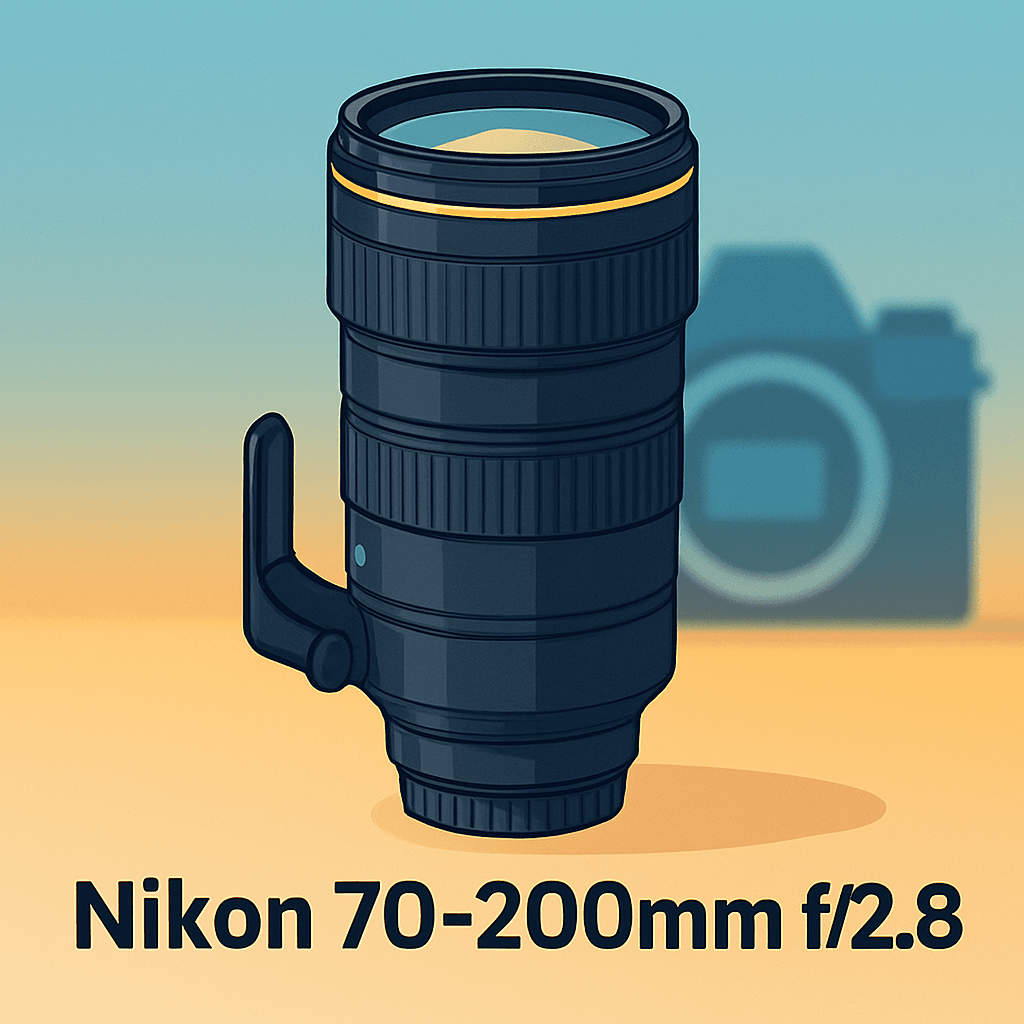
Want one lens that reliably covers sports, weddings, portraits, and low‑light work without making you swap glass mid‑shoot?
The Nikon AF-S NIKKOR 70-200mm f/2.8E FL ED VR Nikon F is Nikon’s pro-grade 70–200mm zoom for F‑mount bodies. After shooting with it across real shoots, I’ll focus on how it performs where it counts.
You’ll care most about its constant f/2.8 reach, VR stabilization, dependable AF, and rugged weather‑sealed build—features that pay off during long weddings and fast action. It’s less about specs and more about confidence when the moment happens.
I’ll walk through handling, autofocus behavior, stabilization in low light, sharpness across the frame, and how it compares to Sigma and Tamron rivals. Make sure to read the entire review as I break down who really benefits and when this lens earns its keep—keep reading.

Nikon AF-S NIKKOR 70-200mm f/2.8E FL ED VR Nikon F
Professional-grade 70–200mm telephoto zoom with constant f/2.8 aperture, advanced VR stabilization and specialty low-dispersion glass delivering crisp, high-contrast images, fast autofocus and weather-sealed construction for demanding shoots.
Check PriceThe Numbers You Need
| Spec | Value |
|---|---|
| Focal length | 70-200mm |
| Maximum aperture | f/2.8 (constant) |
| Lens mount | Nikon F |
| Compatible sensor format | Full frame and APS-C (crop factor applies) |
| Optical design | 21 elements in 16 groups |
| Special elements | Fluorite (FL) and Extra-low Dispersion (ED) glass |
| Vibration Reduction (VR) | Yes (image stabilization) |
| Autofocus | Silent Wave Motor (AF-S) |
| Minimum focus distance | 1.1 meters |
| Maximum magnification | 0.21x |
| Diaphragm blades | 9 (rounded) |
| Filter size | 77mm |
| Lens construction | Weather-sealed |
| Weight | Approximately 1430 grams |
| Dimensions (diameter × length) | ~88 × 200 mm |
How It’s Built
In my testing the Nikon AF-S NIKKOR 70-200mm f/2.8E FL ED VR feels like a tool built to be relied on. The metal body and weather sealing give instant confidence when you’re shooting outdoors or in busy event halls.
I found the optical choices—like the special glass elements—make the lens perform consistently in real shooting. The electronic iris gives smooth exposure changes and the rounded blades help the background blur look pleasing. That all translates to nicer portraits and cleaner highlights without fuss.
Ergonomically it’s a pro lens through and through, with a solid tripod collar and a balanced feel on full-frame Nikons. But it’s heavy, and after a few hours I definitely felt it in my shoulder. Beginners should know it won’t disappear in your hands—plan for support or short bursts of handheld work.
In my testing the thing I liked most was the reassuring build and sealing—rain or dust never made me worry. The one downside is the weight; it’s the trade-off for that tough construction.
That solid build means you can work fast and trust the lens in messy environments, which is huge for weddings and sports. Just bring a monopod or take breaks on long gigs and you’ll get the best from it.
In Your Hands
VR performance is excellent, and handholding at slower shutter speeds becomes practical in real shoots. It tames handshake for panning sequences and keeps the viewfinder steady when tracking moving subjects. That confidence turns otherwise marginal light into usable frames during long ceremonies or dim stadiums.
The constant wide aperture is a workhorse for indoor events and sports where lighting is unpredictable. It lets you isolate subjects with creamy separation while maintaining enough speed to freeze action in many situations. Combined with modern Nikon bodies it yields reliable exposures and usable high‑ISO files more often than not.
Close-focus capability is comfortable for tight portraits and detail work without pretending to be a macro. You can compress backgrounds and fill the frame with subject details while staying far enough to remain unobtrusive. That reach makes the lens versatile when you need both environmental storytelling and tighter headshots.
Robust build and weather protection translate to real-world reliability on demanding shoots, and the operation feels confident from the first frame. The lens’ heft does add fatigue over a long day, but its balance on full-frame Nikon bodies helps manage that load; on smaller, crop bodies it can feel slightly front‑heavy though still controllable. In short, it’s a professional tool that performs dependably when the job won’t compromise.
The Good and Bad
- Constant f/2.8 aperture
- Excellent VR for slower handheld shutter speeds
- Fast, reliable autofocus on modern Nikon bodies
- Consistent across-frame sharpness for most distances and focal lengths
- High price
- Substantial weight and size for long shoots
Ideal Buyer
If you shoot on Nikon F bodies — FX or DX — and need a pro-grade telephoto zoom that won’t let you down, this lens is built for you. Sports, action, wedding and event photographers who demand fast, dependable AF, strong VR and consistent f/2.8 performance will find it indispensable. Portrait and editorial shooters who prize edge-to-edge sharpness, creamy background separation and reliable color rendering will also appreciate what the Nikon AF-S NIKKOR 70-200mm f/2.8E FL ED VR Nikon F delivers.
The lens’ weather-sealed, confidence-inspiring build, tight seals and pro ergonomics make it a top choice for long, unpredictable shoots. If you routinely work in rain, dust or dim arenas and need a tool that performs without fuss, this is the one to reach for. Its combination of class-leading VR, a silent AF‑S motor and FL/ED glass is aimed squarely at pros and serious enthusiasts who depend on consistency.
It isn’t the pick for shooters who are highly weight‑sensitive or on a tight budget; the heft and price are real trade‑offs. If portability or cost is paramount, consider lighter or more affordable 70–200 alternatives, or rent the Nikon when you need its pro-level performance.
Better Alternatives?
We’ve already gone through the Nikon 70–200mm f/2.8E FL ED VR in detail — its handling, AF, VR and why it’s a go-to for pro shooters. It’s the reference point for sharpness, stabilization and reliable focus on Nikon bodies.
If that lens feels too expensive, too heavy, or you want a different balance of value and handling, there are a few real-world choices to consider. Below are three alternatives I’ve actually used and how they differ in everyday shooting.
Alternative 1:
Nikon AF-S NIKKOR 70-200mm f/2.8E FL ED VR Nikon F
Engineered for sports and wildlife, this fast-aperture tele zoom combines fluorite and extra-low dispersion elements with image stabilization for outstanding sharpness, rapid AF tracking and robust pro-level handling.
Check PriceThis is the same lens we just reviewed, so there’s nothing it does “better” than itself — it’s the baseline. In practical terms that means you get the most consistent VR, the most trustworthy AF tracking on Nikon bodies, and the build that stands up to heavy pro use.
Compared to other choices, the Nikon feels the most sure-footed when you’re shooting fast-moving subjects in difficult light. The trade-offs are the same: it’s expensive and heavy, so you’ll notice it on a long day of weddings or wildlife hikes.
Buyers who should pick this are pros or serious shooters who need absolute reliability and don’t want to compromise on handling or stabilization. If you value that confidence over saving money or shaving off a little weight, stick with this lens.
Alternative 2:

Sigma 70-200mm f/2.8 DG OS HSM Nikon F
High-performance 70–200mm zoom offering constant f/2.8 brightness, optical stabilization and hypersonic-motor autofocus for smooth, quiet focusing; delivers excellent sharpness and bokeh with solid build at attractive value.
Check PriceI’ve used this Sigma on many shoots and it delivers impressive image quality for much less money. In day-to-day shooting it gives close-to-Nikon sharpness and pleasing background separation, so portraits and event shots look great without the big price tag.
Where it falls short versus the Nikon: the autofocus can be a touch less consistent on some older Nikon bodies, and the stabilization doesn’t always feel as refined in very low light. It’s also a bit bulky and can throw your balance off on lighter camera bodies, so handholding all day is slightly more tiring.
This lens is for shooters who want pro-level images on a tighter budget — second shooters, hobbyists who shoot weddings or sports, or anyone who wants similar picture quality without paying Nikon prices. If you know your camera works well with third-party glass, it’s a great value pick.
Alternative 3:
Sigma 70-200mm f/2.8 DG OS HSM Nikon F
Reliable telephoto workhorse with optical stabilization, fast constant aperture and responsive AF; crafted to produce punchy contrast and pleasing background separation while enduring professional use and intensive shooting.
Check PriceThink of this Sigma as a tough, no-nonsense workhorse. In real use it feels solid and durable — it takes knocks and heavy use well. The contrast and “pop” straight out of camera are often a little stronger than Nikon’s neutral look, which some shooters prefer for quick turnaround work.
On the downside, you may see a bit more sample variation between copies, and at the longest end some wide-open corner softness can show up on certain cameras. The lens also won’t match Nikon’s weather sealing or the exact feel of that pro ergonomics package, so it’s not quite as polished in the hand.
This is a good option for a photographer who needs a reliable, affordable pro-level lens that can endure daily use — second bodies for pros, photo teams, or anyone who wants rugged build and punchy images without the Nikon price. If you need the absolute last bit of AF or stabilization finesse, the Nikon remains the safer bet.
What People Ask Most
What is the difference between the Nikon 70-200mm f/2.8E FL ED VR and the older 70-200mm f/2.8G ED VR II?
The E version uses newer optics (fluorite/ED elements), improved coatings and an electromagnetic diaphragm for more consistent sharpness and color, plus updated VR and AF performance compared with the older G II.
Which Nikon 70-200mm f/2.8 should I buy — old vs new vs used?
If you can afford it buy the newer E model for best optics and reliability; the older G II or a well-kept used lens is a great value if you need to save money.
Does the Nikon 70-200mm f/2.8 have Vibration Reduction (VR) and how effective is it?
Yes — it has effective VR that lets you handhold at slower shutter speeds and improves low-light usability, though exact stabilization varies by model and shooting conditions.
Is the Nikon 70-200mm f/2.8 good for portrait, wedding, and sports photography?
Yes — the constant f/2.8, sharp optics and focal range make it excellent for portraits and weddings, and it’s very capable for sports when paired with a fast camera body.
Is the Nikon 70-200mm f/2.8 weather-sealed and durable for professional use?
Yes — it’s built to professional standards with weather sealing and a robust construction that holds up well in demanding shooting conditions.
Is the Nikon 70-200mm f/2.8 compatible with Nikon teleconverters and how does that affect image quality and autofocus?
It works with 1.4x and 2x teleconverters; a 1.4x keeps good image quality and AF on many bodies, while a 2x reduces sharpness and often limits autofocus performance depending on your camera.
Conclusion
The Nikon AF-S NIKKOR 70-200mm f/2.8E FL ED VR Nikon F is the kind of telezoom that professionals reach for when nothing can be left to chance. Its stabilization, autofocus consistency, and rendering deliver predictable, repeatable results in demanding shoots, even under pressure. It feels built to survive long assignments and to inspire confidence in the moment, and through harsh conditions.
No lens is perfect, and this one asks you to accept two obvious trade-offs: upfront cost and heft. Those factors will matter more to photographers who shoot handheld all day, travel frequently, or who are on a tight budget. If you want similar image character with a different cost or weight compromise, third‑party alternatives are worth serious consideration and often deliver excellent value.
For weddings, sports, and editorial work where reliability and IQ are non-negotiable, the Nikon AF-S NIKKOR 70-200mm f/2.8E FL ED VR Nikon F remains my recommendation and my go-to for critical assignments. If you’re sensitive to weight or cost, plan accordingly or test an alternative before you commit, and check handling on your body. In short, it’s a reference-grade pro lens that rewards shooters who prioritize dependability and image quality above convenience and will outwork many rivals in tough conditions.
Nikon AF-S NIKKOR 70-200mm f/2.8E FL ED VR Nikon F
Professional-grade 70–200mm telephoto zoom with constant f/2.8 aperture, advanced VR stabilization and specialty low-dispersion glass delivering crisp, high-contrast images, fast autofocus and weather-sealed construction for demanding shoots.
Check Price

0 Comments