
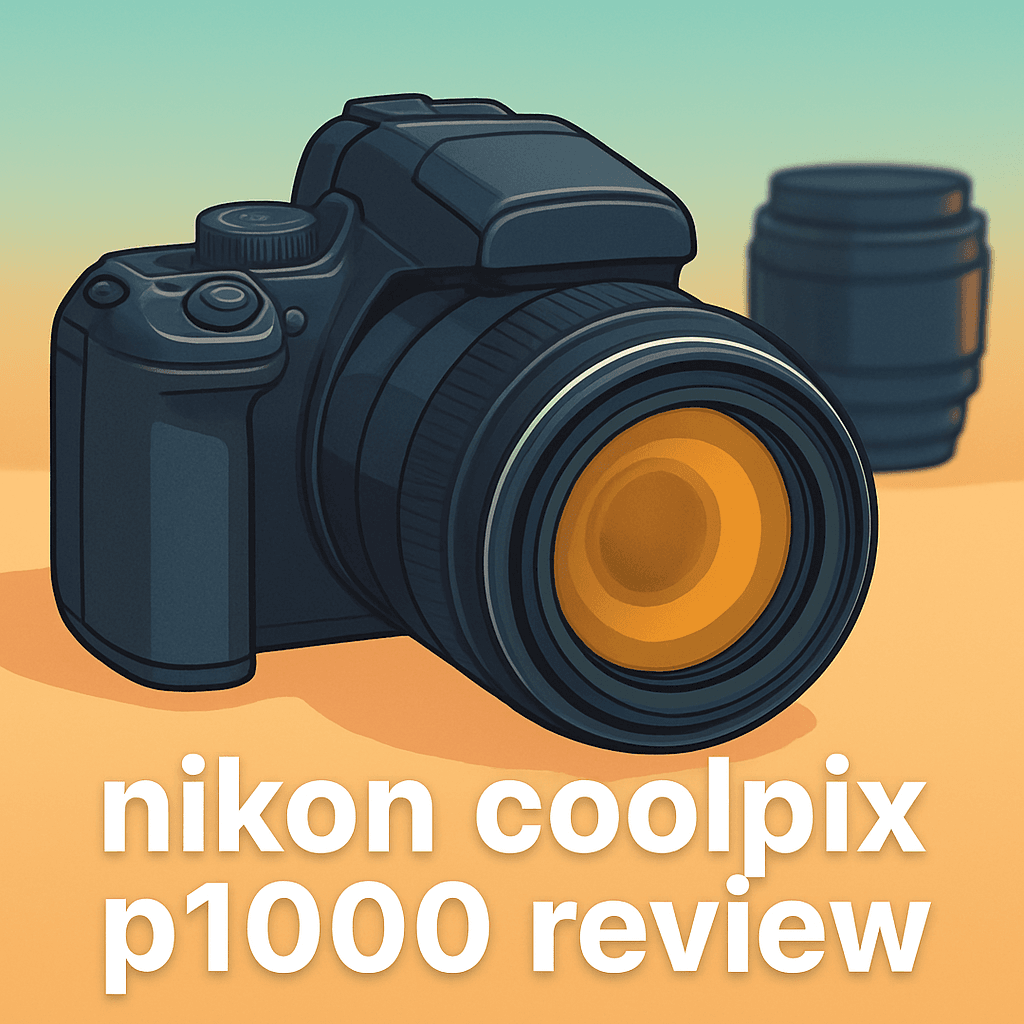
Want to capture distant wildlife or the moon without swapping lenses?
After field-testing the Nikon COOLPIX P1000 Camera, I’ve seen how that extreme reach pays off in real shooting situations.
It pairs a jaw-dropping 125× optical zoom with 4K video, RAW and Dual Detect stabilization, which suits birders, moon shooters and long-distance enthusiasts though you’ll trade portability for reach.
Make sure to read the entire review as I’ll show what works, what frustrates, and how to get sharp shots—keep reading.

Nikon COOLPIX P1000 Camera
Unrivaled 125x superzoom brings distant subjects unbelievably close, while 4K video and full manual controls let adventurous photographers capture wildlife, landscapes and moon shots with impressive detail and stability.
Check PriceThe Numbers You Need
| Spec | Value |
|---|---|
| Sensor | 16MP 1/2.3″ |
| Lens | 24–3000mm (125× optical zoom) |
| RAW Support | Yes |
| Video | 4K |
| Stabilization | Yes |
| Sensor Size | 1/2.3″ |
| Weight | Bulky |
| Zoom Type | Optical |
| Lens Mount | Fixed |
| Viewfinder | Electronic |
| Display | Vari-angle LCD |
| Image Stabilization | Dual Detect VR |
| Movie Recording | 4K UHD at 30fps |
| ISO Range | 100–6400 |
| Shutter Speed | 1/4000s to 30s |
How It’s Built
In my testing the Nikon COOLPIX P1000 Camera immediately feels substantial in the hand. It’s a fixed-lens bridge body that leans toward the bulky side, so you notice it the moment you pick it up. That size is part of the deal—don’t expect a pocket camera.
The electronic viewfinder is crisp and the vari-angle LCD makes odd-angle shots much less painful. I found myself using the EVF a lot when zooming way in because it steadies the shot and keeps things from drifting. For beginners, the screen and finder give two simple ways to compose without wrestling the camera.
Ergonomics are thoughtful overall; the main buttons fall naturally under my fingers. The zoom rocker and stabilization controls are easy to reach even when you’re concentrating on framing. After using it for a while the layout felt intuitive, which helps newcomers focus on shooting instead of menus.
Portability is the camera’s trade-off. It’s not fun to carry on long hikes unless you plan for it, and handheld marathons will tire your arms fast. In real use I often grabbed a small tripod or used a strap for longer sessions.
Build quality impressed me — it feels solid and well-made, which gave me confidence in the field. One thing I really liked was that sturdy feel; one thing that could be better is the balance when the lens is extended, which becomes front-heavy. That shift means you’ll want to practice good support or use a tripod to get the best results.
In Your Hands
Dual Detect VR does most of the heavy lifting across the zoom range, and at wide to mid focal lengths it makes handheld shooting comfortably usable. At extreme reach the stabilization noticeably tames shake but doesn’t eliminate the need for bracing or support, so technique matters as much as tech. In practice it gives you the confidence to attempt hand-held long shots, but sharp results still reward a steady setup.
Autofocus is quick and decisive in good light, locking onto contrasty subjects with little fuss. In lower light and at the longest reach AF slows and can hunt, so tracking fast movers becomes more of a challenge. Switching AF modes and anticipating movement helps a lot when subjects aren’t cooperating.
The shutter and sensitivity options let you freeze action in favorable light and explore long exposures when stationary, but boosting sensitivity to rescue dim scenes brings softer detail and more noise. That makes exposure discipline, a steady platform, and RAW processing important parts of the workflow. For handheld action, faster shuttering and firm technique are essential.
4K video yields usable, detailed clips with pleasing color straight from the camera, and VR smooths many handheld pans. Zooming while recording is practical for documentary-style work but reveals limitations in stabilization and autofocus—slow, deliberate moves look best. For polished telephoto video you’ll want support and practiced zoom control.
Shooting at the extreme end—think 3000mm—turns composition into a learned craft: the EVF and articulating LCD are indispensable for finding and tracking tiny subjects. Bracing against your body, controlling breath, and using a monopod or tripod dramatically boost keeper rates. Expect a short learning curve, then great reach becomes empowering rather than frustrating.
On long outings the P1000’s all-in-one approach is liberating, but plan for a field workflow that includes spare media and a power plan. Large RAW files and 4K clips fill cards quickly, so periodic offloads and thoughtful file management pay off. Overall, the camera rewards patience, preparation, and a steady hand more than sheer luck.
The Good and Bad
- 125× optical zoom covering 24–3000mm equivalent
- 4K UHD video at 30fps
- RAW shooting capability
- Dual Detect VR image stabilization
- Bulky and heavy for travel and prolonged handheld use
- Small 1/2.3″ sensor (trade-offs versus larger-sensor rivals)
Ideal Buyer
If your photographic priorities revolve around reaching subjects no one else can, the Nikon COOLPIX P1000 Camera is made for you. Its 24–3000mm equivalent zoom and 4K/RAW toolkit put extreme reach and creative control in a single body. It’s a specialist tool, not a do‑everything compact.
Think birders staking out treetops, airshow photographers freezing aircraft passes, or landscape shooters pulling distant ridgelines into frame during golden hour. Astronomers and hobbyists wanting the moon large in the frame will also appreciate the scale. It’s handy for coastal observers and wildlife watchers who can’t physically get closer.
This camera rewards patience, technique and stabilization. Expect to travel with a solid grip on tripod use or to accept a heavier bag in exchange for that unmatched focal‑length flexibility, and practice with the zoom is essential to nail tack‑sharp results at 3000mm. Enthusiasts who love tinkering with RAW files will find the workflow satisfying.
It is not for photographers who prioritize light travel, interchangeable lenses, or the cleaner high‑ISO performance of a larger sensor. Wedding, studio or low‑light event shooters should look elsewhere. Consider a lighter superzoom, a 1‑inch‑sensor bridge camera, or an interchangeable‑lens mirrorless body if those trade‑offs bother you.
Better Alternatives?
We’ve spent a lot of time with the P1000 and why its insane reach matters. It’s the camera you grab when you need to pull a subject that feels miles away right up into the frame. But that reach comes with trade-offs—size, weight, and handling at extreme focal lengths.
If those trade-offs don’t fit your shooting style, there are practical alternatives that keep much of the P1000 experience while giving you better handling, speed, or value. Below are three cameras I’ve used in the field that make different choices—less maximum reach for easier use, faster handling, or a lighter pack for long days on the move.
Alternative 1:

Nikon COOLPIX P950 Camera
Designed for serious birders and wildlife enthusiasts, this long-range telephoto offers remarkable reach, dependable stabilization, intuitive controls and a high-resolution electronic viewfinder for steady, detailed shots from afar.
Check PriceI’ve spent mornings with the P950 following herons and hawks, and it feels like a smaller, more manageable cousin to the P1000. What it does better is balance and ease of use—it’s noticeably lighter and you can handhold it for longer without getting fatigued. The zoom still gets you very close to birds and wildlife, and the stabilization is solid enough that you can shoot long focal lengths handheld more often than not.
Where it falls short versus the P1000 is obvious: you lose some of that mind-blowing maximum reach. If you need to pick out tiny details on a subject that’s extremely far away, the P1000 will get you further. Image character and low-light behavior are also similar to the P1000, so you shouldn’t expect big gains in high ISO or dynamic range.
Buy the P950 if you want most of the long-telephoto experience without hauling the biggest superzoom. It’s a good choice for birders and wildlife shooters who want easier handheld use and lower weight for long walks or long stakeouts, but don’t need every extra millimeter of reach the P1000 offers.
Alternative 2:

Canon PowerShot SX70 Camera
Versatile all-in-one zoom combining an ergonomic body, extensive focal range and advanced connectivity to handle travel, wildlife and everyday shooting—delivering crisp 4K video and tactile manual controls for creative freedom.
Check PriceUsing the SX70 in the field felt like using a quicker, more responsive tool compared with the P1000. Autofocus and subject tracking are often snappier for moving subjects, and the camera’s controls and grip make it easy to work handheld for travel and street use. The 4K video and solid JPEGs mean you can shoot and share quickly without heavy editing.
Compared to the P1000, the SX70 gives up the extreme top-end reach. You won’t get the same “pulling the horizon close” effect, so for very distant wildlife or tiny subjects you’ll be limited. Image quality and low-light performance are in the same ballpark because both use small-sensor designs, so don’t expect dramatic improvements in noise or depth-of-field control.
Pick the SX70 if you value speed and everyday usability over the absolute maximum zoom. It’s a good pick for travelers, casual wildlife shooters, and people who want faster handling and reliable autofocus for moving subjects rather than chasing the last bit of reach.
Alternative 3:

Panasonic LUMIX FZ80 Camera
Compact bridge camera with impressive 60x zoom and 4K Photo capability, offering speedy autofocus, stabilized shooting and creative shooting modes—perfect for exploring distant subjects without carrying heavy telephoto gear.
Check PriceThe FZ80 is the little workhorse I’ve grabbed when I wanted a long zoom that’s light in a backpack. It shines in portability and value—you can cover a wide range of subjects and use the 4K Photo feature to grab sharp stills from a burst of frames. Stabilization and autofocus are good for casual use and make it easy to get usable shots without overthinking technique.
What it won’t do like the P1000 is reach as far or produce cleaner files in low light. You’ll be trading away extreme telephoto power and the fine detail that comes with it. In real shooting, that means you’ll approach distant birds and subjects closer than you would with the P1000 or accept cropping more aggressively.
Choose the FZ80 if you want a true grab-and-go superzoom on a budget. It’s great for weekend trips, family outings, and photographers who want long reach without the bulk—ideal for someone who shoots a mix of travel, casual wildlife, and everyday scenes and values light weight over absolute distance.
What People Ask Most
Is the Nikon Coolpix P1000 worth buying?
Yes if you need extreme reach in a single, portable package—it’s unmatched for long tele work—but image quality and low-light performance won’t match interchangeable-lens cameras.
How good is the zoom on the Nikon Coolpix P1000?
The 125x (24–3000mm equivalent) zoom is astonishing and usable thanks to VR, but sharpness and detail fall off at the longest focal lengths and in poor light.
Can the Nikon Coolpix P1000 shoot RAW photos?
Yes — it records RAW (NEF) files so you can recover more detail and adjust exposure and color in post.
Is the Nikon Coolpix P1000 good for astrophotography?
Great for the moon and planets because of the long reach, but the small sensor and noise make deep-sky imaging limited; use a tripod and manual exposure control.
What is the battery life of the Nikon Coolpix P1000?
Expect around 250 shots per charge (CIPA) on the EN-EL20 battery, so carry a spare for long outings or cold weather.
Is the Nikon Coolpix P1000 good for wildlife photography?
Very useful for distant, stationary wildlife thanks to the huge zoom, but autofocus speed and buffer are not ideal for fast action like chasing birds in flight.
Conclusion
The Nikon COOLPIX P1000 Camera is the tool for photographers who need unreachable subjects in a single, all‑in‑one package. Its staggering 125× optical reach, paired with 4K video, RAW capture and dependable stabilization, makes distant wildlife, aviation and lunar work suddenly practical for a single-camera kit. In short: nothing else in a fixed‑lens bridge body covers this ground with the same raw reach.
Those strengths come with clear trade‑offs: the body is bulky for travel and long handheld sessions, and the small sensor brings real compromises in low‑light performance and fine‑detail rendering. You also lose the flexibility of interchangeable lenses and the portability of lighter superzooms when you commit to the P1000. If you want lighter handling choose the P950, for snappier carry the SX70 HS, and for markedly better image quality opt for the FZ1000 II.
Buy the P1000 if unmatched reach is your primary need and you’re willing to adapt your technique and stabilization to tame the long end; it rewards patience with images other cameras can’t frame. Bring a solid tripod, learn good bracing, and accept that composition and timing matter more than brute force. It’s a uniquely capable, specialist tool — brilliant when used for what it was built to do, but not the best choice as an everyday, all‑purpose camera.
Nikon COOLPIX P1000 Camera
Unrivaled 125x superzoom brings distant subjects unbelievably close, while 4K video and full manual controls let adventurous photographers capture wildlife, landscapes and moon shots with impressive detail and stability.
Check Price


0 Comments