
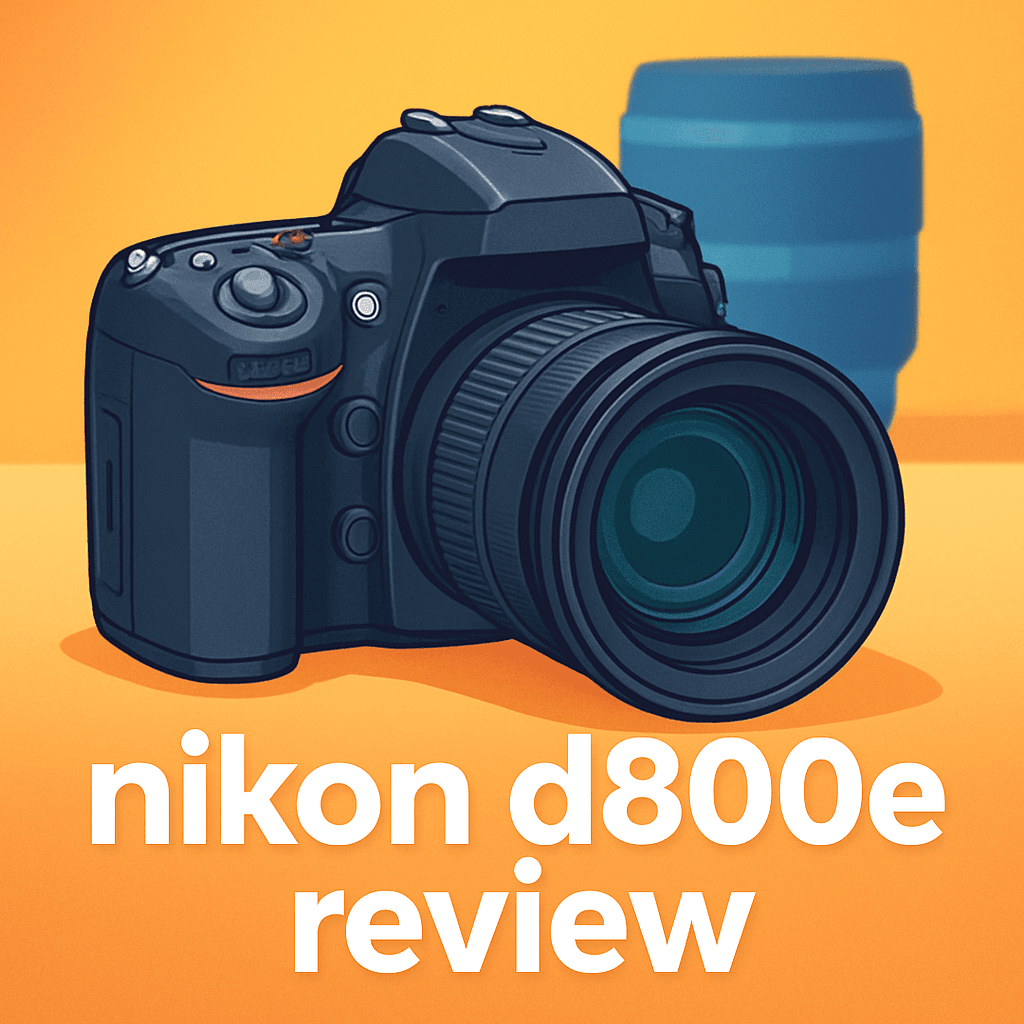
Want to push your image quality to the next level?
The Nikon D800E promises exceptional stills detail, and it’s a hands-on look at real-world usability rather than lab numbers.
After years shooting high-res bodies, I field-tested the D800E across landscapes, studio work, and assignments to see how it behaves in practice.
If you care about fine texture, large prints, or heavy cropping, this review will show who benefits most and why.
I’ll cover design, handling, autofocus and speed, resolution, low-light behavior, and video trade-offs in real shoots—keep reading.

Nikon D800E Camera
Studio-grade 36.3MP full-frame body with no optical low-pass filter for unmatched fine detail, expansive dynamic range, and professional build. Ideal for landscape, studio, and high-resolution commercial photography.
Check PriceThe Numbers You Need
| Spec | Value |
|---|---|
| Sensor | 36.3 MP |
| Type | Full-frame DSLR |
| Low-Pass Filter | Omitted |
| Resolution | 7360 × 4912 pixels |
| Lens Mount | Nikon F-mount |
| ISO Range | 100–6400 (expandable to 25,600) |
| Autofocus | 51 points |
| Shutter Speed | 1/8000s to 30s |
| Continuous Shooting | Up to 4 fps |
| Video | 1080p @ 30 fps |
| Body Weight | Approximately 900g |
| LCD Screen | 3.2 inches |
| Viewfinder | Optical |
| Memory Slots | Dual CF/SD |
| Weather Sealing | Moderate |
How It’s Built
In my testing the Nikon D800E feels like a proper tool—you can feel the traditional DSLR heft and balance as soon as you pick it up. The grip is reassuring and controls are within easy reach for long shoots with heavy lenses.
The optical viewfinder is a joy—bright, lag-free and great for fast composition. The rear screen is large enough for honest image review and live view, but I still relied on the finder for most critical focus checks.
Dual card slots were a real comfort on paid jobs; I set one slot for instant backup and the other for overflow and never worried about losing files. For beginners this is a simple safety net that pays off in peace of mind.
I liked how solid the body feels and how confident it is in the field; it takes normal outdoor work without flinching. One thing that could be better is the weather sealing—it’s fine in light rain, but I treated it with care rather than throwing it into harsh conditions.
On a tripod or in the studio the weight actually helps stability, but carrying it all day will fatigue you if you’re traveling light. In my testing the balance and control layout made long sessions manageable, and beginners will appreciate the straightforward, confidence-inspiring design.
In Your Hands
The D800E’s autofocus is confidence-inspiring for portraits, studio work and moderately paced events; its multi-point AF finds eyes and faces reliably so you spend less time hunting focus and more time composing. Continuous shooting is deliberate rather than frenetic, which means you’ll capture decisive moments at weddings and ceremonies but you’ll feel the limits on fast sports or skittish wildlife. In practice that balance steers the camera firmly toward thoughtful, image-first shooting rather than frenzy-driven action work.
Shutter and exposure flexibility make the body equally at home on sunlit rooftops and long-exposure landscapes from a tripod, while its native sensitivity range gives clean, color-rich files at low and mid settings with usable, workmanlike results when light gets scarce. The absence of an anti-aliasing layer keeps images looking impressively sharp, though it also raises the bar on technique and lens choice as noise and micro-artifacts can become more apparent at higher sensitivities. For critical work you’ll want fast primes or solid stabilization and disciplined shutter control.
Video is serviceable for run-and-gun cutaways or client reference footage but this remains a stills-first body; don’t expect modern cinema features. Dual card slots are a practical perk for client shoots—mirror or overflow strategies are easy and reassuring—but the very large RAW files demand a patient workflow and a stout editing rig. Buffer recovery and card-write times are the most noticeable slow-downs during long bursts.
On real assignments the camera rewards careful techniques: landscapes on a tripod with sharp primes reveal the sensor’s payoff, studio strobes pair beautifully with tethered capture for pixel‑level checks, and casual event coverage delivers excellent final images so long as you respect burst limits and preview on a calibrated monitor rather than the rear LCD for fine focus decisions. The optical viewfinder stays the best tool for framing and timing, while tethering or laptop review becomes essential when you need to judge critical sharpness at high resolution.
The Good and Bad
- 36.3MP full-frame sensor delivers high detail and large print potential
- Low-pass filter omitted for crisp, high-frequency detail
- Dual CF/SD card slots for reliable backup and overflow
- Nikon F-mount compatibility with extensive lens options
- Up to 4 fps continuous shooting limited for fast action
- Omitted low-pass filter increases moiré risk on repeating patterns
Ideal Buyer
If your priority is per-pixel detail rather than burst rates or modern video, the Nikon D800E Camera is aimed squarely at shooters who demand the purest still-image quality. Its 36.3MP sensor, with the optical low-pass filter omitted, rewards good technique, tack-sharp glass and careful focusing for images that stand up to enormous prints. Expect studio discipline: tripod work, precise shutter speeds and patient framing to squeeze every bit of resolving power from your lenses.
Landscape, architecture, product, fine-art and studio portrait shooters get the biggest return on investment from this body. Printmakers and retouchers who rely on crop latitude and micro-detail will appreciate the headroom in RAW files for sharpening and tone work. Nikon F-mount users with a collection of high-resolution primes or sharp zooms will find the sensor truly revealing.
Commercial and editorial photographers who need dependable, high-detail stills will value the dual-card redundancy and the optical viewfinder for confident composition. Be ready for very large RAWs that demand storage discipline, fast cards, and a workstation that can handle heavy files without slowing your delivery.
Avoid the D800E if you chase fast-moving sport or wildlife, or if video is central to your output — the 4 fps burst and 1080p-era video are limiting. For anyone whose priority is stills-first resolution and per-pixel clarity, this camera remains a surgical tool; others should consider newer bodies that trade resolution for speed, AF and modern codecs.
Better Alternatives?
We’ve gone through the Nikon D800E hands-on — how it feels, how it resolves detail, and where it struggles in real shoots. The D800E is a stills-first camera that rewards careful technique and sharp glass, but that doesn’t mean it’s the best pick for every job or every photographer.
Below are three real-world alternatives I’ve used in the field. I’ll tell you what each one does better and where it falls short compared to the D800E, and who would likely prefer each camera in everyday shooting.
Alternative 1:

Nikon D850 Camera
Flagship 45.7MP sensor combines speed and resolution with advanced autofocus, outstanding low-light performance, 4K video, and excellent battery life—perfect for wedding, wildlife, and commercial shooters demanding versatility.
Check PriceThe D850 feels like the modern, faster sibling to the D800E. In real shoots I noticed sharper-looking files straight out of camera thanks to the higher 45.7MP sensor and cleaner high-ISO handling. Autofocus is more confident and the faster burst and better battery life mean you can shoot weddings or wildlife all day without worrying as much about missing key moments.
Where it’s worse than the D800E is mainly file and workflow cost: the images are larger, so storage and editing need more muscle and time. It also doesn’t add in-body stabilization, so handholding very long lenses still depends on lens or technique. And if you loved the very specific look and handling quirks of the D800E (the slightly rawer, low-pass-free look), the D850’s files feel more polished and modern rather than identical to the D800E’s character.
If you shoot a mix of genres — events, wildlife, commercial — and want high resolution but also reliable autofocus, longer battery life, and 4K video for occasional clips, the D850 is the sensible step up. If you’re strictly a detail-obsessed studio or landscape shooter who values the D800E’s exact rendering and are okay with slower bursts, sticking with the D800E still makes sense.
Alternative 2:

Canon EOS 5DS R Camera
Massive 50.6MP full-frame capture with suppressed anti-aliasing for razor-sharp output, superb color fidelity, and robust ergonomics; built for large-format prints, studio work, and meticulous commercial retouching.
Check PriceThe Canon 5DS R is all about pure detail — its 50.6MP files are breathtaking when you’re under studio lights or on a tripod. In studio work I got finishes and skin textures that held up to very large prints, and Canon’s color rendering made skin tones fall naturally without heavy correction. If ultimate still resolution is your priority, it beats the D800E on sheer pixel count.
Its downsides versus the D800E show up when light gets messy or subjects move. The 5DS R has less forgiving high-ISO performance and a slower overall shooting feel, so it’s not my pick for low-light events or fast action. File sizes are also very large, so editing and storage can become a burden faster than with the D800E. Video is basic, and autofocus doesn’t match the responsiveness of newer bodies.
Choose the 5DS R if you’re a studio, commercial, or fine-art photographer who controls light and needs the biggest files possible for prints or retouching. If you frequently shoot handheld at night or cover active events, you’ll miss the D800E’s more balanced low-light handling and quicker, more usable AF in the field.
Alternative 3:
Canon EOS 5DS R Camera
Engineered for ultimate resolution, the sensor delivers extraordinary detail and crop flexibility, with precise metering, reliable build, and studio-friendly connectivity—ideal for fine art reproduction and architectural photography.
Check PriceViewed from an architectural and product perspective, the 5DS R’s strength is its ability to hold tiny lines and textures with minimal interpolation. I used it on building façades and product shelves where cropping and pixel-level detail matter — the latitude for fine retouching is excellent and often better than what I got from the D800E in the same situations.
On the flip side, the camera’s heavier file workflow and weaker high-ISO headroom make it a less flexible travel or run-and-gun tool than the D800E. The D800E’s slightly cleaner mid-ISO performance and more usable burst make it easier to use in less controlled environments. Also, if you’ve invested in Nikon glass, adapting lenses to Canon reduces the simple compatibility advantage the D800E has with native Nikon optics.
This version of the 5DS R is best for photographers focused on architecture, museum reproduction, and product work where absolute detail and reliable color are the priorities. If you work a lot outdoors in mixed light or need faster action capture, the D800E remains a more practical choice despite the 5DS R’s superior resolution on paper.
What People Ask Most
Is the Nikon D800E worth buying in 2026?
Yes, if you want very high resolution on a budget and don’t need the latest AF, video, or high-ISO performance; otherwise a newer body or mirrorless camera is a better long-term choice.
What is the difference between the Nikon D800 and D800E?
The D800E removes the optical low-pass (AA) filter for slightly sharper images and more micro-detail, at the cost of increased risk of moiré compared with the standard D800.
Does the Nikon D800E have an optical low-pass (AA) filter?
No — the D800E is designed without the AA filter (or with a neutralized AA effect) to maximize resolving power.
Is the Nikon D800E good for landscape photography?
Yes — its 36MP sensor and strong dynamic range make it excellent for landscapes, as long as you use good lenses, a tripod, and watch for moiré in fine repeating patterns.
How does the Nikon D800E compare to the D810 and D850?
The D810 improves processing and ISO handling over the D800E, while the D850 adds much better AF, battery life and high-ISO performance; both newer models are generally more capable but cost more used.
Is the Nikon D800E still a good camera for studio and portrait work?
Yes — the high resolution and color rendering are great for studio and portraits, though you’ll miss newer autofocus features and workflow conveniences of modern bodies.
Conclusion
The Nikon D800E Camera is a stills-first, high-resolution full-frame DSLR that prioritizes absolute per-pixel detail by removing the optical low-pass filter. In hand it rewards slow, deliberate shooting, careful technique and the use of sharp lenses to unlock its potential. For photographers who print large, crop heavily or pursue fine-art detail, it remains a compelling tool even years on.
It truly shines on landscapes, studio and architectural work where lens quality and stability let the sensor sing with texture and micro-detail. The honest optical viewfinder, tactile controls and dual-card redundancy give confidence on paid assignments and long days in the field. When matched with premium glass the payoff in fidelity and cropping latitude is unmistakable and often breathtaking.
Those rewards come with trade-offs: modest continuous shooting, basic video, a heavier carry and the need to manage moiré and large files. Workflows slow when processing oversized RAWs, and pixel-level focus demands extra care in low light. It isn’t the best choice for action shooters or video-centric creators.
Choose the Nikon D800E Camera if still-image resolution and an optical-viewfinder shooting experience are your top priorities; choose something newer if speed, AF responsiveness, stabilization or advanced video matter more. In this nikon d800e review my verdict is simple: a specialist workhorse that rewards discipline and premium glass, great for landscape, studio and print-focused pros.
Nikon D800E Camera
Studio-grade 36.3MP full-frame body with no optical low-pass filter for unmatched fine detail, expansive dynamic range, and professional build. Ideal for landscape, studio, and high-resolution commercial photography.
Check Price

0 Comments