
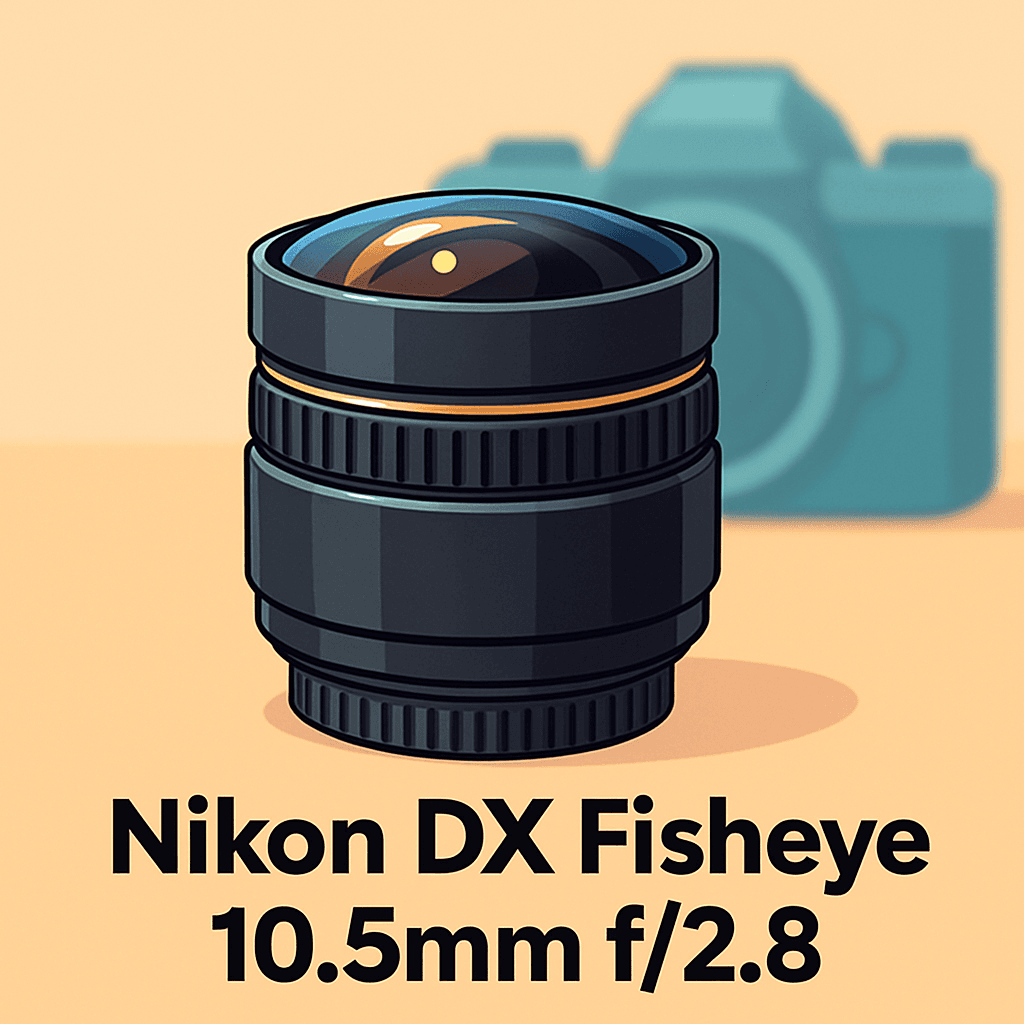
Want to give your photos an immersive, in-your-face perspective that stops people mid-scroll?
The Nikon AF DX NIKKOR 10.5mm f/2.8G Fisheye is built to do exactly that for Nikon DX shooters who crave dramatic wide-angle looks and low-light flexibility, and I’ve field-tested it in streets, interiors, and night shoots.
If you’re curious about how this lens changes composition, handling, and creative payoff compared with more conventional glass, this review will walk you through the real-world strengths, quirks, and when it’s worth packing—keep reading.

Nikon AF DX NIKKOR 10.5mm f/2.8G Fisheye
Compact ultra-wide fisheye prime offering dramatic 180° perspective, bright f/2.8 aperture for low-light shooting, crisp center-to-edge sharpness, and rugged build ideal for creative landscapes and interiors.
Check PriceThe Numbers You Need
| Spec | Value |
|---|---|
| Focal length | 10.5 mm |
| Lens type | Fisheye |
| Maximum aperture | f/2.8 |
| Mount | Nikon F-mount (DX format) |
| Format compatibility | APS-C (DX) sensors |
| Angle of view | 180° diagonal |
| Optical construction | 10 elements in 7 groups |
| Minimum focusing distance | 0.14 m (5.5 in) |
| Aperture blades | 7, rounded |
| Filter size | 62 mm (front) |
| Autofocus | Yes; built-in autofocus motor |
| Dimensions (diameter × length) | Approx. 73 × 69 mm |
| Weight | Approx. 335 g (11.8 oz) |
| Special features | Extra-low dispersion (ED) glass element |
| Hood | Built-in petal-shaped lens hood |
How It’s Built
In my testing the Nikon AF DX NIKKOR 10.5mm f/2.8G Fisheye feels surprisingly at home on smaller Nikon bodies. It’s compact and light, so it doesn’t pull down the camera and is easy to carry all day. That makes it a great travel and street companion for beginners.
The build feels solid for a small lens and the mount stayed tight through heavy use. I didn’t baby it on shoots and it kept performing, which gives you confidence in the field. For everyday use that matters more than lab numbers.
The focus ring is narrow but smooth and simple to use when you need to fine-tune close shots. In my testing it offered decent tactile feedback for quick tweaks, so manual focusing isn’t scary for newcomers. Aperture changes behaved predictably on Nikon bodies, which keeps your workflow straightforward.
I really liked the built-in petal hood because it protects the front element and helps control flare without extra parts. One downside is that the hood makes using a standard lens cap awkward, so you’ll either fiddle with a special cap or be more careful in your bag.
Autofocus works thanks to the built-in motor, so even entry-level Nikons get AF. After using it for a while I appreciated the overall balance and portability, though I wished the cap situation was easier to live with.
In Your Hands
The Nikon AF DX NIKKOR 10.5mm f/2.8G Fisheye focuses with a purposeful, confident snap in good light, and its built‑in motor keeps autofocus usable across the Nikon DX lineup. In dim, low‑contrast scenes it can hesitate and occasionally hunt, so a little patience or a quick pre‑focus often pays off. When it locks on, accuracy is solid for run‑and‑gun shooting.
The bright aperture pays immediate dividends after dusk and inside venues, letting you preserve ambient mood while maintaining usable shutter speeds. For night streets and lit interiors the lens balances reach with context, keeping scenes immersive without sacrificing practicality. That speed also helps tame subject motion and offers more separation than most extreme wide lenses.
Closing the gap to a subject produces dramatic foreground emphasis and a near‑immersive perspective that rewrites composition rules. The extreme field of view forces deliberate placement—edges bend faces and horizons will appear to tilt if you’re loose with framing. I found small adjustments, a steady eye on the horizon, and occasional manual tweaks ergonomically essential.
Switching between AF and manual is part of the rhythm; autofocus covers most handheld work while manual focus is invaluable for tricky low‑contrast or close‑distance shots. The integrated petal hood is practical in the field, reducing flare and protecting the prominent front element so you can work faster and travel lighter.
The Good and Bad
- True 180° diagonal fisheye coverage on DX
- Bright f/2.8 aperture for low light and action-stopping possibilities
- Very close focusing (0.14 m) for dramatic, immersive perspectives
- Compact and lightweight with integrated petal hood for protection
- Specialized fisheye look isn’t universally useful for all genres
- Prime focal length lacks the framing flexibility of fisheye zooms
Ideal Buyer
The Nikon AF DX NIKKOR 10.5mm f/2.8G Fisheye is made for Nikon DX shooters who want a true 180° diagonal fisheye and the extra punch of a bright f/2.8. It excels when you need immersive, ultra‑wide perspective straight out of the camera. It’s a specialist tool rather than an everyday substitute for a wide‑angle zoom.
Its super‑close 0.14 m focus and exaggerated foreground rendering appeal to creatives who like bold, in‑your‑face compositions for interiors, street, and night scenes. The f/2.8 aperture also pays dividends in low light and event work. Close‑focus shots feel immersive and are great for making small rooms and foreground subjects dominate the frame.
Travel and run‑and‑gun photographers who value a compact, lightweight prime with an integrated hood and reliable AF on DX bodies will find it liberating. The balance on small Nikon bodies feels natural and keeps carry weight low. Built‑in hood helps control flare and protects the front element on hikes and city shoots.
This lens isn’t suited to photographers chasing a circular fisheye look or those who need the framing flexibility of a zoom. If you need full‑frame coverage, variable focal lengths, or softer discipline‑free backgrounds, look at the alternatives. Compare it to fisheye zooms and circular alternatives if you want more framing options or a different aesthetic.
Better Alternatives?
We’ve gone through the Nikon 10.5mm f/2.8 and what makes it special: the bright f/2.8 speed, that tight DX diagonal fisheye look, the very close focus, and how it handles in real shoots. If that lens fits your needs, great — but there are other ways to get into fisheye territory depending on whether you want a zoom, a circular image, or a different price point.
Below are three real-world alternatives I’ve used. I’ll point out what each one does better and worse than the Nikon 10.5, and who I’d recommend each for, so you can pick the one that matches how you shoot.
Alternative 1:

Tokina ATX 10-17mm f/3.5-4.5 DX AF Nikon
Versatile ultra-wide zoom delivering flexible fisheye effects across the range, smooth autofocus, solid construction, and portable design—perfect for dramatic architecture, action, and immersive creative photography on crop bodies.
Check PriceI’ve shot with the Tokina 10-17mm on weekends where I needed flexibility. What it does better than the Nikon 10.5 is framing: you can dial in anything from a near-circular fisheye to a more usable diagonal look. That zoom range is huge when you don’t want to move your feet to change the amount of distortion.
Where it loses to the Nikon is speed and edge consistency. The variable f/3.5–4.5 aperture isn’t as good in low light, and I’ve seen softer edges at the extreme ends compared with the Nikon prime. In bright daylight it’s fine, but if you rely on f/2.8 for indoor or night work the Tokina will force you to push ISO or slow shutter more often.
Buy the Tokina if you want one lens to cover several fisheye looks and you travel or shoot architecture where framing matters. If you need the absolute best low-light speed, the Nikon prime still wins.
Alternative 2:

Sigma 10mm f/2.8 EX DC HSM Fisheye Nikon
Bright fisheye prime with fast f/2.8 aperture and quiet HSM autofocus for responsive shooting; delivers punchy distortion, strong contrast, and reliable performance for landscapes, interiors, and night skies.
Check PriceThe Sigma 10mm is a classic circular fisheye on APS-C and I used it when I wanted an all-out immersive, round image. Compared to the Nikon 10.5 it gives a much more extreme, circular look — if that’s the creative effect you want, it’s hard to beat. The f/2.8 speed is the same, so it’s still good for low light and night sky work.
On the downside, the Sigma can feel older in how it renders corners and contrast. In my experience the center is strong but edges show more fringing and can be softer than the Nikon’s diagonal prime. I also found flare could be more noticeable in certain backlit shots unless I stopped down or shaded the front element.
Choose the Sigma if you want a circular fisheye that makes a bold, graphic statement — for creative portraitures, skate/park work, or dramatic sky shots. If you want a gentler diagonal fisheye that’s more forgiving at the edges, stick with the Nikon.
Alternative 3:
Sigma 10mm f/2.8 EX DC HSM Fisheye Nikon
Compact circular fisheye designed for crop-sensor cameras, offering an expansive field of view, impressive edge-to-edge rendering, quick AF, and durable build—great for creative travel, cityscapes, and astrophotography.
Check PriceSeen from another angle, the Sigma is compact and feels solid in the hand. I liked carrying it on trips because it packs light and gives you a very wide playground for composition. Compared to the Nikon 10.5, it wins on sheer reach of view — you get more sky and foreground inside one frame, which is great for travel and cityscapes.
Its weaknesses, again, are in consistency and control. The Sigma’s extreme circle means horizons and people at the frame edge can look more distorted; that’s part of the look, but it makes some usable shots harder to get. Also, while AF is quick and quiet in my setups, you’ll sometimes need to double-check focus when working on fine details or in low contrast scenes.
If you want the most dramatic circular fisheye effect in a small, tough package — and you don’t mind dealing with the extra distortion — the Sigma is a smart, budget-friendly pick. If you want a more balanced, easier-to-use diagonal fisheye for everyday DX shooting, the Nikon 10.5 stays the more practical choice.
What People Ask Most
Is the Nikon 10.5mm f/2.8 DX fisheye compatible with full-frame (FX) Nikon cameras?
It’s a DX lens so on full-frame bodies it will produce heavy vignetting or a circular image; many FX cameras will switch to DX crop mode but you’ll lose resolution.
What is the angle of view and 35mm equivalent focal length of the Nikon DX Fisheye 10.5mm f/2.8?
On DX it gives roughly a 180° diagonal angle of view, and the 35mm-equivalent focal length is about 16mm (10.5mm × 1.5 crop).
Is the Nikon 10.5mm f/2.8 a true fisheye or a rectilinear lens?
It’s a true fisheye lens, designed to produce pronounced curved distortion rather than straight-line rectilinear rendering.
How close can the Nikon 10.5mm f/2.8 focus (minimum focus distance)?
The minimum focus distance is about 0.14 meters (14 cm), letting you get very close to subjects for dramatic foreground effects.
Does the Nikon 10.5mm f/2.8 have autofocus or vibration reduction?
It offers autofocus (uses Nikon’s focus motor) but it does not have vibration reduction (no VR).
Is the Nikon 10.5mm f/2.8 sharp enough for landscapes and astrophotography?
Yes—centers are quite sharp and f/2.8 is helpful for astrophotography and wide landscapes, though corners can be softer and stopping down improves edge performance.
Conclusion
The Nikon AF DX NIKKOR 10.5mm f/2.8G Fisheye is a purpose-built creative tool that delivers an unmistakable, immersive look and consistently dependable handling in real-world shooting. Its bright, fast character, near‑macro close‑focus feel, and autofocus that works well on Nikon DX bodies all add up to a lens that simply gets out of the way when you’re composing. In short, it does exactly what a specialist fisheye should do—make images feel bigger and more immediate.
That usefulness is also its limitation. The pronounced fisheye curvature is a stylistic choice that won’t suit every job, and the fixed focal length means you sacrifice framing flexibility compared with zoom options. It’s built for crop‑sensor bodies, so photographers wanting different fisheye aesthetics or full‑frame coverage will want to look elsewhere.
If your visual aim is immersive interiors, creative street work, tight travel scenes or low‑light experimentation, this lens is hard to beat for the character it brings and the ease of use it offers. If you need a toolkit lens that covers many genres, consider alternatives that trade some speed and immediacy for greater versatility.
Ultimately, the Nikon 10.5 is a specialist with clear strengths and clear trade‑offs. Buy it if you want bold, reliable fisheye personality in a compact package; skip it if you need one lens to do everything.
Nikon AF DX NIKKOR 10.5mm f/2.8G Fisheye
Compact ultra-wide fisheye prime offering dramatic 180° perspective, bright f/2.8 aperture for low-light shooting, crisp center-to-edge sharpness, and rugged build ideal for creative landscapes and interiors.
Check Price




0 Comments