
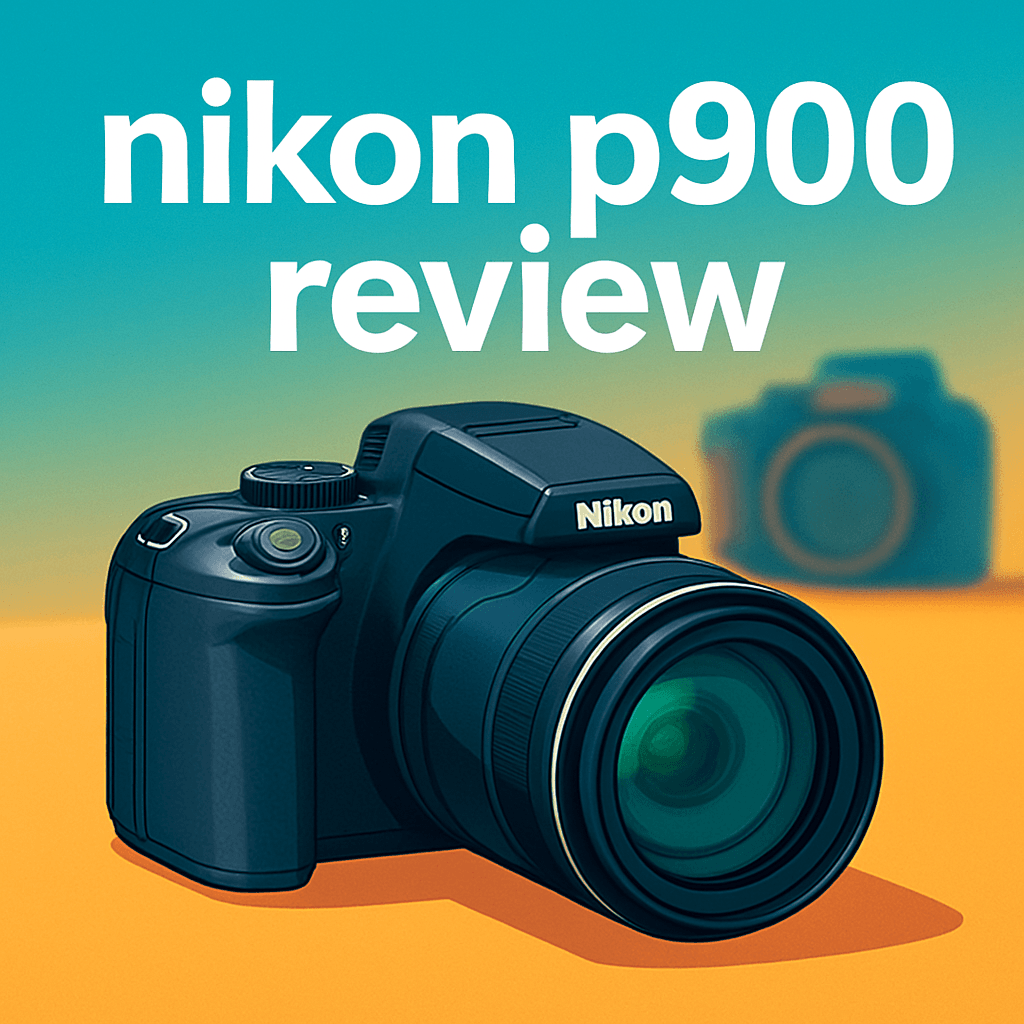
Ever wish you could frame the moon, a distant bird, or an airshow jet without swapping lenses or lugging primes? If you’re asking whether one camera can really get you that close, you’re not alone.
The Nikon COOLPIX P900 Camera’s headline is its 83x optical zoom — a 24–2000mm equivalent reach that changes what you can capture from afar. It’s paired with a small 1/2.3″ sensor, 16MP, EVF, 1080p video and image stabilization.
That reach makes the P900 compelling for wildlife, moon, travel, and airshow shooters who put distance over low-light prowess. It’s fairly hefty and gives roughly 360 shots per charge, so handling and battery planning matter, and I field-tested it to see how it behaves in real use.
I’ll walk you through practical tips for taming 2000mm, stabilizing and focusing at extreme reach, and when a tripod’s worth it. Make sure to read the entire review as I break down real-world performance and keep reading.

Nikon COOLPIX P900 Camera
Super-telephoto bridge camera delivering 83x optical reach, crisp stabilization, high-resolution EVF, and easy connectivity. Perfect for wildlife and travel shooters chasing distant action without heavy lenses.
Check PriceThe Numbers You Need
| Spec | Value |
|---|---|
| Sensor Size | 1/2.3" |
| Sensor Resolution | 16 MP |
| Zoom | 83x Optical (24–2000mm equiv.) |
| Lens Focal Length | 24–2000mm |
| Image Stabilization | Yes |
| Video Resolution | 1080p |
| Autofocus | Yes |
| Screen Size | 3" |
| Screen Type | LCD |
| ISO Range | Not specified |
| Weight | Not specified (varies by model, typically around 890g) |
| Dimensions | 140 x 103 x 137 mm |
| Viewfinder | Electronic |
| Flash | Built-in |
| Battery Life | Approximately 360 shots |
How It’s Built
In my testing the Nikon COOLPIX P900 Camera feels substantial in the hand, more like a proper camera than a pocket point-and-shoot. It’s solid enough to inspire confidence and it balances surprisingly well as you creep the zoom out, though it does get front-heavy at the long end. For casual travel that means you won’t want it bouncing around your neck all day, but it’s perfectly usable when you brace up or use a strap for support.
The electronic viewfinder is the feature I reached for first. I found it much easier to frame distant subjects through the EVF than the rear screen, especially in bright sun where the LCD can wash out a bit. Menus are straightforward, so beginners won’t feel lost, and the built-in flash is handy for close subjects even if it won’t reach far-off things.
Ergonomics are thoughtful: the grip gives you a good hold and the main controls fall naturally under my fingers when tracking moving subjects. One practical note from field use — a tripod plate can block the battery door, so choose a plate that provides room or be ready to remove it to swap power. That surprised me the first time.
Build quality feels durable and the lens extends smoothly, though the cap and hood can be a little fiddly to manage when you’re on the move. One thing I really liked was the confidence the design gives when hunting distant targets; one thing that could be better is the front-heavy feel at full zoom. Bring an extra battery for a full day of shooting and you’ll be set.
In Your Hands
The P900’s extreme telephoto reach turns tiny, distant subjects into frame-filling opportunities, whether you’re hunting birds, isolating lunar detail, or picking out aircraft and distant landmarks. At the far end of the lens atmosphere and haze become obvious, so patience, choosing cleaner air or shooting from a closer vantage point, and stepping down the zoom a little often improves clarity.
Autofocus is eager and dependable at shorter focal lengths, but it tightens up as you push toward the long end; expect a slower, more deliberate feel when you’re working on small targets far away. Favor single-point or center AF, use short bursts to increase keeper odds, and be ready to nudge focus manually when contrast is low.
Image stabilization does heavy lifting and lets you handhold more than you’d expect, but steady technique matters—tuck your elbows, control your breath, and use the electronic viewfinder to anchor the camera. For truly critical work or longer framing sessions, a monopod or tripod quickly moves from optional to essential to preserve detail.
For casual telephoto video the camera produces usable results, especially for short wildlife clips, but long handheld pans amplify shake and rolling artifacts. Keep clips brief, use the EVF for steadier composition, and stabilize the body any way you can to avoid drift during recording.
Framing through the EVF feels more precise than the rear screen when the lens is extended, and tracking erratic subjects demands anticipation and frequent reframing. Plan your shooting rhythm around bursts and short clips, conserve power between sequences, and carry a spare battery for a full day in the field.
The Good and Bad
- Massive 83x optical zoom (24–2000mm equivalent) enables shots not feasible with standard lenses
- Image stabilization aids handholding at long focal lengths
- 16 MP resolution adequate for web and modest prints when shot in good light
- Electronic viewfinder improves composition and stability over LCD-only shooting
- Small 1/2.3″ sensor limits high-ISO and low-light image quality
- Handling at 2000mm equivalent is challenging and often requires a tripod or monopod
Ideal Buyer
If reach is the main goal, this is your camera. The Nikon COOLPIX P900’s 83x zoom turns tiny specks on the horizon into frame-filling subjects — birds, the moon, airshows and distant ships suddenly become shootable. Field photographers who prioritize reach over low-light finesse will appreciate what it lets you capture, from backyard birding to distant lunar detail.
Travelers who want a single, do-everything camera without swapping lenses will find the P900 appealing. It’s bulky but far less fussy than carrying telephoto glass and adapters, and its roughly 360-shot battery life usually covers a long outing with a spare, though a compact tripod or monopod often makes long-tele work more rewarding. Be prepared to learn bracing, monopod use, and careful focus technique to make the most of 2000mm equivalent.
Enthusiasts who enjoy practicing technique get the biggest payoff; steady hands, patience, and framing discipline dramatically raise keeper rates. Casual videographers content with 1080p and shooters who accept small-sensor noise at higher ISO will find the trade-offs reasonable for the zoom gains, especially for social sharing and modest prints. If you crave reach and real-world versatility the Nikon COOLPIX P900 remains one of the most compelling, accessible telephoto solutions.
Better Alternatives?
We’ve spent a lot of time on the P900 and its crazy 83x reach, how it handles in the field, and where it shines and struggles. If you like the idea of a single camera that gets you close to distant birds, the moon, or planes at an airshow, the P900 makes a strong case — but it isn’t the only way to get there.
Depending on what matters most to you — absolute reach, better video/processing options, lighter carry, or a lower price — there are several sensible alternatives. Below are three real-world options I’ve shot with, what they do better or worse than the P900, and who will enjoy each one.
Alternative 1:

Nikon COOLPIX P1000 Camera
Unrivaled extreme-zoom tool with 125x optical power, rock-steady stabilization, and detailed long-range capture capabilities. Ideal for wildlife, aviation, and astrophotography when distant subjects demand precision.
Check PriceI’ve used the P1000 on moon shots and distant wildlife, and its reach is simply on another level compared to the P900 — you can frame tiny subjects much larger without stacking extenders. That extra reach is the P1000’s whole point: it lets you capture more detail at extreme distances and gives you room to crop in further in post. If your main goal is getting as close as possible without swapping lenses, this one delivers.
That said, the P1000 is heavier and more tiring to handhold than the P900. At the longest focal lengths you’ll want a solid tripod and patience with stabilization and focus. The tiny sensor still limits low-light detail, so while you gain reach you don’t get magic in dim conditions. Also, because it’s bigger and bulkier, it’s less pleasant on long hikes or casual travel days.
If you’re a moon shooter, serious wildlife spotter, or someone who wants the maximum single-lens reach and is fine carrying a tripod, the P1000 is the choice. If you prefer lighter gear or you mainly shoot in mixed conditions where speed and portability matter, the P1000 may feel like overkill.
Alternative 2:

Canon PowerShot SX70 Camera
Versatile superzoom with 65x optical range, fast autofocus, ergonomic controls, and a bright electronic viewfinder. Great for travel, family events, and flexible everyday telephoto shooting.
Check PriceI’ve shot travel and birds with the SX70 and found it to be a very balanced option. It doesn’t reach as far as the P900, but the ergonomics, handling, and AF feel more friendly for everyday use. For walking around towns, family events, or quick wildlife moments, the SX70 lets you move faster and stay comfortable on your feet for longer.
Compared to the P900, the SX70 gives up some ultimate reach but often gains in practical usability — the zoom feels smoother, the controls are easy to use on the fly, and I had fewer missed moments when subjects moved. Low-light performance is similar: neither camera is great in dark conditions because of the small sensors, so you still want good light for clean shots.
The SX70 is a good pick if you want a superzoom that’s easier to live with day-to-day. Choose it if you travel a lot, like a snappier feel for moving subjects, or want a gentler weight and size trade-off rather than pushing to the extreme tele end like the P900.
Alternative 3:

Panasonic LUMIX FZ80 Camera
Affordable superzoom offering 60x reach, powerful image stabilization, responsive performance, and user-friendly controls. A compact choice for beginners wanting dramatic close-ups of faraway subjects.
Check PriceThe FZ80 is the budget-friendly option I’ve used when I needed reach but didn’t want to spend or lug a heavier camera. It’s lighter and easier to carry than the P900, so it’s great for casual trips and family outings where you still want to pull in distant subjects. The stabilization works well for handheld shooting at modest zoom levels.
Where it falls short versus the P900 is obvious in reach and in some handling refinements — you won’t get the same tight framing on faraway birds or the moon, and the AF can be a bit slower in tricky light. Image quality in low light is also more limited, so plan to shoot in good daylight for the best results. Still, for general superzoom use and learning telephoto technique, it’s a very practical tool.
Pick the FZ80 if you’re on a budget, want a light camera that’s easy to carry, or you’re new to long-zoom shooting and want something forgiving and simple. If you need extreme reach or the best possible handling at long focal lengths, step up to one of the larger options above.
What People Ask Most
Is the Nikon P900 worth buying?
Yes if you want an affordable camera with insane reach for travel and wildlife; skip it if you need RAW, 4K, or top image quality in low light.
How good is the zoom on the Nikon P900?
Its 83x optical zoom (about 24–2000mm equivalent) is excellent for distant subjects, though extreme telephoto images can be soft and benefit from a tripod.
Does the Nikon P900 shoot in RAW?
No — the P900 only records JPEG files, so it has limited flexibility for heavy post-processing.
Can the Nikon P900 record 4K video?
No, it does not shoot 4K; video tops out at Full HD (1080p).
How long does the battery last on the Nikon P900?
Expect roughly 300–400 shots per charge under typical use, or a few hours of shooting; bring a spare for long outings.
Is the Nikon P900 good for astrophotography or moon photography?
Great for moon and bright planet shots thanks to the long zoom, but it’s limited for deep-sky astrophotography due to a small sensor, noise, and lack of RAW; use a tripod and remote shutter for best results.
Conclusion
The Nikon COOLPIX P900 Camera is unapologetically built around reach, putting distant subjects within practical framing without swapping glass. Its stabilized long lens, electronic viewfinder and Full HD video make it a versatile tool for wildlife, the moon and airshows. In good light it can produce satisfying results where ordinary compacts simply can’t go.
But that reach comes with compromises. Low-light performance and fine detail at extreme distances are constrained by the small sensor and the realities of atmosphere, and handheld handling at full extension can be fatiguing. If you need modern video codecs or the ultimate pixel-level quality, there are better choices.
For photographers who prize reach above all else, the P900 is a compelling, practical choice that delivers unique framing possibilities at a very reasonable trade-off. If you want even more reach and 4K/RAW workflows, consider the Nikon COOLPIX P1000; if you prefer better handling and a balanced travel superzoom look at the Canon PowerShot SX70 HS or the lighter Sony HX400V. Decisive verdict: buy the P900 if extreme telephoto access is your priority and you accept the handling and low-light trade-offs; otherwise choose a model that better matches portability or image-quality goals.
Nikon COOLPIX P900 Camera
Super-telephoto bridge camera delivering 83x optical reach, crisp stabilization, high-resolution EVF, and easy connectivity. Perfect for wildlife and travel shooters chasing distant action without heavy lenses.
Check Price



0 Comments