
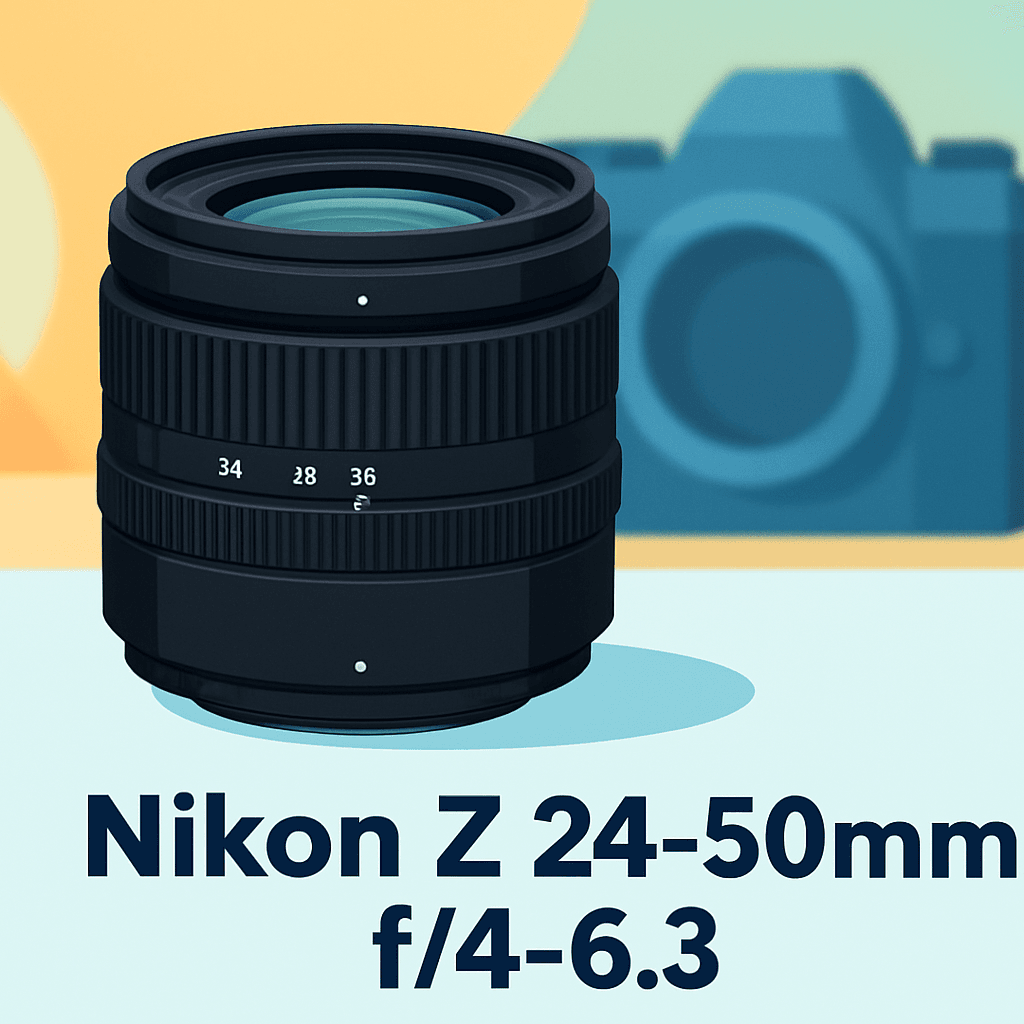
Want to travel lighter without sacrificing image quality? The Nikon NIKKOR Z 24-50mm f/4-6.3 is an ultra-compact full-frame standard zoom for Z-mount that’s built around portability and simplicity.
It’s aimed at everyday carry, travel, street, casual portraits and documentary work, and it pairs especially well with Z bodies that have in-body stabilization. After spending time with it in the field, I wanted to see if that tiny footprint costs too much in real shooting situations.
Expect a lens that trades constant aperture and in-lens stabilization for featherweight convenience and discreet handling — which brings limits in low light and weather resistance but real-world payoff in comfort and speed. Make sure to read the entire review as I break down AF, sharpness, and practical trade-offs — keep reading.

Nikon NIKKOR Z 24-50mm f/4-6.3
Pocketable, lightweight walkaround zoom delivering dependable sharpness from wide-angle to standard telephoto. Ideal for travel and everyday shooting, it balances compact design with surprisingly clean rendering and quick autofocus performance.
Check PriceThe Numbers You Need
| Spec | Value |
|---|---|
| Lens type | Standard zoom |
| Mount type | Nikon Z mount |
| Focal length range | 24–50 mm |
| Maximum aperture | f/4–6.3 (variable) |
| Lens construction | 9 elements in 8 groups |
| Minimum focus distance | 0.35 m (35 cm) |
| Maximum reproduction ratio | 0.18× |
| Image stabilization | No — relies on camera body stabilization |
| Autofocus | Stepping motor (quiet and precise) |
| Filter size | 52 mm |
| Aperture blades | 7, rounded |
| Length (retracted) | Approx. 53.5 mm |
| Weight | Approx. 230 g |
| Compatible sensor format | Full-frame (also usable on APS-C with crop factor) |
| Weather resistance | No — not sealed against dust and moisture |
How It’s Built
In my testing the Nikon NIKKOR Z 24-50mm f/4-6.3 feels like it was built to disappear on a camera — it’s tiny and light, and it mates naturally with the small Z bodies. That compactness means it’s easy to carry all day and barely noticeable on a strap or in a bag.
The lens stays nicely stowed until you need it, and it pops into shooting position without any fuss. The zoom ring is smooth with just the right amount of resistance, so I could reframe quickly without overshooting my mark.
Handling-wise I liked how well it balances on lightweight Z cameras; it never felt front-heavy or awkward during long walks. One thing that could be better is the lack of weather protection — I avoided soggy shoots and took extra care in dusty places.
The build is mostly plastic, but it still feels solid in everyday use and the filter thread accepts common filters easily. Because there’s no lens stabilization, I found pairing it with an IBIS-equipped body makes a big practical difference for handheld low-light shots.
After using it for a while I appreciated the simple, uncluttered design that’s beginner-friendly and forgiving. If you want a tiny, capable walkaround lens and don’t need pro-level sealing or in-lens stabilization, this one makes a lot of sense.
In Your Hands
In the field the Nikon NIKKOR Z 24-50mm f/4-6.3 feels like a true grab-and-go optic — it tucks away small in a pack yet pops into action with minimal fuss, so you find yourself shooting more and thinking less. Its discreet footprint and featherlight carry mean long days walking city streets or museum halls end with energy left for creative framing rather than sore shoulders.
For family gatherings and travel storytelling the lens covers the everyday range you reach for most: wide views become environmental portraits, and you can tighten the frame when you want to isolate a subject without switching glass. Landscapes and architecture benefit from the wider end’s breadth, while the tighter end handles tighter compositions without feeling cramped.
That compactness comes with exposure trade-offs — the maximum aperture narrows toward the long end, so you’ll lean on faster ISOs or steadier shutter speeds as light falls. On bodies with in‑body stabilization the lens partners very well, letting you work handheld in lower light than the lens alone would allow.
Close-focus performance is useful for near-subject storytelling: you can capture tabletop details and candid face-to-face moments, though it won’t replace a dedicated macro for tiny subjects. The modest magnification keeps things versatile without demanding a lens change for every close shot.
Overall workflow gains are obvious — the lens is unobtrusive and encourages spontaneous shooting, and it’s a practical video/stills companion on stabilized Z bodies. Mounted on crop-sensor Z cameras it becomes an even more reach-oriented walkaround, preserving the small-body balance while changing the field of view to suit tighter-framing needs.
The Good and Bad
- Ultra-compact and lightweight
- Practical everyday zoom range covering wide to short-tele needs
- Quiet, precise stepping-motor autofocus suitable for casual video and stills
- Affordable compared with higher-end alternatives
- Variable maximum aperture limits low-light performance and background separation, especially at the long end
- No in-lens stabilization; relies entirely on in-body stabilization
Ideal Buyer
If you prize pocketable weight and simple versatility, the Nikon NIKKOR Z 24-50mm f/4-6.3 is built for you. It’s tailor-made as an everyday carry for travel, street photography, and casual documentary work where low fatigue and a discreet presence matter. The 24–50mm range covers landscapes to environmental portraits without forcing lens swaps.
Owners of Nikon Z bodies with in-body stabilization will get the most from this lens, since IBIS makes up for the lack of optical VR and lets you shoot slower handheld. Amateurs, enthusiasts, and content creators who favor a compact, light kit over constant apertures or heavy pro glass will appreciate its balance of performance and value. Its quiet stepping motor and modest weight make it especially friendly for street shooters and run-and-gun video.
Avoid the 24–50 if your work demands rock‑solid weather sealing, consistent wide‑open low‑light speed, or pronounced subject isolation for tight portraits. If you need a single-lens solution that reaches farther or holds a constant aperture for event or commercial work, you’ll be better served by heavier S‑line or VR-equipped zooms. Think of this lens as a lightweight, affordable companion — perfect as a go‑everywhere second lens or primary for casual shooters.
Better Alternatives?
We’ve already walked through what the Nikon Z 24-50mm f/4–6.3 brings to the table: tiny size, very light weight, and an easy, low-profile travel companion for Z bodies with IBIS. It’s great when you want to carry one lens all day and don’t need long reach or big background blur.
If you find yourself reaching for better sharpness, more reach, consistent exposure while zooming, or weather sealing, you’ll want to consider stepping up. Below are three realistic alternatives I’ve used in the field and how each one compares to the 24–50 in everyday shooting.
Alternative 1:

Nikon NIKKOR Z 24-70mm f/4 S
Constant-aperture standard zoom engineered for consistent, edge-to-edge sharpness and controlled bokeh. Robust, weather-sealed construction and quiet autofocus make it a favorite for portrait, landscape, and event work.
Check PriceCompared to the 24–50, the 24–70 f/4 S gives you a clear step up in image quality. In real shoots I noticed cleaner files at all focal lengths, better edge detail on high-res bodies, and more consistent color and contrast. That means less cleanup in post and nicer-looking portraits and landscapes straight out of the camera.
The trade-off is size and weight. The 24–70 is noticeably bigger and heavier than the 24–50, and it costs a fair bit more. You’ll lose the “pocketable” feel of the smaller lens, but you gain a constant f/4 aperture so exposure and depth of field stay predictable as you zoom.
Who should buy it: photographers who want a real step up in image quality and a more solid build for everyday professional use — people shooting portraits, location work, or travel where sealing and consistent performance matter more than tiny size.
Alternative 2:

Nikon NIKKOR Z 24-120mm f/4 S
Versatile all-in-one telezoom with a constant aperture delivering reliable performance across wide-angle to telephoto ranges. Smooth focus, impressive control and premium optics suit travel photographers and hybrid shooters.
Check PriceMoving to the 24–120 f/4 S is about reach and consistency. In the field I loved not having to swap lenses when scenes changed — landscapes, tight portraits, and medium telephoto shots all covered without pause. The constant f/4 also helps a lot in mixed lighting when you don’t want exposure jumping around as you zoom.
Downsides versus the 24–50 are the same old story: it’s heavier, bigger, and pricier. You lose the ultra-light carry comfort, and you’ll notice the weight after a full day. But that extra tele reach and the S-line optics make it a far more flexible one-lens kit for travel, events, and documentary work.
Who should buy it: travelers and event shooters who want one go-to lens that covers wide to short-tele without changing glass — people who value reach and steady performance over the smallest size and lowest price.
Alternative 3:
Nikon NIKKOR Z 24-120mm f/4 S
Workhorse zoom offering consistently neutral color, minimal distortion and reliable autofocus—perfect for long days when you need one lens to cover landscapes, portraits, events and run-and-gun video.
Check PriceI’m repeating the 24–120 here because it really wears two hats: a polished travel zoom and a true workhorse for long shoots. Compared to the 24–50 it feels much more “professional” in handling — weather sealing, steady AF, and neutral color that’s easy to grade. For video, the focus tracking and smooth zoom behavior make it far more reliable for run-and-gun jobs.
What it doesn’t beat the 24–50 at is compactness. If you want the lightest possible kit or you shoot mostly in bright daylight and value sneakiness on the street, the 24–50 is still nicer. The 24–120 asks you to carry more weight for a lot more capability.
Who should buy it: shooters who work long days and need one lens that won’t let them down — wedding shooters, travel vloggers, and hybrid photo/video creators who want consistent color, reliable AF, and the freedom to go from wide to tele without changing glass.
What People Ask Most
How sharp is the Nikon Z 24-50mm f/4-6.3?
It’s reasonably sharp in the center, especially stopped down, but edges and corners can be soft at the long end and wide apertures.
Is the Nikon Z 24-50mm f/4-6.3 weather-sealed?
No, it does not have full weather sealing, so avoid heavy rain and dusty conditions.
Does the Nikon Z 24-50mm f/4-6.3 have image stabilization?
No, the lens has no optical stabilization, so use a Z camera with IBIS or faster shutter speeds for steady shots.
Is the Nikon Z 24-50mm f/4-6.3 worth buying as a kit lens?
Yes if you want a compact, lightweight walkaround and value portability and price; skip it if you need strong low-light performance or very shallow bokeh.
How does the Nikon Z 24-50mm f/4-6.3 compare to the Nikon Z 24-70mm f/4?
The 24-70mm f/4 is larger, sharper overall, and offers a constant aperture and longer reach, while the 24-50mm is much lighter, smaller, and more budget-friendly.
Is the Nikon Z 24-50mm f/4-6.3 good for portraits and travel?
It’s excellent for travel thanks to its size and focal range, and okay for casual portraits at 50mm, but it won’t produce the creamy background blur of faster primes.
Conclusion
The Nikon NIKKOR Z 24-50mm f/4-6.3 makes a clear promise: ultra-compact full‑frame convenience in a simple, lightweight package. It’s built for shooters who value minimalism and mobility over pro-level specs. The trade-offs—variable aperture, no in‑lens stabilization, and modest weather protection—are part of that bargain reality.
In real use the lens impresses for what it is. Its tiny footprint and quiet autofocus make it a natural go-to for everyday carry, travel and street work, and the focal range covers most casual needs without fuss. Close-focus friendliness and low fatigue on long days turn practicality into a genuine advantage.
That practicality comes with limits. If you frequently shoot in dim light, need strong subject isolation, robust sealing, or want longer reach without swapping glass, this is not the tool for you. It’s a deliberately pared-down option and should be judged by that intent.
If you own a Z body with IBIS and want a discreet all‑day lens, the 24‑50mm is an easy recommendation. If you need higher build quality or broader versatility, step up to the 24–70 f/4 S, the 24–120 f/4 S, or the 24–200 f/4–6.3 VR. For anyone chasing ultra-portability and sensible image quality at a modest price, this lens delivers a focused, practical value.
Nikon NIKKOR Z 24-50mm f/4-6.3
Pocketable, lightweight walkaround zoom delivering dependable sharpness from wide-angle to standard telephoto. Ideal for travel and everyday shooting, it balances compact design with surprisingly clean rendering and quick autofocus performance.
Check Price

0 Comments