
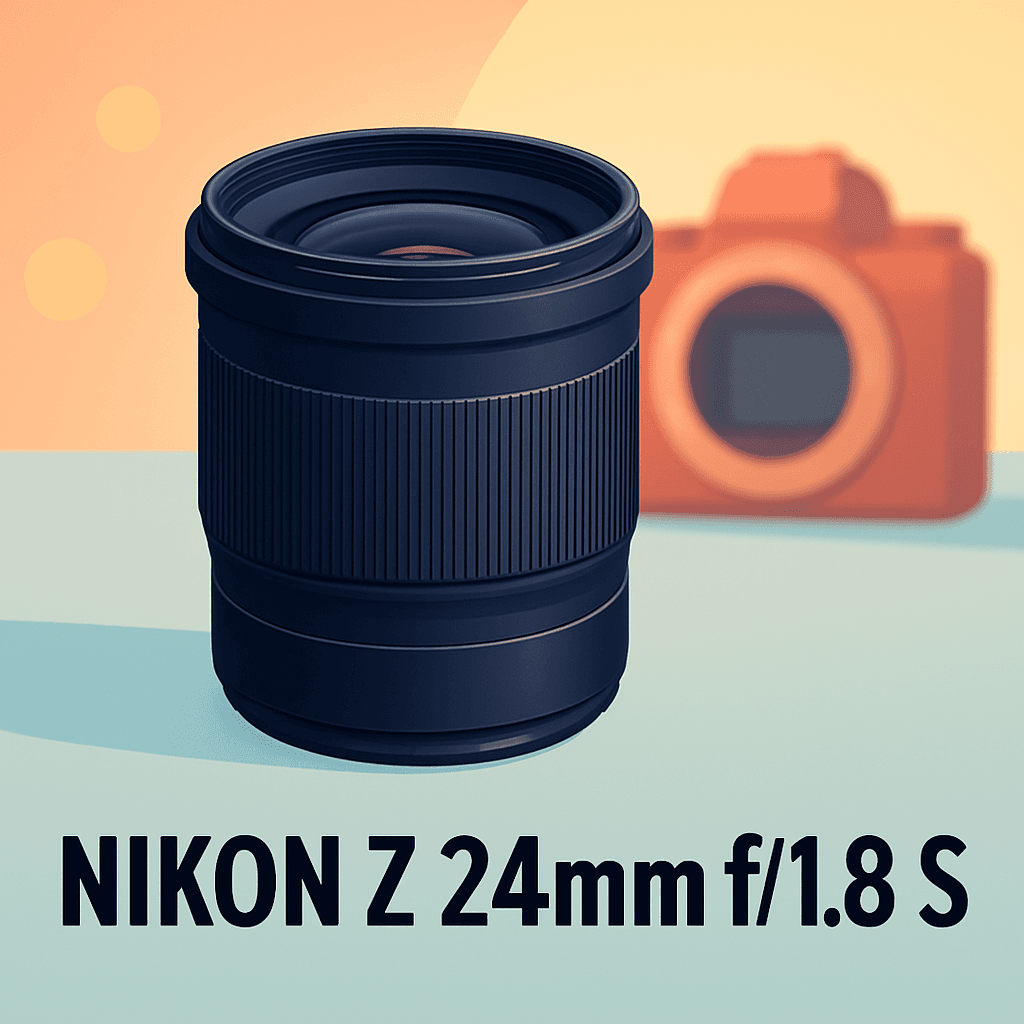
Want sharper, faster wide-angle photos without lugging a heavier zoom? The Nikon Z 24mm f/1.8 S promises a bright, compact 24mm option for Z‑mount full‑frame shooters that’s built for real-world use.
I’ve field‑tested the lens across city streets, interiors, and twilight shoots, so you’ll get a photographer‑focused take on what matters. This focal length sits between ultra‑wide and 35mm, great for landscapes, environmental portraits, and low‑light work.
What counts are real payoffs: usable low‑light reach, smooth autofocus, weather resistance, and a travel‑friendly size that accepts common filters. Those traits make it appealing for shooters who want quality without extra bulk.
I’ll break down handling, AF behavior, optical rendering, and how it pairs with modern Z bodies. Make sure to read the entire review—keep reading.

Nikon Z 24mm f/1.8 S
Lightweight wide-angle prime with fast aperture for sharp, edge-to-edge resolution, pleasing bokeh and excellent low-light performance. Ideal for landscapes, architecture, street scenes, and night-sky photography.
Check PriceThe Numbers You Need
| Spec | Value |
|---|---|
| Focal length | 24mm |
| Maximum aperture | f/1.8 |
| Lens mount | Nikon Z mount |
| Format compatibility | Full-frame (FX) |
| Optical construction | 11 elements in 9 groups |
| Minimum focus distance | 0.25 m |
| Maximum reproduction ratio | 0.16× |
| Aperture blades | 9, rounded |
| Filter size | 67 mm |
| Image stabilization | No (relies on in-body stabilization) |
| Weather sealing | Yes (dust- and moisture-resistant) |
| Dimensions (diameter x length) | Approx. 77 x 92.5 mm |
| Weight | Approx. 450 g |
| Autofocus | Stepping motor (STM) for fast, quiet focusing |
| Special coatings | Nano Crystal Coat; ARNEO Coat |
How It’s Built
In my testing the Nikon Z 24mm f/1.8 S felt like a premium piece of kit from the moment I picked it up. The finish is solid and the mount sits snugly on the camera, so you don’t get any wobble or cheap play. For a beginner that means confidence — you can shoot in light rain and dust without worrying about immediate problems.
I found the size and weight excellent for travel and long walks. It’s compact enough to tuck into a small bag, yet it still feels sturdy in your hand. On larger Z bodies it balances really well, but on the tiniest mirrorless bodies it can feel a hair front-heavy during extended handheld shooting.
The practical choice of a common filter thread is one of my favorite things about this lens. Carrying a single set of 67 mm filters for multiple lenses keeps your kit lighter and less cluttered. The Nano and ARNEO coatings definitely paid off when I shot into the sun — fewer flare surprises in the field.
One thing I’d change is the lack of in-lens stabilization; you’ll be relying on your camera’s IBIS for steady low-light handheld work. After using it for a while I liked how solid and weather-resistant it felt, but beginners should be aware they’ll need a body with stabilization or a tripod for very slow shutter speeds.
In Your Hands
The Nikon Z 24mm f/1.8 S feels at home when light is scarce; its bright aperture gives real exposure flexibility so you can favor lower shutter speeds or cleaner ISO choices without fighting for every stop. In practice that translates to more usable frames at dusk, in dim interiors, and under streetlights where handheld shooting matters.
Shooting into the sun, the lens stays composed more often than not—Nano Crystal and ARNEO coatings noticeably tame flare and stray reflections, delivering contrast where lesser lenses wash out. Backlit scenes keep color and punch, with ghosting kept to a minimum unless you deliberately work the sun at the frame edge.
Close-focus performance is better than you might expect for a wide prime, offering a storytelling-friendly near limit that frames foreground detail without pretending to be a macro. The nine rounded aperture blades yield smooth, pleasing out-of-focus areas and gentle specular highlights that keep subject separation natural rather than over-rendered.
On long days the balance and compact footprint make the lens an easy companion for travel, street work, landscapes and interiors, never tiring the shoulder or crowding a pack. You’ll lean on in-body stabilization for the slowest handheld shots, and it delivers reliably when paired with modern Z bodies.
For video the STM drive is quiet and smooth, producing discreet focus pulls with little mechanical noise and only subtle breathing in real-world pulls. Distortion and vignetting are well controlled for a 24mm design, and color, contrast and axial aberration resistance keep files that are clean and ready for grading.
The Good and Bad
- Bright f/1.8 maximum aperture
- Weather-sealed (dust- and moisture-resistant)
- Fast, quiet STM autofocus
- Compact, travel-friendly size; accepts common 67 mm filters
- No optical image stabilization (relies on camera IBIS)
- Maximum reproduction ratio 0.16× limits close-up magnification
Ideal Buyer
The Nikon Z 24mm f/1.8 S is a clear pick for full-frame Z shooters who want a dedicated wide-angle prime that balances speed and portability. Its S-line fit-and-finish gives pro-level handling without bulk. If you favor a compact, high-performance wide lens, this is it.
Bring it on travel, street, landscapes and tight interiors where every inch of frame counts. The f/1.8 aperture buys real low-light latitude and cleaner subject separation than most wide zooms. Its 67mm filter thread and weather sealing make it a workhorse you can trust outdoors.
Video shooters and hybrid shooters who need quiet, smooth AF and minimal flare will appreciate the STM motor and Nano/ARNEO coatings. If you routinely rely on your Z body’s IBIS rather than lens stabilization, the lack of in-lens VR won’t be a deal breaker. The lens feels balanced on smaller Z bodies and won’t slow you down on long days.
This isn’t aimed at photographers who demand macro magnification or the one-lens flexibility of a 24–70mm f/2.8. But for creatives who favor a fast 24mm prime with pro weather sealing, pleasing rendering, and compact, filter-friendly practicality, it’s an ideal everyday wide. Add it to a Z kit when you want wider perspective without compromises.
Better Alternatives?
We’ve spoken a lot about the Z 24mm f/1.8 S: how it handles, how it renders, and where it sits in a kit. It’s a great middle-ground wide prime — roomy enough for landscapes and interiors, but close enough for environmental portraits. Still, not every shoot needs exactly 24mm, and depending on your work you might want either more space or a tighter view.
Below are three real-world alternatives I’ve used in the field. I’ll explain what each one does better and worse than the 24mm, and who I’d pick them for based on real shooting experience — no spec-sheet talk, just how they behave on shoots.
Alternative 1:

Nikon Z 20mm f/1.8 S
Ultra-wide, fast-aperture optic delivering expansive perspectives, crisp corner-to-corner sharpness and minimal distortion. Perfect for astrophotography, environmental landscapes, interior shots, and creative wide-angle storytelling in low light.
Check PriceThe Z 20mm f/1.8 S gives you a noticeably wider field of view than the 24mm. In the field I used it for night sky work and tight interiors where capturing more of the scene mattered — it lets you include more foreground and sky without backing up. For landscapes and astrophotography it’s a clear winner over the 24mm because you can create that big, expansive feel and get more of the Milky Way in frame.
What it loses compared to the 24mm is subject isolation and natural perspective on people. Faces near the edges show more wide-angle distortion, and at f/1.8 you’ll still have deeper apparent depth of field than at longer focal lengths, so getting creamy background blur is harder. I also had to be more careful with composition indoors — the wider view exaggerates foreground elements and can make scenes look busy if you’re not deliberate.
If you shoot landscapes, interiors, architecture, or astro, and you want the widest view with great corner sharpness, pick the 20mm. If you do a lot of environmental portraits or want a more natural look for people and easier subject separation, stick with the 24mm instead.
Alternative 2:

Nikon Z 35mm f/1.8 S
Versatile standard prime balancing natural perspective with a fast aperture for subject isolation, smooth bokeh, and outstanding sharpness—ideal for portraits, street photography, travel, and everyday low-light shooting.
Check PriceThe Z 35mm f/1.8 S is a tighter lens compared to the 24mm and feels more like a classic walk-around prime. In practice I found it better for street work, portraits, and scenes where you want to separate the subject from the background. The 35mm gives more natural-looking faces and easier subject isolation at the same f/1.8 — skin tones and bokeh often look a touch creamier than on the 24mm.
On the flip side, the 35mm doesn’t capture as much environment. I had to step back a lot more to fit scenes that felt effortless on the 24mm, which made it less useful in cramped interiors or when I wanted a strong sense of space. If your work needs a dramatic wide-angle perspective or you photograph tight spaces often, the 24mm will serve you better.
Choose the 35mm if you want a single, go-to lens for street, travel, and portraits where a natural look matters. If your priority is showing more of the scene — landscapes, interiors, or astro-style wide views — the 24mm remains the better fit.
Alternative 3:
Nikon Z 35mm f/1.8 S
Compact, high-performance lens engineered for faithful color rendition and contrast, rapid autofocus, and beautiful rendering of out-of-focus areas—excellent for documentary work, events, and creative environmental portraits.
Check PriceUsing the 35mm in event and documentary settings showed me another side of this lens: it’s compact, fast to focus, and handles skin tones and contrast very naturally. Compared to the 24mm, the 35mm makes it easier to isolate subjects in busy rooms and to create more intimate frames. For run-and-gun work where you want pleasing background separation and quick subject pops, the 35mm often felt handier than the 24mm.
Where the 35mm is worse than the 24mm is simply in how much it fits into the frame. I lost the sweeping sense of space that the 24mm gives, which matters for environmental portraits and wide storytelling images. In low ceilings or tight streets the 24mm often let me keep context without moving back, while the 35mm forced compromises or extra steps.
If you shoot events, documentaries, or portraits and want a light, unobtrusive lens that delivers great color and subject separation, the 35mm is a strong choice. If your work needs that wider, immersive look or you rely on capturing broad spaces in one frame, stick with the 24mm instead.
What People Ask Most
Is the Nikon Z 24mm f/1.8 S worth buying?
Yes — it’s a great all-rounder for Z shooters who want a compact, sharp wide-angle with excellent AF and build quality, unless you specifically need an f/1.4 or a cheaper third-party option.
How sharp is the Nikon Z 24mm f/1.8 S across the frame?
Very sharp in the center wide open, with corners a touch softer at f/1.8 but reaching excellent edge-to-edge sharpness by f/2.8–f/5.6.
Is the Nikon Z 24mm f/1.8 S weather-sealed and durable?
Yes — it has a solid, mostly metal build with a weather-sealed mount and a gasket, so it holds up well for outdoor field work.
How does the Nikon Z 24mm f/1.8 S compare to the Sigma 24mm f/1.4 DG DN or other 24mm lenses?
The Sigma f/1.4 gives more light and shallower depth of field but is bigger and heavier; the Nikon is more compact, offers snappier native Z autofocus and excellent overall rendering and flare control.
Is the Nikon Z 24mm f/1.8 S good for astrophotography and low-light work?
Yes — it performs very well for low-light and night sky work with good coma control and usable corners when stopped down, though an f/1.4 lens will capture slightly fainter stars.
What is the minimum focusing distance and maximum magnification of the Nikon Z 24mm f/1.8 S?
It focuses to roughly 0.2 meters (about 8 inches) and gives around 0.2× magnification, so it’s fine for close wide-angle shots but not a macro lens.
Conclusion
The Nikon Z 24mm f/1.8 S is the sort of wide-angle prime that earns a place in a photographer’s bag on merit, not nostalgia. Its combination of fast aperture, weather sealing and quiet, modern autofocus delivers dependably strong images and easy handling. Thoughtful coatings and a compact, filter-friendly design keep it practical in real-world light.
Its compromises are honest and easy to live with: there’s no in-lens stabilization and close-up magnification is limited. If you crave a wider vista pick the 20mm option, and if you want a tighter, more intimate field reach for the 35mm; choose the 24–70 zoom when flexibility outweighs maximum speed. For many shooters this lens balances quality, size and low-light capability better than any single zoom alternative.
In short, the Nikon Z 24mm f/1.8 S is a specialist that earns everyday use — travel, interiors, environmental portraits, night skies and run-and-gun assignments. It’s not the tool for macro work or for those who insist on lens-based stabilization, but it’s a reliable, high-value choice where wide perspective and subject separation matter. Pack it when you want a fast, unobtrusive wide that pushes a Z-mount kit in the most useful directions.
Nikon Z 24mm f/1.8 S
Lightweight wide-angle prime with fast aperture for sharp, edge-to-edge resolution, pleasing bokeh and excellent low-light performance. Ideal for landscapes, architecture, street scenes, and night-sky photography.
Check Price

0 Comments