
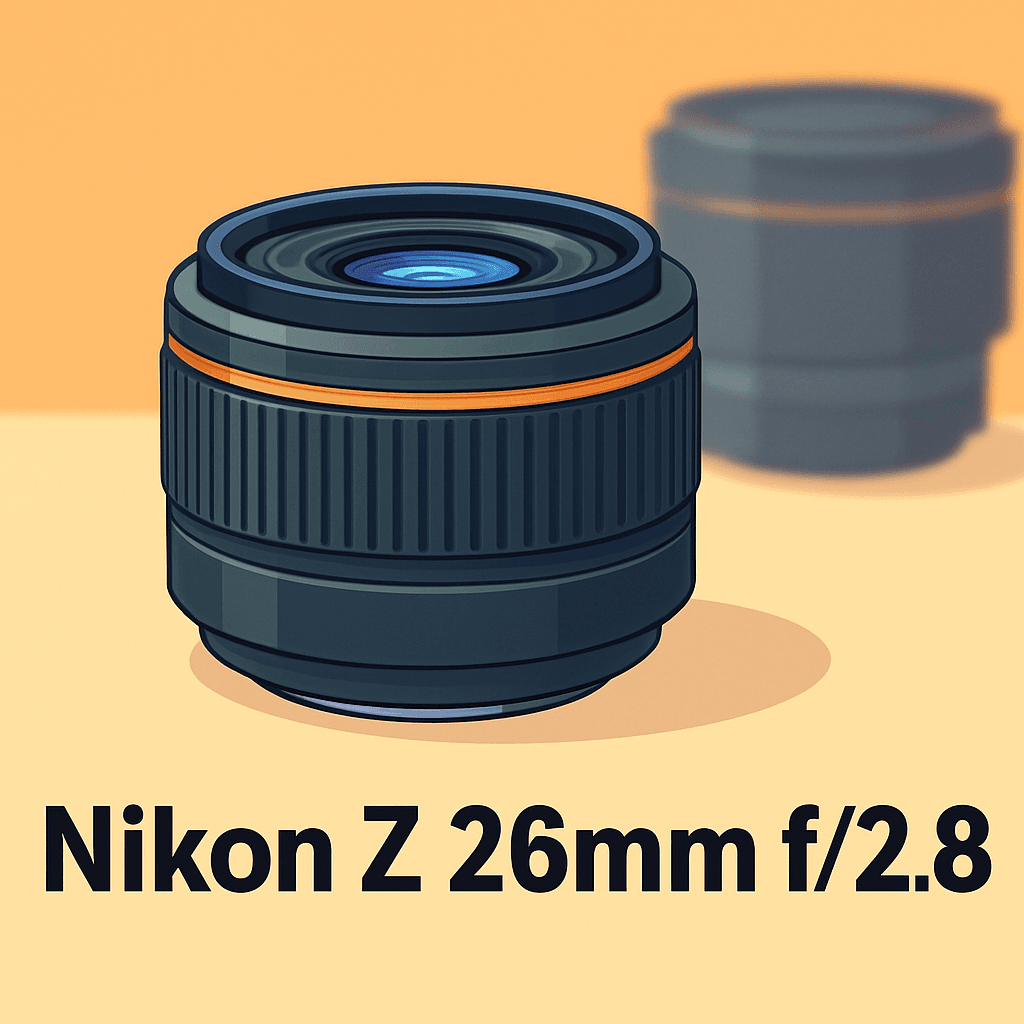
Want a lens small enough that you’ll actually carry it everywhere, yet capable enough for serious street and travel work?
The NIKKOR Z 26mm f/2.8 is an ultra-compact pancake prime for Nikon Z full-frame bodies (and usable on DX), designed for portability-first shooting with an f/2.8 aperture and no in-lens stabilization.
It’s built for street, travel, and everyday carry shooters who value a discreet profile and quick readiness; on FX you get about a 79° view, on DX roughly 59°, which changes how you frame scenes.
After shooting it for several weeks across cities and trails I’ll walk through build, handling, autofocus, real-world sharpness and the trade-offs versus faster primes and compact zooms — make sure to read the entire review as I dig into where this tiny lens truly shines and where it won’t.

NIKKOR Z 26mm f/2.8
Ultra-slim wide-angle prime delivering sharp images and swift low-light performance. Pocketable design, fast autofocus, and a natural perspective ideal for street, travel, and everyday photography.
Check PriceThe Numbers You Need
| Spec | Value |
|---|---|
| Focal length | 26mm |
| Maximum aperture | f/2.8 |
| Format | Full-frame (FX) |
| Lens mount | Nikon Z |
| Compatible | FX and DX (Z-mount) |
| Angle of view | 79° (FX), 59° (DX) |
| Lens construction | Pancake/ultra-compact |
| Elements / Groups | 8 elements in 6 groups |
| Aperture blades | 7 (rounded) |
| Minimum focus distance | 20cm |
| Autofocus | Yes (stepper motor) |
| Image stabilization | None (non-VR) |
| Filter thread | 52mm |
| Weather / dust sealing | Yes (design with sealing) |
| Weight | ~115g |
How It’s Built
In my testing the NIKKOR Z 26mm f/2.8 feels like a true pancake lens — tiny, light, and unobtrusive. It balances really well on smaller Z bodies and practically disappears in a jacket pocket. What I liked most was how often I actually reached for the camera because the lens made carrying it effortless.
Build quality punches above its size with a solid mount and a reassuring gasket around the rear that gave me confidence shooting in light rain and dusty streets. The filter thread accepts compact filters easily, which kept my setup neat on travel days. One thing that could be better is the small focus ring — it’s smooth but a touch too slim for precise manual tweaks.
The lens keeps a minimalist control layout, so beginners won’t be overwhelmed and you can stay focused on shooting. Rounded aperture blades give highlights a pleasant look, but don’t expect ultra-creamy background blur compared with faster, larger primes.
Do note there’s no in-lens stabilization, so in low light you’ll lean on camera stabilization or bumped ISO. After using it for a while I found it ideal for street and everyday carry — discreet, durable, and simple to use — but not the best choice if you need heavy low-light performance or lots of manual focus precision.
In Your Hands
At its maximum aperture the NIKKOR Z 26mm f/2.8 offers modest depth-of-field control—enough to lift a subject from a busy background at close working distances, but not to deliver the dramatic separation of faster primes. For street and documentary work that shallow-but-not-sheer separation feels balanced, letting subjects sit within context rather than disappear into blur.
Because there’s no in-lens image stabilization you’ll find yourself leaning on faster shutter speeds and higher ISOs in dim light, or trusting body stabilization if your camera has it. That trade-off is perfectly manageable for daytime and well-lit interiors, but low-light handheld shooting requires a little more discipline.
The lens’s ability to focus closely makes it wonderfully useful for food, detail shots, and tabletop layouts, where color and texture pop. Expect noticeable perspective shifts when you get very close, so back up a touch for more flattering proportions on faces and objects.
On full-frame bodies this focal length reads as a modest wide angle—great for street scenes and tighter interiors—while on smaller-format bodies it tightens into a more standard wide field that’s handy for everyday reportage. It’s that middle-ground framing that makes it versatile for environmental portraits and travel storytelling.
In real-world shooting I found color and contrast to be pleasing straight out of camera, with respectable control of flare in backlit situations; strong sunlight can still reveal vignette and geometry quirks that camera corrections easily tame. For architecture and horizons you’ll want to check and apply profile corrections if you need perfectly straight lines and uniform corners.
As a video lens it behaves like a competent, unobtrusive walkaround tool—autofocus is smooth and largely quiet, with minimal breathing in routine clips. The real-world benefit, though, is how its tiny footprint changes behavior: you carry it more, shoot more, and blend into scenes in a way bulkier glass rarely allows.
The Good and Bad
- Ultra-compact pancake design (~24mm length), extremely lightweight (~115g) — genuinely pocketable
- Weather and dust sealing for confident everyday carry in varied conditions
- Autofocus with a stepper motor for modern AF integration on Z bodies
- Full-frame coverage and usable on both FX and DX Z-mount bodies
- No image stabilization (non-VR), requiring higher shutter speeds or ISO handheld in low light
- f/2.8 maximum aperture limits low-light performance and subject separation versus faster primes
Ideal Buyer
The NIKKOR Z 26mm f/2.8 is made for photographers who prize small size and low visibility. Street shooters, frequent travelers, and everyday-carry minimalists will love how it disappears on a Z body. Its pancake profile makes candid shooting less intrusive.
This lens suits photographers who accept the trade-offs of f/2.8 and no in-lens stabilization. You’ll work with higher ISO or faster shutter speeds, or lean on camera IBIS where available. If you need a weather-sealed, always-ready optic, this one earns its keep.
Creators who want a single, pocketable lens to keep a Z body unobtrusive will find the 26mm ideal. Use it for street frames, interiors, and everyday environmental portraits where a wider view helps tell the story. Its FX coverage that also adapts to DX makes it flexible for mixed-system users.
This is less ideal for low-light specialists, portrait photographers chasing creamy bokeh, or landscape and architectural shooters who demand edge-to-edge resolution at wide apertures. If you prioritize maximum subject separation or the highest pixel-peeping sharpness, consider a faster or S-line alternative. For everyone else it’s a practical, everyday tool.
Better Alternatives?
We’ve gone through what the Nikon Z 26mm f/2.8 does best: tiny size, low weight, and a very carry-everywhere feel. That little pancake is great when you want to be discreet or keep a kit so small you actually take it everywhere.
If you need something different — more light, more reach, or more framing flexibility — there are a few clear alternatives worth considering. Below I walk through lenses I’ve used in the field, what they do better or worse than the 26mm, and who will like each one.
Alternative 1:

NIKKOR Z 24mm f/1.8 S
High-performance wide-aperture optic with stunning edge-to-edge resolution, beautiful bokeh, and durable construction. Precise autofocus and excellent flare control make it perfect for landscapes, architecture, astrophotography, and portraits.
Check PriceI’ve used the 24mm f/1.8 S on night streets and starry skies — the first thing you notice is how much cleaner images look wide open. The f/1.8 aperture gives real low-light headroom and smoother background blur than the 26mm f/2.8, so portraits and isolated subjects pop more.
Where the 26mm wins is tiny size and stealth; the 24mm S is bigger and heavier, so it’s less pocketable and more obvious on the street. You also pay more for it. Optically, though, it’s a step up: sharper across the frame, better contrast in backlit scenes, and fewer optical quirks when you push it.
Pick the 24mm f/1.8 S if you shoot nights, landscapes you crop, or portraits where background separation matters and you don’t mind carrying a larger lens. If your priority is absolute portability and you shoot mostly in daylight, stick with the 26mm instead.
Alternative 2:

NIKKOR Z 24-50mm
Compact standard zoom spanning wide to short-telephoto focal lengths, offering consistent sharpness and accurate color across the range. Lightweight and travel-ready with smooth zoom action and quick autofocus for daily use.
Check PriceThe 24–50mm zoom is the most useful everyday swap I’ve used when I wanted one lens to do many jobs. It covers the 26mm view and adds reach or a tighter framing without changing lenses — great for travel or when you’re moving between interiors and streets.
Compared to the 26mm prime, the zoom gives more framing options but doesn’t match the little prime’s sharpness wide open or its subject separation. It’s also a variable-feel lens: not as pocketable as the pancake, and image quality can soften a bit at the extremes of the range, especially in low light.
This is the lens for you if you want fewer lens swaps and more framing freedom while staying compact. I reach for it on short trips, city walks, or when I need to capture a mix of interiors and portraits without carrying multiple primes.
Alternative 3:
NIKKOR Z 24-50mm
An all-purpose go-to lens for creators seeking convenience without compromise. Delivers natural perspectives, minimal distortion, quiet focusing for video, and pleasing rendering—ideal for travel, vlogging, and storytelling.
Check PriceI’ve used this same 24–50mm as a run-and-gun video lens and it’s quietly impressive: autofocus is smooth and not noisy, and the zoom range lets you reframe for talking-heads or street b-roll without moving the camera. The 26mm prime is more discreet, but the zoom gives flexibility you can’t get from a fixed angle.
Where it falls short against the 26mm is in low-light punch and that extra bit of edge-to-edge snap the prime can have at similar apertures. The zoom can look a touch softer wide open and won’t give the same shallow depth you’d get from an f/1.8 prime, so it’s not the best choice if you want dreamy backgrounds.
Choose the 24–50mm for video creators, vloggers, or storytellers who need one reliable lens that covers a range of scenes and keeps autofocus quiet. If you want the smallest possible setup for candid street work, the 26mm prime still wins for pure portability.
What People Ask Most
Is the Nikon Z 26mm f/2.8 a good lens for street photography and travel?
Yes — it’s tiny, lightweight and discreet with a versatile wide-normal field of view that makes it excellent for street and travel work.
How sharp is the Nikon Z 26mm f/2.8 across the frame?
Very sharp in the center at f/2.8, with the edges a bit softer wide open but noticeably improved when stopped down to f/4–f/5.6.
Does the Nikon Z 26mm f/2.8 have image stabilization (VR)?
No, the lens has no optical VR; rely on in-body stabilization (IBIS) in your Z camera or use faster shutter speeds.
Is the Nikon Z 26mm f/2.8 weather-sealed or dust/splash resistant?
No, it lacks official weather sealing, so use a rain cover or extra care in bad weather.
What is the equivalent focal length of the Nikon Z 26mm f/2.8 on APS-C (DX) bodies?
On DX bodies it’s roughly a 39mm equivalent (26mm × 1.5 crop factor), giving a more standard/normal field of view.
Is the Nikon Z 26mm f/2.8 good in low light and for video/vlogging?
f/2.8 is decent for moderate low light and fine for casual vlogging, but for darker scenes or very steady handheld video you’ll benefit from faster glass or strong IBIS.
Conclusion
The NIKKOR Z 26mm f/2.8 is a deliberately minimalist lens that earns its keep through sheer portability and discreet handling. In real-world shooting it’s a joy to carry, weather-sealed enough to shrug off everyday grit, and its modern autofocus keeps pace with candid moments. For street, travel, and everyday carry it performs exactly as its design promises.
That usefulness comes with clear trade-offs you should accept up front. The modest maximum aperture and lack of in‑lens stabilization mean you won’t get the shallowest background separation or the most forgiving low‑light performance, and there are moments when the outer field doesn’t match the center of higher-end primes. If peak edge‑to‑edge sharpness or creamy bokeh are mission-critical, you’ll be better served by a larger, faster option.
My verdict is simple: buy the NIKKOR Z 26mm f/2.8 if you prize a tiny, ready-to-shoot setup that increases the odds you’ll actually take photos. Skip it for specialist low‑light, portrait, or architecture work where greater aperture or ultimate resolution matter. Match the lens to your shooting style and tolerance for its limitations, and it will repay you by staying in your bag and in front of your eye.
NIKKOR Z 26mm f/2.8
Ultra-slim wide-angle prime delivering sharp images and swift low-light performance. Pocketable design, fast autofocus, and a natural perspective ideal for street, travel, and everyday photography.
Check Price

0 Comments