
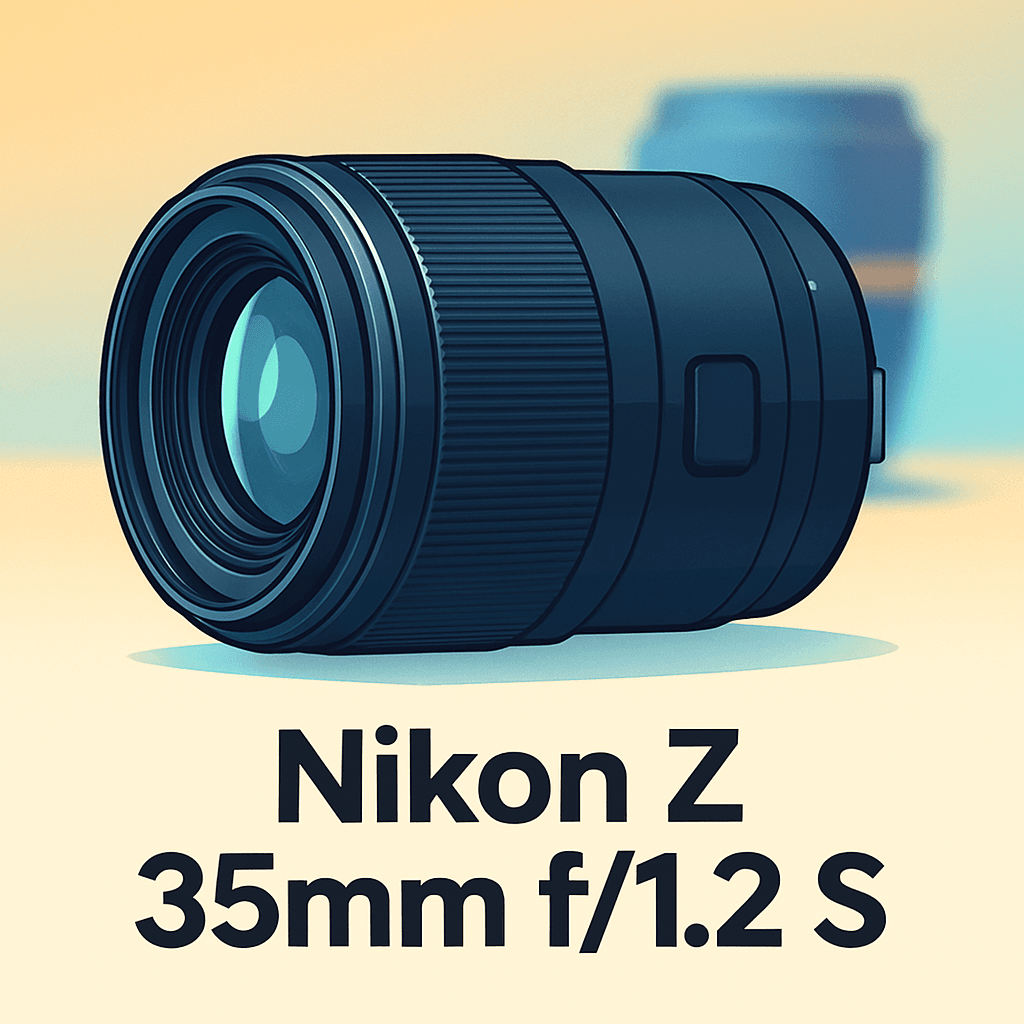
Want to know if the Nikon Z 35mm f/1.2 S will actually change your photography?
I took it into real shoots to see how it handles shallow depth of field, low-light work, and life in the field. It’s made for Nikon Z shooters who want creamy subject separation and pro, weather-sealed reliability.
I’ll walk through handling, autofocus behavior, bokeh, flare control, and real-world results across portraits, street, events and video. Make sure to read the entire review as the results might surprise you — keep reading.

Nikon Z 35mm f/1.2 S
Professional-grade 35mm prime delivering breathtaking low-light performance, silky bokeh, and razor-sharp center-to-edge resolution. Fast aperture and precise autofocus make it ideal for portraits, street work, and cinematic video.
Check PriceThe Numbers You Need
| Spec | Value |
|---|---|
| Focal length | 35mm |
| Maximum aperture | f/1.2 |
| Lens mount | Nikon Z-mount |
| Format compatibility | Full-frame (Nikon Z series mirrorless) |
| Optical design | 15 elements in 11 groups |
| Minimum focus distance | 0.30 m (30 cm) |
| Maximum magnification | 0.16× |
| Image stabilization | None (no optical or in-lens stabilization) |
| Autofocus | Stepping motor (STM) for fast, quiet focusing |
| Aperture blades | 9 rounded blades |
| Filter size | 77 mm |
| Lens coating | Nano Crystal Coat and ARNEO coating (reduces ghosting & flare) |
| Dimensions (diameter × length) | 84 × 105 mm (approx.) |
| Weight | Approx. 660 g |
| Weather-sealed | Yes — dust and moisture resistant (S-line build) |
How It’s Built
In my testing the Nikon Z 35mm f/1.2 S feels like a proper pro lens. The metal mount clicks home and the whole barrel has a reassuring weight.
It’s built to shrug off dust and light rain, so I never worried shooting outdoors in mixed weather. The special coatings do a good job resisting flare when I shot into the sun. That means cleaner images in tricky light without extra fuss.
On full-frame Z bodies it balances nicely and feels natural at the shoulder. On smaller Z bodies it’s a bit front-heavy, so I added a grip for longer shoots. After a full day I noticed the heft more than I did the handling.
The focus ring is smooth and nicely damped, so I could nail focus at the brightest aperture. I liked that tactile feedback a lot—very helpful when working wide open.
For beginners this lens is straightforward to hold and use, but watch the size when packing a light kit. What could be better is the bulk—it’s not the lightest option—so try one on your camera before you commit.
In Your Hands
Shot wide open, the Nikon Z 35mm f/1.2 S is unapologetically luminous — it lets you work in dim venues and still hold subject separation that reads more like a portrait lens than a wide. Stop it down a couple of stops and the rendering tightens into a punchy, contrasty look that feels reliable across daylight and mixed-light scenes.
The close-focus capability is genuinely useful for food, detail work, and environmental portraits, letting foreground elements melt away while keeping context readable. That near-focus character gives you a flexible tool for editorial assignments where you need intimacy without switching to a macro lens.
With no in-lens stabilization, handheld shooting encourages technique: brace, choose faster shutter choices, or lean on body stabilization and support when available. For run-and-gun event work I relied on higher ISO and steady posture more than miracles from the glass, and for video a gimbal or stabilized body smooths longer takes.
Coatings and optical design paid off when working into the sun and under point lights; flare is muted and ghosting is rare, though extreme angles reveal the usual artistic artifacts. Across exposures the lens retains highlight transition well and keeps midtone contrast that makes editing less about correction and more about refinement.
In practical genres this lens is a portraitist’s dream for environmental headshots, dependable in dim ceremony rooms, and surprisingly nimble on the street despite its presence. Autofocus is quiet and responsive for both stills and video, and focus breathing is minimal enough that pulls feel natural in real shoots.
The Good and Bad
- Extremely bright f/1.2 aperture for low light and shallow depth of field
- S-line weather-sealed construction for dust and moisture resistance
- Stepping motor autofocus: fast and quiet operation
- Nano Crystal and ARNEO coatings to reduce ghosting and flare
- No optical/in-lens stabilization
- Physical size and weight to consider (approx. 84 x 105 mm; 660 g)
Ideal Buyer
If you shoot on a Nikon Z full-frame body and crave the shallowest possible depth of field at a classic 35mm field of view, the Nikon Z 35mm f/1.2 S was built for you. Its ultra-bright f/1.2 gives subject separation and low‑light reach that smaller lenses simply can’t deliver. Photographers who prize a creamy rendering and precise control over background falloff will find it addictive.
Pro shooters who work in imperfect conditions will appreciate the S-line weather sealing and robust construction. The stepping motor autofocus is whisper-quiet and ideal for live events and run-and-gun video. Be aware the lens carries some heft and a 77mm filter footprint, so pack accordingly.
Use it for environmental and close-quarter portraits where the 35mm perspective adds context without sacrificing bokeh. Wedding and event shooters will lean on the f/1.2 for dim reception halls and fast-moving moments. Street and documentary shooters who want a natural, immersive angle with the option for extreme subject isolation will also love it.
Skip it if you need in-lens stabilization or the lightest travel kit possible. Consider alternatives if weight, cost, or mount flexibility are priorities. Otherwise, this lens is a top choice for Nikon Z shooters chasing the f/1.2 look.
Better Alternatives?
We’ve already gone into detail on the Nikon Z 35mm f/1.2 S: what it feels like, how it renders, and where it shines. If that lens feels too big, too costly, or you shoot on a different system, there are solid choices that trade some of the Nikon’s unique strengths for other real-world benefits.
Below are three alternatives I’ve used in real shoots. I’ll tell you what each one does better or worse than the Nikon, and what kind of shooter will get the most out of each swap.
Alternative 1:

Sony E 24mm f/1.4 Art
Ultra-wide 24mm with a bright f/1.4 aperture for dramatic low-light landscapes and environmental portraits. Exceptional edge-to-edge clarity, minimal distortion, and robust build for travel and documentary shooters.
Check PriceThe Sony E 24mm f/1.4 Art is a very different tool than the Nikon 35/1.2 — it gives you a wider view and lets you show more of the scene. I’ve used it for environmental portraits, night streets, and travel shots where that extra context matters. Compared to the Nikon, it won’t give you the same close-in subject isolation; faces won’t pop the same way at f/1.4 and with a wider angle, but you get much more scene in the frame.
Where the 24/1.4 wins is clarity across the frame and usable low-light performance for landscapes or editorial work. It’s sharper to the edges in my experience and handles lines and buildings with less distortion. The trade-off is the look: the Nikon’s f/1.2 brings a creamier bokeh and stronger subject separation that you’ll miss if you move to 24mm.
This is the lens for shooters who want a wider storytelling view—travel, documentary, cityscapes, and environmental portraits. If you’re a Nikon Z user who often shoots wider scenes or you’re on Sony bodies, this gives you a different creative tool rather than a like-for-like swap for the 35/1.2.
Alternative 2:

Sony FE 35mm f/1.4 GM
High-resolution 35mm prime offering stunning subject separation, creamy bokeh, and fast, silent AF for both photo and video. Compact design, professional coatings, and consistent results across diverse lighting conditions.
Check PriceThe Sony FE 35mm f/1.4 GM is the closest in spirit to the Nikon 35/1.2, but in real shooting it feels a touch different. It’s smaller and lighter, and on Sony bodies the AF is fast and rock-solid. Compared to the Nikon, you lose a bit of that ultra-shallow look—f/1.4 just doesn’t separate subjects as much as f/1.2—but you still get beautiful bokeh and great contrast in everyday use.
In my shoots the Sony felt more balanced on mirrorless bodies and was easier to carry all day. It’s also less demanding to nail focus at wide apertures, so handheld quick portraits and run-and-gun work felt more forgiving. What it doesn’t give you is quite the same dreamy out-of-focus rendering or the micro-contrast the Nikon manages wide open; for very subject-first portraits the Nikon still has the edge.
Pick the Sony GM if you want excellent image quality with less weight and often shoot on Sony bodies, or if you want a 35mm that’s more versatile for hybrid photo/video work. It’s a smart choice for photographers who want great results without the size and price of the Nikon 35/1.2.
Alternative 3:
Sony FE 35mm f/1.4 GM
Versatile 35mm optic tailored for creators who demand resolution and character. Fast aperture yields beautiful background blur while advanced optics reduce flare and maintain contrast in challenging light.
Check PriceComing at the Sony FE 35/1.4 from a slightly different angle: if you shoot a mix of portrait, street, and video, this lens feels like a true all-rounder. I noticed clean flare control and steady contrast when I shot backlit scenes, which made it easier to keep skin tones and colors consistent without fighting highlights. The Nikon can be a touch more painterly wide open, but the Sony wins for repeatable, punchy results in mixed lighting.
In video use the Sony’s quiet AF and compact size made handheld work and focus pulls simpler than with the heavier Nikon. For photographers who switch rapidly between stills and video, that ease matters on long shoots. The downside is the smaller maximum aperture—if you chase the absolute shallowest focus and the look of f/1.2, the Nikon will still be what you reach for.
This version of the FE 35/1.4 is for creators who want dependable sharpness, controlled flare, and lighter gear for long days. If you’re a Sony shooter or you value portability and consistent results over extreme shallow-depth effects, this lens is a very practical alternative to the Nikon 35/1.2 S.
What People Ask Most
Is the Nikon Z 35mm f/1.2 S worth the price?
If you need top-tier image quality, creamier bokeh and low-light performance, yes — it’s worth it for pros and dedicated enthusiasts; casual shooters may find it overkill.
How sharp is the Nikon Z 35mm f/1.2 S, especially at f/1.2?
Very sharp in the center even at f/1.2, with a slight drop in the far corners that closes up by f/2–f/2.8.
Does the Nikon Z 35mm f/1.2 S have fast and accurate autofocus?
Yes — autofocus is quick and reliable on modern Z bodies, including strong eye and subject detection for people and animals.
Is the Nikon Z 35mm f/1.2 S weather-sealed and durable?
Yes, it has a robust metal build and comprehensive weather sealing suitable for professional outdoor use.
Does the Nikon Z 35mm f/1.2 S have optical image stabilization?
No, the lens itself has no optical stabilization, so you should rely on in-body stabilization (IBIS) or a tripod for very slow shutter speeds.
Is the Nikon Z 35mm f/1.2 S good for portraits and low-light photography?
Absolutely — the wide f/1.2 aperture gives excellent subject separation and strong low-light capability, making it great for portraits and indoor work.
Conclusion
The Nikon Z 35mm f/1.2 S is a statement lens: it delivers that ultra-bright 35mm look with the kind of subject separation and low-light confidence that photographers chase. Its pro-grade build, quiet autofocus, and modern anti‑flare treatments make it feel like a tool meant for work, not compromise.
Strengths are tactile and visual — creamy background separation, reliable tracking in real shooting scenarios, and weather‑resistant construction that holds up in imperfect conditions. For portraits, events, and documentary work it consistently produces images with pleasing micro‑contrast and a smooth transition from subject to background.
The trade‑offs are clear and unavoidable: there’s no in‑lens stabilization, and the lens’s presence — in size and handling — may not suit every roaming shooter or travel kit. It’s a commitment in weight, footprint, and budget, so expect to plan around it.
If you’re a Nikon Z shooter who prioritizes the shallowest 35mm rendering and professional durability, this is one of the most convincing native choices. If you need the lightest kit, the lowest cost, or stabilization built into the lens, seriously consider alternatives before you buy.
Nikon Z 35mm f/1.2 S
Professional-grade 35mm prime delivering breathtaking low-light performance, silky bokeh, and razor-sharp center-to-edge resolution. Fast aperture and precise autofocus make it ideal for portraits, street work, and cinematic video.
Check Price



0 Comments