
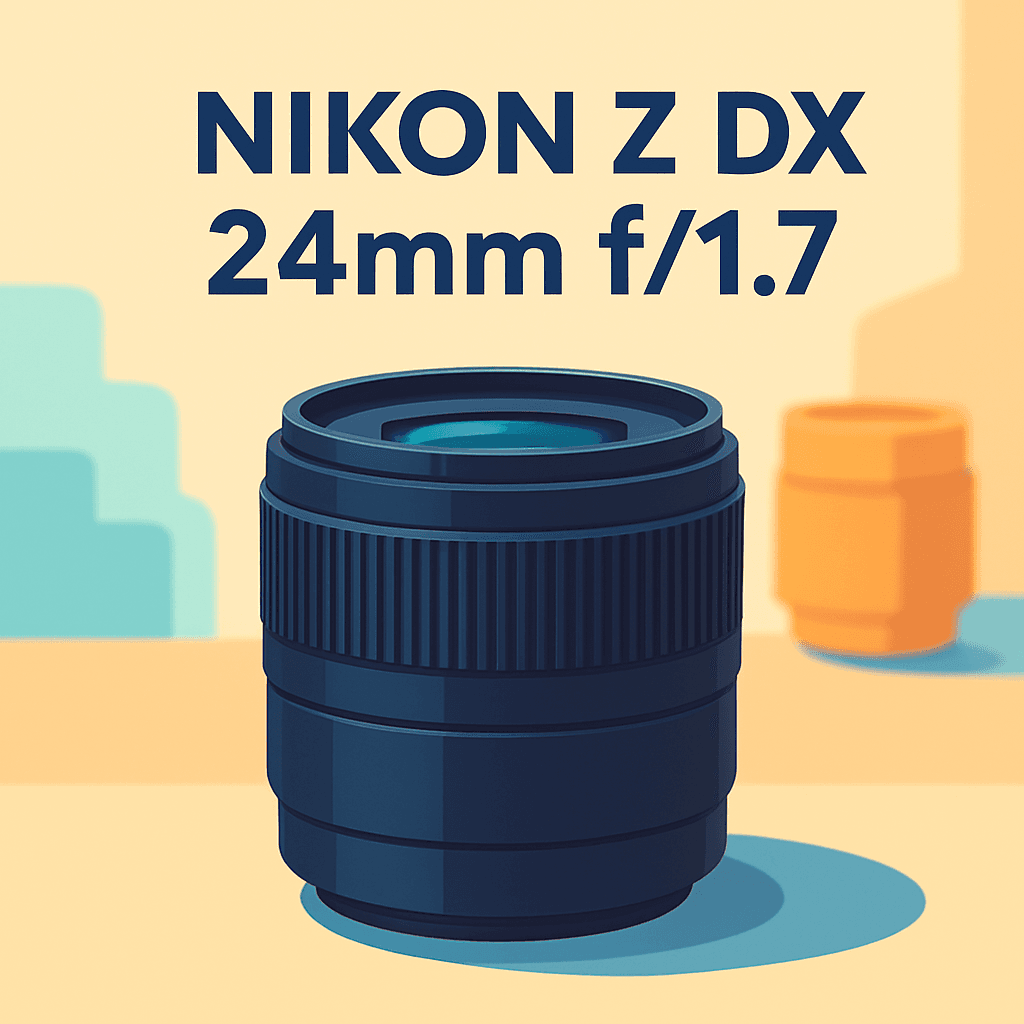
Want a small, fast prime that makes everyday shots look better?
The Nikon NIKKOR Z DX 24mm f/1.7 is a compact, bright normal‑wide I’ve field‑tested on street and travel shoots.
It’s aimed at DX shooters who want lightweight, low‑light capability for street, environmental portraits, interiors, and casual video. Expect subject separation, easy handheld shooting, and a carry‑everywhere footprint.
Don’t expect weather sealing or in‑lens stabilization—this prioritizes size and speed over ruggedness. You’ll get a control ring, quiet STM autofocus, and tiny 46mm filters for minimal bulk.
Curious how it handles, renders, and fits into a DX kit? Make sure to read the entire review — keep reading.

Nikon NIKKOR Z DX 24mm f/1.7
Compact, bright prime tailored for APS-C shooters: fast f/1.7 aperture delivers creamy bokeh, excellent low-light performance, and punchy wide-angle perspective—ideal for street, travel, and vlogging with lightweight handling.
Check PriceThe Numbers You Need
| Spec | Value |
|---|---|
| Focal length | 24mm |
| Aperture | f/1.7 |
| Lens mount | Nikon Z DX |
| Format | APS-C (DX) |
| Full-frame equivalent | 36mm |
| Optical design | 8 elements in 6 groups |
| Diaphragm blades | 7 |
| Minimum focus distance | 11.8cm (0.39ft) |
| Maximum magnification ratio | 0.19x |
| Filter thread | 46mm |
| Weight | 135g |
| Length | 40mm |
| Diameter | 70mm |
| Autofocus | Yes (stepping motor STM) |
| Weather sealing | No |
How It’s Built
I spent weeks with the Nikon NIKKOR Z DX 24mm f/1.7 on small Z bodies and it feels like a go‑everywhere lens. It’s compact and light, so it balances well and slips into a small bag without fuss. Using small filters and the short hood was easy on the road.
It has a smooth control ring you can map to aperture or exposure, and the stepping‑motor AF was quiet and confident in my testing. The seven‑blade diaphragm gives a pleasing blur that’s friendly for portraits and street work. One thing I really liked was how natural and simple the controls felt when I needed to react fast.
One thing that could be better is the lack of weather sealing and built‑in stabilization — I had to be careful in drizzle and bump up ISO more than I wanted for handheld low‑light shots. The short barrel can make the ring feel a bit crowded on the smallest bodies, so your hand position matters. For beginners, that means a very handy lens to carry, but plan for basic protection and steady hands when light gets tough.
In Your Hands
On APS‑C Z bodies the Nikon NIKKOR Z DX 24mm f/1.7 reads as a familiar normal‑wide — roughly a 36mm equivalent — a framing that feels neither too intimate nor too wide. It’s the kind of focal length that makes street walks, environmental portraits and interiors come together naturally, keeping your subject in context while giving scenes room to breathe.
The bright f/1.7 aperture matters in real use: handheld low‑light interiors and twilight streets remain shootable without aggressive ISO hikes, and you get pleasing subject separation for head‑and‑shoulders and small groups. That shallow depth yields a cinematic feel at wide apertures while preserving usable detail when stopped down.
Close‑focus capability lets you approach for product‑style details and near‑macro looks without swapping lenses, though it won’t replace a dedicated macro. Rendering is friendly — the seven‑blade diaphragm produces smooth blur — but expect mild cat’s‑eye shaping and corner falloff at the widest settings that improve when stopped down; backlit scenes were generally handled well, with only occasional veiling under very strong direct light.
Its compactness makes this lens a genuine grab‑and‑go companion, easier to carry and react with than most zooms, so you actually shoot more. The lack of in‑lens stabilization nudges you toward faster shutter speeds for motion or a tripod for dim still life, but within a small Z DX kit it keeps the system light, discreet and highly practical for everyday use.
The Good and Bad
- Bright f/1.7 aperture for low light and subject separation
- 36mm equivalent field of view: versatile normal‑wide perspective
- Very compact and lightweight (40mm length, 135g) for daily carry and travel
- Close focusing to 11.8cm with 0.19x magnification for detail shots
- No weather sealing
- No built‑in optical stabilization
Ideal Buyer
The Nikon NIKKOR Z DX 24mm f/1.7 will appeal to Nikon Z DX shooters who prize portability and speed. It’s perfect for photographers who want a carry‑everywhere prime that won’t weigh down a small kit. Street, travel and casual documentary shooters will appreciate how the little lens disappears on the camera.
Its 24mm DX framing (about a 36mm full‑frame equivalent) sits in a comfortable normal‑wide sweet spot for environmental portraits, interiors, and everyday street work. The bright f/1.7 aperture gives real low‑light latitude and subject separation compared with typical kit zooms. Close‑focusing ability also lets you grab detail shots without switching to a macro specialist.
Don’t reach for this lens if you need weather sealing, built‑in optical stabilization, or the absolute corner‑to‑corner resolution of Nikon’s S‑line primes. Professionals who demand the toughest build and the cleanest edges for large prints will find better options in the 20mm/35mm S series. If you prefer the framing flexibility of a zoom or need significantly wider or tighter coverage in one glass, a compact zoom or S‑line prime will serve you better.
Better Alternatives?
We’ve gone through the Nikon Z DX 24mm f/1.7 and what it brings to a small, carry‑everywhere DX kit: fast aperture, tiny size, and a useful “normal‑wide” field of view that works for street, travel, and everyday video. It’s a nice balance of reach, low‑light ability, and closeness for detail shots, but it isn’t the only way to get that look on a Z system.
If you want a different feel — sharper edges, a wider sweep, or a more solid pro build — there are a few lenses that cover those needs better. Below I’ve listed the options I’ve used in the real world, how they compare to the 24mm f/1.7, and what kind of shooter would prefer each one.
Alternative 1:

Nikon NIKKOR Z 35mm f/1.8 S
Premium wide-normal lens offering stunning edge-to-edge sharpness and smooth bokeh; fast aperture enables low-light shooting and subject separation while advanced optics and AF make it excellent for portraits, events, and video.
Check PriceThe 35mm f/1.8 S is a step up if image quality and build matter more than weight. I’ve used it for portraits and event work where I needed clean edges and very reliable autofocus — the images just look crisper and have more pop than what the little DX 24mm delivers. The bokeh is smoother too, so subjects stand out nicely in photos and video.
Compared to the DX 24mm f/1.7 it does a few things better: edge-to-edge sharpness, tougher build and weather resistance, and a more refined rendering. What it doesn’t do as well is match the tiny size and near‑macro close focus fun of the DX 24mm — it’s noticeably larger and heavier, and on a DX body it frames tighter, so you lose some of that environmental‑wide look.
Pick the 35mm S if you’re after higher image quality for portraits, prints, or professional work and you don’t mind carrying a bigger lens. If you need the absolute smallest, lightest walkaround setup or prefer a slightly wider field for interiors and street scenes, the DX 24mm is still the better carry option.
Alternative 2:

Nikon NIKKOR Z 20mm f/1.8 S
Ultra-wide, fast optic engineered for expansive landscapes and astrophotography: f/1.8 brightness, precise corner-to-corner resolution, minimal coma, and robust build produce dramatic, immersive images in challenging light.
Check PriceThe 20mm f/1.8 S is the choice when you want to open a scene up. I’ve shot landscapes, interiors and night skies with it — it captures more of the scene and gives that dramatic wide feeling the 24mm on DX can’t match. In tight interiors or when you want to show context around a subject, the 20mm simply makes more of the room fit into the frame.
In practice the 20mm S outperforms the DX 24mm in edge sharpness and control of things like coma for stars and corners, so your wide shots look cleaner without heavy corrections. The trade‑offs are the obvious ones: it’s bigger, heavier, and less flattering for close portraits, and because it’s wider you get less background blur for a given subject size compared with the 24mm.
Choose the 20mm S if you shoot landscapes, architecture, night‑sky or cinematic wide video and you want top optics and control at the edges. If you shoot a lot of street portraits, cramped interiors where subject separation matters, or you prioritize the smallest possible kit, the DX 24mm will be the more convenient tool.
Alternative 3:
Nikon NIKKOR Z 20mm f/1.8 S
Delivers sweeping perspectives with professional-level contrast and color rendition; swift, quiet autofocus and durable construction support handheld nightscapes, architecture, and cinematic wide-angle video with impressive control over distortion.
Check PriceThinking of the 20mm from a different angle: this lens is about control and color. I’ve used it handheld at dusk and it holds contrast and color beautifully — scenes feel more three‑dimensional than with the DX 24mm. Autofocus is quiet and smooth for video, and distortion is handled well so architecture and straight lines look correct without fighting heavy corrections.
Compared to the DX 24mm f/1.7, the 20mm gives a more cinematic, immersive look and better corner performance. What you give up is the DX lens’s extreme portability and its ability to focus very close for tight detail shots; the 20mm is a bigger commitment in size and cost, and it won’t replace the tiny convenience of the 24mm for everyday carry.
This version of the 20mm is a great fit for filmmakers, landscape photographers, and anyone who needs crisp wide frames and reliable AF in real shooting situations. If your priority is the lightest, simplest prime for street and travel, stick with the DX 24mm — but if wide, dramatic images are your goal, the 20mm S is hard to beat.
What People Ask Most
Is the Nikon Z DX 24mm f/1.7 good for low-light photography?
Yes — the f/1.7 aperture lets in a lot of light and performs well in dim conditions, though it has no in-lens stabilization so you’ll rely on high ISO, a steady hand, or a body with IBIS.
What is the 35mm equivalent focal length of the Nikon Z DX 24mm f/1.7 on DX cameras?
On Nikon’s DX bodies the 24mm gives about a 36mm equivalent field of view (24mm × 1.5 crop factor ≈ 36mm).
Is the Nikon Z DX 24mm f/1.7 sharp wide open at f/1.7?
Yes — center sharpness is strong at f/1.7 with some corner softness that improves noticeably when you stop down to f/2.8–f/4.
Does the Nikon Z DX 24mm f/1.7 have image stabilization?
No, the lens has no optical stabilization; use a Z-body with IBIS or faster shutter speeds to avoid blur.
Is the Nikon Z DX 24mm f/1.7 compatible with full-frame Nikon Z cameras?
Technically it mounts on full-frame Z bodies but will force the camera into DX crop mode (or cause heavy vignetting), so it’s best used on DX bodies.
Is the Nikon Z DX 24mm f/1.7 good for portraits and landscape photography?
Yes — on DX it’s great for environmental portraits and everyday landscapes, but it’s not ideal for tight headshots due to its moderate wide angle.
Conclusion
The Nikon NIKKOR Z DX 24mm f/1.7 is a pocketable, fast normal‑wide prime that delivers exactly what it promises: portability, usable low‑light speed and close‑focus utility. It brings a useful control ring and quiet STM autofocus to compact DX kits. The tradeoffs—no weather sealing, no in‑lens stabilization and the inherent DX limitation—are real but deliberate.
In hand it balances beautifully on small Z bodies; the control ring is tactile and useful for quick adjustments. Autofocus is quiet and accurate in most situations with only occasional hunting in very low light. Optically the center is impressively sharp wide open and the frame evens out when you stop down, while bokeh is pleasant though not silky smooth in every stop.
For DX shooters who prioritize everyday carry, street work, travel and interiors, this lens is an excellent value and a frequent keeper. If you demand top‑tier edge performance, weather sealing or in‑body stabilization you should consider an S‑line alternative or a zoom with VR. Bottom line: buy the 24mm f/1.7 if portability and fast usable optics are your priorities; skip it if ruggedness and ultimate corner performance matter most.
Nikon NIKKOR Z DX 24mm f/1.7
Compact, bright prime tailored for APS-C shooters: fast f/1.7 aperture delivers creamy bokeh, excellent low-light performance, and punchy wide-angle perspective—ideal for street, travel, and vlogging with lightweight handling.
Check Price


0 Comments