
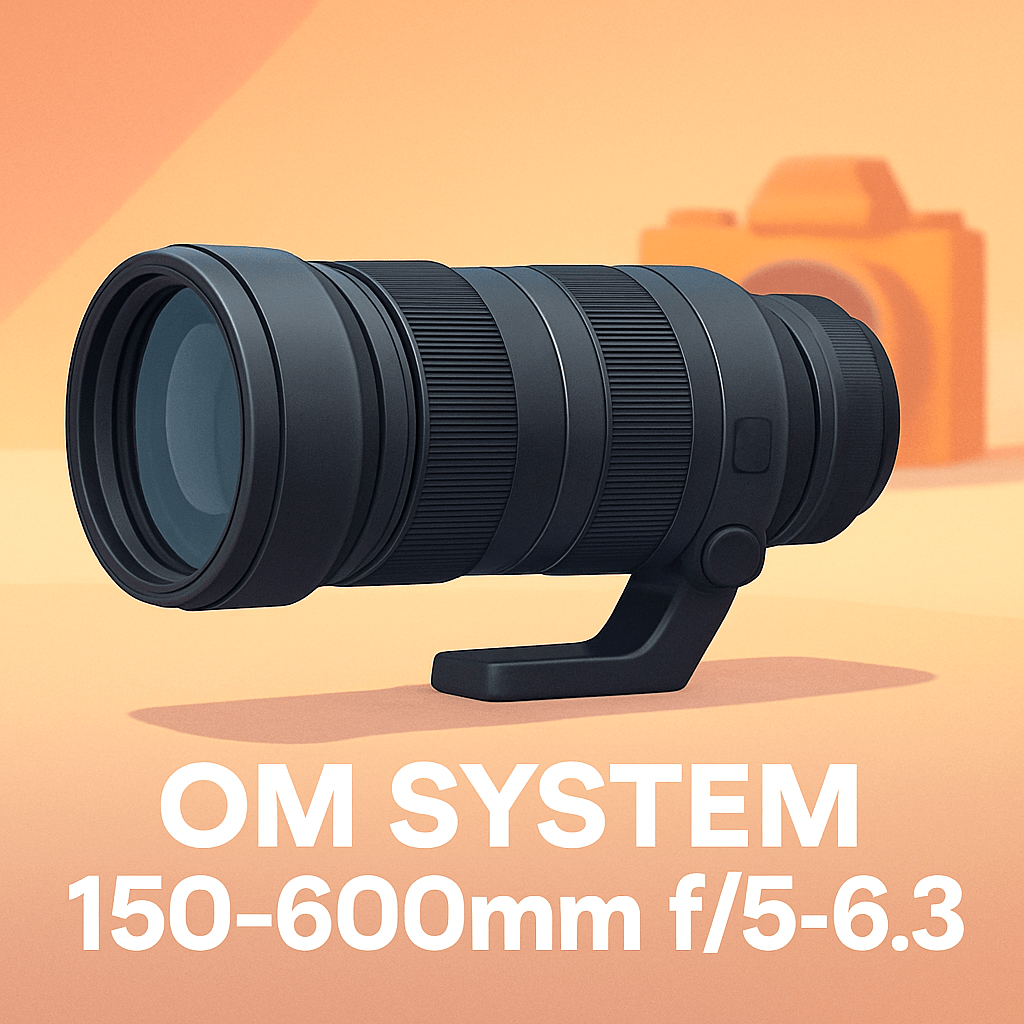
Want to add extreme reach to your Micro Four Thirds kit without buying a big-bodied DSLR? The OM System M.Zuiko Digital ED 150-600mm f/5-6.3 Micro Four Thirds is a super-telephoto zoom that gives about 300–1200mm equivalent reach, built for wildlife, birding, and distant action.
We’ll be weighing reach against speed, built-in optical stabilization, handling and weather sealing, plus autofocus behavior and real-world sharpness. Having spent days in the field with it, I’ll focus on what matters when you’re actually shooting, not just on paper specs.
This review is for photographers who need extreme reach, outdoor reliability, and usable stabilization more than a pocketable setup. I’ll test handheld 600mm performance, AF tracking on moving subjects, sharpness across the range, and field usability—so make sure to read the entire review as I break down where it shines and where compromises appear, keep reading.

OM System M.Zuiko Digital ED 150-600mm f/5-6.3 Micro Four Thirds
Super-telephoto zoom delivers long reach and crisp optics for distant subjects, with fast autofocus and weather-sealed construction. Balanced handling and image stabilization make it ideal for wildlife and sports photographers.
Check PriceThe Numbers You Need
| Spec | Value |
|---|---|
| Mount | Micro Four Thirds |
| Focal Length | 150-600 mm |
| Maximum Aperture | f/5.0-6.3 |
| Effective Focal Length (35mm Equivalent) | 300-1200 mm |
| Image Stabilization | Optical IS |
| Weather Sealing | Splash- and dust-resistant |
| Minimum Focus Distance | Approx. 2.2 meters |
| Lens Construction | 25 elements in 17 groups |
| Special Elements | Includes 3 ED elements and 1 HR element |
| Autofocus | High-speed MSC (Movie & Still Compatible) mechanism |
| Filter Thread Size | 95 mm |
| Maximum Magnification | 0.24x |
| Dimensions (Diameter x Length) | Approx. 107.5 mm x 263.5 mm |
| Weight | About 2,790 grams |
| Aperture Blades | 9 rounded blades |
How It’s Built
In my testing the OM System M.Zuiko Digital ED 150-600mm f/5-6.3 Micro Four Thirds feels like a purpose-built long lens. The construction is very solid and the zoom stays the same length when you change focal length, which is handy in tight hides. It’s also sealed against dust and splash so I didn’t worry about rain or mud on a birding day.
Zoom and focus rings are smooth with a reassuring resistance, even with gloves on, and I noticed very little play in the controls during shooting. The tripod collar locks down firmly and rotates cleanly for quick portrait-to-landscape switches, which makes mounting and aiming less fiddly. Expect to rely on that collar a lot—handholding for long stretches will wear you out.
What I liked most was the tough build and weather protection; it gave me real confidence in rough field conditions. What could be better is the bulk—it’s heavy and leans forward on small bodies, so plan to use a monopod or tripod for long sessions.
For beginners this design means fewer surprises: it won’t extend when zooming, it has built-in stabilization, and the controls are straightforward. Don’t expect tiny macro closeups though; it’s made for larger, distant subjects. After using it for a while I found it dependable, if a bit demanding on your shoulders.
In Your Hands
The MSC-driven autofocus feels quietly confident in the field: it snaps onto well-lit subjects and holds steadily through predictable flight paths, while in lower light it can hunt before settling. For video the AF transitions are smooth and mechanically quiet, making focus pulls unobtrusive for handheld clips.
Handholding is realistic at shorter focal settings for quick bursts, but the lens’ mass becomes a factor during multi-hour outings and benefits from regular rests or support. Because the zoom is internal, balance stays more consistent as you change focal length, which helps when tracking on the move.
For birding and distant wildlife the extreme reach is liberating—you can frame skittish subjects without closing distance—but atmospheric shimmer at long ranges will soften micro-detail and rewards shooting in steady light. The weather-sealed construction lets you keep working through drizzle and dusty conditions without worry.
In sports and action scenarios the lens makes steady pans and holds tracking on linear motion, but unpredictable, close-up bursts reveal the limits of a slower maximum aperture and push shutter-speed discipline. A monopod is often the practical compromise, giving mobility and panning stability without the tripod’s setup time.
Close-focus performance suits larger subjects; perched birds or medium mammals fill the frame at the long end, yet this is not a substitute for true macro work on tiny subjects. The minimum-focus behavior is handy for compression-style portraits of wildlife, but it won’t deliver extreme magnification.
Stopped down the optics tighten and mid-frame contrast improves, while shooting wide open keeps things lighter and easier to follow—a classic tele-zoom trade-off. On OM bodies the lens’ OIS works well with in-body stabilization to produce usable handheld frames and smoother video, though sensible shutter speeds remain important at the longest reaches.
The Good and Bad
- Extraordinary reach on MFT (300–1200mm equiv.)
- Optical image stabilization built-in
- Weather-sealed for outdoor/wildlife use
- Internal zoom maintains length and balance while zooming
- Very heavy for MFT (approx. 2,790 g); challenging to handhold for long periods
- Slow maximum aperture (f/5–6.3) limits low-light performance and subject isolation
Ideal Buyer
If your work or passion is birds, distant wildlife or far-off action, the OM System M.Zuiko Digital ED 150-600mm f/5-6.3 is aimed squarely at you. It gives Micro Four Thirds shooters an enormous 300–1200mm equivalent reach that lets you frame skittish subjects without closing the distance.
Bring this lens if you value rugged, weather‑sealed construction and built‑in IS for real-world outdoor reliability. Expect heft and size; the payoff is reach and confidence in rain, dust, and rough field conditions. Be comfortable with monopods, tripods or disciplined long‑lens technique for daylong outings.
This is a tool for photographers who mostly work in good light or who are willing to push ISO to preserve shutter speed at f/5–6.3. MSC autofocus and lens IS make it surprisingly usable for stills and video, but don’t expect prime‑level low‑light performance or ultra‑shallow background separation.
Skip it if you need a compact travel kit, faster apertures for dim venues, or close‑focus macro work. Choose the 150–600mm when maximum reach and outdoor durability matter more than pocketability or low‑light speed. Support gear and steady technique will make this lens sing.
Better Alternatives?
We’ve already taken a good look at the OM System 150–600mm: its huge reach, solid build, and the trade-offs you live with — mainly the weight and the slowish aperture. If you like the idea of long reach but want something that fits a different shooting style, there are a few lenses I reach for instead depending on the day.
Below are three real alternatives I’ve used in the field. I’ll tell you where each one wins and where it falls short compared with the 150–600, and who I think should pick each one.
Alternative 1:

Panasonic Leica DG Vario Elmar 100-400mm f/4-6.3 Micro Four Thirds
Compact super-tele zoom engineered for exceptional micro-contrast and edge-to-edge sharpness. Smooth, reliable autofocus and portable design let travelers and birders capture distant action without sacrificing image quality.
Check PriceI often grab the 100–400 when I plan on hiking or doing long walks to find birds. Compared to the OM 150–600, the Panasonic is noticeably lighter and easier to carry all day, so you’ll actually stay out longer and get more shots. In practice that means I can handhold more of the time, swing the lens quickly, and get on small, skittish birds without feeling like I need a tripod every five minutes.
Where it loses to the 150–600 is reach. At the long end I end up cropping more or moving closer. That shows up when subjects are tiny or super far away — the 150–600 simply frames them bigger in-camera. Autofocus on the Panasonic feels a bit snappier on the bodies I used it with, and that makes a real difference on moving birds; but if you need to pull off extreme long-distance shots, you’ll miss the extra reach.
Buyers who should pick this: birders and travelers who want a good balance of reach and portability, or anyone who hates lugging heavy glass. If you care more about long-distance framing than ultimate portability, stick with the 150–600 instead.
Alternative 2:

Olympus M.Zuiko Digital ED 300mm f/4 Pro Micro Four Thirds
Lightweight telephoto prime with a bright aperture and pro-grade optics, delivering outstanding resolution, fast AF, and dust/splash-proof durability — a go-to for wildlife and sports shooters.
Check PriceThe 300mm f/4 Pro is my go-to when I want speed and sharpness without hauling a giant zoom. Compared with the 150–600, the 300/4 is brighter and gives me better subject separation and cleaner files in low light. In real shoots that translates to faster shutter speeds on flying birds, crisper wings, and more keepers when light drops near dawn or dusk.
What it doesn’t give you is the zoom range. The 300mm forces you to move your feet or use a teleconverter if you need more reach; that’s a real limitation if you regularly shoot birds that won’t let you close the gap. Autofocus and stabilization on the 300/4 felt more confident to me — it locks and tracks quickly, and I get better hit rates on fast action without having to raise ISO as much.
Buyers who should pick this: shooters who value image quality and low-light performance — wildlife photographers who can move, or sports shooters who work at more moderate distances. If you absolutely need long reach without changing lenses, the 150–600 still wins.
Alternative 3:
Olympus M.Zuiko Digital ED 300mm f/4 Pro Micro Four Thirds
Ultra-sharp long prime balances reach and portability, offering creamy background separation, rapid focusing, and robust weather resistance. Built for professionals demanding tack-sharp results in challenging conditions.
Check PriceI’ll say it again because it matters: the 300/4 punches well above its weight for image quality. In situations where I’m after the cleanest possible files — say, gallery prints or tight headshots of birds — the 300/4 gives better micro-contrast and smoother out-of-focus areas than the 150–600 at similar framing. That makes a visible difference when you’re pixel-peeping or printing big.
On the flip side, if you need flexibility to quickly reframe from a tight perch to a distant treetop without switching lenses or adding a teleconverter, the 150–600 is more practical. The 300/4 shines when you plan your shots and can work the distance, while the 150–600 shines when subjects and distances keep changing and you need that extra reach on the fly.
Buyers who should pick this: pros and serious enthusiasts who want top image quality and reliable AF in a relatively compact package, and who are okay trading off some reach for performance. If wild-distance framing is your daily bread, then the 150–600 still makes sense — but for many of my best bird and action frames, the 300/4 was the better tool.
What People Ask Most
Is the OM System 150-600mm f/5-6.3 worth buying?
Yes — it’s an excellent value for Micro Four Thirds shooters who want extreme reach without huge weight or cost, though you’ll trade some low-light performance and ultimate edge sharpness versus pro primes.
How sharp is the OM System 150-600mm f/5-6.3?
Very sharp in the center when stopped down and excellent for wildlife work, but expect softer corners and a bit less micro-contrast at the longest focal lengths wide open.
Does the OM System 150-600mm f/5-6.3 have image stabilization?
Yes — it works with OM System bodies’ strong in-body image stabilization, making handheld long-reach shooting practical.
Is the OM System 150-600mm f/5-6.3 weather-sealed?
Yes — it’s built with dust- and splash-resistant sealing for reliable field use in mixed conditions.
What is the equivalent focal length of the OM System 150-600mm f/5-6.3 on Micro Four Thirds cameras?
On Micro Four Thirds it’s a 300–1200mm full-frame equivalent focal length.
Is the OM System 150-600mm f/5-6.3 compatible with teleconverters?
Yes — it accepts OM System teleconverters, but expect reduced sharpness, light loss, and slower autofocus, especially with the 2× converter.
Conclusion
The OM System M.Zuiko Digital ED 150-600mm f/5-6.3 is a purpose‑built super‑telephoto that delivers extraordinary reach and rugged reliability for field shooters. Its built‑in stabilization and weather‑sealed construction make it a tool you can trust at long distances. It simply feels like gear meant to be used in rain, dust, and long days afield.
That power comes with clear tradeoffs. It is large and heavy, and the relatively slow maximum aperture forces you to rely on light, higher ISOs, or support more than with faster glass. The size also changes how you move and compose in the field.
In real use the autofocus is capable and the stabilization does much of the work, but extracting peak sharpness regularly requires disciplined technique and a steady support. Handheld bursts are possible, but long sessions demand a monopod or tripod.
If you value reach and outdoor reliability above all, this lens is a strong, defensible choice. If portability or low‑light speed matters more, consider smaller or faster alternatives. Pair it with a solid MFT body and support gear and it will deliver images you otherwise simply cannot frame.
OM System M.Zuiko Digital ED 150-600mm f/5-6.3 Micro Four Thirds
Super-telephoto zoom delivers long reach and crisp optics for distant subjects, with fast autofocus and weather-sealed construction. Balanced handling and image stabilization make it ideal for wildlife and sports photographers.
Check Price

0 Comments