
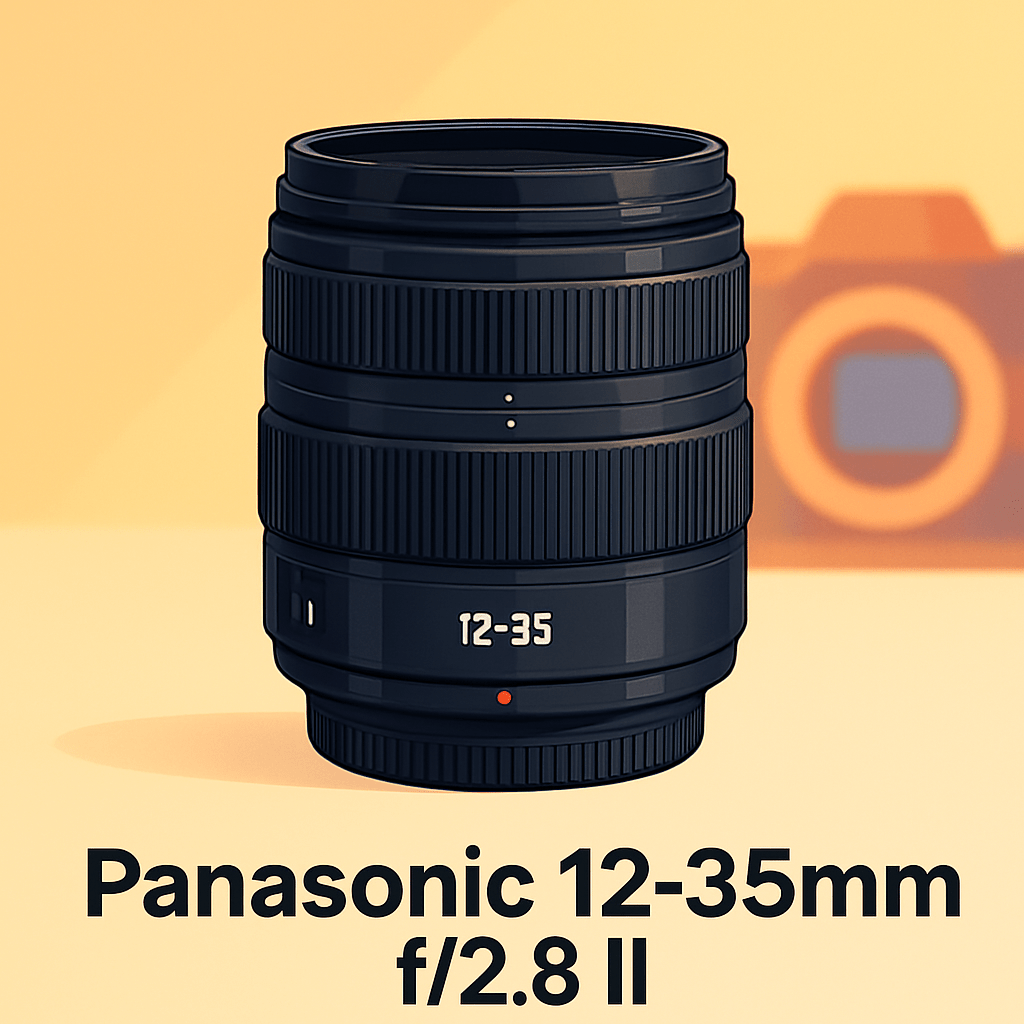
Want one compact zoom that can handle travel, run‑and‑gun shoots, and low‑light gigs without weighing you down?
The Panasonic LUMIX G X VARIO II 12-35mm f/2.8 Micro Four Thirds is a constant‑aperture standard zoom with in‑lens stabilization, weather sealing, and quiet AF that’s aimed at hybrid shooters and pros on the move.
I’ve put this lens through its paces in varied conditions, and this review will cover design, handling, AF, stabilization, real‑world image use, who benefits most, and smart alternatives — make sure to read the entire review as I break it down, keep reading.

Panasonic LUMIX G X VARIO II 12-35mm f/2.8 Micro Four Thirds
Constant-bright professional-standard zoom delivering edge-to-edge sharpness, fast low-light performance and smooth focusing. Weather-sealed, compact build balances stills and video needs for travel, events, and run-and-gun shoots.
Check PriceThe Numbers You Need
| Spec | Value |
|---|---|
| Focal Length | 12-35mm |
| Maximum Aperture | f/2.8 (constant) |
| Lens Mount | Micro Four Thirds |
| Optical Image Stabilization | POWER O.I.S. |
| Lens Construction | 14 elements in 9 groups |
| Minimum Focus Distance | 0.25 m |
| Filter Thread Size | 58 mm |
| Angle of View | approx. 34°–84° |
| Aperture Blades | 7 (rounded) |
| Autofocus | Fast, silent autofocus motor |
| Weather Sealing | Yes (dust and splash resistant) |
| Maximum Magnification | 0.17× |
| Lens Type | Standard zoom |
| Weight | Approximately 305 g |
| Dimensions (Diameter × Length) | 67.6 × 73.8 mm |
How It’s Built
In my testing the Panasonic LUMIX G X VARIO II 12-35mm f/2.8 feels like a tiny workhorse — compact, light, and confidently sealed against dust and drizzle. I actually shot through a brief rain shower and kept going without worry, which for me was a big win. That weather resistance is one thing I really liked because it makes the lens usable in real-world, imperfect conditions.
The zoom and focus rings are nicely made and straightforward to use. The zoom rotates with a smooth, slightly firm resistance and I didn’t notice any zoom creep, so compositions stay put when you point up or down. The focus ring is quick and accurate for everyday work, though its short throw means fine manual focusing can feel a bit twitchy if you pixel-peep — something that could be better.
On small Micro Four Thirds bodies the lens balances very well and doesn’t make your rig front-heavy, so it’s easy to carry all day. The common filter thread size makes adding a polarizer or ND filter painless, and the front element’s coatings wipe clean without fuss — useful for beginners who don’t want high-maintenance glass.
Build-wise it has a solid, reassuring feel without being bulky, and the aperture blades give pleasing background blur for portraits and everyday shots. Be aware that when you stop way down the highlights can take on a slightly polygonal look, but for most users this won’t spoil the practical, durable nature of a lens you can rely on daily.
In Your Hands
The Panasonic LUMIX G X VARIO II 12-35mm f/2.8 maps neatly from wide environmental vistas into natural, slightly telephoto everyday perspectives, making it an effortless grab-and-go for run-and-gun work. Its field of view feels familiar and flexible on a Micro Four Thirds body, covering interiors, street scenes, and documentary assignments without fuss.
The constant wide aperture gives consistent exposure and depth control as you zoom, which translates into confidence in low-light hand-held shooting and predictable subject separation for portrait and lifestyle frames. Stopping down tightens up edge definition and calms softness toward the frame edges, though highlights can take on a slightly geometric character when you push the aperture smaller.
Close-focus performance is commendably practical: you can get in close enough for convincing detail and product shots, food frames, or tight environmental accents without switching to a dedicated macro. It won’t replace a macro lens, but for editorial and social content it’s more than serviceable.
Optically the lens delivers crisp, pleasing center detail wide open with corners that gain noticeably when stopped down, and an overall contrast profile that renders textures with lively micro-contrast. Distortion and vignetting are present but unobtrusive and easy to correct in processing, while coatings hold flare and ghosting at bay most of the time.
In everyday shooting the lens shines on wide interiors and mid-range portraits, and its stabilized, constant-aperture character makes handheld indoor events much less stressful. The focus ring is smooth and responsive for manual pulls, and focus breathing is kept to a minimum for hybrid photo/video work.
The Good and Bad
- Constant f/2.8 aperture throughout the zoom range
- POWER O.I.S. for stabilized stills and video
- Fast, silent autofocus motor
- Compact and lightweight for a pro-leaning standard zoom (approx. 305 g; 67.6 × 73.8 mm)
- Tele end stops at 35mm (less reach than 40mm and 60mm alternatives)
- Max magnification 0.17× (not a macro solution)
Ideal Buyer
The Panasonic LUMIX G X VARIO II 12-35mm f/2.8 Micro Four Thirds is for Micro Four Thirds shooters who want a compact, pro-leaning everyday zoom with a constant f/2.8. It brings in-lens POWER O.I.S. and weather sealing so you can work in mixed conditions. If you prize a small, high-performing standard zoom, this is aimed squarely at you.
Hybrid creators and videographers will appreciate the fast, silent autofocus and stabilized footage. It lets you pull off run-and-gun interviews, event coverage, and handheld b-roll without obvious focus noise. The lens’s consistent exposure through the zoom simplifies lighting and log workflows.
Photographers who shoot weddings, documentary, and indoor events get real benefit from f/2.8 across the range. The close-focus and usable wide-to-normal perspective handle environmental portraits and detail shots without constant lens changes. Bodies lacking strong in-body stabilization will especially benefit from the lens’s O.I.S.
If you need extra tele reach or true macro capability this isn’t the perfect single-lens answer. Consider a 12‑60mm for reach or a dedicated macro for tight close-ups. Otherwise, this 12‑35mm II is a compact, dependable workhorse for most everyday pro needs.
Better Alternatives?
We’ve already looked closely at the Panasonic 12-35mm f/2.8 II — how it handles, its constant f/2.8, the built-in O.I.S., and why it’s such a solid everyday pro zoom for Micro Four Thirds. It’s small, weather-sealed, and great for hybrid shooters who switch between stills and video.
If that lens didn’t quite match your needs — maybe you want a different look, a bit more reach, or the best one-lens travel option — here are three real-world alternatives I’ve used in the field and how they compare to the 12-35mm II.
Alternative 1:

OM System M Zuiko Digital ED 12-40mm f/2.8 Pro Micro Four Thirds
Pro-class standard zoom with constant aperture for consistent exposure, superb optical correction, quick responsive autofocus, and durable weather sealing—ideal for landscape, wedding, and documentary photographers seeking reliability and image fidelity.
Check PriceIn the field the 12-40mm Pro feels built like a tool — heavier in the hand and rock-solid on a tripod. Compared to the Panasonic 12-35 II it gives you an extra 5mm on the long end (40mm vs 35mm), which matters when you need just a touch more reach for tighter portraits or to crop in a little without changing lenses. Optically it delivers very pleasing contrast and detail; shots have a clean, “pro” look that I liked for weddings and landscapes.
Where it loses to the Panasonic 12-35 II is stabilization. The OM lens has no in-lens OIS, so if your camera body doesn’t have strong IBIS you’ll notice the difference handheld in low light. Also, on smaller Panasonic bodies the pairing doesn’t feel quite as seamless as native Panasonic glass — AF is still fast, but the Panasonic II’s focus and stabilization combination can feel a hair more confident for run-and-gun situations.
Pick the 12-40mm Pro if you want the best-built feel, a tiny bit more reach, and a lens that feels like a professional tool. It’s a great choice if you shoot on Olympus/OM bodies with good IBIS or you prioritize handling and pro-grade build over having in-lens stabilization.
Alternative 2:

Panasonic Leica DG Vario Elmarit 12-35mm f/2.8 Micro Four Thirds
High-grade standard zoom crafted for rich contrast and natural color rendition, offering constant low-light aperture, precise manual focus feel, and compact weather-resistant construction—perfect for portraits, street, and cinematic video.
Check PriceThe older Panasonic Leica 12-35mm is closest in use to the 12-35 II — same focal range and also has POWER O.I.S. In real shooting I found it gives a slightly different image character: a touch warmer color and a Leica-ish micro-contrast that some people prefer for portraits and cinema-style work. It’s a good pick if you want that classic Leica rendering but still want stabilization and weather sealing.
Compared to the 12-35 II, the Leica version can feel a step behind in tiny handling and autofocus refinements. The II has improved mechanics and a slightly snappier AF in trickier situations. Also, the II may edge out the older Leica in corner sharpness stopped down. Where the Leica wins is price — used examples can be a real value — and its distinct color/contrast look.
Choose this Leica 12-35 if you want that specific color and contrast character or are shopping used for a lower-cost way into a constant f/2.8, stabilized zoom. It’s ideal for photographers who care about rendering and value a slightly different look more than the absolute newest handling tweaks.
Alternative 3:

Panasonic Leica DG Vario Elmarit 12-60mm f/2.8-4.0 Micro Four Thirds
Extended-range travel zoom combining wide-angle punch with useful tele reach, flexible variable aperture for everyday shooting, stabilized optics and rugged, splash-resistant build—great for travel, landscapes, family events, and vlogging.
Check PriceThe 12-60mm is the most practical lens I’ve carried for travel. That extra reach to 60mm is a real advantage when you don’t want to swap lenses at a market or on a hike. In everyday shooting it covers wide scenes and decent portrait reach in one package, and it still has POWER O.I.S., so handheld in mixed light it’s very forgiving.
But it’s not as strong as the Panasonic 12-35 II in low light or shallow depth-of-field work. The aperture changes to f/4 at the long end, so you lose subject separation and need higher ISO or slower shutter speeds indoors. Optically it’s excellent for its class but a touch softer at the extremes than a dedicated constant f/2.8 zoom — you can see that in corner detail when pixel peeping.
This 12-60mm is for the shooter who wants one-lens convenience: travelers, vloggers, and families who value reach and flexibility over the shallowest background blur. If you want an all-in-one that’s weather-sealed and stabilized, it’s hard to beat; if you prioritize low-light performance and consistent f/2.8, stick with the 12-35 II.
What People Ask Most
What are the specifications of the Panasonic 12-35mm f/2.8 II?
It’s a Micro Four Thirds zoom covering 12–35mm (≈24–70mm full-frame equivalent) with a constant f/2.8 aperture, built-in O.I.S., and a weather-resistant design for everyday pro use.
Is the Panasonic 12-35mm f/2.8 II weather-sealed?
Yes — the lens is designed with dust and splash resistance for outdoor shooting in less-than-perfect conditions.
Does the Panasonic 12-35mm f/2.8 II have image stabilization?
Yes, it includes Panasonic’s POWER O.I.S. to steady handheld shots and complement in-body stabilization.
How does the Panasonic 12-35mm f/2.8 II compare to the original 12-35mm f/2.8?
The Mark II is a refined update with improved optics and autofocus behavior while keeping the same useful focal range and constant f/2.8 brightness.
Is the Panasonic 12-35mm f/2.8 II good for video?
Yes — the constant f/2.8, smooth zoom behavior, O.I.S., and reliable autofocus make it a very solid choice for run-and-gun and hybrid video work.
What filter size does the Panasonic 12-35mm f/2.8 II use?
The lens takes 58mm screw-in filters, which are easy to find and swap for creative shooting.
Conclusion
The Panasonic LUMIX G X VARIO II 12-35mm f/2.8 Micro Four Thirds is, in my experience, a compact, capable workhorse that nails the balance between pro-minded handling and everyday usability. Its constant aperture, confident in-lens stabilization, quiet autofocus, and weather resistance give it clear strengths for hybrid shooters and fast-moving assignments. The trade-offs are obvious: it favors portability over extra reach and it won’t replace a dedicated macro or a longer portrait lens for specialized tasks.
For event photographers, documentary shooters, and videographers who need consistent exposure and reliable stabilization in mixed conditions, this lens is a smart, practical choice. If you routinely need longer reach, a distinct rendering character, or the deepest close-focus capability, you’ll be better served by one of the alternative zooms that prioritize those attributes. Consider your body’s stabilization and shooting priorities when deciding which compromise makes the most sense.
All told, I recommend the 12-35mm f/2.8 II for Micro Four Thirds users who want a single, go-to standard zoom that performs dependably in the field. It’s a deliberate, well-rounded tool that earns its place in a compact kit and will cover the vast majority of real-world shooting scenarios with confidence.
Panasonic LUMIX G X VARIO II 12-35mm f/2.8 Micro Four Thirds
Constant-bright professional-standard zoom delivering edge-to-edge sharpness, fast low-light performance and smooth focusing. Weather-sealed, compact build balances stills and video needs for travel, events, and run-and-gun shoots.
Check Price



0 Comments